Best Emergency Nurse Practitioner (ENP) MSN Programs in Alabama
Compare 2 accredited Emergency Nurse Practitioner programs in Alabama, with graduate earnings, cost, debt, and completion data from IPEDS and the U.S. College Scorecard.

South Alabama's dual FNP/ENP master's runs 57 credit hours, a clearer description than most master's programs in Alabama give. Pages label emergency NP training inconsistently: an MSN track, a dual degree, or a post-graduate certificate.
Most ENP preparation sits on a family nurse practitioner foundation, which is why dual FNP/ENP programs are the search that matters. The emergency skills are added to the primary care credential, never substituted for it.
Key Points
- South Alabama offers both a dual FNP/ENP master's and a post-graduate ENP certificate.
- South Alabama's 57-credit dual master's costs about $34,713 in tuition at $609 per credit.
- Alabama requires national certification verified directly to the Board of Nursing for CRNP approval.
Ranked: Alabama's Top Emergency Nurse Practitioner Master's Programs
Each program below earned its spot on value and on how directly its clinical training prepares you for emergency care. Alabama has three ENP-focused master's options, and all of them build the emergency specialty on top of family nurse practitioner training. Graduation rates cited are institution-wide figures, not completion rates for the ENP program itself.
University of South Alabama
#1Mobile, AL · ~$9,000/yr (est.)
Best for: Nurses seeking two certifications in one degree
The University of South Alabama in Mobile runs a true dual-role FNP/ENP master's track. It is a 57-credit hybrid MSN with 840 practicum hours, two required on-campus skills intensives, and clinicals in emergency departments, urgent care, and ground or air transport. Federal data lists graduate tuition at $8,640 in-state and $17,280 out-of-state, and the university's institution-wide graduation rate is about 53%. Students from Louisiana, South Dakota, and New York are not currently accepted.
- 57 total credit hours with 840 clinical hours
- Prepares graduates for both FNP and ENP board exams
- Hybrid format with two required on-campus skills intensives
- Clinicals span emergency, urgent care, trauma, and air or ground transport
- CCNE accredited; MSN must be finished within five years
- Not accepting students from LA, SD, or NY
University of Alabama at Birmingham
#2Birmingham, AL · ~$9,000/yr (est.)
Best for: Certified FNPs adding an emergency subspecialty
UAB's School of Nursing in Birmingham offers an Emergency Nurse Practitioner subspecialty for family nurse practitioners, taught in part by emergency medicine physicians and designed with distance-accessible classes for working nurses. Applicants need at least one year of emergency services experience, and entry is through the MSN FNP/ENP dual option or as a post-graduate certified FNP. Federal data lists graduate tuition at $8,640 in-state and $21,168 out-of-state, with an institution-wide graduation rate near 64%. Confirm with UAB that the dual option is open for your intended start term.
- Fall start with a cohort-based structure
- Requires at least one year of emergency services experience
- Open to post-graduate certified FNPs
- Instruction from emergency medicine physicians
- Flexible, distance-accessible interactive classes
- Eligible for the AANP Emergency Nurse Practitioner exam
- CCNE accredited
Samford University
#3Birmingham, AL · $20,000 – $25,000/yr (est.)
Samford University's Moffett & Sanders School of Nursing in Birmingham lists a hybrid Family Nurse Practitioner with ENP Specialty MSN. Its institution-wide graduation rate of about 77% is the strongest of the three, but graduate tuition of $20,897 is the highest and does not vary by residency. Samford's 2025-2026 catalog describes its ADN/ASN-to-MSN version of this pathway as closed to new admissions, so verify directly that the program is accepting applicants before shortlisting it.
- Hybrid MSN with an ENP specialty built on FNP training
- Requires an unencumbered RN license and a CCNE, CNEA, or ACEN accredited BSN
- 3.0 nursing GPA minimum plus prerequisite courses
- Video interview required for applicants
- Up to 12 graduate credits may transfer
- B or better required in every course; six-year completion window
- CCNE accredited
Cost & outcomes by school
Federal data for the highest-earning Emergency Nurse Practitioner programs, independent of the ranking above. Earnings are this field's master's graduates four years after completing, where the Scorecard reports them.
| School | Earnings | Tuition / yr | Debt | Grads/yr | Format |
|---|---|---|---|---|---|
| Samford University AL | $127,084 | $21,797 | $110,952 | 38 | Hybrid |
| University of South Alabama AL | $122,851 | $9,360 | $51,673 | 769 | Hybrid |
Sources: U.S. Department of Education. Tuition and graduates: IPEDS. Earnings and debt: College Scorecard, this field's master's graduates; a dash means no figure is reported.
ENP Master's or Post-Graduate Certificate? How Alabama's Pathways Actually Work
Two routes, not one
The University of South Alabama's emergency NP training comes in two shapes, and which one you apply to depends entirely on what credential you already hold. There is a dual Family Nurse Practitioner/Emergency Nurse Practitioner (ENP) MSN, a 57-credit master's with 840 practicum hours and on-campus clinical intensives, that prepares graduates to sit for both the FNP and ENP board exams. Separately, there is a post-graduate ENP certificate. South Alabama does not publish a standalone ENP-only MSN.
Who is eligible for which
BSN-prepared RNs enter through the dual FNP/ENP MSN, subject to the College of Nursing's admission requirements. The post-graduate certificate is closed to them: applicants must already hold FNP certification to enroll and to become eligible for the ENP board exam. That distinction is the whole game. A bedside RN with a BSN needs the full master's. A practicing, certified FNP who wants emergency credentialing needs only the shorter certificate, not a second degree.
Check status before you apply
Both pathways are active for 2026, with applications accepted year round and deadlines posted by the College rather than fixed to a single cohort date. Note the residency limits: South Alabama does not accept applicants from Louisiana, South Dakota, or New York.
Rule of thumb: BSN-prepared RN, apply to the dual FNP/ENP MSN; certified FNP, apply to the post-graduate certificate.
Online and Hybrid ENP Master's Options: Clinical Hours and Campus Intensives
Online does not mean place-free: across the best online emergency nurse practitioner MSN programs, Alabama's dual FNP/ENP master's programs trade some geographic flexibility for required campus time and hands-on skills checks. At UAB, the part-time MSN FNP/ENP dual program, one of the FNP programs in Alabama, is distance-accessible and pairs online coursework with required on-campus intensives, though official sources do not publish an exact intensive count or schedule. South Alabama's program is online and currently requires two on-campus Clinical Skills Intensives, with 2026 Phase 1 dates in February and Phase 2/check-off dates in late October and early November.
Clinical Hours and the Emergency Split
South Alabama lists 840 practicum hours total and says clinical experiences may occur in primary care, urgent care, emergency departments, and air/ground transport. Its first practicum course carries 120 clinical hours, but the school does not publish the full family-versus-emergency allocation. UAB's dual program requires 10 clinical-practicum credits within 45 total credits but does not convert those credits to hours or separate them by specialty.
Preceptors and Placement Logistics
South Alabama notes that clinical requirements can usually be met with preceptors in a student's home community, yet it does not clarify whether the university arranges placements or students must find them. UAB describes support through more than 5,000 clinical affiliates but does not state it secures every placement. Working emergency nurses should start identifying preceptors early and budget travel for any campus intensive dates.
Which Alabama ENP Master's Programs Make the GRE Optional?
Only UAB and South Alabama publish admissions criteria we could verify. Samford University's GRE and GPA policies for this track weren't confirmed, so check its admissions page directly.
- University of Alabama at Birmingham: GRE waived at a 3.2 GPAApplicants with a 3.2 cumulative undergraduate GPA, calculated overall or on the last 60 semester hours, are exempt. Below 3.2, submit a GRE (minimum 297 combined) or GMAT (480) taken within five years. The minimum GPA is 3.0. UAB's available pages don't spell out an emergency experience requirement.
- University of South Alabama: no published GRE policyThe MSN admissions criteria don't mention the GRE, a waiver, or a minimum score, so confirm with the college. MSN applicants need a 3.0 on all BSN work. Certificate applicants need a 3.0 graduate GPA. Two years of RN experience in the specialty area is required before NP clinical courses.
- Samford University: no policy confirmedWe could not verify a GRE policy, minimum GPA, or emergency experience requirement for Samford's track. Don't assume a waiver; ask the admissions office.
- Common prerequisites and deadlinesExpect an unencumbered RN license and a BSN from an accredited program. UAB also requires a descriptive statistics course (MA-180 equivalent) before starting. UAB's Oct. 22, 2026 deadline is for Summer 2027, and Feb. 11, 2027 is for Fall 2027. South Alabama's deadlines are Nov. 1 (Spring), Apr. 1 (Summer), and July 15 (Fall).
Related Articles
What an Emergency NP Master's Costs in Alabama: Resident vs. Nonresident Tuition
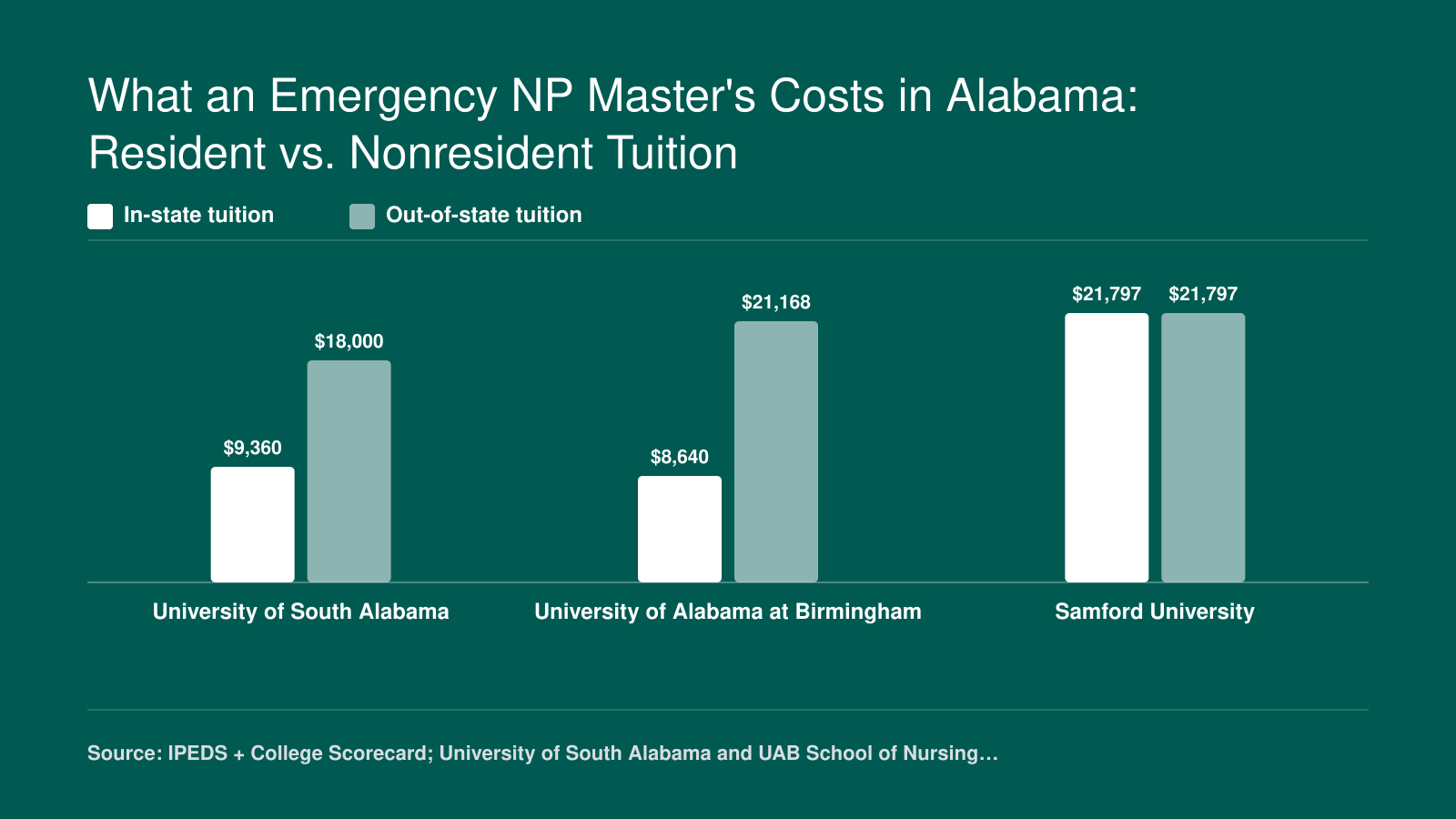
The bars show each school's published annual graduate tuition for residents and nonresidents. For 2026-2027, the University of South Alabama charges $609 per credit hour online, with no residency difference. Its 57-credit dual FNP/ENP master's totals about $34,713 in tuition, and no extra program or clinical fees are published. UAB charges $744 per semester hour for everyone, plus a $235 technology fee per course. Its 45-credit FNP master's comes to $33,480 in tuition alone, and a dual ENP total is not published. Samford's per-credit rate was not available. Federal net price is an institution-wide average, not a quote for this program.
Alabama CRNP Licensure for Emergency Nurse Practitioners
UAB vs. South Alabama: Choosing the Right Emergency NP Program for You
South Alabama publishes two distinct emergency NP routes, so it appears twice below. Details for UAB could not be verified here, so confirm them with the program before you apply. South Alabama figures reflect the university's own descriptions.
| Factor | UAB | South Alabama: Dual FNP/ENP | South Alabama: ENP Post-Graduate Certificate |
|---|---|---|---|
| Credential type | Confirm current ENP offering (MSN, dual, or certificate) with UAB | Dual-role FNP/ENP master's program | Post-graduate certificate |
| Entry requirement | Confirm with UAB | Generally a BSN-prepared RN; confirm on the program page | Certified FNP; not an initial FNP program |
| Emergency experience minimum | Confirm with UAB | Check the admissions page | Check the admissions page |
| Format and intensives | Confirm with UAB | About 2 on-campus clinical intensives; the page notes 3 beginning in 2023, so verify | Confirm with the program |
| Credits and clinical hours | Confirm with UAB | 57 credits; 840 practicum hours | 15 credits over 4 semesters; 420 emergency practicum hours (other university pages cite different totals, so verify) |
| National certification | Confirm AANPCB approval and FNP exam eligibility before applying | Prepares for the FNP and ENP-C exams; ENP-C eligibility requires FNP certification plus AANPCB requirements | AANPCB ENP-C, via FNP certification plus AANPCB requirements |
Emergency NP Master's Programs in Alabama: Your Questions Answered
What is the difference between an FNP and an ENP?
Should I choose an ENP or an adult-gerontology acute care NP (AGACNP) for emergency work?
Can a family nurse practitioner work in an Alabama emergency department without ENP certification?
Compare Emergency Nurse Practitioner programs on the data that matters
Explore more Nursing specializations or browse every graduate field.
All Nursing programs