Best M.Ed. Programs in Virginia
Compare 243 accredited Education (M.Ed.) programs in Virginia at 31 schools, with graduate earnings, cost, debt, and completion data from IPEDS and the U.S. College Scorecard.
A Virginia master's in education usually runs 30 to 42 credit hours, and teachers take one on for concrete reasons: adding a special education endorsement, moving up a district pay scale, or qualifying for school leadership. Which program fits depends on cost, format, and whether it leads to the Virginia teaching licensure you need.
Cost spreads widely: average annual net price at the schools ranked here runs from $17,915 at George Mason University to $31,309 at the University of Richmond.
For working teachers, the costliest mistake is a degree that adds no endorsement.
Key Points
- Median program debt at University of Virginia is $19,960, about $227 monthly.
- Rankings rest on federal data: net price, completion, and graduate earnings.
- Initial Virginia licensure requires an approved preparation program or alternate route.
The 10 Best M.Ed. Schools in Virginia for 2027
This ranked list brings together public and private Virginia universities offering M.Ed. programs on campus, online, and in hybrid formats. Each school appears with its key education master's options, delivery methods, and accreditation status where published. The order reflects graduate earnings, institution-wide graduation rates, affordability, and program strength.
University of Virginia
#1Charlottesville, VA · ~$24,000/yr (est.)
Best for: Online educators wanting research-backed curriculum
UVA pairs a highly ranked graduate school of education with flexible online delivery. The M.Ed. in Curriculum & Instruction offers nine concentrations and no GRE requirement, while campus-based programs in teaching, counseling, and higher education provide licensure pathways. Its education unit is CAEP-accredited.
- 9 concentration options
- No GRE required
- Asynchronous online classes
- Complete in 1 year full-time or 2-3 years part-time
- Virginia alternate licensure pathway
- Transfer up to 6 credits
- Ranked #5 for online graduate education
- Concentration in Educational Innovation
- 8 concentration options
- No entrance exam required
- Optional dual MBA/M.Ed.
- Ranked #5 online graduate education
- Concentration in English as a Second Language
- No GRE required
- Test optional
- Guaranteed admission for UVA B.S.Ed. graduates
- CACREP accredited
- 2 concentration options
- Test optional
- 2-Year program, 61 credits
- 700 clinical hours
- Eligible for LPC licensure
- CACREP accredited
- 2 concentration options
- 2-Year program
- 61 credit hours
- Prepares for school counselor licensure
- Free summer course for SMHL
- CACREP accredited
- 2-Year program
- 61 credit hours
- 700 clinical hours
- Prepares for LPC licensure
- Trauma-informed care emphasis
- Part-time online evening classes
- Four to five semesters
- Prepares for School Leaders Licensure Assessment
- Annual summer residency in VA
- Discounted tuition for VA educators
- 1-Year program
- 2.7 GPA minimum
- Leads to Virginia ESL preK-12 licensure
- Internships in elementary and secondary ESL classrooms
- 1-Year program
- 2.7 GPA minimum
- Prepares for Praxis
- Initial licensure in Virginia
- Summer entry
- No entrance exam required
- 1-Year program
- 2.7 GPA minimum
- Prepares for Praxis
- Initial licensure in Virginia
- 4 concentration options
- 1-Year program
- 2.7 GPA minimum
- Robert Noyce Scholarship: $18,000 per year
- GRE not required
- Initial licensure in Virginia
- Part-time online format
- 2.7 GPA minimum
- Prepares for Praxis Teaching Reading
- No GRE required
- Initial licensure in Virginia
- 3 concentration options
- 1-Year program
- 34 credit hours
- Cohort model of 40 students
- Over 50 internship sites
- Paid internships
- 30 credit hours
- Prepares for initial professional licensure
- Up to 6 transfer credits
- Distance learning except California
- 30 credit hours
- 10 total courses
- Prepares for Reading Specialist Praxis
- Science-based reading instruction
- Flexible pacing 1 to 3.5 years
- Reduced tuition for Virginia educators
William & Mary
#2Williamsburg, VA · $15,000 – $20,000/yr (est.)
Best for: Career changers seeking licensure cohorts
William & Mary offers rigorous, cohort-based master's programs for aspiring and practicing educators. The M.A.Ed. in Curriculum & Instruction includes elementary, secondary, English, mathematics, science, and special education tracks, many leading to Virginia licensure. Its education unit does not publish CAEP accreditation status.
- 12-Month program
- 42 credit hours
- Summer start
- Eligible for Virginia PK-6 licensure
- Fall practicum and 15-week student teaching
- 4 concentration options
- 44 credit hours
- Full-time, on-campus
- Eligible for Virginia 6-12 licensure
- Fall field experience and spring student teaching
- 12-Month program
- 37 credit hours
- Full-time and part-time options
- Eligible for Virginia K-12 Special Education licensure
- Fall and spring student teaching internships
- 1-Year program
- 44 credit hours
- Prepares for Praxis Subject Assessment in English
- 60-hour clinical field experience
- Eligible for Virginia teaching license
- 1-Year program
- 41 credit hours
- Prepares for Praxis Subject Assessment in Mathematics
- Noyce Scholarship available
- Eligible for Virginia teaching licensure
- 4 concentration options
- 1-Year program
- 41 credit hours
- 100% job placement rate
- Noyce scholarships up to $26,000 yearly
- Eligible for Virginia secondary teacher licensure
- 2-Year program
- 36 credit hours
- Evening classes for working professionals
- 140 clinical hours
- Career paths in admissions, student affairs, athletics
- 2-Semester program
- STEM-designated MSBA program
- One-third curriculum is AI/ML
- Real-world capstone project
Virginia Polytechnic Institute and State University
#3Blacksburg, VA · ~$19,000/yr (est.)
Best for: Working professionals seeking instructional technology
Virginia Tech emphasizes instructional technology and licensure-focused graduate education. Its online M.A.Ed. in Curriculum and Instruction with Instructional Technology concentration suits working educators and corporate trainers. CAEP accreditation is not published for the education unit.
- All courses delivered online
- Focus on instructional design and technology
- Projects based on professional experience
- Prepares for instructional technologist roles
- Structured plan of study
- Practicum in higher education setting
- Some courses offer online lectures
- Coursework in student affairs
- Coursework in college student development
- Cohort-based structure
- Initial teacher licensure pathway
- CAEP accredited program
- Fully online option available
- Cohort-based structure
- Priority deadline: May 1
- Includes Reading Specialist endorsement
- Built for working professionals
- Teacher preparation program
- Accelerated BA-M.A.Ed. option
- In-state teacher 25% tuition discount
- Praxis II required for licensure
- 4 concentration options
- 39 credit hours
- Cohort-based structure
- Prepares for Praxis II
- Leads to licensure in grades 6-12
- 2 concentration options
- Cohort-based structure
- 100% job placement rate
- Virtual options for distance students
University of Richmond
#4University of Richmond, VA · ~$31,000/yr (est.)
The University of Richmond serves working K-12 educators through hybrid and evening programs. The Curriculum & Instruction M.Ed. offers optional focus areas in gifted education, special education, and educational leadership. CAEP accreditation is not published for its education unit.
- 30 credit hours
- Capstone required
- For licensed K-12 educators
- Optional focus areas in Gifted Education, Special Education, ESL
- Comprehensive written capstone
- 31 credit hours
- Includes 320-hour internship
- Satisfies Virginia administration endorsement
- Practicum integrated in each course
- 8 concentration options
- 2-Year program
- Part-time available
- Leads to Virginia teaching license
- 15-week clinical or yearlong paid internship
- Evening classes for working professionals
James Madison University
#5Harrisonburg, VA · ~$13,000/yr (est.)
James Madison University offers campus-based initial licensure programs and online literacy education for experienced teachers. The M.A.T. in Secondary Education prepares candidates in English, mathematics, sciences, and social studies. CAEP accreditation is not published for its education unit.
- Entrance exam required (Praxis)
- 33 credit hours
- 2.7 GPA minimum
- Requires pre-professional SEED minor
- Dual-degree program integrated with undergraduate
- Online program
- No entrance exam required
- GRE optional
- 33 credit hours
- 2.8 GPA minimum
- Prepares for Reading Specialist Exam
- Requires valid teaching license
- 4 concentration options
- Entrance exam required (Praxis, SAT, ACT)
- 3-Semester program
- 33 credit hours
- 2.7 GPA minimum
- Prepares for Virginia Teaching License
- Entrance exam required (Praxis)
- 31 credit hours
- 2.8 GPA minimum
- Approved by Virginia Department of Education
- Leads to Virginia Teaching License
- 3 concentration options
- Entrance exam required (Praxis)
- 2.5 GPA minimum
- Initial licensure program
- Minimum 30 graduate credits
George Mason University
#6Fairfax, VA · $15,000 – $20,000/yr (est.)
George Mason University offers a wide range of M.Ed. programs with online, hybrid, and on-campus options across early childhood, elementary, secondary, special education, and leadership. Virginia educators receive a tuition discount. CAEP accreditation is not published for its education unit.
- 30 credit hours
- Fully online option available
- $779 per credit
- 2 concentration options
- 3.0 GPA minimum
- Leads to licensure endorsement in Early Childhood Special Education and PreK-3
- 5 concentration options
- Prepares for initial teacher licensure
- Accelerated master's pathway available
- Hybrid delivery
- 2-Year program
- 30 credit hours
- 100% online option
- 3.0 GPA minimum
- Prepares for Virginia admin endorsement
- 36 credit hours
- Leads to Virginia teaching license
- State-approved educator preparation program
- 100% online format
- Prepares for Praxis
- Virginia educator discount
- 2 concentration options
- Stackable certificate to MEd
- 4 concentration options
- 30-credit non-licensure option
- Pathway to doctoral studies
- Behavior Analyst Certification Board exam prep
- Hybrid delivery
- 39 credit hours
- Cohort-based structure
- 3.0 GPA minimum
- Leads to initial teaching license PK-6
- Blended on-campus and online format
- 4 concentration options
- 2-Year program
- 30 credit hours
- Capstone required
- Aligned with National Board standards
- 5 concentration options
- 30 credit hours
- Praxis testing required
- Admissions interview required
- Hybrid delivery
- 4-Semester program
- 30 credit hours
- 3.0 GPA minimum
- Leads to Virginia teaching licensure
- VA educator discount available
- 4 concentration options
- 2-Year program
- 30 credit hours
- 100% online option available
- VA educator discount
- 5 concentration options
- 4-Semester program
- 30 credit hours
- Leads to Virginia teaching licensure
- VA educator discount
- 2-Year program
- 30 credit hours
- 100% online
- Prepares for leadership in private schools
- Non-licensure path
- Synchronous online classes
- Earn Virginia math specialist endorsement
- 15% tuition reduction for educators
- Designed for working educators
- 4-Semester program
- 30 credit hours
- 3.0 GPA minimum
- Clinical experiences in 18 partner schools
- VA educator discount
- 4-Semester program
- 30 credit hours
- Leads to Virginia teaching licensure
- VA educator discount
- Blended online and on-campus format
Christopher Newport University
#7Newport News, VA · $13,000 – $23,000/yr (est.)
Christopher Newport University offers a Master of Arts in Teaching with 12 CAEP-accredited endorsements. The program provides three pathways including a five-year bachelor's to MAT and initial licensure for non-degree seekers. Its education unit is CAEP-accredited.
- 12 concentration options
- CAEP Frank Murray Leadership Award
- Three program options available
- Licensed to teach in Virginia and more
- Combined bachelor's to MAT in five years
- Initial licensure for non-degree seekers
Virginia Commonwealth University
#8Richmond, VA · ~$17,000/yr (est.)
Virginia Commonwealth University offers M.Ed. programs in special education, curriculum and instruction, educational leadership, and reading. Several programs are available online or hybrid, with Virginia licensure pathways. CAEP accreditation is not published for its education unit.
- 37 credit hours
- Hybrid program
- 3.0 GPA minimum
- 3 letters of recommendation
- Leads to Virginia teacher licensure with early childhood special education endorsement
- 33 credit hours
- Online format available
- 3 letters of recommendation
- Focus on democracy, equity and ethics
- 4 concentration options
- Fully online option available
- 30-33 credits by concentration
- Focus on change and improvement
- 7 concentration options
- Entrance exam required (Praxis)
- 34 credit hours
- 3.0 GPA minimum
- Eligibility for Virginia teaching licensure
- 37 credit hours
- Online format available
- Leads to Virginia teaching license
- Prepares for general curriculum K-12 endorsement
- 33 credit hours
- Fully online format
- Designed for experienced teachers
- Approved for Virginia reading specialist endorsement
Eastern Mennonite University
#9Harrisonburg, VA · ~$16,000/yr (est.)
Eastern Mennonite University emphasizes social and emotional learning in its online M.A. in Education. The program offers elementary, middle, and high school emphases and is designed for practicing teachers. CAEP accreditation is not published for its education unit.
- 3 concentration options
- 36 credit hours
- Fully online program
- Focus on social and emotional learning
- Designed for practicing teachers
- 40 credit hours
- Hybrid online and in-person options
- Reading specialist endorsement available
- Action research capstone project
- Rolling admissions
Cost & outcomes by school
Federal data for the highest-earning Education (M.Ed.) programs, independent of the ranking above. Earnings are this field's master's graduates four years after completing, where the Scorecard reports them.
| School | Earnings | Tuition / yr | Debt | Grads/yr | Format |
|---|---|---|---|---|---|
| University of Virginia's College at Wise VA | — | $8,352 | — | — | Online |
| Liberty University VA | — | $8,730 | — | 19,236 | Online |
| Longwood University VA | — | $7,758 | — | 1,040 | Hybrid |
| Virginia Wesleyan University VA | — | $8,982 | — | 76 | Campus |
| Bluefield University VA | — | $9,540 | — | 326 | Online |
| George Mason University VA | — | $17,964 | — | 7,100 | Online or campus |
| University of Lynchburg VA | — | $10,860 | — | 276 | Online |
| Averett University VA | — | $12,090 | — | 118 | Online |
| University of Mary Washington VA | — | $12,462 | — | 184 | Campus |
| James Madison University VA | — | $13,464 | — | 1,196 | Campus |
| Radford University VA | — | $13,762 | — | 846 | Online |
| Virginia State University VA | — | $13,218 | — | 168 | Campus |
Sources: U.S. Department of Education. Tuition and graduates: IPEDS. Earnings and debt: College Scorecard, this field's master's graduates; a dash means no figure is reported.
How These Virginia M.Ed. Schools Earned Their Spots
Every school in this ranking of the Best M.Ed. Programs earned its place on federal outcome data: what students pay, whether they finish, and what graduates earn. Reputation surveys and advertising spend played no part.
The inputs are plain. IPEDS supplies net price and graduate tuition, along with each institution's overall graduation rate. College Scorecard adds program-level earnings, debt, and completions where the federal government publishes them.
Two caveats matter. Graduation rates cover the whole institution, not the education program alone, so treat them as a signal of student persistence rather than a program guarantee. Net price is an average after aid, not a personal quote, and your own cost will differ.
Campus, online, and hybrid programs share a single list, so you can compare formats across Master's Programs in Virginia on the same measures.
Online and Hybrid Master's in Education Options at Ranked Virginia Schools
Flexibility and format fit matter as much as program name when you are balancing a teaching job against graduate study. The ranked schools here deliver their master's in education in distinct ways, and the right choice depends on whether you already hold a license or still need supervised classroom hours.
Fully Online and Asynchronous
University of Virginia runs its Curriculum & Instruction and Special Education M.Ed. tracks online and asynchronously, with no campus visit required. UVA Wise also offers an asynchronous M.Ed. with no observation hours. Liberty University's online M.Ed. programs are taught largely in 8-week terms, though some courses may use intensive or full-semester formats.
Hybrid and Embedded Fieldwork
Shenandoah's educational leadership track is hybrid, pairing 8-week online classes with Winchester sessions and a local-school practicum. Where fieldwork applies, it is often embedded in your own setting: UVA's Administration & Supervision internship sits in your home building, and Virginia State's PK-12 administration M.Ed. combines embedded fieldwork with a full-time summer internship. Placement in your own division is sometimes possible but not always guaranteed.
Working teachers with a license will find asynchronous and embedded-internship tracks fit best. Career changers who need full student teaching should weigh campus or hybrid options with structured placements.
What You'll Need to Apply: Deadlines and Prerequisites
Requirements vary by school and by track. Licensure programs add testing and clinical expectations that non-licensure tracks often skip, so confirm each program's current admissions page before you apply.
- Bachelor's degree and minimum GPAEvery program here expects a bachelor's degree. Stated GPA floors differ: Virginia Tech asks for 3.0 in the last 60 undergraduate hours, with provisional admission possible below that. Virginia State and UVA's College at Wise ask for 3.0 cumulative, and Old Dominion lists 2.80. Marymount offers three routes: 2.75 overall, 3.25 in the last 60 hours, or 3.0 in the endorsement area.
- TranscriptsExpect to submit transcripts from every institution you attended. The University of Virginia accepts unofficial transcripts for its online Curriculum and Instruction application, and Regent University's online application also starts with unofficial transcripts.
- Letters of recommendationCounts vary. UVA and VCU Educational Leadership ask for two, while Virginia Tech, VCU Special Education, and UVA Wise ask for three.
- Statement of purpose or essayLength differs by school. UVA wants a goal statement of roughly 500 words or less, Virginia Tech asks for a 3–4 page double-spaced essay, and UVA Wise asks for 600–900 words.
- Teaching license or experienceLeadership and advanced tracks often require one. VCU Educational Leadership asks for an active renewable Virginia license and two years of licensed school experience. UVA Wise requires a Virginia license or an approved route, including provisional.
- Virginia testing for licensure tracksVirginia Tech asks applicants to submit Praxis 5001 but doesn't require a passing score until before completing teacher preparation. It also requires 100 documented hours with children. Virginia State lists CASE Mathematics, Praxis II, and VCLA during admission, plus the RVE before candidacy. Marymount requires VCLA and math competency evidence for licensure programs, while non-licensure Curriculum and Instruction, administration, and certificate tracks are exempt.
- Deadlines and rolling admissionTypical windows run March to April for fall and November for spring. VCU Special Education lists March 15 for fall and summer and November 1 for spring, VCU Educational Leadership lists April 1, and Marymount lists April 1 priority or August 1 for fall, November 1 for spring, and March 1 for summer. Virginia Tech has an October 15 early deadline with rolling regular review. Several schools, including UVA, UVA Wise, Old Dominion, Virginia State, and Regent, don't publish a specific 2026 deadline in the sources reviewed.
Related Articles
Virginia Licensure at a Glance
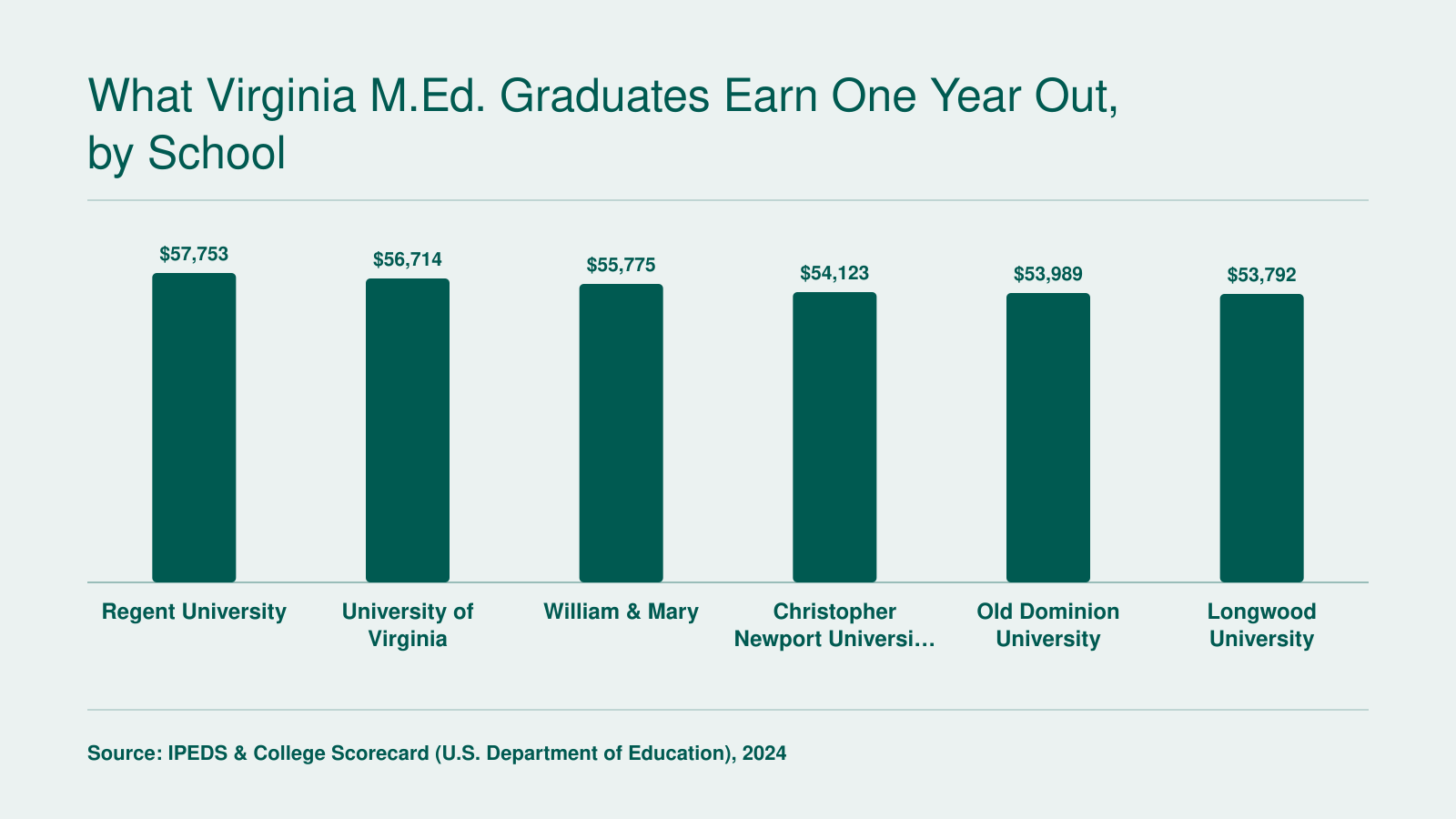
What Virginia M.Ed. Graduates Earn One Year Out, by School
Is an M.Ed. worth it for teachers in Virginia? These are median program-level earnings one year after finishing, for the schools with published figures. Pair them with debt: median program debt is $19,960 at University of Virginia ($227 a month over 10 years), $20,500 at William & Mary ($233), and $34,166 at Regent University ($389). Debt is not reported at the program level for Longwood University.
Compare Education (M.Ed.) programs on the data that matters
Explore more MEd specializations or browse every graduate field.
All MEd programs