Accelerated M.Ed. Programs
Compare 6,600+ accredited fastest Education (M.Ed.) programs at 1,050+ schools, with graduate earnings, cost, debt, and completion data from IPEDS and the U.S. College Scorecard.

A district pay raise or an advanced role can hinge on a master's, but two years of evening classes is a poor trade for an already full teaching schedule. Accelerated M.Ed. programs compress that work into roughly a year, and the schools ranked here span a net price range from about $13,500 to nearly $40,000. Online and campus formats are both represented.
The ranking starts with one-year options, then covers real completion timelines, tuition gaps, licensure rules, and graduate-earnings patterns that determine whether the faster route pays off.
Key Points
- Most accelerated M.Ed. programs run 10 to 18 months.
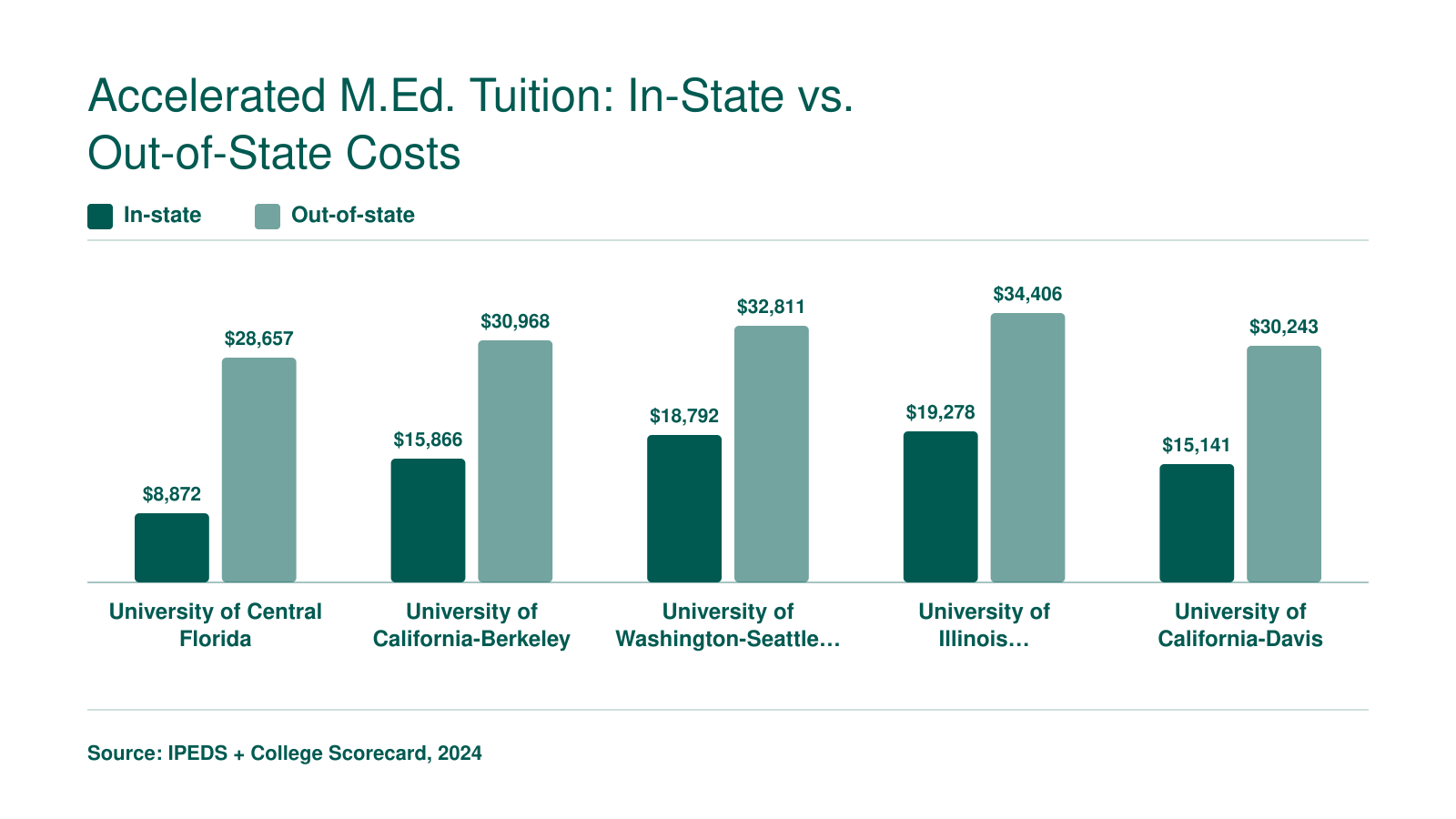
- Out-of-state tuition at University of Central Florida is more than triple in-state.
- Five years after finishing, Santa Clara graduates earn a median $79,261.
The Best Accelerated M.Ed. Programs of 2027
These are the fastest, outcomes-focused accelerated M.Ed. options we found. Each card lists the school's net price, in-state and out-of-state graduate tuition, institution-wide graduation rate, format, and concentration. Where CAEP accreditation could not be independently verified, confirm current status directly with the school before applying.
Tufts University
#1Medford, MA · ~$51,000/yr (est.)
Best for: STEM educators seeking thesis-focused campus program
Tufts offers a campus-based MS in STEM Education that can be completed in about one year. The program blends advanced education coursework with graduate STEM study and a year-long seminar, with a thesis, project, research team, or internship capstone. It suits educators and researchers planning school, museum, and curriculum leadership or doctoral study.
- 12 total courses
- Thesis or capstone option
- Financial aid available
- Prepares future PhD candidates
- Careers in PreK-16 STEM education
- STEM Ed seminar for 1 year
- Research team or internship options
- Transfer credits accepted
University of Pennsylvania
#2Philadelphia, PA · ~$48,000/yr (est.)
Best for: Aspiring higher ed leaders wanting campus immersion
Penn's Graduate School of Education runs compact, mostly one-year master's programs for higher education leadership and learning sciences. Students take 10 courses, can pursue paid graduate assistantships, and choose specialized focus areas or interdisciplinary electives. It is a campus-based option for aspiring administrators and learning technology specialists.
- 1-Year program
- 10 total courses
- 6 specialization options
- Full-time and part-time options
- Paid graduate assistantships available
- Comprehensive exam required
- Discussion-based seminars and faculty mentorship
- 1-Year program
- 10 total courses
- Full-time and part-time options
- STEM OPT extension eligible
- Interdisciplinary cognitive science focus
- Video games and virtual worlds study
- Learning analytics and big data
- Doctoral study pathway
The University of Texas at Austin
#3Austin, TX · ~$12,000/yr (est.)
Best for: Texas social studies teachers needing license endorsements
UT Austin offers a one-year Master of Education pathway for aspiring secondary social studies teachers in Texas. The 36-credit cohort runs full-time from summer, includes urban field experience, and leads to social studies and ESL endorsements with eligibility for Texas certification. No GRE is required.
- 36 total credit hours
- 1-Year program
- No entrance exam required
- Test optional
- Prepares for Texas teacher certification
- Earn ESL endorsement
- Social studies secondary endorsement
- Extensive urban field experience
University of Virginia
#4Charlottesville, VA · ~$24,000/yr (est.)
UVA combines a fully online Curriculum & Instruction M.Ed. that can be finished in one year full-time with several one-year, campus-based Master of Teaching paths for initial licensure. Students may choose from concentrations such as ESL, gifted education, literacy, or customized plans, and secondary programs include student affairs practice. The school is a strong fit for working educators who want asynchronous online coursework or for future licensed teachers in Virginia.
- 9 concentration options
- Fully online asynchronous format
- Complete in one year full-time or two to three years part-time
- No GRE required
- Virginia alternate licensure pathway
- Transfer up to 6 credits
- Optional dual MBA/M.Ed. option
- Ranked #5 for online graduate education
- 1-Year program
- Leads to Virginia ESL preK-12 initial licensure
- Internships in elementary and secondary ESL classrooms
- Praxis English to Speakers of Other Languages (5362)
- Cohort-based structure
- 2.7 GPA minimum
- Discounted tuition for Virginia preK-12 educators
- In-person program in Charlottesville, VA
- 1-Year program
- Starts summer
- Cohort-based structure
- 2.7 GPA minimum
- Prepares for Praxis
- Initial licensure in Virginia
- Diverse school internships
- Mentor teachers and clinical coaches
- 1-Year program
- Full-time enrollment
- Starts summer
- Cohort-based structure
- 2.7 GPA minimum
- Prepares for Praxis
- Initial licensure in Virginia
- Ranked #10 in elementary teacher education
- 4 endorsement options: Biology, Chemistry, Earth Science, Physics
- One-year program, June through May
- 2.7 GPA minimum
- Robert Noyce Scholarship: $18,000 per year
- Prepares for Praxis
- Initial licensure in Virginia
- Internships in diverse school settings
- GRE not required for admission
- 1-Year program
- 34 total credit hours
- Cohort of 40 students
- Over 50 internship sites
- Paid internships available
- 3.0 GPA minimum
- Early notification deadline Feb 1
- Full-time and part-time options
Grove City College
#5Grove City, PA · ~$9,000/yr (est.)
Grove City College appears in this comparison for its accelerated one-year graduate program in systems engineering and technology management, not an M.Ed. The 30-credit program can be completed online or part-time and is priced below typical graduate tuition. Prospective education students should treat this entry as a related accelerated master's example, not a teaching credential pathway.
- 1-Year program
- 30 total credit hours
- Full-time and part-time options
- Prepares for technical leadership positions
- Tuition below state and national averages
- Applications open Dec. 1
- Fully online format
- College accredited by Middle States
University of Minnesota-Twin Cities
#6Minneapolis, MN · ~$22,000/yr (est.)
Minnesota's College of Education and Human Development offers one-year M.Ed. programs in literacy education and English education for currently licensed teachers. Evening and summer courses, no prerequisites, and a 30-credit structure make these flexible paths for working educators. Graduates often move into reading specialist or instructional coordinator roles.
- 1-Year program
- Complete in two years or less
- 30 total credit hours
- Designed for licensed teachers
- No prerequisites or cohort requirements
- Flexible evening and summer courses
- 2.8 GPA minimum
- Transfer up to 10 graduate credits
- 1-Year program full-time, two years part-time
- 30 total credit hours
- Designed for current teachers
- No entrance exam required
- No prerequisites required
- 2.8 GPA minimum
- Transfer up to 10 graduate credits
- Prepares for instructional coordinator roles
Johns Hopkins University
#7Baltimore, MD · ~$65,000/yr (est.)
Johns Hopkins offers the TeachingWell M.Ed. for teaching professionals, a full-time, campus-based teacher preparation program with a paid residency year and full-tuition support. It focuses on STEM and secondary mathematics instruction, includes four years of career support, and prepares graduates for Maryland certification. The program is intended for aspiring middle and high school STEM teachers.
- 4 semesters of coursework plus 1 year of paid residency
- 39 total credit hours
- Full-tuition support provided
- Living stipend and paid residency
- Four years of career support
- Prepares for Maryland teaching certification
- Secondary Mathematics or STEM concentration
- Cohort-based and in-person immersive
Vanderbilt University
#8Nashville, TN · ~$58,000/yr (est.)
Vanderbilt Peabody offers one-year M.Ed. options in multilingual learner education, higher education administration, and music education through a Blair-to-Peabody pathway. Programs combine Nashville campus immersion with hands-on experiences, optional licensure or endorsements, and strong faculty mentorship. Education students can often complete coursework in one academic year and enter K-12 or higher education roles.
- 1-Year program
- Complete in as little as one academic year
- 30 to 33 credit hours depending on track
- Initial teacher licensure and ESL endorsement optional
- Hands-on immersive classroom experiences
- Rolling admissions
- Merit-based scholarships and Teacher Pathway scholarship
- Campus-based in Nashville
- Can be completed in one year with online and summer courses
- 36 total credit hours
- 93% job placement rate
- Built-in practicum experience
- Ranked #1 in Educational Administration
- Full-time, campus-based program
- Rolling admissions
- 1-Year program
- Earn B.Mus and M.Ed. in five years
- 100% job placement rate
- National teacher licensure in 46 states
- Three practica included
- 15 weeks of field placements
- Starts summer
Boston College
#9Chestnut Hill, MA · ~$38,000/yr (est.)
Boston College's Lynch School offers a one-year M.Ed. in Secondary Education with subject concentrations including English. The program includes 37 credit hours, a 14-week student teaching placement in Greater Boston, and optional TELL certificate or Donovan Urban Scholars track. It leads to Massachusetts initial licensure in several subject areas.
- 1-Year program
- 37 total credit hours
- 13 total courses
- Licensure in six subject areas
- Full-time student teaching for 14 weeks
- Donovan Urban Scholars program available
- Earn TELL Certificate option
- Approved by Massachusetts DESE
Santa Clara University
#10Santa Clara, CA · ~$32,000/yr (est.)
Santa Clara offers a one-year or two-year Master of Arts in Teaching plus teaching credential, with fully online and hybrid options. Students choose multiple subject for elementary or single subject for middle and high school, complete a year-long practicum, and earn a California preliminary credential. A bilingual authorization adds nine units.
- One-year or two-year academic sequence
- Fully online option available
- Multiple Subject track: 59 units
- Single Subject track: 53 units
- Earns California preliminary teaching credential
- Online option includes three-day campus residency
- Full-year practicum at placement sites
- Interns can serve as teacher of record
Cost & outcomes by school
Federal data for the highest-earning Education (M.Ed.) programs, independent of the ranking above. Earnings are this field's master's graduates four years after completing, where the Scorecard reports them.
| School | Earnings | Tuition / yr | Debt | Grads/yr | Format |
|---|---|---|---|---|---|
| Fitchburg State University MA | — | $6,246 | — | 2,418 | Online |
| University of Colorado Denver/Anschutz Medical Campus CO | — | $9,298 | — | 4,614 | Hybrid |
| Middle Georgia State University GA | — | $4,534 | — | 388 | Hybrid |
Sources: U.S. Department of Education. Tuition and graduates: IPEDS. Earnings and debt: College Scorecard, this field's master's graduates; a dash means no figure is reported.
How Long Does an Accelerated M.Ed. Take to Complete?
An accelerated M.Ed. is not one fixed calendar length: most M.Ed. programs run 12 to 18 months for roughly 30 to 36 credits, with the pace set by credits, term length, and how many courses you take at a time. Fitchburg State University and Southeastern Oklahoma State University use 7-week terms and advertise 12-month completion. Southern Arkansas University lists 12 to 18 months, while Arizona State University's principalship track runs 14 months on 7.5-week terms.
What Shapes the Timeline
Compressed terms, year-round enrollment, and taking multiple courses at once do most of the work. Transfer credit can also shorten the path. Many programs cap transfers at 6 to 9 graduate credits, though limits vary: Northwestern College allows up to 20% of total credits, and Eastern Washington University lists 12 credits for one option.
Workload and the One-Year Reality
Expect 8 to 12 hours per week for one accelerated course, or 15 to 20 hours for two at once. In 8-week terms, two courses may take 15 to 25 hours per week; Northwestern College estimates 9 to 18 hours for each 3-credit course. Yes, one-year M.Ed. programs exist, but only at a full-time pace with no breaks.
Accelerated M.Ed. Tuition: In-State vs. Out-of-State Costs
Published graduate tuition differs sharply by residency. The largest gap is at the University of Central Florida, where out-of-state students pay more than three times the in-state rate; none of the schools in this chart publishes a flat online rate. Keep in mind that published tuition is not the same as net price after grants and scholarships.
Related Articles
Licensure vs. Non-Licensure M.Ed. Pathways (And How an M.Ed. Differs From an MAT)
Licensure vs. MAT
Most accelerated M.Ed. programs are built for teachers who already hold an initial license and want salary-schedule movement or advanced licensure. For first-time teachers, a MAT is usually the clearer initial-certification route; an M.Ed. title alone does not establish licensure eligibility.1
State Authorization and Reciprocity
An online M.Ed. is not categorically different from an on-campus one, but the institution must be authorized and accredited, and the state where you plan to teach makes the final call.1 States may accept out-of-state degrees through reciprocity, require additional coursework or exams, or deny equivalency if the program does not address the license area. NC-SARA's SARA Policy Manual governs state authorization but does not guarantee another state will accept the degree.1
Salary and Disclosure
Salary and licensure are separate determinations: state acceptance for license advancement does not guarantee a district lane change, and district pay credit does not guarantee state advanced licensure.1 Some states tie salary-lane movement to graduate credits only after initial licensure, and districts may require advance approval. Check district salary schedules before enrolling. Federal rules require schools to publish state-by-state licensure disclosures, so confirm your state is listed as meeting requirements on the program's disclosure page.2
Earnings, Debt, and ROI for Accelerated M.Ed. Graduates
Return on an accelerated M.Ed. comes down to three numbers: what graduates earn, what they borrowed, and what that loan costs each month. Five years after finishing, Santa Clara University's teaching master's graduates earn a median $79,261 against median debt of $32,690, about $372 a month on a 10-year plan. The University of Washington's Master in Teaching shows $76,198 at five years with $30,990 in debt ($353 monthly). Penn's Higher Education MSEd posts $74,964 at five years, but its $55,857 median debt means roughly $635 a month, a much heavier lift than the most affordable M.Ed. programs typically require. Johns Hopkins teaching graduates earned $74,065 five years out.
One 2026 estimate puts the typical M.Ed. salary bump at $4,000 to $8,000 a year, though your district's salary schedule sets the real figure.
Speed does not cost you credibility. Districts generally move teachers in accredited M.Ed. programs up a salary lane based on regional accreditation, official transcripts, and degree conferral, and they typically do not distinguish a 12-month degree from a 24-month one. Licensure programs should also hold CAEP accreditation. Expect a heavier weekly workload, not a lighter credential.
Accelerated M.Ed. Admission Requirements Checklist
Requirements vary by program and track, but these are the common pieces to prepare.
- Bachelor's degree and GPAExpect an accredited bachelor's, with minimum GPAs typically around 2.75–3.0; some programs apply the 2.75 only to your last 60 credits or graduate coursework.
- Licensure or experienceLicensure-track and leadership programs may require a current teaching license and classroom experience, while non-licensure options often do not.
- GRE policyMost accelerated programs waive the GRE. Check each program, since at least one reports requiring scores with exceptions.
- Supporting materialsPrepare official transcripts, a resume, a statement of purpose, and recommendation letters. Letter requirements range from none to three, depending on the school.
- Deadlines and start datesSeveral schools use rolling admissions or multiple 8-week starts. Where dates are fixed, examples include August 5 and September 28, 2026; some programs have no deadlines.
Education (M.Ed.) programs by state
Frequently Asked Questions About Accelerated M.Ed. Programs
Can you earn an M.Ed. in one year?
Can I work full time while earning an accelerated M.Ed.?
What is the cheapest accelerated M.Ed. program?
Are accelerated M.Ed. programs respected by employers?
Compare Education (M.Ed.) programs on the data that matters
Explore more MEd specializations or browse every graduate field.
All MEd programs