Best M.Ed. Programs in Rhode Island
Compare 38 accredited Education (M.Ed.) programs in Rhode Island at 9 schools, with graduate earnings, cost, debt, and completion data from IPEDS and the U.S. College Scorecard.

A one-year Master of Arts in Teaching at Brown and a 36-credit, part-time M.Ed. in School Leadership at Providence College answer two different questions: becoming a teacher versus advancing as one. Rhode Island's small set of graduate education programs splits along that line, with campus formats dominating and one fully online leadership track.
Price is where the gap widens. In-state tuition at Rhode Island College's TESOL program runs a fraction of private-school rates, yet every path still funnels through RIDE certification and Praxis requirements that your degree title alone won't satisfy.
Key Points
- Rhode Island College's TESOL M.Ed. is cheapest here at $10,112 in-state.
- The University of Rhode Island offers a fully online educational leadership master's.
- An M.A.T. leads to initial licensure; an M.Ed. advances licensed teachers.
Rhode Island's Top M.Ed. and Master's in Education Programs for 2027
The programs below stand out for observable graduate outcomes, price after aid, and delivery flexibility, not just institutional prestige. Use the cards to compare tuition, net price, completion rates, and licensure or accreditation signals side by side.
Providence College
#1Providence, RI · ~$13,000/yr (est.)
Best for: Licensure-focused leaders and reading specialists
Providence College sets itself apart with a deep M.Ed. catalog: school leadership, higher education, special education with dyslexia credential, literacy, and mathematics, plus the PACT secondary pathway for Catholic educators. Graduate tuition is about $63,550 in and out of state, and the average net price after aid is roughly $48,523; the school's graduation rate is 86%. The college is regionally accredited by NECHE and its Rhode Island educator preparation programs hold RIDE approval; it does not list a separate CAEP status.
- 36 credits, 12 courses, culminating six-credit internship
- Prepares for Praxis School Leaders Licensure
- On campus with fall, spring, summer starts
- Requires 3.0 GPA and performance assessment
- Cohort option at Cranston High School West with reduced tuition
- 36 credits with two 150-hour internships
- Capstone required; starts fall, spring, summer
- On campus; alumni placed at Harvard University
- $65 application fee; two recommendation letters minimum
- Wilson Reading System Level I certification pathway
- 65+ lesson practicum prepares Wilson Dyslexia Practitioner credential
- Hybrid or fully online delivery
- Full-time completion possible in one academic year; part-time available
- Requires state teaching credential
- Two years of service as Catholic school teachers
- Eligibility for Rhode Island teacher certification
- Science of Reading and Structured Literacy focus
- Includes BRIDGE-RI instructional modules
- Open to already-certified educators
- 36 credits, 12 courses, 300 clinical hours
- Prepares for Praxis Reading Specialist exam
- Rolling admissions; three start dates yearly
- Aligned with ILA Standards and Science of Reading
- Can take up to two courses before matriculating
- Hybrid format with evening and online courses
- 80 clinical hours; 12-week student teaching practicum
- Prepares for Praxis; certification reciprocates in 45 states
- Full-time and part-time options
- Prerequisite courses required
Rhode Island College
#2Providence, RI · ~$10,000/yr (est.)
Best for: Affordable public-school licensure and M.Ed. tracks
Rhode Island College is the state's largest educator preparation institution, with M.Ed. and MAT options spanning TESOL, special education, reading, elementary, secondary, art, and music. In-state graduate tuition is about $11,300, out-of-state is about $27,299, and the average net price is roughly $9,478; the school's graduation rate is 48%. RIC is regionally accredited by NECHE and holds RIDE approval for its education programs; a separate CAEP designation is not published in the materials reviewed.
- Prepares for TESOL certification
- Field work in schools or community organizations
- Take two courses before matriculating
- $50 application fee; fall/spring starts
- Optional bilingual education concentration
- Leads to early childhood special education licensure
- Requires RI early childhood education certification
- Designed for practicing early childhood teachers
- One-year program with five concentration options
- 36 credits, 11 courses, literacy clinic experience
- Includes Literacy/Dyslexia Endorsement pathway
- Prepares for Reading Specialist certification
- Synchronous online and hybrid classes; May 1 deadline
- Prepares for high school teacher certification
- Teaches grades 9-12 in multiple subjects
- Additional ESL or Special Ed endorsements available
- 89% of faculty hold terminal degrees
- One-year intensive or two-year completion options
- Eligible for elementary teacher certification in one year
- Summer/spring starts; financial aid available
- Culturally responsive teaching focus; B or higher required
- Eligible for pre-K-12 music certification
- Clinical experiences and full-time student teaching
- Individually developed Plan of Study
- 89% faculty hold terminal degrees
- Prepares for pre-K-12 art teacher certification
- For art studio or art history degree holders
- Only public RI institution offering this MAT with certification
- Combines art education theory and curriculum development
- Leads to licensure as grades 1-6 special educator
- Focus on literacy, STEM, and blended learning
- Synchronous and asynchronous options
- Prepares for inclusive and multilingual settings
- Leads to licensure as grades 7-12 special educator
- Synchronous and asynchronous options
- High demand for special education teachers
- Prepares for inclusive and multilingual settings
- Prepares for grades 9-12 teaching
- Rhode Island high school certification
- Subjects include general science and mathematics
- Additional ESL or Special Ed endorsements available
Brown University
#3Providence, RI · $65,000 – $70,000/yr (est.)
Best for: Career changers wanting one-year secondary licensure
Brown's one-year MAT places students in classrooms from the first summer and leads to Rhode Island secondary teaching certification with a multilingual learner endorsement. Graduate tuition is about $71,412, but the average net price after aid is roughly $25,184; the school's graduation rate is 96%. Brown is regionally accredited by NECHE and its MAT holds RIDE approval; a separate CAEP status is not published in the sources reviewed.
- One-year, on-campus cohort model
- Summer semester at Brown Summer High School
- 100% licensure pass rate
- Prepares for RI teaching certificate with multilingual learner endorsement
- Test optional; no GRE required
- Concentrations in English, math, social studies, science
- Concentration in secondary English
- Year-long classroom residency
- Prepares for Praxis; three recommendation letters minimum
- Concentration in secondary math
- Prerequisite courses required
- Full-year practicum and student teaching
- Endorsement in teaching multilingual learners
- Science tracks include biology, chemistry, engineering-physics
- Entrance exam TOEFL/IELTS for international applicants
- Leads to Rhode Island teaching certificate
- Licensure reciprocity via NASDTEC
- No GRE required
University of Rhode Island
#4Kingston, RI · ~$18,000/yr (est.)
The University of Rhode Island stands out for its ALA-accredited Master of Library and Information Studies, offered online with concentrations including school library media and digital media, plus an M.A. with teacher certification for secondary subjects. In-state graduate tuition is about $16,942, out-of-state is about $37,146, and the average net price is roughly $21,440; the school's graduation rate is 73%. URI is regionally accredited by NECHE, its education programs hold RIDE approval, and it uses AAQEP accreditation rather than CAEP.
- ALA-accredited; next review 2033
- Online format ideal for working professionals
- Requires 3.00 GPA, statement, two recommendations
- Focus areas include Children's Services and School Librarianship
- Application deadline in March for May start
- Two-year program leading to initial Rhode Island teacher certification
- 30 subject-area credits for certification
- 12-credit supervised student teaching and teaching seminar
- Licensure aligned in six states
- Advisor sets Program of Study
- Fully online concentration
- Digital preservation and information architecture focus
- No GRE required
- Multiple start dates; financial aid available
- Fully online concentration
- Focus on diverse communities and critical librarianship
- Master's degree level
- Fully online with rolling admissions
- Field experience component
- State certification eligible
- K-12 career preparation with digital literacy training
- No GRE requirement
Roger Williams University
#5Bristol, RI · ~$21,000/yr (est.)
Roger Williams University's hybrid Master of STEM Education is designed for K-12 educators and career changers, with asynchronous online coursework and select Saturday sessions; the program does not lead to Rhode Island licensure. Graduate tuition is about $44,418 and the average net price is roughly $37,999; the school's graduation rate is 69%. RWU is regionally accredited by NECHE and its education programs are Rhode Island-approved, but it does not publish a separate CAEP status.
- 37 credits, hybrid with asynchronous online and Saturday sessions
- $780 per credit for 2026-27
- Full-time/part-time maps; 4+1 option for RWU undergraduates
- Includes 4-credit internship and 3-credit capstone
- 15% tuition discount for educators
- No GRE; does not meet Rhode Island licensure
Rhode Island School of Design
#6Providence, RI · $60,000 – $65,000/yr (est.)
Rhode Island School of Design offers a one-year MAT for artists and designers seeking PK-12 art teacher certification, with studio access and community partnerships. Graduate tuition is about $62,688 and the average net price is roughly $50,507; the school's graduation rate is 89%. RISD is regionally accredited by NECHE; the sources reviewed do not list a separate CAEP status or a current RIDE program-approval confirmation, so certification status should be verified.
- One-year intensive cohort for artists and designers
- Prepares for PK-12 art teacher certification
- Reciprocity in 44+ states
- Portfolio of 20 images required
- 3.0 GPA minimum; no GRE required
- Curriculum focused on social and ecological justice
Johnson & Wales University
#7Providence, RI · ~$15,000/yr (est.)
Johnson & Wales University offers cohort-based MAT concentrations in elementary/elementary special education, business/secondary special education, and culinary arts education, with evening classes and field experiences in Rhode Island schools. Graduate tuition is about $13,365 and the average net price is roughly $20,252. JWU is regionally accredited by NECHE and its education programs are RIDE-approved; it does not publish a separate CAEP status in the materials reviewed.
- Dual certification in elementary and elementary special education
- $572 per credit; five-semester cohort
- Evening classes 2-3 times per week on Providence campus
- Prepares for Rhode Island teaching licensure
- 25% alumni tuition discount
- Dual concentration in business and secondary special education
- $572 per credit; five-semester cohort
- Field-based experiences in public schools
- Evening classes for working professionals
- 25% alumni tuition discount
- Concentration in culinary arts education
- $572 per credit; five consecutive semesters
- Fieldwork in culinary classrooms
- Central Falls substitute teaching partnership
- Prepares for RI teaching licensure
Cost & outcomes by school
Federal data for the highest-earning Education (M.Ed.) programs, independent of the ranking above. Earnings are this field's master's graduates four years after completing, where the Scorecard reports them.
| School | Earnings | Tuition / yr | Debt | Grads/yr | Format |
|---|---|---|---|---|---|
| Rhode Island College RI | — | $10,112 | — | 618 | Campus |
| Providence College RI | — | $13,440 | — | 386 | Campus |
| Salve Regina University RI | — | $13,365 | — | 518 | Online |
| Johnson & Wales University RI | — | $15,156 | — | 418 | Campus |
| Johnson & Wales University RI | — | $15,156 | — | 246 | Campus |
| University of Rhode Island RI | — | $18,028 | — | 1,290 | Campus |
| Roger Williams University RI | — | $21,305 | — | 308 | Hybrid |
| Rhode Island School of Design RI | — | $62,688 | — | 434 | Campus |
| Brown University RI | — | $69,948 | — | 2,048 | Campus |
Sources: U.S. Department of Education. Tuition and graduates: IPEDS. Earnings and debt: College Scorecard, this field's master's graduates; a dash means no figure is reported.
Most Affordable Rhode Island's Top M.Ed. and Master's in Education Programs for 2027
The programs below are ordered by the lowest published net price after aid, using federal IPEDS and College Scorecard data. Net price is the average annual cost after grants and scholarships, so it is a better affordability signal than sticker tuition. Delivery format is shown as campus or hybrid.
| School | City | Program | Net price after aid | Format |
|---|---|---|---|---|
| Rhode Island College | Providence | Teaching English to Speakers of Other Languages (TESOL) MED | $9,478 | Campus |
| Johnson & Wales University | Providence | Master of Arts in Teaching | $20,252 | Campus |
| University of Rhode Island | Kingston | Master of Library and Information Studies (MLIS) | $21,440 | Campus |
| Brown University | Providence | Master of Arts in Teaching | $25,184 | Campus |
| Roger Williams University | Bristol | Master of STEM Education | $37,999 | Hybrid |
Online and Hybrid Master's in Education Options in Rhode Island
Yes, an accredited online option exists in Rhode Island, but it is narrower than the "online M.Ed." label suggests. The University of Rhode Island's M.A. in Educational Leadership and Policy is fully online, mixes synchronous and asynchronous coursework, and has no on-campus requirement. Note that it is an M.A., not an M.Ed.
The other M.Ed. programs here are tagged campus-based: Providence College's M.Ed. in School Leadership, Rhode Island College's TESOL M.Ed., and the M.A.T. programs at Brown, RISD, and Johnson & Wales. Working teachers should look at schedules. Johnson & Wales lists evening classes, Providence College starts cohorts in fall, spring, and summer, and Brown and RISD begin in summer. Rhode Island College courses may be online, on campus, or hybrid, so confirm the current format with the department.
Online does not mean no in-person hours. URI places fieldwork in your current school or district and cites 500+ clinical hours, though a separate page lists 135 fieldwork hours plus 400 practicum hours, so ask which applies. Brown's spring student-teaching placement and Johnson & Wales's K-12 fieldwork are in-person. Only URI states that your own school can host placements.
Which Rhode Island M.Ed. Programs Waive or Make the GRE Optional?
Testing rules for Rhode Island accredited M.Ed. programs are set program by program. The test you face depends on the specific track, not just the school, and the same is true for M.Ed. With No GRE Required options.
- University of Rhode Island: The Graduate School leaves testing to each program. Many URI programs no longer ask for the GRE, though some may still require GRE, GMAT, MAT or Praxis scores.
- Providence College: Its general graduate requirements list GRE or GMAT scores taken within the past five years, with separate waiver criteria1, no minimum score and holistic review.2 The catalog notes that selected Education programs require the MAT instead.3
- Rhode Island College: The GRE or MAT applies to "some programs." Applicants are told to check the individual program for its rule.
- Johnson & Wales, Roger Williams, Brown and RISD: We found no official GRE policy for their education master's programs. Treat the requirement as unconfirmed.
Before paying for any exam, ask the program's admissions office to confirm the current policy in writing.
Related Articles
What a Rhode Island Master's in Education Costs, and How It Ties to Licensure
Prices for a Master's in Education in Rhode Island vary far more than the degree titles suggest, and residency drives much of the gap. Rhode Island College's TESOL M.Ed. is the cheapest program here at $10,112 in-state and $18,806 out-of-state, against a flat $15,156 at Johnson & Wales and $18,028 in-state ($33,148 out-of-state) at the University of Rhode Island. The $9,478 net price listed for Rhode Island College is an approximate institution-wide average, not a program figure.
Per-credit rates and totals
For 2025-2026, Rhode Island College lists $580 per credit in-state with fees and $844 out-of-state, about $17,400 and $25,320 over 30 credits.1 Those estimates already include the School of Education fee ($23 per credit, capped at $275 a semester).1 URI charged $919 in-state and $1,796 out-of-state per credit, roughly $27,570 and $53,880 for 30 credits. For 2026-2027 it lists $951 and $1,852, plus a $1,427 regional rate for eligible matriculated plans. Verify that your specific M.Ed. qualifies before counting on that discount.
The licensure link
Most M.Ed. programs serve teachers who are already certified and want advancement or an added endorsement. Initial-certification routes, such as Master of Arts in Teaching (MAT) in Rhode Island programs including Brown's spring student-teaching placement, cost more because of student-teaching terms. The RIDE certification callout below lays out the official pathway.
Rhode Island Educator Certification at a Glance
M.Ed. vs. M.A.T. vs. M.A.: Which Rhode Island Degree Leads Where
The deciding question is not prestige but where you stand today: do you need an initial teaching license, or do you already hold one and want to advance? Rhode Island programs sort along that line.
- M.A.T.: Built for bachelor's holders without a certificate. It includes pedagogy coursework and supervised student teaching, and it leads to initial certification. Rhode Island College's Elementary Education M.A.T. runs about 12 months; its Secondary track prepares graduates for 9-12 certification. Brown's M.A.T. is roughly 36 credits with a spring student-teaching placement of at least 12 weeks and Praxis exams before a certification recommendation.
- M.Ed.: Advanced study for practicing educators, commonly assuming an existing license and classroom experience. Rhode Island College's M.Ed. runs 30 to 36 credits. On its own, an M.Ed. does not grant initial licensure unless the specific program is an approved certification track.
- M.A. in Education: Specialization or research work for already-certified teachers; it does not lead to initial certification.
If you need a first license, start with an M.A.T.
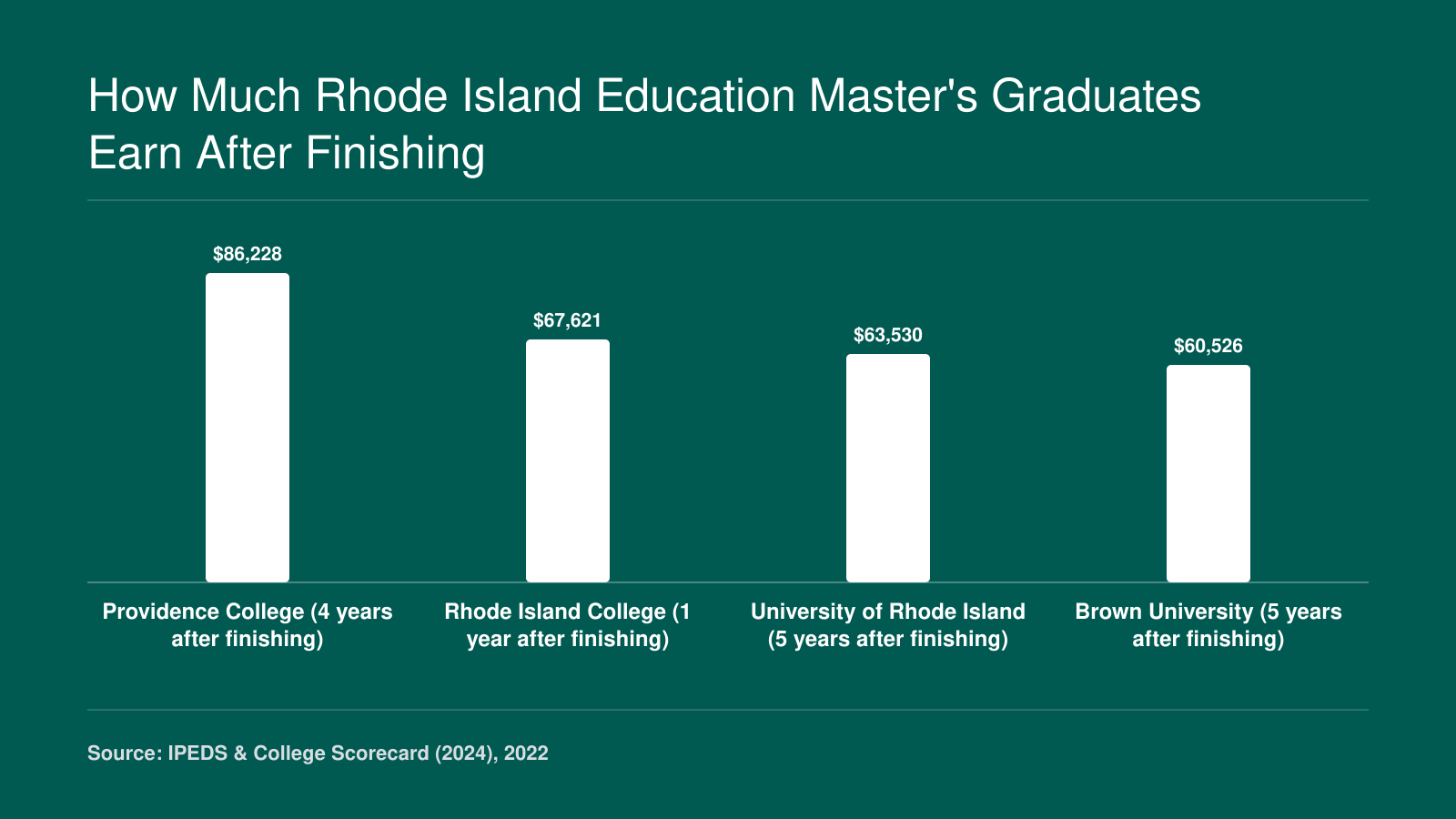
How Much Rhode Island Education Master's Graduates Earn After Finishing
The figures below reflect median earnings for each program's graduates in the years after finishing. They vary by measurement window, so compare the labels carefully. Higher earnings make loan repayment easier, while lower earnings stretch the same monthly payments over more years.
Choosing the Right M.Ed. Specialization in Rhode Island
Some specializations keep you in the classroom, while others move you toward leadership or a niche role. The concentrations at the schools here cover both directions.
- Educational Leadership: Providence College's Master of Education in School Leadership prepares for the Praxis School Leaders Licensure and points toward principal and superintendent roles.
- TESOL & Multilingual Learners: Rhode Island College's TESOL M.Ed. prepares for TESOL certification and leads to ESL teaching.
- Elementary/Elementary Special Education: Johnson & Wales University's MAT concentration targets special education teaching, with preparation for Rhode Island licensure.
- Teaching: Brown's MAT and RISD's art-focused MAT prepare for initial Rhode Island certification.
- Curriculum & Instruction or Reading: Where offered, these tracks typically lead to instructional coach or reading specialist work.
Before comparing price, identify the RIDE endorsement or certificate you want, then confirm the concentration prepares you for it. Even the most affordable M.Ed. program that doesn't lead to that credential costs more in the end.
Quick Answers: Timelines, Transfer Credits, and Application Deadlines
M.Ed. timelines and transfer rules vary by program. The details below use published graduate policies where available, but students should confirm current requirements directly with each institution before applying.
How long does it take to get an M.Ed. in Rhode Island if you study part-time while teaching?
Can you transfer graduate credits into a Rhode Island master's in education?
What GPA and application deadlines do Rhode Island M.Ed. programs typically set?
Compare Education (M.Ed.) programs on the data that matters
Explore more MEd specializations or browse every graduate field.
All MEd programs