Best Master's in STEM Education Programs in Texas
Compare accredited Stem Science Technology Engineering Math master's programs by earnings, cost, and outcomes.
Sample layout — live rankings and program data appear here once the data source is connected.

UT Austin's 24-month campus M.Ed. and UTEP's fully online 30-credit MA in Education, at $490 per credit, reach similar STEM leadership roles by different routes. Most applicants want stronger STEM classrooms, a coaching or curriculum role, or a way into teaching from a STEM career.
Campus, online, and hybrid programs are ranked together. But a STEM-focused education & teaching master's program in Texas does not certify you to teach: career changers still need an SBEC-approved educator preparation program.
Key Points
- Only the first few ranked programs are education degrees built for teachers.
- The University of Texas at Austin lists its STEM Education M.Ed. as requiring no entrance exam.
- Texas teacher certification runs through an SBEC-approved preparation program, so confirm certification status before comparing tuition.
The 10 Best Master's in STEM Education Programs in Texas
This ranking weighs what Texas STEM education master's applicants ask about most: real graduate earnings, institution-wide completion rates, net price, and whether the format fits a working teacher's schedule. The list includes campus, online, and hybrid programs, with tuition shown as one year of graduate study. Each card also notes the share of students the school graduates overall.
The University of Texas at Austin
#1Austin, TX · ~$12,000/yr (est.)
Best for: Current educators seeking research-focused STEM master's
The University of Texas at Austin offers an on-campus STEM education master's that can be completed in 24 months with Master of Arts or Master of Education pathways, including thesis and non-thesis options. In-state graduate tuition is $11,688 per year and out-of-state is $44,908. The institution graduates about 89 percent of students. Standout: no entrance exam is required, and faculty are active in STEM education research.
- On-campus, 24 months, with thesis or capstone option
- Two concentration options; M.Ed. requires teacher certification
- No GRE required; 3.0 GPA minimum; fall start
- Research-focused curriculum with faculty active in STEM education
Texas A&M University-College Station
#2College Station, TX · ~$12,000/yr (est.)
Best for: Working teachers needing asynchronous online cohort
Texas A&M University offers an online Master of Education in Curriculum and Instruction with a STEM emphasis for working educators; the 36-credit asynchronous program uses a cohort model and includes an integrated graduate STEM certificate. In-state graduate tuition is $13,154 per year and out-of-state is $40,124. The school graduates about 84 percent of students. Standout: no thesis or capstone is required, and the integrated certificate's credits apply directly to the degree.
- 36 credit hours, asynchronous online classes, starts summer
- Cohort-based; no thesis or capstone required
- Integrated graduate STEM certificate in first semesters
- Standalone 12-credit STEM certificate available
- Focus on action research; Canvas online platform
The University of Texas at El Paso
#3El Paso, TX · $5,000 – $10,000/yr (est.)
Best for: Budget-conscious online STEM education learners
The University of Texas at El Paso offers a fully online Master of Arts in Education with a STEM Education concentration; the 30-credit program includes a graduate certificate in STEM education. In-state tuition is $9,744 per year and out-of-state is $25,502. The university graduates about 50 percent of students. Standout: tuition is $490 per credit in-state or $575 out-of-state, and the program uses culturally sustaining and project-based pedagogies.
- 30 credit hours, 10 courses, 100 percent online
- Thesis or capstone option; 3.0 GPA minimum
- Includes a graduate certificate in STEM education
- $490 per credit in-state, $575 out-of-state
- Culturally sustaining and project-based learning focus
The University of Texas at Tyler
#4Tyler, TX · ~$8,000/yr (est.)
The University of Texas at Tyler's Master of Education in Curriculum and Instruction includes a STEM education specialization and can be completed online or face-to-face in 15 to 18 months. The 30-credit program lists a $15,710 total program tuition for Fall 2025, while annual in-state graduate tuition is $9,736 and out-of-state is $25,494. The school graduates about 54 percent of students. Standout: TEACH Grant support is available, and GRE may be requested below a 3.25 GPA.
- 30 credit hours, 15 to 18 months, fully online option
- STEM education, instructional coaching, educational technology, and initial certification specializations
- STEM applicants must be certified teachers with two years experience
- GRE may be requested below 3.25 GPA; TEACH Grant support available
Texas Christian University
#5Fort Worth, TX · $35,000 – $40,000/yr (est.)
Texas Christian University's Master of Education in Curriculum and Instruction allows students to choose mathematics education or science education as one of four content specializations, with either a research or teaching and learning emphasis. In-state and out-of-state graduate tuition is $61,740 per year. The school graduates about 86 percent of students. Standout: an Accelerated Master track is available, and faculty include two Piper Professors.
- Four concentration options, including mathematics and science education
- Choose research or teaching and learning emphasis
- Accelerated Master track available
- Faculty include two Piper Professors and an NSF Research Fellow
University of North Texas
#6Denton, TX · $9,000 – $16,000/yr (est.)
The University of North Texas offers a hybrid Master of Science in Information Systems and Technologies with four technology concentrations, plus a hybrid Master of Science in Mathematics with a mathematics education concentration that has a fully online option and prepares students for dual-credit teaching. In-state graduate tuition is $11,309 per year and out-of-state is $21,149. The university graduates about 61 percent of students. Standout: the mathematics education track is 36 credits and can be completed fully online.
- 30 credit hours, 18-24 months, capstone required
- Concentrations: cloud computing, cyber security, project management, business intelligence
- Online and in-person; STEM-approved for 36-month OPT
- Located in Dallas-Fort Worth area; 700 plus companies offer internships
- 36 credit hours, three-year program, fully online option
- Prepares for dual-credit teaching; summer and evening courses
- Research methods coursework and professional project
- Serves developmental math instructors
Texas State University
#7San Marcos, TX · ~$9,000/yr (est.)
Texas State University offers several STEM-related graduate programs, including a hybrid Master of Science in Data Analytics and Information Systems and a Mathematics Master of Education or Master of Science with no entrance exam. In-state graduate tuition is $11,450 per year and out-of-state is $22,930. The university graduates about 55 percent of students. Standout: the mathematics program has about 20 mathematics education researchers on faculty.
- 30 credit hours, one year full-time, AACSB accredited
- STEM-designated; meets CPA education requirements
- Covers information security, business intelligence, and regulatory reporting
- Full-time and part-time options; San Marcos campus
- 30 credit hours, 16 months, hybrid and in-person
- AACSB accredited; STEM-designated analytical focus
- Thesis or capstone option; full-time and part-time
- Covers machine learning and data visualization
- 36 credit hours; no entrance exam; rolling admissions
- 2.8 GPA minimum; fall, spring, or summer starts
- Nine-hour mathematics core; comprehensive exam required
- About 20 mathematics education researchers on faculty
University of Dallas
#8Irving, TX · ~$23,000/yr (est.)
The University of Dallas offers hybrid Master of Science in Business Analytics and Master of Science in Data Science and Artificial Intelligence programs that are STEM-designated and do not require the GMAT or GRE. In-state and out-of-state graduate tuition is $53,930 per year. The university graduates about 73 percent of students. Standout: the hybrid format uses evening and online classes with multiple start dates.
- 30 credit hours, 13 courses, flexible evening and online classes
- No GMAT or GRE required; test optional
- STEM-designated with 24-month OPT extension for international students
- Prepares for data scientist, BI analyst, or CIO roles
- 36 credit hours, 13 courses, hybrid evening and online classes
- No entrance exam; test optional
- STEM-designated with OPT extension
- Small class settings and experiential AI projects
University of Houston-Clear Lake
#9Houston, TX · $5,000 – $10,000/yr (est.)
The University of Houston-Clear Lake offers a campus-based Master of Science in Systems Engineering with a Healthcare Systems Engineering concentration, welcoming students from math, physics, and computing backgrounds. In-state graduate tuition is $7,770 per year and out-of-state is $21,114. The university graduates about 52 percent of students. Standout: GRE waivers are available for experienced professionals.
- Four concentration options; GRE required
- 3.0 GPA minimum; prerequisite courses required
- Concentration: Healthcare Systems Engineering
- Careers in aerospace, energy, healthcare, finance, or IT
LeTourneau University
#10Longview, TX · ~$17,000/yr (est.)
LeTourneau University offers a 30-credit, non-thesis Master of Engineering that integrates Christian faith with engineering practice and offers four specializations in mechanical, electrical, biomedical, or materials joining. In-state and out-of-state graduate tuition is $37,160 per year. The university graduates about 59 percent of students. Standout: over 90 percent of engineering graduates are employed within six months.
- 30 credit hours, four semesters, no thesis or capstone
- Concentrations: mechanical, electrical, biomedical, materials joining
- 90 percent job placement rate within six months
- Prepares for PE licensure; high-tech labs
Online and Hybrid Master's in STEM Education Options in Texas
Working teachers now drive demand for master's programs that fit around a school day, and the STEM education master's programs here reflect it. Among the programs ranked here, two STEM education degrees are built for distance learners, while one is campus-based.
- Texas A&M University: The M.Ed. in Curriculum and Instruction with a STEM emphasis is fully online and asynchronous. It requires 36 credit hours, uses a cohort structure, and has no thesis or capstone. Completion time is not published on the program page.
- UTEP: The MA in Education with a STEM Education concentration is 100% online and 30 credits. UTEP advertises completion in as little as 16 months.
- UT Austin: The STEM Education master's is an on-campus program, typically 24 months, with a fall start and a thesis or capstone option.
The pages reviewed do not describe practicum, field experience, or synchronous session requirements for the online programs. Ask each admissions office before you enroll.
One cost tip for Texas master's programs: do not assume a flat rate. UTEP lists $490 per credit for Texas residents and $575 for nonresidents. Texas A&M's page does not give a per-credit figure, so confirm it on the cost page.
Which Ranked Texas STEM Education Master's Programs Waive the GRE?
Few ranked Texas programs state a GRE waiver plainly, so confirm each admissions page before you assume anything.
The University of Texas at Austin is the clearest case. Its STEM Education M.Ed. does not publish an entrance exam requirement, and its catalog entry names a bachelor's degree, prior coursework, and K-12 certification without mentioning the GRE. The Curriculum and Instruction admissions page says GRE scores are no longer required, but it sends STEM Education applicants to a separate page, so check that one. The University of Dallas lists its business analytics master's as test optional. The University of Houston-Clear Lake lists the GRE for its systems engineering master's but notes a waiver for industry experience. The University of Texas at Tyler lists the GRE as required.
Texas A&M University-College Station's online M.Ed. is a no-GRE master's program, and I found no published GRE policy for Texas Christian University, the University of North Texas, Texas State University, LeTourneau University, or the University of Texas at El Paso. Treat that as unpublished, not as waived.
Where waivers exist, they usually turn on a minimum undergraduate GPA (often 3.0), a prior graduate degree, or years of teaching or industry experience.
Admissions Checklist for a Master's in STEM Education in Texas
Requirements vary by school, so confirm details on each program's admissions page. Deadlines below come from official pages and may shift from year to year.
- Bachelor's degree and STEM prerequisitesExpect a bachelor's degree from a regionally accredited institution. UT Austin looks for a STEM degree or transcript evidence of prior STEM coursework. UTEP and Texas A&M do not list specific prerequisite courses.
- Minimum GPAUT Austin, Texas A&M, and UTEP all point to about a 3.0. At Texas A&M it is recommended rather than absolute. UT Austin lets lower-GPA applicants petition. Some programs elsewhere accept 2.75 on the last 60 hours, so check each school.
- Teaching certificate or classroom experienceUT Austin prefers teaching experience but does not require it. UTEP does not state a requirement, though a resume showing education-related experience helps. Texas A&M's admissions page lists no certificate requirement, but its separate certification track requires teaching experience.
- Letters, statement, and resumeUT Austin asks for a resume or CV, statement of purpose, transcripts, and letters of recommendation. UTEP asks for a resume, statement, and all transcripts. Texas A&M requires three professional letters, including at least one from an instructor or academic referee. Texas A&M does not require the GRE.
- Application deadlinesUT Austin's fall deadline is December 15. Texas A&M's STEM emphasis admits for summer only, with a March 20 deadline. UTEP lists August 9 for fall, January 5 for spring, and May 3 for summer. Spring and summer dates were not found for UT Austin, so check with the department.
Related Articles
Cost of a Master's in STEM Education in Texas and How It Ties to Certification
Price differences among these programs are wide enough to change which degree makes financial sense, and certification status is the single biggest cost variable.
What the published rates look like
Among the options here with transparent pricing, American College of Education is the cheapest, at roughly $235 per credit across 31 credits, which the school publishes as a total near $9,100 including technology and conferral fees.1 Texas State's 30-credit educational technology master's runs about $502 per credit, or roughly $15,060, before per-semester course-materials charges that are billed separately and can be opted out of.2 Texas Tech's 36-credit online STEM education concentration falls between $415 and $500 per credit depending on residency classification.3 Published annual tuition at the public universities ranked here mostly sits in the $7,000 to $11,000 range for residents and climbs substantially out of state. Institution-wide net price figures after aid are useful context but are averages across all students, not a quote for any graduate program.
Certification changes the math
Most of these degrees assume you already hold a Texas teaching certificate. UTEP's 30-credit STEM education master's, for example, does not confer a credential on its own; pairing it with the alternative certification route pushes the total to 45 credits and requires a separate application. Career changers should confirm the pathway before comparing sticker prices.
Texas Teacher Certification for STEM Educators
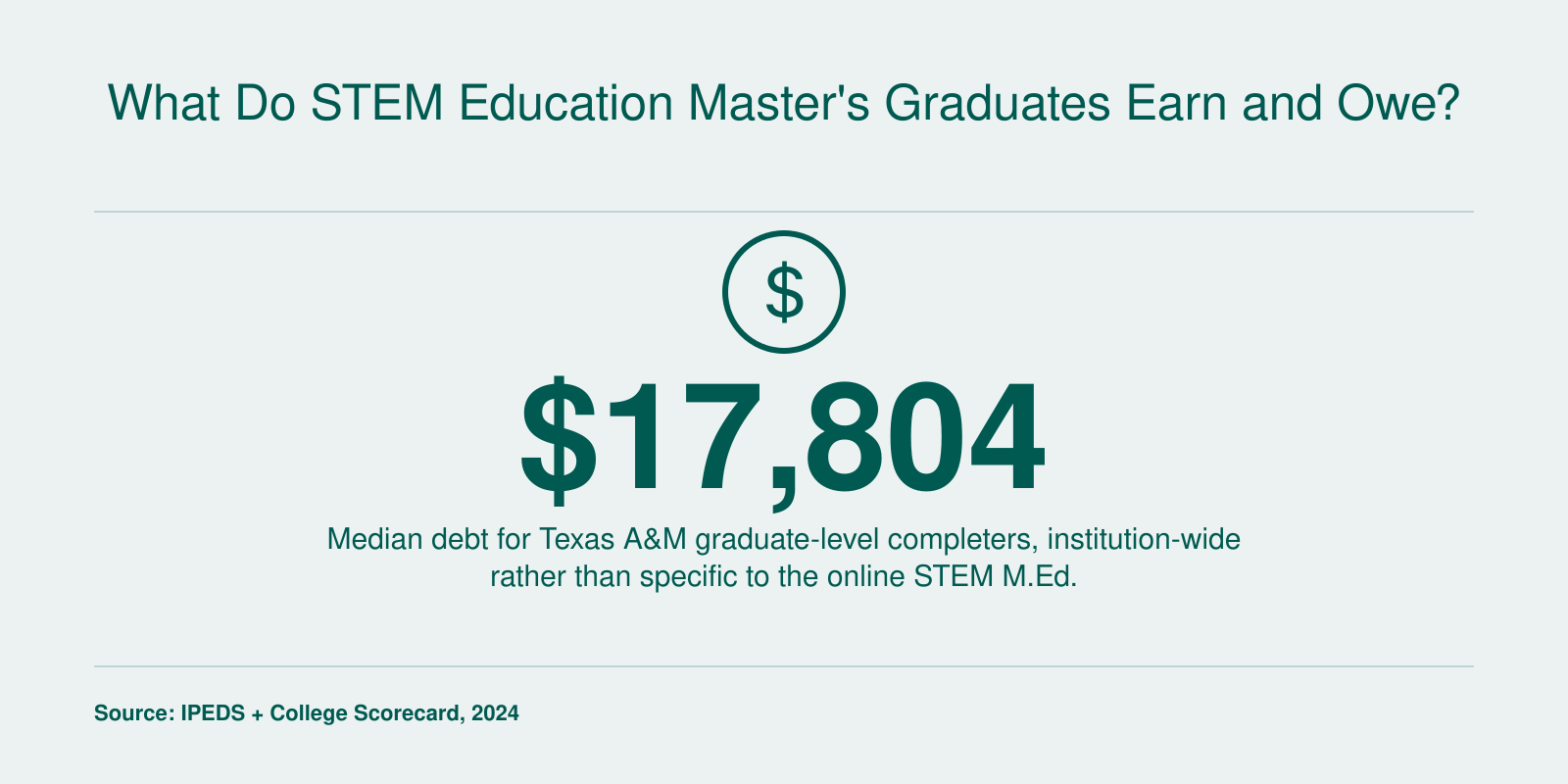
What Do STEM Education Master's Graduates Earn and Owe?
Program-level earnings for STEM education master's graduates are not yet published for the schools ranked here, so we do not show an earnings chart. Institution-wide earnings would misrepresent what these programs pay, so we left them out. Common roles for graduates include STEM teacher, instructional coach, curriculum specialist, and district STEM coordinator. Debt is the one outcome we can report, so weigh it against Texas salary schedules and district stipends for advanced degrees.
FAQs About Master's in STEM Education Programs in Texas
These answers draw on program pages from schools in the ranked list. Requirements differ by university and track, so confirm details with each admissions office before you apply.
What can you do with a master's in STEM education?
Do I need teaching certification to apply for a STEM education master's in Texas?
What is the difference between an M.Ed. and an M.A. in STEM education?
Is a master's in curriculum and instruction with a STEM focus the same as a STEM education master's in Texas?
Compare Stem Science Technology Engineering Math programs on the data that matters
Explore more Education & Teaching specializations or browse every graduate field.
All Education & Teaching programs