Best Master's in Business Analytics Programs in Texas
Compare 36 accredited Analytics programs in Texas at 34 schools, with graduate earnings, cost, debt, and completion data from IPEDS and the U.S. College Scorecard.

Which business analytics master's in Texas is worth the money? Employers in Houston's energy and healthcare systems, Dallas finance, and Austin's tech sector all hire people with Data Analytics skills, which is why the degree carries weight here.
Campus, hybrid, and online programs are ranked together, and the cost spread is wide: institution-wide net price runs from roughly $13,400 to $41,100. Private tuition drives most of that gap, and a bigger sticker price doesn't guarantee a bigger paycheck.
Key Points
- UT Arlington and UT San Antonio describe their analytics master's as STEM-designated, which can support F-1 work authorization.
- Program tuition and fees average about $12,990 in-state and $20,510 out-of-state.
- UT Austin makes the GRE and GMAT optional, but policies vary, so check each school.
Best Master's in Business Analytics Schools in Texas
These ten Texas programs blend campus, hybrid, and online formats, from one-year STEM-designated degrees to part-time options for working professionals. Tuition figures below are university-wide published graduate rates, so confirm program-specific pricing with each school. Program-level earnings and debt figures are not yet available for these programs, so we leave them out rather than guess.
Rice University
#1Houston, TX · ~$57,000/yr (est.)
Best for: Online learners blending data science and business
Rice University in Houston offers its business analytics focus inside a fully online Master of Data Science, built jointly by the Department of Computer Science and Rice Business. Students take six courses drawn from Rice's online MBA analytics curriculum and work in Python and machine learning. Graduate tuition is listed at $56,230 university-wide, and the university's graduation rate is 94.6%.
- Fully online, with full-time and part-time pacing
- Full-time students finish in about 12 to 18 months
- Part-time students take roughly 2 to 3.5 years
- Six courses come from Rice's online MBA analytics curriculum
- Covers operations, quantitative finance, and marketing analytics
- Python and machine learning models for cleaning and optimizing data
Texas A&M University-College Station
#2College Station, TX · ~$12,000/yr (est.)
Best for: Working Houston professionals studying part-time
Texas A&M University-College Station delivers its Master of Science in Analytics through Mays Business School, in a hybrid format at CityCentre in Houston. Students attend in person or join synchronously online, which suits a full-time work schedule. University-wide graduate tuition is listed at $6,885 in-state and $19,642 out-of-state, and the university's graduation rate is 83.9%.
- Five-semester, part-time program of 36 credit hours
- Face-to-face at CityCentre in Houston or synchronous online
- Offered by Mays Business School
- No thesis option and no final exam required
- Advisory committee shapes an individual degree plan
- Seven-year completion limit
The University of Texas at Austin
#3Austin, TX · ~$12,000/yr (est.)
Best for: Full-time students seeking on-campus immersion
The University of Texas at Austin runs its Master of Science in Business Analytics inside the McCombs School of Business. Full-time students finish on campus in 10 months, and a part-time track for working professionals takes 23 months. Published program tuition for the 2026 cohort is $55,600 for Texas residents and $59,700 for non-residents, and the university's graduation rate is 88.9%.
- 36 credit hours with a required capstone
- Full-time format is in person in Austin, starting in summer
- Part-time format combines online courses with campus immersions
- Curriculum spans statistics, optimization, and computer science
- Recruiting events draw employers such as Walmart, Dell, and Deloitte
- MS Bridge Program available for UT undergraduates
The University of Texas at Dallas
#4Richardson, TX · ~$15,000/yr (est.)
The University of Texas at Dallas offers a Master of Science in Business Analytics and Artificial Intelligence through the Naveen Jindal School of Management. It is a STEM-designated program with Flex, Cohort, and Online options and a long list of elective tracks. University-wide graduate tuition is listed at $11,856 in-state and $26,236 out-of-state, and the university's graduation rate is 75.7%.
- 36 credit hours, STEM-designated
- Flex, Cohort, and Online program options
- 11 concentration options including finance, healthcare, and data science
- Three start dates per year: fall, spring, and summer
- GRE and GMAT scores are optional
- 3.0 GPA minimum, one recommendation letter, and prerequisites required
- Teaches SAS, R, machine learning, and data visualization
Texas Christian University
#5Fort Worth, TX · $35,000 – $40,000/yr (est.)
Texas Christian University's Neeley School in Fort Worth runs an 11-month, STEM-designated Master of Science in Business Analytics that welcomes applicants from any academic background. Students work on real client projects and case studies. The program reports average total compensation of $81K, a school-reported figure. University-wide graduate tuition is listed at $38,610, and the university's graduation rate is 85.5%.
- 11-month, on-campus program starting in summer
- STEM-designated
- Open to applicants from any academic background
- Real-world client projects and case studies
- Military benefits and employer tuition reimbursement supported
- Scholarships and financial aid available
University of Houston
#6Houston, TX · $10,000 – $19,000/yr (est.)
The University of Houston's Bauer College of Business offers a STEM-certified Master of Science in Business Analytics with a Data Analytics track and a Data Management alternative. Evening and online classes, full-time or part-time, make it workable for people who keep their jobs. University-wide graduate tuition is listed at $9,019 in-state and $18,199 out-of-state, and the university's graduation rate is 64.6%.
- Two concentration options: Data Analytics and Data Management
- Full-time and part-time, with evening and fully online options
- GMAT or GRE required, with waivers possible
- STEM-certified degree using R and Python
- Rockwell Career Center support for job searches
- Military benefits accepted; scholarships available
Baylor University
#7Waco, TX · ~$44,000/yr (est.)
Baylor University in Waco offers a 36-credit-hour, STEM-designated Master of Science in Business Analytics that students complete in one calendar year. The curriculum includes advanced Python, business intelligence, ethics in data analytics, and AI integration. University-wide graduate tuition is listed at $43,578, and the university's graduation rate is 80.0%.
- One-calendar-year, on-campus program of 36 credit hours
- STEM-designated
- Python proficiency and a statistics or QBA course are required
- Six credit hours of restricted electives, including marketing analytics and cloud computing
- Coursework includes big data ethics and predictive forecasting
Texas Tech University
#8Lubbock, TX · $5,000 – $10,000/yr (est.)
Texas Tech University in Lubbock offers an online Master of Science in Marketing Research and Analytics. It is a marketing-focused analytics degree rather than a general business analytics program. The 30-credit, part-time cohort format has start dates in January, June, and August. University-wide graduate tuition is listed at $6,956 in-state and $15,356 out-of-state, and the university's graduation rate is 68.7%.
- Fully online, part-time, cohort-based format
- 30 credit hours with rolling admissions
- Three start dates per year: January, June, and August
- Covers survey research, experimental design, and digital marketing analytics
- No concentration required; certifications can be earned
University of North Texas
#9Denton, TX · $9,000 – $16,000/yr (est.)
The University of North Texas in Denton offers three analytics paths: Business Analytics, Advanced Data Analytics, and an Interdisciplinary Studies concentration in Applied Analytics. All three have fully online options. UNT sits in the Dallas-Fort Worth market and reports relationships with employers such as Dell, Google Cloud, and PepsiCo. University-wide graduate tuition is listed at $7,160 in-state and $14,540 out-of-state, and the university's graduation rate is 60.7%.
- 36 credit hours, completed in one to two years
- Six concentration options
- STEM-approved, with 12-month CPT and 36-month OPT noted
- Fully online option available
- Partnerships with Dell and Google Cloud
- 30 credit hours, finishable in as few as 12 months
- Concentrations in Digital Retailing, Health Data Analytics, and Management and Statistics
- Five start dates a year with accelerated 8-week sessions
- Analytics Capstone instead of a thesis
- In-person courses at Frisco and Denton
- 30 credit hours, typically a two-year program
- Fully online, or in person at Frisco or Denton
- Coursework in business analytics and economics
- Focus on practical application rather than theory
University of Houston-Clear Lake
#10Houston, TX · $5,000 – $10,000/yr (est.)
The University of Houston-Clear Lake offers a STEM-designated Master of Science in Data Science with a business analytics concentration. It welcomes students from non-STEM backgrounds and does not require an entrance exam. Every student completes a capstone, often sponsored by local industry partners. University-wide graduate tuition is listed at $8,190 in-state and $17,622 out-of-state, and the university's graduation rate is 51.6%.
- STEM-designated and built for non-STEM backgrounds
- Three concentration options, including Business Analytics
- No entrance exam required
- 3.0 GPA minimum, and prerequisite courses are required
- Required capstone, often industry-sponsored
- Option to design a custom specialization with faculty
Cost & outcomes by school
Federal data for the highest-earning Analytics programs, independent of the ranking above. Earnings are this field's master's graduates four years after completing, where the Scorecard reports them.
| School | Earnings | Tuition / yr | Debt | Grads/yr | Format |
|---|---|---|---|---|---|
| The University of Texas at Dallas TX | — | $15,168 | — | 1,033 | Campus |
| Texas A&M University-Texarkana TX | — | $6,036 | — | — | Online |
| Texas A&M University-Kingsville TX | — | $6,157 | — | — | Campus |
| Texas A & M International University TX | — | $6,650 | — | — | Campus |
| The University of Texas at El Paso TX | — | $7,166 | — | — | Campus |
| West Texas A & M University TX | — | $7,284 | — | — | Online |
| Texas Southern University TX | — | $8,328 | — | — | Campus |
| Texas Tech University TX | — | $9,518 | — | — | Online |
| Texas A&M University-College Station TX | — | $11,748 | — | — | Hybrid |
| University of North Texas TX | — | $9,091 | — | 356 | Hybrid |
| East Texas A&M University TX | — | $7,338 | — | 257 | Online |
| University of St Thomas TX | — | $21,634 | — | — | Campus |
Sources: U.S. Department of Education. Tuition and graduates: IPEDS. Earnings and debt: College Scorecard, this field's master's graduates; a dash means no figure is reported.
How We Rank Texas Business Analytics Master's Programs
Federal IPEDS and College Scorecard data drive the Master's in Business Analytics rankings on this page: graduate tuition, net price, institution-wide graduation rate, and, where published, program-level earnings and debt for graduates. Campus, online, and hybrid master's programs in Texas are ranked together, so a fully online option competes with an on-campus one on the same measures.
Two limits are worth knowing. Net price is an institution-wide average after grant aid, so it reflects the whole university rather than a single master's program, and your own cost will vary with your aid package and credit load. The graduation rate is also institution-wide. Some programs have no published Scorecard earnings yet, so those schools are judged on the remaining measures. Check each program's own site for current tuition and outcomes before you apply.
Online and Hybrid Master's in Business Analytics Options in Texas
Campus-only, full-time models
TCU is in person in Fort Worth, runs 11 months, and starts in June. Baylor's program is residential and finishes in one calendar year. Both suit students who can step away from work. TCU's page does not state a residency requirement, class-session format, or part-time track.
Online and hybrid programs
- UT Austin: The full-time format is on campus for 10 months. The part-time format runs 23 months and is delivered primarily through an online master's program with five weekend immersions in Austin. It blends self-paced work with weekly live sessions on Tuesday evenings (7:00 to 9:45 pm CST), which fits working professionals.
- Texas A&M: Classes are offered at CityCentre in Houston, face-to-face or by synchronous distance education, with part-time study available.
- UT Dallas: Flex, Cohort, and Online options are listed, along with a fully online path.
- University of Houston: Evening and online classes are aimed at busy professionals, with full-time and part-time enrollment.
- Rice: Its online data science master's has a Business Analytics specialization, with part-time and fully online options.
- UNT: Formats include on-campus, online, and hybrid, taking one to two years.
Rice, UT Dallas, Houston, and UNT did not clearly publish residency counts or synchronous versus asynchronous details, so confirm them with admissions before applying.
A STEM-designated degree can qualify F-1 graduates for a 24-month STEM OPT extension, up to 36 months of total work authorization. Both UT Arlington and UT San Antonio describe their business analytics master's as STEM-designated, though exact eligibility depends on the program's recorded CIP code and employer requirements.
Texas Business Analytics Master's Programs That Waive or Make the GRE Optional
Test-optional admissions has shifted from a pandemic stopgap to the standing policy at most Texas analytics programs, a pattern now common across No-GRE master's programs, though the details still vary enough to matter.
Published testing policies
UT Austin makes the GRE and GMAT optional in both the on-campus and working-professional versions of its business analytics master's; applicants who submit upload a score report and request official scores. The committee sets no minimum, but notes that competitive applicants generally land at or above the 60th percentile. UT Dallas does not require an entrance exam for its business analytics and AI master's and uses scores only when applicants choose to send them, alongside a 3.0 GPA minimum. UH-Clear Lake likewise lists no entrance exam requirement, while the University of Houston's Bauer program still lists the GMAT or GRE as required. For Rice, Texas A&M, TCU, Baylor, Texas Tech, and North Texas, we could not confirm a current testing policy published on the program's own admissions page, so ask the department directly rather than assuming a waiver.
Deadlines and prerequisites
UT Austin's on-campus round closes October 13, 2026, with remaining materials due a week later and decisions by December 11; the working-professional format adds rounds in January and March 2027 and asks for two recommendations. Coursework expectations repeat across programs: a semester each of calculus and statistics plus programming experience for UT Austin's online format, calculus at UT Dallas (coverable through a bridge course if unmet), and Python plus a statistics course at Baylor. Texas Tech admits on a rolling basis.
Related Articles
Cost and Professional Certification for a Master's in Business Analytics in Texas
Across the schools below, program tuition and fees average about $12,990 in-state and $20,510 out-of-state, with an average net price near $9,760. Rice University, the only private school here, pulls those figures up; the public universities average roughly $8,100 in-state. Net price is an institution-wide average after aid, not a quote for any one master's program. Texas requires no state license for business analysts, so credentials are voluntary. INFORMS CAP-Essentials and CAP-Pro have no prerequisites (exam fees run $195 to $275 and $325 to $460, depending on membership). CAP-Expert asks for a master's plus two years of experience or a bachelor's plus four, with a $55 application fee. IIBA's CCBA and CBAP require 3,750 and 7,500 hours of business analysis experience, a $145 application fee, and exam fees of $250 to $405 and $350 to $505.
| School | Sector | In-State Tuition and Fees | Out-of-State Tuition and Fees | Net Price |
|---|---|---|---|---|
| Texas A & M International University | Public | $6,650 | $15,490 | $3,637 |
| The University of Texas Rio Grande Valley | Public | $8,589 | $15,971 | $4,831 |
| Lamar University | Public | $8,642 | $16,022 | $9,366 |
| The University of Texas at El Paso | Public | $7,166 | $16,621 | $9,403 |
| University of Houston-Downtown | Public | $10,029 | $16,509 | $10,542 |
| The University of Texas at San Antonio | Public | $10,116 | $28,720 | $10,836 |
| Midwestern State University | Public | $8,198 | $9,498 | $11,656 |
| East Texas A&M University | Public | $7,338 | $14,718 | $11,841 |
| Texas A&M University-Kingsville | Public | $6,157 | $14,560 | $12,090 |
| Rice University | Private | $57,030 | $57,030 | $13,370 |
Business Analytics Master's Salary in Texas: What Graduates Earn
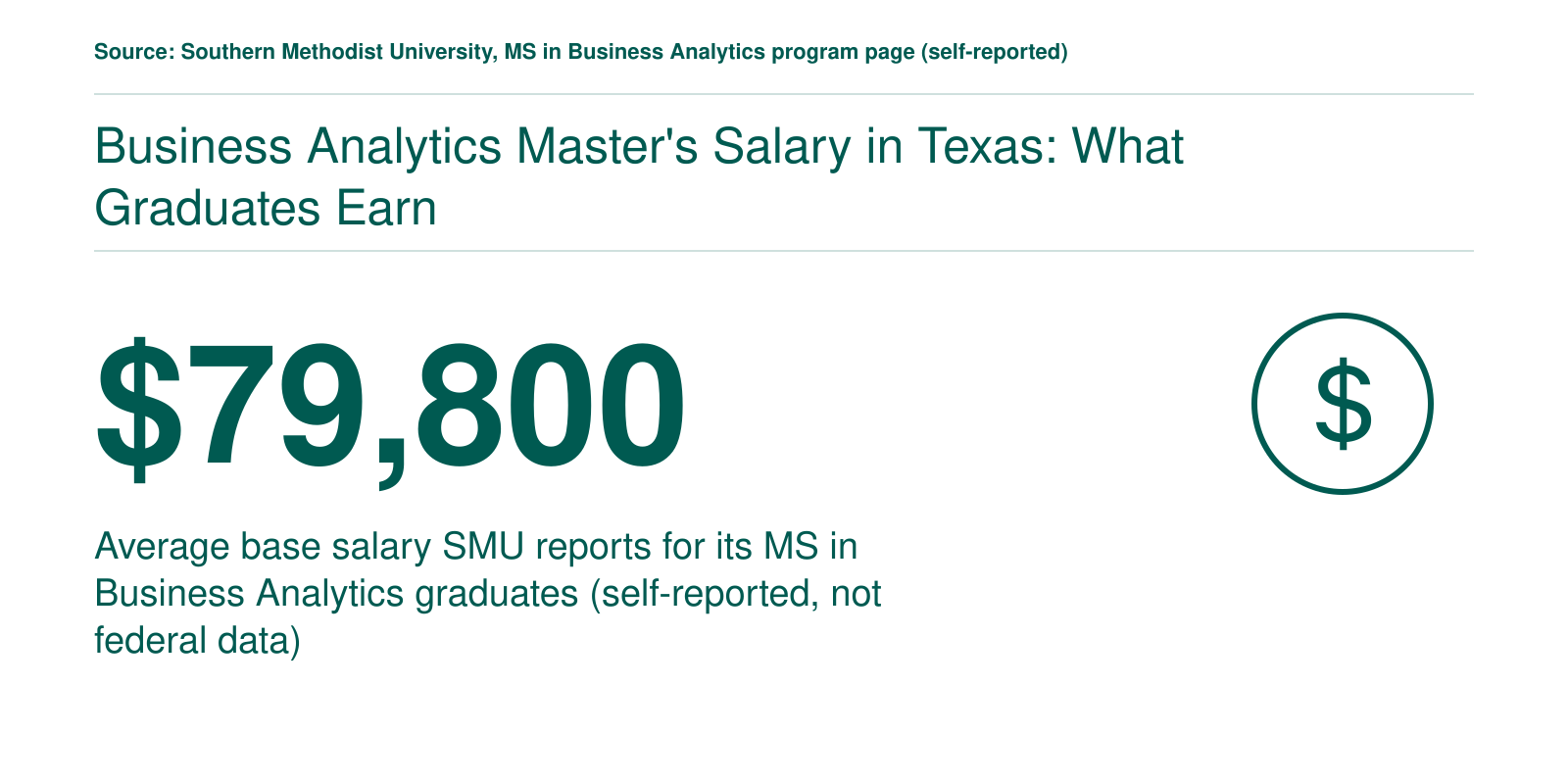
Federal program-level earnings and debt figures are not yet published for the Texas business analytics master's programs ranked here, so we do not chart them. School-wide earnings would not be a fair stand-in for what these specific graduates make. The best available program-level figure is one a school reports itself, so treat it as a marketing claim to verify, not a federal outcome.
Texas Business Analytics Master's FAQ
How long does it take to complete a master's in business analytics in Texas?
Do I need a programming or math background to apply to a Texas business analytics master's?
When are application deadlines for Texas business analytics master's programs?
Compare Analytics programs on the data that matters
Explore more Business & Management specializations or browse every graduate field.
All Business & Management programs