Best Master's in Early Childhood Education Programs in Mississippi
Compare 3 accredited Early Childhood Education programs in Mississippi, with graduate earnings, cost, debt, and completion data from IPEDS and the U.S. College Scorecard.

Does a master's in early childhood education actually pay for itself for a Mississippi Pre-K or K-3 teacher? The arithmetic is tighter than most prospective students expect. Published in-state graduate tuition at the state's ranked programs runs under $10,000, and program graduates report median earnings in the mid to upper $40,000s a few years out.
With only a handful of early childhood graduate programs operating in Mississippi, the choice turns on format, admissions requirements, and whether the coursework leads to the Child Development (Pre-K to K) endorsement. Prestige is not the deciding variable here.
Key Points
- Alcorn State reports $47,985 median earnings four years after completing.
- Jackson State reports $44,066 median earnings five years after completing.
- In 2027, Ole Miss charges a $33.33 per-credit online distance fee.
Ranked: Mississippi's Top Master's in Early Childhood Education Programs
Every Mississippi program on this list had to clear a practical bar, not just a name: published cost and outcome data strong enough to show a master's degree can be worth the money. For early childhood educators, that means looking past reputation to tuition, net price, delivery format, and whether the degree supports state endorsements. These three programs do that in different ways.
University of Mississippi
#1University, MS · $5,000 – $10,000/yr (est.)
Best for: Licensed teachers adding a Pre-K endorsement
Ole Miss offers the Master of Education in Early Childhood Education in asynchronous online and Oxford campus formats. In-state graduate tuition is about $9,772, with an average net price near $13,314, and the school graduates roughly 72 percent of students institution-wide. Ole Miss holds SACSCOC accreditation; current CAEP status for its educator-preparation unit is not publicly established. Track 1 can add early childhood as a license content area for licensed teachers, while Track 2 is open to career changers without a teaching license but does not add the content area.
- 30-credit, 10-course degree can be completed in under two years
- All courses use an asynchronous online format
- Track 1 requires a valid teaching license and can add early childhood as a license content area
- Track 2 requires no license or field experience but cannot add the content area
- Admission requires a 3.0 GPA in the last 60 undergraduate hours
- Praxis II, GRE scores, or a valid teaching license required
- Starts are offered summer, fall, and spring
Jackson State University
#2Jackson, MS · ~$9,000/yr (est.)
Best for: Working educators needing affordable online flexibility
Jackson State, a public HBCU, offers a Master of Science in Early Childhood Education fully online through its College of Education and Human Development. In-state graduate tuition is about $8,965, while the average net price is near $23,836, and the school graduates about 51 percent of students institution-wide. Jackson State is SACSCOC-accredited, and its educator-preparation unit holds CAEP full accreditation. Conditional admission sets a 2.5 minimum undergraduate GPA and requires three recommendation forms plus official transcripts.
- Offered fully online through JSU Online at $550 per credit hour
- Conditional admission requires a 2.5 minimum undergraduate GPA
- Three recommendation forms and all college transcripts required
- Completion options: 36 hours without scholarly paper, 33 with paper, or 30 with thesis
- Educator-preparation unit holds CAEP full accreditation
Alcorn State University
#3Alcorn State, MS · ~$10,000/yr (est.)
Best for: Certified K-3 educators stacking endorsements
Alcorn State, a public HBCU, offers a campus-based Master of Science in Elementary Education in Early Childhood Education in Alcorn State, Mississippi. In-state graduate tuition is about $8,785, with an average net price near $13,265, and the school graduates about 57 percent of students institution-wide. The program is limited to educators with a Standard Educator License and K-3 or K-6 certification. Available materials do not detail Alcorn's regional or educator-preparation accreditation status.
- 33-credit curriculum: 12 core, 15 endorsement field, and 6 elective hours
- Requires a Standard Educator License and K-3 or K-6 certification
- 27 of 33 credits must be completed in residence at Alcorn
- No more than two C grades allowed across the degree
- Core and Area Examinations required to exit
- Up to six transfer credits accepted; six years allowed to complete
Cost & outcomes by school
Federal data for the highest-earning Early Childhood Education programs, independent of the ranking above. Earnings are this field's master's graduates four years after completing, where the Scorecard reports them.
| School | Earnings | Tuition / yr | Debt | Grads/yr | Format |
|---|---|---|---|---|---|
| Alcorn State University MS | $47,985 | $9,520 | $85,750 | 41 | Campus |
| Jackson State University MS | $46,522 | $8,965 | $47,735 | 115 | Campus |
| University of Mississippi MS | — | $9,772 | — | 4 | Online |
Sources: U.S. Department of Education. Tuition and graduates: IPEDS. Earnings and debt: College Scorecard, this field's master's graduates; a dash means no figure is reported.
Online and Hybrid Master's in Early Childhood Education in Mississippi
The University of Mississippi's M.Ed. in Early Childhood Education runs 30 credits across 10 courses and is offered both online and residentially on the Oxford campus. Its online master's in early childhood education is asynchronous, meaning coursework is completed on your own schedule rather than at set meeting times, which suits full-time teachers juggling a classroom. Jackson State University lists a fully online M.S.Ed. in Early Childhood Education, one of the online master's programs in Mississippi, requiring at least 36 credits.
Asynchronous vs. Synchronous
Asynchronous courses let you log in and complete work when it fits your week. Synchronous formats require logging in at scheduled times, often live evening sessions. Confirm each program's format on its own program page, since delivery can vary by course even within an online degree.
In-Person Requirements to Plan Around
Field experience is where a working teacher should look closely. At Ole Miss, Track 1 (which requires a valid teaching license) carries field-experience requirements tied to adding early childhood education to a Mississippi license, while Track 2 has none.
Before you enroll in any online program, confirm with the department that practicum or field placements can be completed in your own Mississippi school or center, so you are not commuting across the state to satisfy a requirement.
Which Mississippi ECE Master's Programs Waive or Make the GRE Optional?
GRE expectations differ sharply by school, as they do among No-GRE master's programs. At University of Mississippi, a competitive GRE is only one qualifying route for applicants to master's in early childhood education no gre programs. Applicants can instead submit a passing Praxis II Content Field score, a passing Praxis II PLT score, or a valid teaching license, so the GRE is effectively waived when an alternative is provided. The program also wants a 3.0 GPA in the last 60 undergraduate hours and a bachelor's in elementary, secondary, special, or early childhood education or a closely related field. Deadlines are April 1 for summer, May 1 for fall, and November 1 for spring; delivery is residential and online.
Jackson State's ECE program catalog does not state a GRE requirement or waiver policy. The university's general graduate page requires national exam scores, but the materials do not establish whether the early childhood program applies that rule or allows an alternative. GPA information is mixed: the program catalog sets a 3.00 standard on master's coursework, while Jackson State Online describes a 2.5 undergraduate GPA for conditional admission. Applications are accepted throughout the year for fall, spring, and summer; general priority dates are March 1 fall, March 15 summer, and October 15 spring.
Alcorn State's published ECE admissions materials do not state a GRE requirement or waiver policy.
What a Master's in Early Childhood Education Costs in Mississippi
These tuition figures are the published graduate rates in the federal data, and the net price column is an institution-wide average after grants and scholarships, not a program-specific quote. For online students, Ole Miss adds a $33.33 per-credit distance fee and $50 registration fee, bringing its 30-credit M.Ed. estimate to $17,699.90; Jackson State lists $550 per credit for a 36-credit estimate of $19,800 before mandatory fees. Jackson State carries the lowest listed in-state graduate tuition here, while Alcorn State charges the same rate to residents and nonresidents.
| School | In-State Graduate Tuition | Out-of-State Graduate Tuition | Average Net Price |
|---|---|---|---|
| Alcorn State University | $9,520 | $9,520 | $13,265 |
| University of Mississippi | $9,772 | $28,600 | $13,314 |
| Jackson State University | $8,965 | $11,965 | $23,836 |
Related Articles
Mississippi Licensure and Pre-K Endorsement for Early Childhood Educators
Career Outcomes and Earnings for ECE Master's Graduates
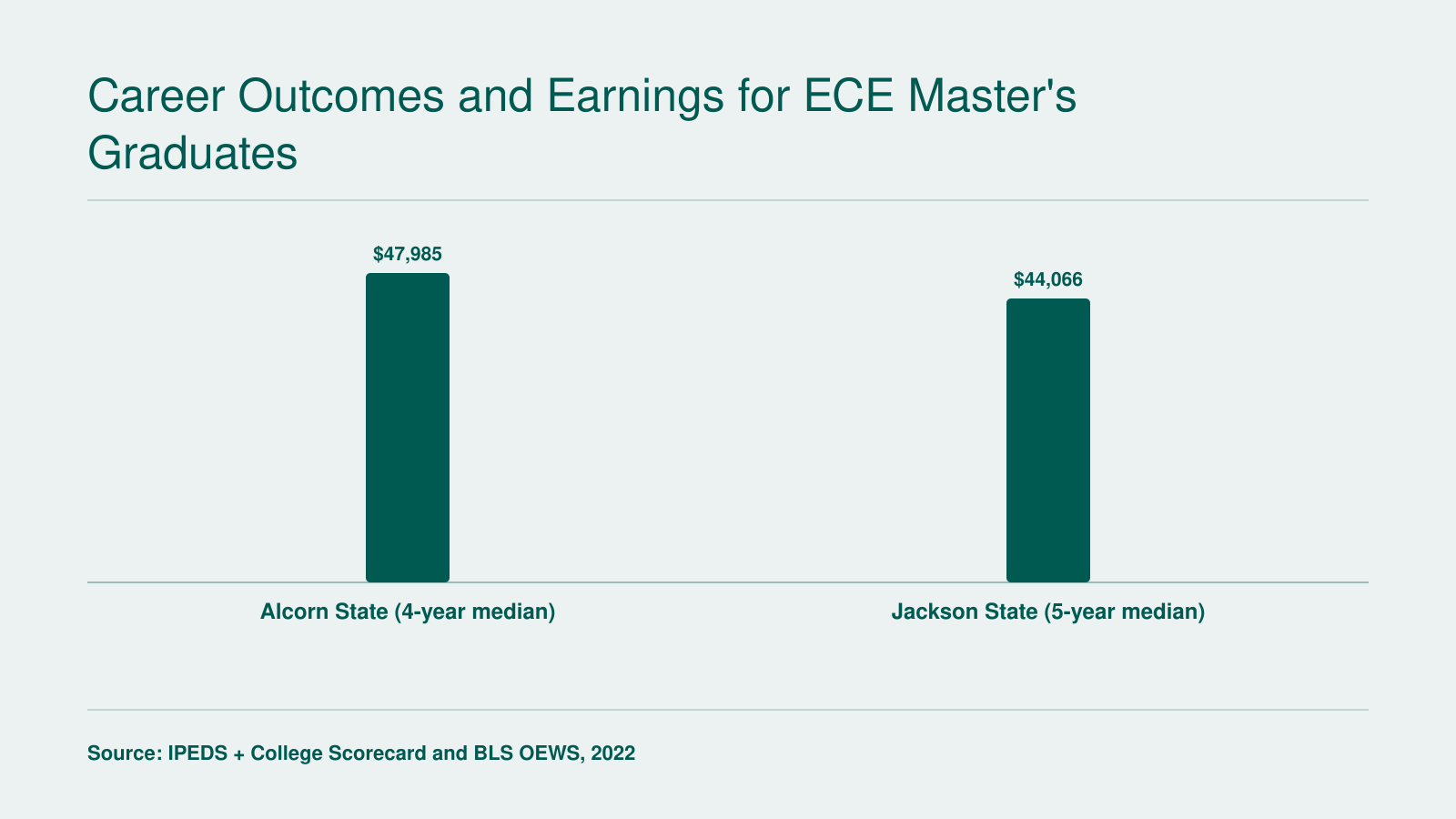
Program median earnings differ by time window: Alcorn State reports $47,985 four years after finishing, and Jackson State reports $44,066 five years after finishing. University of Mississippi does not publish a program-level median in this cohort. Mississippi's May 2025 OEWS shows a preschool teacher median of $35,500; state medians for kindergarten teachers and preschool/childcare directors are not displayed in the state extract, so the national medians of $62,680 and $59,300 are for context only. Median program debt is $85,750 at Alcorn and $47,735 at Jackson, which matters when weighing earnings against borrowing.
How We Evaluated Mississippi ECE Master's Programs
College Scorecard reports what graduates of a specific program actually earn and borrow, and that program-level view anchors every position on this list. For a working teacher, those two figures answer the most practical question: will the raise cover the loan payment?
IPEDS supplies graduate tuition and net price, which show what the degree costs before and after grants. Institution-wide graduation rates round out the picture by signaling whether students who enroll tend to finish.
Online and campus programs were held to the same yardstick, so a flexible format neither helped nor hurt a school's standing.
Two limits are worth knowing. Graduation rates cover each university as a whole, not the early childhood education master's program alone. Net price reflects all students, not graduate students alone, so your own bill may differ.
Frequently Asked Questions About Early Childhood Education Master's Programs in Mississippi
These answers focus on practical questions about Mississippi early childhood education master's programs, using published details where available. Where a program has not published a policy, we say so rather than guessing.
What can you do with a master's in early childhood education?
How long does it take to get a master's in early childhood education?
Is a master's in early childhood education worth it?
Can I get a master's in early childhood education online in Mississippi?
What is the difference between early childhood education and elementary education?
Do I need a teaching license before applying to an early childhood education master's program in Mississippi?
How do Ole Miss and Jackson State compare for an early childhood education master's?
Will an ECE master's raise my pay on the Mississippi teacher salary scale?
Compare Early Childhood Education programs on the data that matters
Explore more Education & Teaching specializations or browse every graduate field.
All Education & Teaching programs