Best Master's in Early Childhood Education Programs in Tennessee
Compare 5 accredited Early Childhood Education programs in Tennessee, with graduate earnings, cost, debt, and completion data from IPEDS and the U.S. College Scorecard.

The split between an initial licensure track and an advanced degree for licensed teachers matters more than a school's name. Lipscomb's 30-credit M.Ed. builds in student teaching for post-baccalaureate candidates, while Vanderbilt's 36 to 39 credit M.Ed. centers on birth through kindergarten.
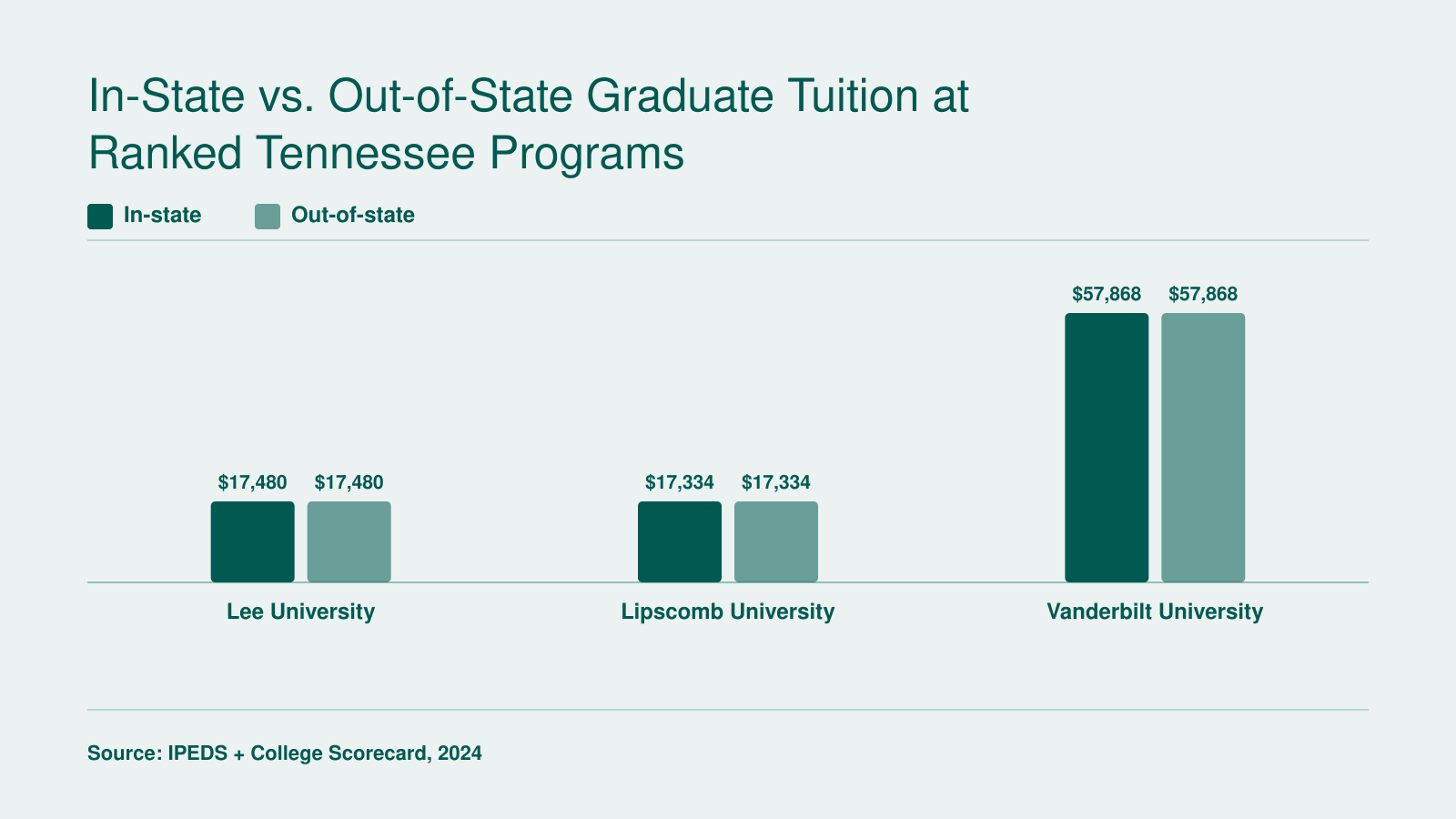
Price diverges just as sharply. Published annual graduate tuition runs $17,334 at Lipscomb and $17,480 at Lee University, against $57,868 at Vanderbilt.
The field for the best master's in early childhood education Tennessee offers is small, and the credential a program produces matters more than its brand.
Key Points
- Vanderbilt, Lipscomb, and Lee charge the same tuition to residents and nonresidents.
- Lipscomb graduates reach median earnings of $60,844 five years after finishing.
- Rankings rest on federal earnings, net price, and debt data, not prestige.
Top Master's in Early Childhood Education Programs in Tennessee, Ranked
Three Tennessee schools in our federal data set offer an early childhood master's with a clear licensure or birth-through-kindergarten focus. Graduate tuition figures below are annual published rates and do not reflect total program cost, since credit requirements differ. Confirm accreditation and licensure details on each program page before applying.
Vanderbilt University
#1Nashville, TN · ~$58,000/yr (est.)
Best for: Future early interventionists seeking fieldwork depth
Vanderbilt University in Nashville graduates 94% of its students, and its Peabody College runs the Integrated Early Childhood Education M.Ed. on campus. Published graduate tuition is about $56,376 a year for in-state and out-of-state students alike, so the total depends on whether you take the 36 to 39 credit track or the longer ABA add-on. Its initial teacher-education programs hold full CAEP accreditation through December 2031, while its advanced programs received probationary CAEP status on one standard in fall 2024, so ask which category your track falls under. Candidates complete fieldwork in inclusive settings, with most placements through Metro Nashville Public Schools.
- Campus program based in Nashville
- 36 to 39 credit hours, or 48 to 51 with the optional ABA add-on
- Focus on children from birth through kindergarten
- Licensure and endorsement pathways
- Field experiences in inclusive settings
- Fall start; priority decisions December 1 and January 3, then rolling
- Teacher Pathway scholarship guarantees at least 30% for eligible initial licensure programs
Lipscomb University
#2Nashville, TN · ~$17,000/yr (est.)
Best for: Career changers needing initial licensure
Lipscomb University in Nashville graduates 72% of its students. Its M.Ed. in Instructional Practice PreK-3/Special Education is an initial licensure route for post-baccalaureate candidates who need Tennessee teacher certification. Published graduate tuition is about $17,334 a year for in-state and out-of-state students alike, and the 30-credit degree is the shortest on this list. Graduates are prepared for licensure in early childhood education (PreK-3) integrated with special education.
- Campus program in Nashville
- 30 credit hours across ten courses
- Initial licensure for post-baccalaureate candidates
- Dual PreK-3 and special education preparation
- Extended clinical experience: 7-credit student teaching or 4-credit minimum mentoring
- Two non-credit, no-charge pass/fail courses
- Coursework aligned to InTASC standards
Lee University
#3Cleveland, TN · ~$17,000/yr (est.)
Best for: Budget-focused teachers adding special education
Lee University in Cleveland graduates 63% of its students and has the lowest published graduate tuition of the three, about $17,280 a year for in-state and out-of-state students alike. Its Master of Education in Special Education with Early Childhood PreK-3 Licensure pairs a special education core with an early childhood emphasis. The core covers action research, inclusion and diversity, school law, and reading assessment. The school's page does not state total credit hours in the material we reviewed.
- Campus program in Cleveland
- Early Childhood PreK-3 licensure concentration
- Special education core, with 3 credits per core course
- Core includes Action Research Methods and Inclusion and Diversity in the Classroom
- Core also covers School Law and Assessing and Guiding Reading Instruction
- Thesis Seminar or Current Issues and Strategies in Education required
Cost & outcomes by school
Federal data for the highest-earning Early Childhood Education programs, independent of the ranking above. Earnings are this field's master's graduates four years after completing, where the Scorecard reports them.
| School | Earnings | Tuition / yr | Debt | Grads/yr | Format |
|---|---|---|---|---|---|
| Lipscomb University TN | $65,590 | $17,334 | — | 2 | Campus |
| Vanderbilt University TN | $57,106 | $57,868 | $37,924 | 27 | Campus |
| Lee University TN | $52,116 | $17,480 | $36,000 | 14 | Campus |
| The University of Tennessee-Knoxville TN | — | $15,972 | — | — | Campus |
| Tennessee Tech TN | — | $12,386 | — | — | Online or campus |
Sources: U.S. Department of Education. Tuition and graduates: IPEDS. Earnings and debt: College Scorecard, this field's master's graduates; a dash means no figure is reported.
Online and Hybrid Early Childhood Education Master's Options in Tennessee
Delivery format is the first filter, and a program page's label can mislead. Sort Vanderbilt, Lipscomb and Lee into fully online, hybrid, or campus-only by reading each program's official page, then confirm with admissions. Many M.Ed. programs in Tennessee described as online still require some on-campus meetings.
Accreditation deserves equal attention. Regional accreditation of the university is what makes you eligible for federal financial aid. CAEP accreditation of the educator preparation program supports a Tennessee licensure recommendation and usually helps when you transfer a license to another state. CAEP alone does not grant a license, though. Licensure depends on whether the track is an approved initial licensure pathway or a non-licensure concentration for current teachers.
Expect field experience in person. Online coursework rarely removes practicum or student teaching, and for licensure tracks that placement is typically in a Tennessee school.
Working teachers should ask whether courses meet in the evening or run asynchronously, and whether part-time pacing is allowed. Those two answers decide whether you can keep your classroom job.
Related Articles
In-State vs. Out-of-State Graduate Tuition at Ranked Tennessee Programs
Published annual rates for the three ranked schools show a wide spread, from Lee University at the low end to Vanderbilt University at the high end. Each school lists the same figure for in-state and out-of-state students, so residency does not change the sticker price at any of them.
Master's Program Cost and Tennessee Prek-3 Licensure, School by School
The cheapest program and the one that leads to a Tennessee PreK-3 license are not automatically the same, so price each option against the credential it produces.
What the coursework costs
- Vanderbilt: Published tuition for the Integrated Early Childhood Education M.Ed. runs about $57,868, covering 36 to 39 credit hours, or 48 to 51 hours if you add the ABA specialization.
- Lipscomb: Roughly $17,334 for the Instructional Practice PreK-3/Special Education M.Ed., built on 30 credit hours across 10 courses, with two non-credit courses carried at no charge.
- Lee: Roughly $17,480 for the special education, early childhood PreK-3 licensure M.Ed., with core courses at 3 credits each.
Institution-wide net price averages published for these universities are weighted toward undergraduates and should not be read as a quote for a graduate program, especially when comparing the most affordable master's in early childhood education programs.
Where the license sits
Lee and Lipscomb both name PreK-3 licensure in the degree itself, and Lipscomb's route, one of the special education master's programs in Tennessee, is an initial licensure pathway for post-baccalaureate candidates that pairs PreK-3 with special education, including a 7-credit student teaching block and an edTPA seminar. Vanderbilt's birth-through-kindergarten program carries both licensure and endorsement pathways, so confirm which track your admission letter names.
Aid worth asking about
Vanderbilt publishes a Teacher Pathway scholarship of at least 30 percent. TEACH Grant eligibility is program-specific and is not spelled out on these program pages, so ask financial aid directly, along with assistantship and district tuition support options.
What Early Childhood Master's Graduates in Tennessee Earn and Owe
Program-level federal data shows what graduates of early childhood master's programs in Tennessee earn and whether they can comfortably repay their loans.
- Lipscomb University: Graduates' median earnings reach $60,844 five years after finishing, the highest five-year figure on this list.
- Vanderbilt University: Median earnings are $50,383 one year after finishing and $53,405 at five years. Median debt of $37,924 works out to about $431 a month on a 10-year plan.
- Lee University: Graduates earn a median $48,304 one year out and $46,710 at five years, against median debt of $36,000, or roughly $410 a month.
At Vanderbilt and Lee, that loan payment absorbs about a tenth of first-year gross pay, which is manageable. Because most graduates work as PreK-3 teachers, program directors, or early intervention specialists, district salary schedules shape the long-term return. Most schedules pay more for a master's, and annual step increases compound that bump over a career.
How We Ranked These Programs
Reputation-based rankings ask which name sounds best. This ranking asks what the federal numbers show. Every program on this list earned its spot through public data, not prestige or advertising.
- Cost: IPEDS graduate tuition and College Scorecard net price.
- Outcomes: Program-level earnings and debt for graduates.
- Activity: Completions, which show whether a program actually graduates students each year.
Two limits are worth knowing. Graduation rates are reported for the whole institution, not the early childhood program alone. Net price is an average, so your own bill depends on aid and residency. Admissions requirements, GRE policies and licensure details were checked against each school's official program pages as of October 2026, including early childhood education programs with no GRE required.
Quick Answers: Licensure, Degree Types, and Online Study
Licensure rules shape which early childhood master's track fits you. These answers draw on Tennessee State Board of Education licensure policy and Department of Education guidance, so confirm details with the program you are considering.
Do I need a Tennessee teaching license before starting an early childhood master's program?
MAT vs. MS vs. M.Ed. in early childhood education: which one leads to a first license?
Can an online master's program lead to Tennessee PreK-3 licensure, including for students outside Tennessee?
Compare Early Childhood Education programs on the data that matters
Explore more Education & Teaching specializations or browse every graduate field.
All Education & Teaching programs