Best Master's in Early Childhood Education Programs in North Carolina
Compare 4 accredited Early Childhood Education programs in North Carolina, with graduate earnings, cost, debt, and completion data from IPEDS and the U.S. College Scorecard.

A master's in early childhood education in North Carolina is less a prestige play than a tuition and licensing calculation. In-state graduate tuition among ranked public universities runs about $8,100 to $12,800 a year, while program-level federal earnings remains unpublished.
The split is licensure. Applicants should know before applying whether a program leads to an initial Birth-Kindergarten license or serves teachers already licensed. That distinction, not school reputation, determines whether the degree is worth the debt.
Key Points
- UNC Greensboro's Birth-Kindergarten M.Ed. is fully online and does not require the GRE.
- Confirm whether a program leads to an initial or advanced license before applying.
- Program-level graduate earnings are not yet published, so weigh tuition and debt carefully.
Top Master's in Early Childhood Education Programs in North Carolina for 2027
Three North Carolina public universities make this list, and each fits a different kind of student. One is a cohort program for working teachers, one prepares early childhood advocacy and policy leaders, and one is delivered fully online. Program-level earnings and debt figures are not yet published for these programs, so compare cost and format alongside your licensure goals.
University of North Carolina at Chapel Hill
#1Chapel Hill, NC · ~$13,000/yr (est.)
Best for: Experienced teachers pursuing advanced licensure
The University of North Carolina at Chapel Hill offers a part-time, field-based master's for experienced early childhood teachers, with a concentration in early childhood intervention and family support. The program is built for people already working in local schools and community programs, and it is aimed at master's-level licensure. The university graduates about 91% of its students, and the program is administered through the School of Education.
- 30 to 34 credit hours, part-time over two years
- Hyflex format: in-person or remote synchronous, plus asynchronous sessions
- Starts in May; admits students each spring
- Requires at least two years of teaching experience
- At least 50 in-person hours in an inclusive early childhood setting
- Field-based design for teachers working in schools and community programs
- Aimed at master's-level licensure
University of North Carolina Wilmington
#2Wilmington, NC · $8,000 – $24,000/yr (est.)
Best for: Aspiring advocacy and policy leaders
The University of North Carolina Wilmington offers an interdisciplinary M.Ed. specialization that points graduates toward leadership and advocacy rather than classroom teaching alone. It prepares students for family and child advocacy roles in community, state, and national agencies across the public and private sectors. The university graduates about 71% of its students.
- Focus on birth through age eight
- Admission requires three professional recommendations
- Up to 15 elective credit hours
- Electives in public administration, health and human services, and social work
- Capstone research portfolio built in EDN 551 and EDN 567
- Exit requirement includes an oral defense
University of North Carolina at Greensboro
#3Greensboro, NC · ~$9,000/yr (est.)
Best for: Working professionals needing online classes
The University of North Carolina at Greensboro runs an online M.Ed. in Birth-Kindergarten Interdisciplinary Studies, jointly offered by two departments. Students choose between an advanced teaching licensure track and a newer program administration and coaching track. Its tuition is among the more affordable on this list, and it is the most flexible option for working professionals. The university graduates about 56% of its students.
- Concentration: Early Childhood Leadership and Advanced Teaching Licensure
- Concentration: Early Childhood Leadership, Program Administration, and Coaching
- Fully online, synchronous classes
- Finish in as little as two years
- Leadership internship required
- Licensure concentration requires an initial teaching license
- Strongest consideration for a 3.0 undergraduate GPA
- T.E.A.C.H. Early Childhood North Carolina Scholarship available to qualified students
Cost & outcomes by school
Federal data for the highest-earning Early Childhood Education programs, independent of the ranking above. Earnings are this field's master's graduates four years after completing, where the Scorecard reports them.
| School | Earnings | Tuition / yr | Debt | Grads/yr | Format |
|---|---|---|---|---|---|
| University of North Carolina at Chapel Hill NC | $54,867 | $12,751 | $23,462 | 43 | Campus |
| University of North Carolina at Greensboro NC | $52,768 | $8,614 | $25,912 | 44 | Online |
| University of North Carolina Wilmington NC | $50,098 | $8,112 | $25,375 | 50 | Campus |
| Greensboro College NC | — | $4,524 | — | — | Online or campus |
Sources: U.S. Department of Education. Tuition and graduates: IPEDS. Earnings and debt: College Scorecard, this field's master's graduates; a dash means no figure is reported.
Cost, debt & payoff
Median earnings of this field's master's graduates (4 yrs after completing) vs. their median federal loan debt · U.S. College Scorecard
Across these programs the median graduate earns about $52,768 and finishes with roughly $25,375 in debt — a ratio that clears a common rule of thumb (keep debt below first-year salary). Tuition and debt vary widely school to school, so check the per-school figures in the table above before you shortlist.
How We Ranked North Carolina's Master's in Early Childhood Education Programs
A master's in early childhood education in North Carolina only pays off if tuition and debt stay in line with the modest salaries graduates typically earn, so cost and earnings carried the most weight in this ranking. We compared each program on degree-aware graduate tuition, net price after aid, program-level median debt and median earnings where published, completion counts, and institution-wide graduation rate. Net price and graduation rate are institution-wide figures, not program-specific, and net price is an average rather than a personal quote. When a program's earnings or debt data was not published, we still ranked it on the existing data and noted the gap. That keeps the comparison useful even for smaller or newer programs that do not yet report all outcomes.
Online and Hybrid Master's in Early Childhood Education Options in North Carolina
Fully online with scheduled live classes is a different commitment from HyFlex, where you choose in person or remote each session. Before choosing among education & teaching master's programs, know which you are signing up for.
UNC Greensboro's Birth-Kindergarten M.Ed. and its two concentrations are fully online and synchronous, finishing in as little as two years. The leadership tracks include a leadership internship. Total credits and internship hours are not published on the program pages.
UNC Chapel Hill's early childhood M.Ed. is HyFlex, mixing synchronous sessions (in person or remote) with asynchronous work. It runs 30 to 34 credits and about two years part-time for practicing early childhood professionals. Practicum hours are not specified.
UNC Pembroke's online M.A.T. is 30 credits, including a 3-credit, full-semester internship in a North Carolina Birth-Kindergarten classroom. Clock hours and class format are not stated. UNC Charlotte's online M.A.T. is also 30 credits (18 certificate, 12 master's) but is open only to graduates of its Birth through Kindergarten certificate.
Practical tip: if you teach B-K full time, confirm live-session times fall outside school hours before you apply.
Which North Carolina Master's in Early Childhood Education Programs Waive or Make the GRE Optional?
Some programs state their GRE rule plainly, while others say nothing, so check each admissions page before budgeting for testing.
- UNC Greensboro: GRE not required. Expect a 3.0 GPA, three letters (one academic), and a bachelor's in early childhood or a related field. No teaching license is required.
- NC A&T State: The MAT in Child Development Early Education and Family Studies page says no GRE, but the Online MAT in Child Development (Birth, Kindergarten) Admissions page lists GRE or MAT, so confirm. GPA is 2.80 (another page says 2.6), with three recommendations and 24 content credits. Licensure seekers cannot hold a current license beyond temporary or residential.
- Shaw University: GRE policy not published on the Shaw University's Graduate Admissions page. The 2.7 GPA can be waived with 3+ years teaching Preschool to 2nd grade. Two years of early childhood experience and two letters are required.
- UNC Chapel Hill: GRE varies by program. A 3.0 GPA and two to three letters are typical, and the two-year track is for experienced teachers.
- Fayetteville State: GRE, GPA, and letter requirements not published in the Fayetteville State University Graduate Catalog.
- UNCW: GRE policy not published; three letters minimum.
Related Articles
Cost, Licensure, and Certification for an Early Childhood Education Master's in North Carolina
Total cost for a master's in early childhood education is the per-credit rate times required credits, plus fees. Annual graduate tuition (in-state, then out-of-state) is about $8,112 and $24,198 at UNC Wilmington, $8,614 and $23,329 at UNC Greensboro, and $12,751 and $31,408 at UNC Chapel Hill. Per-credit rates and fee schedules were not available to us, so confirm them with each bursar. Chapel Hill's program for experienced teachers runs 30 to 34 credits over two years. If its annual figure held both years, in-state tuition alone would approach $25,500 before fees.
Licensure: initial vs. advanced
North Carolina's Birth-Kindergarten license covers birth through kindergarten, and DPI bases standard licenses on a state-approved preparation program or approved alternative route. Chapel Hill's program lists master's-level licensure, and UNCG's concentration lists advanced teaching licensure alongside leadership. UNCW's specialization targets leadership, policy, and advocacy, so do not assume it leads to a teaching license. For an initial license, DPI requires content exam(s) plus edTPA or PPAT. Ask DPI for the exact B-K exam name. Application fees run $30 to $100.
Pay and funding
The master's salary schedule starts at $52,800 for 10 months in 2026-27.1 A 10% supplement applies when your master's is in the subject you teach, so verify that your degree qualifies.2 T.E.A.C.H. Early Childhood scholarships are a known North Carolina funding source for early educators, but we could not confirm they cover graduate study. Ask before you count on them.
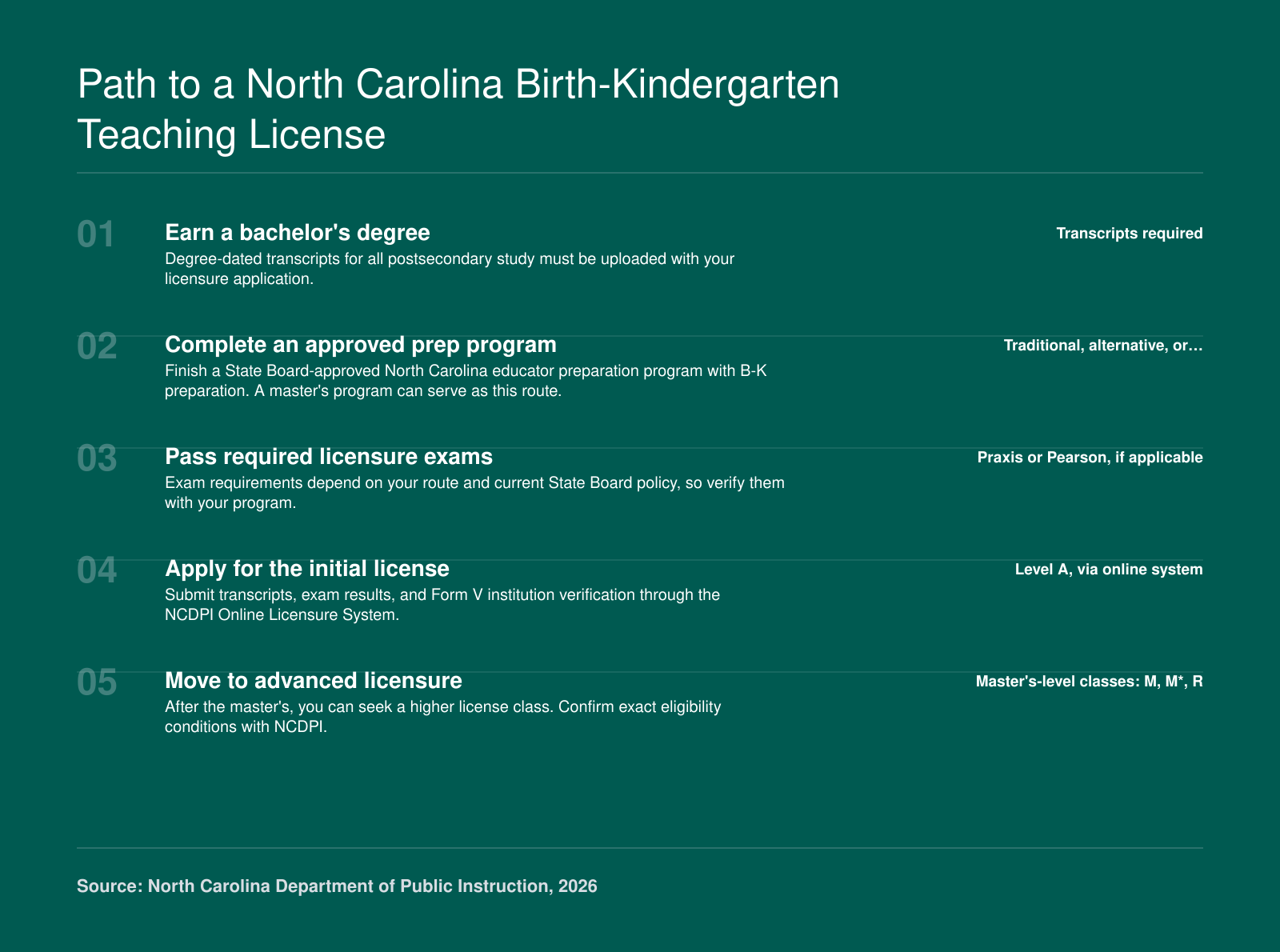
Path to a North Carolina Birth-Kindergarten Teaching License
North Carolina issues the Birth-Kindergarten (B-K) license as a professional educator license through the Department of Public Instruction. Exact requirements vary by program and route, so confirm details with your approved educator preparation program.
What Early Childhood Education Master's Graduates Earn in North Carolina
What does an early childhood education master's actually pay in North Carolina? Honest answer: the federal earnings data that would settle it has not been published at the program level for the degrees ranked here. There are no median earnings figures one, two, or four years after finishing for these specific programs, no program debt medians, no 10-year monthly payment estimates, and no employment or above-poverty shares. Institution-wide earnings exist, but they blend every graduate from law to business and tell you nothing about a birth-kindergarten specialist.
What you can price with confidence is the cost side. In-state tuition for the full degree runs roughly $8,100 at UNC Wilmington, about $8,600 at UNC Greensboro, and near $12,800 at UNC Chapel Hill.
For a working B-K teacher already drawing a district salary, the math is straightforward: the state licensure bump arrives on a published schedule, so the cheapest program on this list repays itself fastest.
Early Childhood Education Master's in NC: Quick Answers
These answers cover the questions applicants ask most often about early childhood education master's programs in North Carolina. Where program-level details are not published or could not be confirmed, we say so and point you to the school.
What is a birth-kindergarten teaching license in North Carolina?
Which North Carolina master's in early childhood education programs are online?
How much does a master's in early childhood education cost in North Carolina?
What can you do with a master's in early childhood education in North Carolina?
Do I need a GRE score for early childhood education master's programs in North Carolina?
Are North Carolina early childhood education master's programs accredited, and does accreditation affect licensure in other states?
Can I earn a B-K license through a master's if my bachelor's degree is in another field?
Is an early childhood education administration master's different from a B-K teaching master's?
Compare Early Childhood Education programs on the data that matters
Explore more Education & Teaching specializations or browse every graduate field.
All Education & Teaching programs