Best Adult-Gerontology Acute Care Nurse Practitioner (AG-ACNP) MSN Programs in Ohio
Compare 10 accredited Adult Gerontology Acute Care Nurse Practitioner programs in Ohio, with graduate earnings, cost, debt, and completion data from IPEDS and the U.S. College Scorecard.
An Ohio RN with several years in an ICU or ED usually knows the acute care NP role is the logical next step. The harder question is which of the best nurse practitioner programs in Ohio fits a night-shift schedule and a limited budget. AG-ACNPs manage complex, unstable adult patients in hospitals, while primary care adult-gerontology NPs work in clinics and follow patients over time.
The two tracks use different certifications and different clinical hours, so picking the wrong one can cost a semester. Hospital-based employers also tend to prefer graduates of the best online Adult-Gerontology Acute Care Nurse Practitioner MSN programs with strong acute care clinical placements.
Key Points
- Ohio State charges $13,901 in-state but $42,740 for nonresidents.
- Even online programs require in-person skills checkoffs, simulation, and clinicals.
- Ohio practice requires a standard care arrangement with a collaborating physician.
Ranking Ohio's Best Adult-Gerontology Acute Care NP Master's Programs
Nine Ohio schools offer an AG-ACNP master's, and they differ widely in format, price and completion. Public universities such as Ohio University and Kent State carry the lowest graduate tuition, while private options trade higher sticker prices for hybrid immersions or specialty tracks. Each card below lists the institution-wide graduation rate and graduate tuition so you can compare cost against completion.
Ohio State University
#1Columbus, OH · ~$14,000/yr (est.)
Best for: ICU nurses wanting on-campus study
Ohio State's on-campus MSN prepares nurses for acute, complex and critical conditions, with clinical practicum courses and simulation work built on NONPF guidelines. Applicants need at least one year of full-time adult acute care experience, ideally in intensive care. Graduate tuition is $12,890 in-state and $41,729 out-of-state, and the institution-wide graduation rate is 87.7%.
- On-campus MSN with a post-master's study option
- CCNE accredited
- One year of full-time acute care RN experience required
- Eligible for AGACNP certification
- Clinical practicum courses and simulation equipment
- Also offered through BSN to DNP and BSN to PhD pathways
Mount Carmel College of Nursing
#2Columbus, OH · ~$23,000/yr (est.)
Best for: Working RNs seeking a hybrid format
Mount Carmel pairs online coursework with scheduled campus immersions in a Columbus-based hybrid MSN that takes 18 months over five semesters. The program totals 48 credit hours and 650 clinical hours aimed at ICU and emergency department roles. Graduate tuition is $22,602 for in-state and out-of-state students alike, and the institution-wide graduation rate is 53.8%.
- Hybrid format with scheduled campus immersions
- 18-month completion over five semesters
- 48 credit hours
- 650 clinical hours
- CCNE accredited
- Post-graduate AGACNP certificate for nurses who already hold a master's
- Average class size of 30
Case Western Reserve University
#3Cleveland, OH · ~$54,000/yr (est.)
Best for: Aspiring flight nurses wanting specialty options
Case Western's hybrid MSN mixes online and intensive campus courses over 18 to 24 months, with 40 credit hours and at least 600 clinical hours. A flight nursing specialty option and joint degree possibilities set it apart. It is the highest-priced program on this list at $53,930 graduate tuition for all students, though the institution-wide graduation rate is 87.2%.
- Hybrid format with intensive and online courses
- 40 credit hours
- Minimum of 600 clinical hours
- 18 to 24 month completion
- Flight nursing specialty option
- Post-master's certificates offered
- Joint degrees and blended majors possible
- CCNE accredited
Cedarville University
#4Cedarville, OH · ~$11,000/yr (est.)
Cedarville's online MSN adds four on-campus simulation intensives and six start dates a year, with full-time or part-time pacing. The curriculum has 45 credit hours, 800 clinical hours and a Christian worldview, and the school provides clinical placement assistance. Graduate tuition is $10,890 for in-state and out-of-state students, and the institution-wide graduation rate is 72.5%.
- Online with four on-campus intensives
- 45 credit hours
- 800 clinical hours
- Starts in August, October, January, March, May or June
- Full-time and part-time options
- Prepares for ANCC or AACN certification
- Clinical placement assistance
- CCNE accredited
Ursuline College
#5Pepper Pike, OH · $30,000 – $35,000/yr (est.)
Ursuline's Breen School of Nursing, an NLN Center of Excellence, prepares RNs for ICU and emergency department practice with fall and spring starts. Applicants need a current Ohio RN license, recent RN experience and three recommendations. Graduate tuition is $31,364 for all students, and the institution-wide graduation rate is 66.7%.
- Hybrid MSN, CCNE accredited
- Fall and spring starts
- Minimum one year of RN experience required
- Three letters of recommendation
- $25 application fee, decision within two weeks
- Eligible for AGACNP certification
Kent State University
#6Kent, OH · ~$12,000/yr (est.)
Kent State offers AG-ACNP as one of nine MSN concentrations, with mostly online coursework and clinicals in acute, emergency and critical care settings. Full-time students finish in four to five semesters, and part-time students take three to four years. Graduate tuition is $12,483 in-state and $23,352 out-of-state, and the institution-wide graduation rate is 63.7%.
- Mostly online coursework, hybrid delivery
- 31 minimum credit hours
- Full-time (four to five semesters) or part-time pacing
- Three start dates a year
- Thesis is optional
- MBA/MSN dual degree option
- Active, unrestricted RN license required
- Six-year limit to finish the degree
Ohio University
#7Athens, OH · ~$10,000/yr (est.)
Ohio University delivers its AG-ACNP track online with both synchronous and asynchronous options, over six part-time semesters. The program totals 40 credit hours and 750 clinical hours at $678 per credit, with a fall start. Graduate tuition is $9,444 in-state and $17,436 out-of-state, and the institution-wide graduation rate is 65.4%.
- Fully online option, synchronous and asynchronous
- 40 credit hours over six semesters
- 750 clinical hours
- $678 per credit hour
- Fall start, part-time pacing
- Online post-graduate certificate for MSN holders
- Ranked #12 in U.S. News Best Online Master's in Nursing
- One of five tracks in the online MSN
Wright State University
#8Dayton, OH · ~$16,000/yr (est.)
Wright State's campus-based MSN concentration runs 51 credits with clinical preceptorships in varied settings. Students can choose an emphasis such as critical care, cardiology, neurology, oncology or trauma. Applicants need a BSN with a 3.0 GPA and critical care experience. Graduate tuition is $15,771 in-state and $25,759 out-of-state, and the institution-wide graduation rate is 41.7%.
- Campus-based MSN concentration
- 51 credit hours
- CCNE accredited
- Areas of emphasis: critical care, cardiology, neurology, oncology, trauma
- 3.0 GPA minimum
- Unencumbered nursing license required
- Eligible for ANCC or AACN certification
- Spring, summer and fall starts
Malone University
#9Canton, OH · ~$14,000/yr (est.)
Malone's campus-based AG-ACNP track in Canton has a 51-credit curriculum with 608 clinical internship hours in a sequential cohort model. Students can choose a two-year or three-year schedule, which helps working nurses. Graduate tuition is $13,050 for all students, and the institution-wide graduation rate is 45.0%.
- Campus-based, sequential cohort model
- 51 credit hours
- 608 clinical internship hours
- Two-year (six-semester) or three-year (nine-semester) schedule
- Fall semester admission
- Requires BSN and RN licensure
- Theological perspectives included in coursework
- CCNE accredited
Cost & outcomes by school
Federal data for the highest-earning Adult Gerontology Acute Care Nurse Practitioner programs, independent of the ranking above. Earnings are this field's master's graduates four years after completing, where the Scorecard reports them.
| School | Earnings | Tuition / yr | Debt | Grads/yr | Format |
|---|---|---|---|---|---|
| Wright State University OH | $128,321 | $15,771 | $47,165 | 17 | Campus |
| Case Western Reserve University OH | $126,688 | $53,980 | $124,668 | 70 | Hybrid |
| Malone University OH | $121,037 | $13,830 | $49,092 | 4 | Campus |
| Mount Carmel College of Nursing OH | $117,251 | $22,602 | $35,963 | 49 | Hybrid |
| Cedarville University OH | $117,244 | $11,015 | $36,896 | 42 | Online |
| University of Cincinnati OH | $114,994 | $14,902 | $54,666 | 409 | Hybrid |
| Kent State University OH | $114,464 | $12,483 | $37,500 | 118 | Hybrid |
| Ohio University OH | $113,469 | $9,720 | $41,000 | 136 | Hybrid |
| Ursuline College OH | $111,922 | $31,864 | $54,879 | 34 | Hybrid |
| Ohio State University OH | $109,662 | $13,901 | $49,134 | 214 | Campus |
Sources: U.S. Department of Education. Tuition and graduates: IPEDS. Earnings and debt: College Scorecard, this field's master's graduates; a dash means no figure is reported.
Cost, debt & payoff
Median earnings of this field's master's graduates (4 yrs after completing) vs. their median federal loan debt · U.S. College Scorecard
Across these programs the median graduate earns about $116,119 and finishes with roughly $48,129 in debt — a ratio that clears a common rule of thumb (keep debt below first-year salary). Tuition and debt vary widely school to school, so check the per-school figures in the table above before you shortlist.
Earnings, Debt, and Completion: The Data Behind This List
Every school on this list of best AG-ACNP MSN programs earned its spot on federal outcome numbers, not on reputation or marketing. The inputs are College Scorecard program-level earnings and median debt, the number of students completing each program, the institution-wide graduation rate, and net price.
Two caveats matter when you read the figures. Graduation rates describe the whole institution, not the AG-ACNP track alone, so treat them as a rough signal of how well a school graduates students overall. Net price is an average after grants and scholarships, not a quote, and your own bill will depend on residency, aid, and credit load.
One list ranks campus and online Master's Programs in Ohio side by side. That lets you compare a traditional classroom-based program against a distance option on the same measures of cost, debt, and earnings.
Online and Hybrid AG-ACNP Master's Options in Ohio: Campus Visits and Clinical Placement
Can you earn an acute care NP master's fully online? Not in any meaningful sense. Coursework may be remote, as in many adult gerontology primary care nurse practitioner MSN programs online, but skills checkoffs, simulation, and in-person clinicals still apply.
Format and campus visits
Cedarville is listed as online, with four on-campus intensives. Mount Carmel, Case Western Reserve, Ursuline, and Kent State are hybrid. Mount Carmel's program involves immersions. Ohio State is listed as campus-based, though its nursing college describes mostly online coursework with brief skills and procedure intensives. Wright State and Malone are campus-based. Ohio University lists two on-campus intensives, plus a 1 to 2 day skills workshop in the first and final APRN clinical courses. Intensive counts for the other schools are not given in the material reviewed.
Who finds your preceptor
Ohio State's Clinical Placement Office works with preceptors and cites partnerships with more than 1,000 agencies, Wexner Medical Center among them. Assignments depend on preceptor availability. That page covers the college broadly, not only AG-ACNP. Cedarville has a placement coordinator for graduate nursing students, though students may begin with their own contacts. Ohio University requires 750 practicum hours, but it does not clearly say who arranges sites. Kent State's placement role is also unclear, a common question in Ohio psychiatric mental health nurse practitioner programs too.
A tip for working RNs
Before you enroll, ask the program whether it has acute care sites near your home, and get that answer in writing. A distant-learning format does not guarantee a nearby ICU or step-down preceptor.
Which Ohio AG-ACNP Programs Waive the GRE?
A documented GRE waiver and simply no published GRE requirement are not the same thing, and the distinction matters when you plan an application, especially for master's programs with no GRE required.
No GRE Listed, But No Waiver Promised
None of the schools here lists the GRE as a requirement for its AG-ACNP master's: Ohio University, Youngstown State, Ursuline College, and Cedarville all leave it off their admissions pages. Read that as absence of a stated requirement, not a confirmed waiver. If the test matters to your timeline, email the nursing department before you assume you can skip it. Cedarville publishes little beyond its 800 required clinical hours, so treat its admission details as unconfirmed.
How the Other Requirements Diverge
The harder differences sit in GPA and experience:
- Ohio University: 3.00 minimum GPA, two years of RN experience (no acute-care specification), online, Fall 2027 start with a July 5, 2027 deadline.
- Youngstown State: 3.00 minimum GPA plus one year of recent critical care (ER, ICU, or intermediate acute care) before the first specialty course; online, January 4, 2027 start, December 14, 2026 deadline, $45 fee.
- Ursuline College: 3.0 recommended (not required), one year of RN work within the past two years, $25 fee.
The requirement applicants most often miss is the critical-care clock: Youngstown State wants that year documented within three years of your first practicum, so verify your hours qualify before you apply.
Related Articles
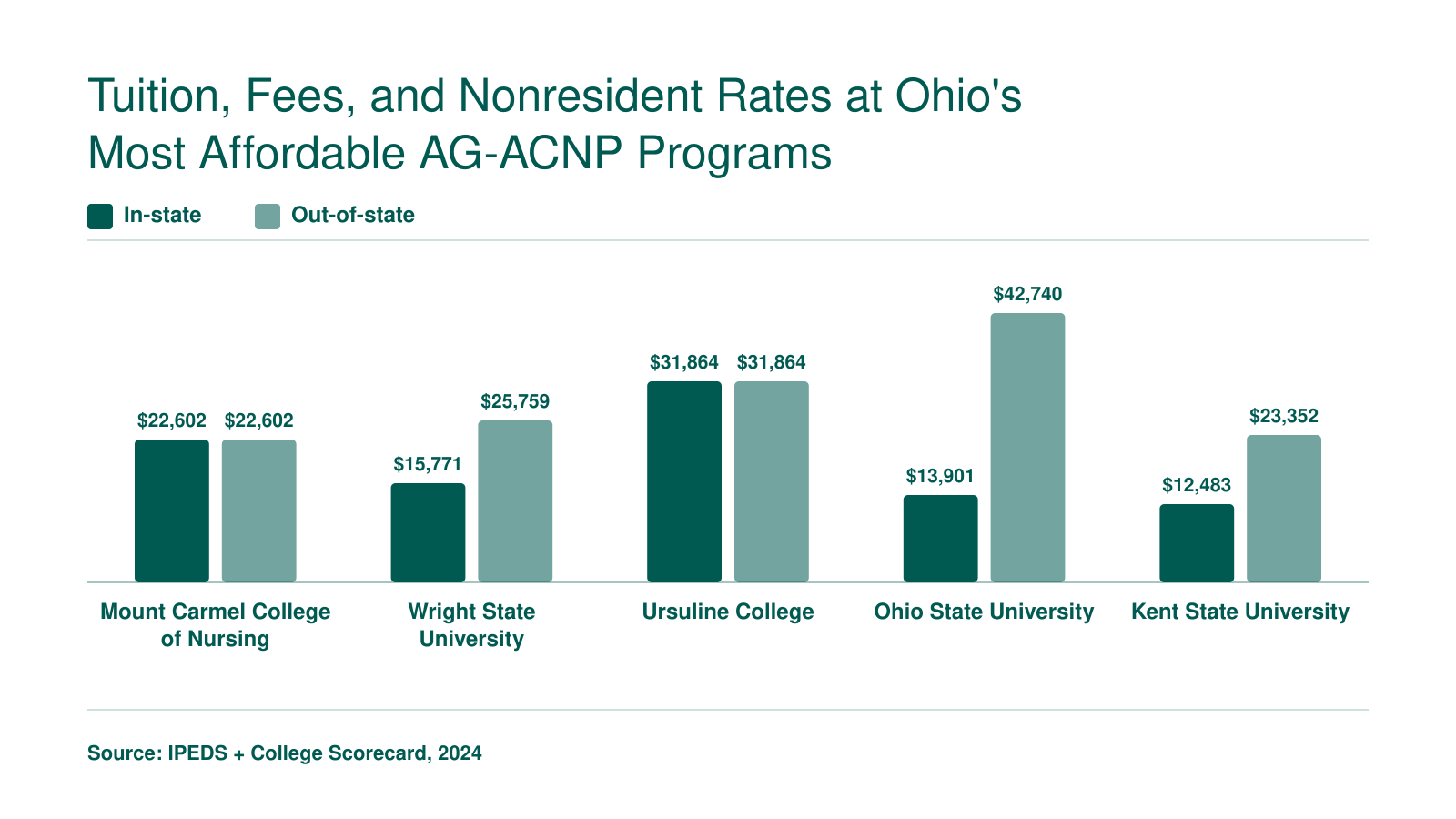
Tuition, Fees, and Nonresident Rates at Ohio's Most Affordable AG-ACNP Programs
Ohio State shows the widest residency gap here, at $13,901 in-state versus $42,740 out-of-state. Kent State and Wright State gaps are about $10,000 each, while Mount Carmel and Ursuline charge everyone the same. Credit totals matter too: Kent State lists 31 credits, Mount Carmel 48, Wright State 51. Ohio University's online track lists $699 per credit for residents and $721 for nonresidents over 40 credits, about $27,960 and $28,840 before a $156 program fee. Its fee schedule may change and does not say how often fees are charged, so confirm before budgeting. Nurses can offset costs through employer tuition reimbursement or Nurse Corps.
Ohio APRN Licensure for Acute Care Graduates
Highest-Earning AG-ACNP Master's Graduates in Ohio
Earnings below come from federal College Scorecard data (2024 release) for nursing master's graduates at each school, and each figure carries its own time window. Mount Carmel College of Nursing advertises a 100% first-time pass rate for its adult-gerontology acute care cohort, and Cedarville University advertises a 98% job placement rate, but neither gives a cohort year. Third-party guides report 100% first-time ANCC AGACNP passing for Wright State University, 96% for Kent State University (combined with the primary care NP track), and 96.3% for Ohio State University 2021 graduates (also combined), and a third-party summary cites 98% job placement at Case Western Reserve University with no year or method. Treat all of these as unofficial, since Ohio University and Malone University publish neither a pass rate nor an employment rate.
| School | Median earnings | Median debt | Estimated monthly payment (10-year plan) |
|---|---|---|---|
| Case Western Reserve University | $119,948 (five years after finishing) | $124,668 | $1,418 |
| Ohio University | $118,775 (five years after finishing) | $41,000 | $466 |
| Cedarville University | $117,244 (four years after finishing) | $36,896 | $420 |
| Mount Carmel College of Nursing | $116,174 (five years after finishing) | $35,963 | $409 |
| Malone University | $113,450 (five years after finishing) | $49,092 | $558 |
AG-ACNP Master's Questions Ohio Applicants Ask
How is an adult-gerontology acute care NP program different from a primary care AGNP program?
How many clinical hours do AG-ACNP students need to sit for certification?
Can I keep working as an ICU nurse while completing an AG-ACNP MSN part-time?
Compare Adult Gerontology Acute Care Nurse Practitioner programs on the data that matters
Explore more Nursing specializations or browse every graduate field.
All Nursing programs