Best MBA in Public Administration Programs
Compare 20+ accredited MBA in Public Administration programs, with graduate earnings, cost, debt, and completion data from IPEDS and the U.S. College Scorecard.

A public administration MBA can mean different commitments. Ohio State's MPA/MBA dual degree runs 90 credit hours over three years, while Southern New Hampshire University's online MBA in public administration totals 30 credits and can finish in as few as twelve months. Both offer the same basic trade: private-sector tools like budgeting, operations, and financial analysis, applied to government agencies, nonprofits, and public authorities.
Price varies just as widely. Average annual net price at the schools ranked here runs from $11,040 at Eastern Kentucky University to $37,050 at New York University.
That spread matters in public service, where many salaries follow fixed pay scales that leave little room for heavy loan payments.
Key Points
- Ohio State charges $42,740 out of state versus $13,901 in-state, a $28,839 gap.
- Program-level graduate earnings are not yet published, so net price and completion drive our picks.
- As of August 2026, 13.6% of federal employees could retire immediately, per OPM.
The 10 Top MBA in Public Administration Programs for 2027, Ranked
These public-administration MBA programs are the ones where cost, completion, and graduate outcomes align best for public-sector-minded students. The ranked list below spans dual degree options, accelerated online formats, and hybrid paths for working professionals. Each entry explains what the program does well and who it fits.
New York University
#1New York, NY · ~$43,000/yr (est.)
Best for: Public-private dual degree seekers
New York University pairs an MBA with an MPA through Stern and Wagner, giving students a full 84-credit, three-year path that spans business fundamentals and public policy. The school's overall graduation rate is 88%. This program fits students who want elite training at the intersection of business and public administration, with a summer internship and professional responsibility coursework built in.
- 84 total credit hours across three years
- Full-time enrollment with fall and spring starts
- Dual degree through Stern and Wagner
- Capstone required for both degrees
- Includes a summer internship
- Professional responsibility course options
- Strategy core requires two sections
Ohio State University
#2Columbus, OH · ~$14,000/yr (est.)
Best for: Working government employees needing hybrid flexibility
Ohio State University combines an MPA and MBA in a three-year, 90-credit program with 22 overlapping credit hours. The school's overall graduation rate is 88%. This hybrid option suits working public servants and nonprofit professionals who want small classes, strong job placement, and a pathway into leadership roles across sectors.
- 90 total credit hours with 22 credit hours of overlap
- Completed in three years with a fall start
- GRE or GMAT required, but waivers are available
- Three letters of recommendation required
- Nearly 100% job placement at graduation
- Over 300 companies recruit from Fisher
- Small class sizes
Liberty University
#3Lynchburg, VA · ~$9,000/yr (est.)
Best for: Budget-focused online students
Liberty University offers a fully online MBA in Public Administration built around 45 credit hours, eight-week terms, and asynchronous flexibility. The school's overall graduation rate is 65%. It is a strong fit for working adults and military students who want an affordable, no-testing-required path with the option to transfer up to half of the degree credits.
- 45 credit hour online MBA in Public Administration
- No standardized testing required for admission
- $580 per credit hour, $290 for military students
- Eight-week terms with eight start dates per year
- Asynchronous classes with no set login times
- Transfer up to 50% of degree credits
- Accredited by SACSCOC and ACBSP
- Taught from a biblical perspective
Eastern Kentucky University
#4Richmond, KY · ~$11,000/yr (est.)
Eastern Kentucky University delivers a one-year MBA with a nine-credit Public Administration concentration and eight-week intensive courses. The school's overall graduation rate is 50%. This accelerated online option is best for budget-conscious students and working professionals who want to move into government leadership without a lengthy time commitment.
- One-year MBA with Public Administration concentration
- Nine-credit concentration plus six core business courses
- Capstone course required
- Eight-week intensive course terms
- Minimum 2.75 undergraduate GPA
- AACSB accredited program
Concordia University-Wisconsin
#5Mequon, WI · ~$13,000/yr (est.)
Concordia University-Wisconsin offers an MBA in Nonprofit Management and Public Administration that can be completed in two years while working. The school's overall graduation rate is 68%. The program's internship, faith-based approach, and focus on government-service professionals make it a practical fit for police, fire, and nonprofit staff moving into administrative roles.
- 36 credit hours, completion in about two years
- No GRE or GMAT required
- $725 per credit hour
- 2.8 GPA minimum for admission
- Supervised on-site internship of at least 120 hours
- Covers administrative law, budgeting, public human resources, and intergovernmental relations
- Campus, off-site, and online class options
- Scholarships for adult learners
Belhaven University
#6Jackson, MS · $10,000 – $15,000/yr (est.)
Belhaven University's online MBA includes a Public Administration concentration focused on government budgeting, public law, and public policy. The school's overall graduation rate is 49%. It fits students who want a faith-informed, budget-friendly path into public or private sector management, with an emphasis on servant leadership and practical business skills.
- Online MBA with Public Administration concentration
- Focus on financial management and government budgeting
- Covers ethics, public law, and public policy
- Builds skills in finance, economics, marketing, and accounting
- Emphasizes servant leadership principles
University of Alaska Anchorage
#7Anchorage, AK · ~$11,000/yr (est.)
University of Alaska Anchorage offers an AACSB-accredited MBA with a Public Sector and Nonprofit Management emphasis. The school's overall graduation rate is 30%. Designed for working professionals, it combines evening and hybrid classes with mentoring through the Tom Case Leadership Fellows program for students heading into government or nonprofit leadership.
- AACSB accredited MBA with Public Sector and Nonprofit Management emphasis
- 96% job placement rate
- Evening and hybrid classes for working professionals
- 21-credit core curriculum
- Six concentration options
- Tom Case Leadership Fellows mentoring program
- Networking events and mentorship
Southern New Hampshire University
#8Manchester, NH · ~$21,000/yr (est.)
Southern New Hampshire University offers an online MBA with a Public Administration concentration made up of 30 credits and 10 courses. The school's overall graduation rate is 43%. With no application fee or test scores, multiple start dates, and accelerated pacing, this program suits career changers who want a fast, low-friction route into government or nonprofit management.
- 30 credit hour online MBA with Public Administration concentration
- 10 courses, can be completed in as few as 12 months
- $659 per credit hour, $19,770 total program tuition
- No application fee or test scores required
- Ten-week terms with fall, spring, and summer starts
- Three public administration concentration courses
- No thesis or capstone required
- 24/7 online support and tutoring
Strayer University-Global Region
#9Washington, DC · ~$15,000/yr (est.)
Strayer University's MBA in Public Administration is a fully online, 12-course program with 11-week terms and a focus on public budgeting, finance, and personnel management. The school's overall graduation rate is 14%. It is a practical option for working adults who want flexible pacing, transfer credits, and career services while preparing for city manager, policy analyst, or nonprofit executive roles.
- 100% online MBA in Public Administration
- 12 courses with 11-week terms
- Covers public budgeting, finance, personnel management, and policy analysis
- Transfer up to 4 courses
- No-cost general education via Sophia
- Scholarships up to $5,000
- MSCHE accredited
Concordia University Ann Arbor
#10Ann Arbor, MI · ~$16,000/yr (est.)
Concordia University Ann Arbor offers an online MBA in Nonprofit Management and Public Administration that takes about two years to complete. The school's overall graduation rate is 48%. This faith-based, no-testing program fits working adults who want scholarships for adult learners and a curriculum grounded in nonprofit governance, fundraising, and public relations.
- Online MBA in Nonprofit Management and Public Administration
- 36 credit hours, typically completed in two years
- No GRE or GMAT required
- $725 per credit hour
- 2.8 GPA minimum and $0 application fee
- Scholarships for adult learners
- Faith-based curriculum focused on nonprofit and public leadership
Cost & outcomes by school
Federal data for the highest-earning Public Administration programs, independent of the ranking above. Earnings are this field's master's graduates four years after completing, where the Scorecard reports them.
| School | Earnings | Tuition / yr | Debt | Grads/yr | Format |
|---|---|---|---|---|---|
| Notre Dame de Namur University CA | $93,465 | $15,300 | — | 5 | Online |
| Ohio State University OH | $74,606 | $13,901 | $33,500 | 87 | Hybrid |
| Columbia Southern University AL | $74,452 | $3,936 | $40,144 | 157 | Online |
| Troy University AL | $70,721 | $8,550 | $44,295 | 39 | Campus |
| Liberty University VA | $69,247 | $8,730 | $30,556 | 122 | Online |
| Strayer University-North Carolina NC | $62,227 | $15,135 | $81,723 | 15 | Online |
| Strayer University-Georgia GA | $62,227 | $15,135 | $81,723 | 14 | Hybrid |
| Strayer University-Global Region DC | $62,227 | $15,135 | $81,723 | 10 | Online |
| Strayer University-Tennessee TN | $62,227 | $15,135 | $81,723 | 9 | Online |
| Strayer University-Virginia VA | $62,227 | $15,135 | $81,723 | 8 | Hybrid |
| Strayer University-Alabama AL | $62,227 | $15,135 | $81,723 | 4 | Hybrid |
| Strayer University-Texas TX | $62,227 | $15,135 | $81,723 | 4 | Online |
Sources: U.S. Department of Education. Tuition and graduates: IPEDS. Earnings and debt: College Scorecard, this field's master's graduates; a dash means no figure is reported.
Cost, debt & payoff
Median earnings of this field's master's graduates (4 yrs after completing) vs. their median federal loan debt · U.S. College Scorecard
Across these programs the median graduate earns about $62,227 and finishes with roughly $81,723 in debt — a ratio that clears a common rule of thumb (keep debt below first-year salary). Tuition and debt vary widely school to school, so check the per-school figures in the table above before you shortlist.
Inside Our Scoring: The Federal Outcome Data Behind Each Pick
A famous name and a strong outcome are not the same thing, and the gap between them is where many graduate students overspend. Our ranking leans on federal records rather than reputation, so every school is measured against the same yardsticks.
What We Weigh
The list draws on IPEDS and the U.S. Department of Education's College Scorecard, not reputation surveys or claims lifted from admissions brochures. Four factors carry the weight:
- Graduate tuition: the published in-state and out-of-state price of the degree.
- Net price: the amount students pay after grant and scholarship aid.
- Graduation rate: the share of students who finish, measured across the whole institution.
- Earnings and debt: program-level figures wherever Scorecard publishes them.
Where the Data Runs Thin
Federal data has limits, and we would rather name them than paper over them. Many MBA programs with a public administration focus graduate too few students for Scorecard to release program-level earnings, so for most schools here those figures are not yet available. Graduation rates also cover the entire university, not the MBA cohort alone.
What We Don't Measure
Faculty prestige, the strength of a school's alumni network, internship pipelines into government agencies, and student satisfaction fall outside federal reporting. They still matter, especially if you plan to move into a city or state agency where local public policy connections carry weight. Ask admissions for placement data, talk to recent graduates, and weigh what you hear alongside the numbers.
MBA With a Public Administration Focus or a Full MPA? a Side-by-Side Look
An MBA in public administration is a business degree with a public-sector concentration. An MPA is a separate degree built around policy and public management. Reported pay runs higher for MBA graduates, but that gap partly reflects their employers, since MBA graduates land mostly in for-profit organizations. Rule of thumb: choose the MBA if you want to manage budgets and operations and keep private-sector options open, and the MPA if you are aiming at policy analysis or a career-long government track.
| Factor | MBA With Public Administration Focus | MPA |
|---|---|---|
| Core curriculum focus | Business, operations, finance, and marketing | Legal, political, and public-policy matters |
| Typical accreditor | AACSB, ACBSP, or IACBE | NASPAA |
| Best-fit careers | Management consultant, financial controller, financial analyst, marketing manager, accounting manager | Budget analyst, program manager, policy analyst, government affairs director, assistant city manager |
| Typical employers | Mostly private companies, plus some nonprofits; public-sector work in infrastructure, health administration, and government consulting | Public institutions and nonprofits |
| Private-sector flexibility | High, because the core is a general business curriculum | Narrower, though roles such as corporate responsibility manager overlap with the MBA |
| Typical credit load | Often about 36 to 60 credits, varying by school | Often about 36 to 48 credits, varying by school |
| Average reported salary (2026) | $102,000 per year | $81,000 per year |
| Related wage benchmark (2024) | $122,090 median for management occupations | $83,720 median for urban and regional planners |
What an MBA in Public Administration Actually Costs, Fees Included
The sticker price on a graduate tuition page is rarely the number you will actually pay, and that is especially true for affordable MBA programs with a public administration focus. Published per-credit tuition and state residency rates are only the starting point. In-state and out-of-state graduate tuition at public universities can differ by thousands of dollars, but the federal net price, an institution-wide average of what students pay after grants and scholarships, is often lower. Remember that net price is not program-specific; it reflects all students at the school, so use it as an estimate, not your bill.
Full-program math at a few schools
For a direct comparison, multiply the per-credit rate by the total credits a program requires. At Southern New Hampshire University, the online rate of $659 per credit times 30 credits equals a $19,770 published program total. Champlain College Online's $608 per-credit rate over 33 credits works out to $20,064, plus a one-time $150 graduation fee. Liberty University's MBA in Public Administration requires 45 credits; at the full-time $600 per-credit rate, the published total is $27,000 before any discounts.
Fees that hide in the fine print
Beyond tuition, look for technology, distance-learning, and graduation charges. Fairleigh Dickinson's 2026-2027 graduate fee schedule, for example, lists a $1,080 annual technology fee for full-time students and a $280 master's graduation fee, though fees vary by program. Some online programs charge a flat per-credit rate regardless of state, including Southern New Hampshire and Champlain, which simplifies budgeting. Residency travel is another hidden cost only if a program requires campus visits; many fully online MBA programs do not.
Public-sector ways to cut the bill
Government and nonprofit employees have specific levers that can lower the net cost. Employer tuition assistance or reimbursement can cover a portion of tuition before you borrow. The federal Public Service Loan Forgiveness program can forgive remaining federal loans after 10 years of qualifying payments for government and eligible nonprofit workers. Check whether your agency has a tuition agreement with the school: Southern New Hampshire, for example, explicitly supports employer reimbursement. Active-duty military tuition is lower at several schools, such as $470 per credit at SNHU and $310 per credit at Liberty.
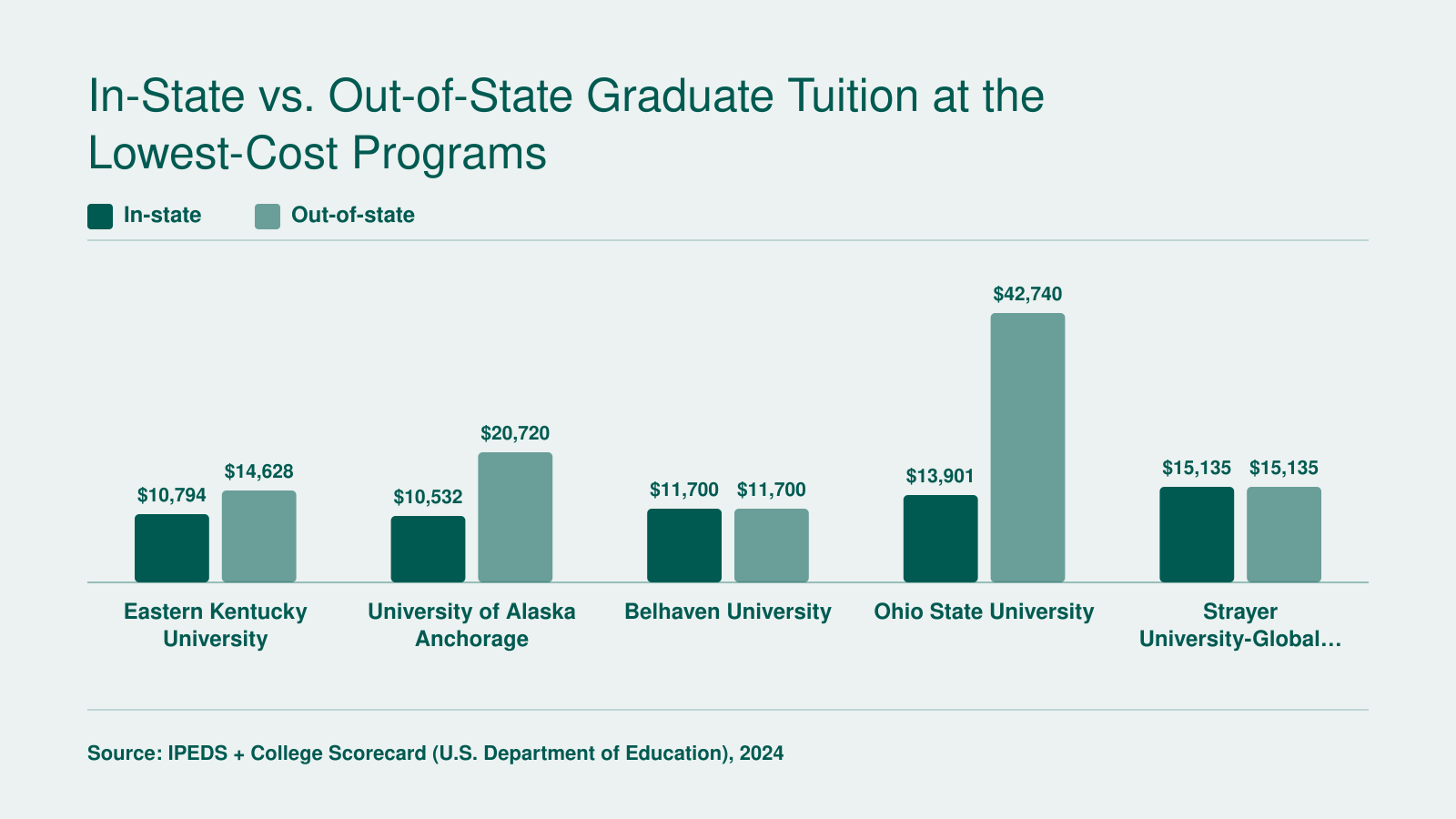
In-State vs. Out-of-State Graduate Tuition at the Lowest-Cost Programs
Residency matters most at public flagships. Ohio State shows the widest gap, with out-of-state tuition of $42,740 against $13,901 in-state, a difference of $28,839. University of Alaska Anchorage is next at roughly $10,200. Belhaven and Strayer charge one rate to everyone, and some public schools extend a single rate to online students, so check each program's online pricing before assuming the out-of-state figure applies.
Related Articles
As of August 2026, 13.6% of federal employees were eligible to retire right now, according to the U.S. Office of Personnel Management's Federal Workforce Data. That steady stream of potential openings is one reason leadership-track public sector roles keep drawing interest from MBA candidates.
Accreditation and GMAT/GRE Policies at the Ranked Schools
Some federal and state employers, and some tuition assistance programs, look for AACSB accreditation, so it is worth confirming before you apply. You can check any school in the AACSB accredited-schools directory on aacsb.edu, and ACBSP and IACBE keep similar searchable directories. Cells marked "Check with school" could not be confirmed from the sources reviewed, and test policies change often, so verify them with the admissions office.
| School | Business Accreditation | GMAT/GRE Policy | Waiver Criteria |
|---|---|---|---|
| Eastern Kentucky University | Check with school | Check with school (a GPA-based admission threshold is listed, but a test requirement is not stated) | Minimum undergraduate GPA of 2.75 |
| Liberty University | Check with school | Check with school (a GPA-based admission threshold is listed, but a test requirement is not stated) | Minimum GPA of 3.0 |
| Southern New Hampshire University | Check with school | Check with school (a GPA-based admission threshold is listed, but a test requirement is not stated) | Minimum GPA of 3.0 |
| Concordia University Ann Arbor | Check with school | Check with school (a GPA-based admission threshold is listed, but a test requirement is not stated) | Minimum GPA of 2.8 |
| UNC Kenan-Flagler | Check with school | Waiver available; applicants with fewer than five years of professional experience generally submit a GMAT or GRE score report | Automatic waiver with seven or more years of work experience |
| George Washington University | Check with school | Waiver available | Automatic waiver with five years of work experience |
| University of Alaska Anchorage (MBA in General Management) | AACSB International | Required for acceptance: either a 3.25 undergraduate cumulative GPA or a GMAT score of 525 | Waiver may be considered with another relevant master's degree, a terminal degree, or a 3.25 cumulative GPA (or 3.25 in upper-division courses) |
Your Application Checklist for a Public Administration MBA
Requirements vary by school, so confirm each item on the program's own admissions page. Most applications for these degrees ask for the following.
- Bachelor's degreeHold a degree from a regionally accredited institution. Most programs accept any major.
- Official transcriptsRequest transcripts from every prior school, including any transfer coursework. Registrars can take a few weeks to process these.
- ResumeShow your professional experience. Many programs use substantial work history to waive the GMAT or GRE, so check each school's policy before you book a test.
- Two professional referencesChoose people who can speak to your work. A public-sector supervisor is ideal if you have one.
- Statement of purposeConnect the business skills you want, such as budgeting, analytics, and operations, to a specific government or nonprofit goal.
- Accreditation checkVerify that the business school holds AACSB, ACBSP, or IACBE status. Confirm it with the accreditor, not only the school's marketing.
- Employer tuition assistanceIf your employer offers it, submit the tuition-assistance form before the term starts. Late paperwork can delay reimbursement or cost you the benefit.
Public Administration programs by state
Your MBA in Public Administration Questions, Answered
These are the questions prospective students ask most often when weighing a public administration MBA. Each answer is short, and where a topic needs more detail we point to the section below that covers it.
Is an MBA in public administration worth it?
Should I pick an MBA in public administration or an MPA if I want to work in government or a nonprofit?
Which schools offer an accredited MBA in public administration, and which accreditor should I look for?
What is the total cost of an MBA in public administration once fees are included?
Do MBA in public administration programs require the GMAT or GRE?
What jobs can I get with an MBA in public administration?
How many credit hours and months does a typical public administration MBA take?
Compare Public Administration programs on the data that matters
Explore more MBA specializations or browse every graduate field.
All MBA programs