MBA in Public Administration Programs With No GMAT or GRE Required
Compare 20+ accredited no-gre MBA in Public Administration programs, with graduate earnings, cost, debt, and completion data from IPEDS and the U.S. College Scorecard.

A program that drops the GMAT outright and one that waives it only for applicants with work experience can carry the same "no GMAT" label. For a professional who wants a public-sector business degree without months of test prep, that difference decides whether a score is still due.
Schools publish these rules in different places: admissions pages, FAQs, or applicant-type footnotes. Online, hybrid, and campus versions of one MBA can follow different policies.
A waived test removes one hurdle. Accreditation and total cost still need checking.
Key Points
- Champlain College and Golden Gate University offer online no-GMAT public administration MBAs.
- Multiply per-credit tuition by total credits, then add fees and residency travel.
- Confirm accreditation through a U.S. Department of Education or CHEA recognized agency.
MBA in Public Administration Programs With No GMAT or GRE Required
-
#1
Liberty University
Master of Business Administration (MBA) in Public Administration
$69,247median earnings $8,730grad tuition / yr $30,556median federal debt 122grads / yrNo GRE required45 credits45 credit hoursVisit program site →61score -
#2
Ohio State University
Master of Public Administration / MBA Program
$74,606median earnings $13,901grad tuition / yr $33,500median federal debt 87grads / yrGRE optional90 credits3 yearsVisit program site →56score -
#3
Concordia University-Wisconsin
MBA in Nonprofit Management and Public Administration
$13,260grad tuition / yrNo GRE required36 credits2 yearsVisit program site →41score -
#4
Southern New Hampshire University
Master of Business Administration (MBA) in Public Administration
$21,387grad tuition / yrNo GRE required30 credits2 yearsVisit program site →40score -
#5
Concordia University Ann Arbor
MBA in Nonprofit Management and Public Administration
$15,870grad tuition / yrNo GRE required36 credits2 yearsVisit program site →38score
How we rank. Each program is scored on graduate figures only: the field's master's earnings and debt, graduate tuition and the number of master's graduates, normalized across all programs in this field. Data comes from the U.S. Department of Education's IPEDS and College Scorecard; no school pays for placement.
Compare the top programs
| Rank | School | Earnings | Tuition / yr | Debt | Grads/yr | Format |
|---|---|---|---|---|---|---|
| 1 | Liberty University VA | $69,247 | $8,730 | $30,556 | 122 | Online |
| 2 | Ohio State University OH | $74,606 | $13,901 | $33,500 | 87 | Hybrid |
| 3 | Concordia University-Wisconsin WI | — | $13,260 | — | — | Hybrid |
| 4 | Southern New Hampshire University NH | — | $21,387 | — | — | Online |
| 5 | Concordia University Ann Arbor MI | — | $15,870 | — | — | Online |
Sources: U.S. Department of Education. Tuition and graduates: IPEDS. Earnings and debt: College Scorecard, this field's master's graduates; a dash means no figure is reported.
Cost, debt & payoff
Median earnings of this field's master's graduates (4 yrs after completing) vs. their median federal loan debt · U.S. College Scorecard
Across these programs the median graduate earns about $62,227 and finishes with roughly $81,723 in debt — a ratio that clears a common rule of thumb (keep debt below first-year salary). Tuition and debt vary widely school to school, so sort the ranking by "Most affordable" or "Lowest debt" to weigh cost against outcomes.
What 'No GMAT or GRE' Really Means in MBA Admissions
"No GMAT or GRE" is not a single policy. It describes at least three different admissions rules, and the difference decides whether you still have to submit a score, request a waiver, or do nothing at all. Not every MBA in Public Administration program drops the exam, and waiver criteria vary widely.
Three Policies You Will Encounter
- Unconditional no-test admission: No exam for any applicant. As of October 2026, Golden Gate University's admissions page states its MBA with a Public Administration concentration requires no GMAT or GRE.
- Test-optional: Scores are accepted but not required, as with many master's programs with no GRE required; a strong score can still help a borderline application.
- Conditional waiver: You qualify to skip the exam only if you meet set criteria. As of October 2026, Bridgewater State University's page lists a waiver tied to a prior master's, doctorate, or JD, certain credentials such as CPA, CMA, or CFP, or a qualifying undergraduate GPA of 3.0.1
How Work Experience and Approval Factor In
Many waivers hinge on professional experience. As of October 2026, Rice University's full-time MBA page describes a case-by-case waiver requiring three years of post-undergraduate work plus a quantitative indicator.2 The University of the District of Columbia lists ten years of progressively responsible work as one path.3
A waiver usually must be requested and approved by a committee; unconditional no-test admission does not. Confirm which applies before you count on it.
How to Find and Verify No-GMAT MBA Public Administration Programs
Admissions pages now carry more no-test language, but the exact policy still varies by school, format, and applicant type. Start with a web search for an mba public administration concentration, then go straight to the program's admissions or requirements page rather than the marketing landing page. Look for exact wording such as "not required," "optional," or "waiver available," and note whether the policy applies to every term, delivery format, and applicant category. International applicants are often handled under separate rules, so check that section if it applies to you.
Golden Gate University's MBA in Public Administration page states "No GMAT or GRE Required." Champlain College Online's MBA with Public Administration Certificate says GMAT/GRE are not required for admission into its online graduate program. Concordia University Wisconsin's MBA in Nonprofit Management and Public Administration states "we don't require the GRE or GMAT to apply."2 These are examples, not a ranked or complete Best MBA Programs list.
Some pages set conditions instead of a blanket waiver. Albany State's MBA in Public Administration catalog, for instance, ties regular admission to a 2.75 undergraduate GPA while a provisional path may require a GMAT 550 or GRE 3001, so read the full policy before counting on a test-free application. Because admissions language changes frequently, save a screenshot or email confirmation of the policy before you apply.
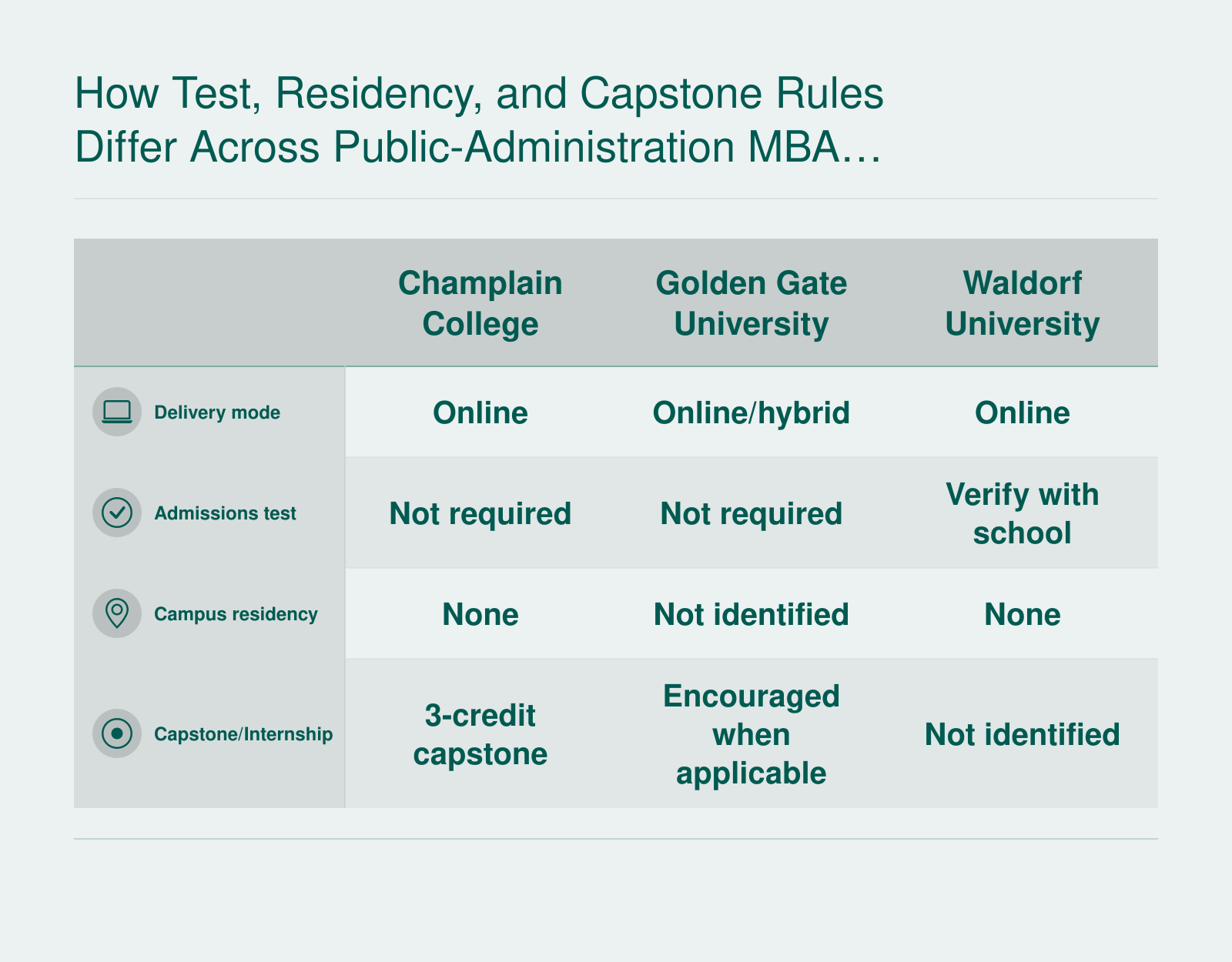
How Test, Residency, and Capstone Rules Differ Across Public-Administration MBA Examples
Online options with no GMAT or GRE requirement exist at Champlain College and Golden Gate University; Waldorf's online Public Administration MBA also lists no campus residency. Official pages do not always publish test or residency rules side by side for online and campus versions of the same degree, and several campus examples in the research are MPAs rather than MBAs. Treat the comparison below as a verification checklist, not a definitive format rule.
Tuition and Total Program Cost: What to Add Beyond the Sticker Price
Multiply per-credit tuition by total credits required, then add mandatory fees, technology or online fees, books and software, residency travel, and graduation fees.
Published rates show why credit counts matter as much as price when comparing the Most Affordable MBA in Public Administration and Accelerated MBA in Public Administration programs:
- Pittsburg State University: $399 per credit across 30 credits, about $11,970 in tuition. Kansas regents review rates annually.
- Columbia Southern University: a lower $359 per credit, but 36 credits, for roughly $12,924.
- Champlain College: $608 per credit for Fall 2026 through Summer 2027 across 33 credits ($20,064), plus a mandatory $150 graduation fee. Alumni, servicemembers, veterans, and family members pay $500 per credit.
- Liberty University: $600 per credit full time ($665 part time) for 2026-2027 across 45 credits, about $27,000 before separately assessed fees.
None of these totals is confirmed as all-in, so request an itemized fee schedule. At public universities, in-state and out-of-state pricing can still apply to online students.
Government employees have two extra levers: employer tuition assistance, and Public Service Loan Forgiveness, which can cancel remaining federal Direct Loan balances after 120 qualifying payments made while working full time for a qualifying public or nonprofit employer.
Related Articles
Accreditation Checks for Accredited No-GMAT Public Administration MBAs
A test waiver says nothing about quality; accreditation does. Check accreditation before you apply.
Start with the institution. It should be accredited by an agency recognized by the U.S. Department of Education or CHEA. Department recognition matters most, because it governs federal student aid and is what federal hiring rules look for.2 State authorization alone is not equivalent.1
Next, check business accreditation separately. AACSB, ACBSP, and IACBE can cover a business school, unit, or specific programs, and a school can be institutionally accredited without them. Confirm the scope expressly includes the MBA, not just undergraduate business.
NASPAA accredits MPA and MPP programs, not MBAs. A public administration MBA is NASPAA-accredited only if the NASPAA directory lists it.
How to Verify
- Institution: Search the Department's DAPIP database by legal name and campus. Its data is agency-reported and unaudited, so confirm status with the accreditor.
- Business program: Use the AACSB directory or the ACBSP and IACBE listings.
- Record it: Note the accreditor, scope, status, and dates, and look for adverse actions.
Treat the school's own page as secondary to the accreditor's directory.
Social and community service managers, a common destination for public administration graduates, earned a median of $80,390 a year as of May 2025, according to the Bureau of Labor Statistics Occupational Outlook Handbook. The BLS projects 7% job growth for the occupation from 2025 to 2035.
MBA vs. MPA: Choosing the Right Public-Service Graduate Degree
Many applicants assume a public-sector MBA and an MPA are interchangeable, but they differ in ways that matter for accreditation and career fit.
How the Two Degrees Compare
- Curriculum: An MBA is a business-management degree with public administration added through a concentration or electives. An MPA centers on governance, public budgeting, policy implementation, ethics, and program evaluation.
- Accreditation: AACSB or ACBSP signals a business school. NASPAA accredits public affairs and administration programs1. The two are not interchangeable.
- Careers: MBA graduates tend toward management, finance, operations, and consulting across sectors. MPA graduates tend toward government, policy analysis, nonprofit leadership, and public budgeting.
- Length: NASPAA's normal expectation is at least 36 semester credits for an MPA1. Seton Hall, Delaware, and Albany State list 36234, Western Carolina 395, and Metro State 406. MBA credit totals vary by school and format, so compare them directly.
- Test policies: These are set program by program. Seton Hall does not require the GRE2, Albany State does not require the GMAT4, Metro State makes the GRE optional6, and NASPAA notes that executive MPA programs often waive it7.
Which One Fits
Choose the MBA if you want finance, operations, or leadership roles that can move between public and private employers. Choose the MPA if your target is policy, budgeting, or running government and nonprofit agencies, particularly if you want NASPAA accreditation.
To avoid the GRE, search both degree types; for example, mba programs no gmat required may also be available. MPA programs are frequently test-optional, which widens your options. Confirm each school's current policy on its own admissions page.
Questions to Ask Admissions Before You Apply
Before you apply, get these details confirmed in writing.
- Is the waiver unconditional?Ask whether the GMAT/GRE is truly waived, optional, or waivable only under set criteria, and get those criteria in writing.
- Does the policy cover all formats and applicants?Confirm it applies equally to online, hybrid, campus, and international applicants.
- What experience counts?Ask required years and types, and whether public-sector, nonprofit, or military service qualifies.
- Transfer credits and deadlines?Request transfer-credit limits, application deadlines, and available start terms.
- What is the full cost per credit?Get the per-credit price with all fees, and confirm regional plus AACSB, ACBSP, or IACBE accreditation.
- Any residency or capstone?Ask whether on-campus residency, orientation, or capstone requirements affect online flexibility.
Public Administration programs by state
Compare Public Administration programs on the data that matters
Explore more MBA specializations or browse every graduate field.
All MBA programs