Best Master's in Interior Design Programs in Alabama
Compare accredited Interior Design master's programs by earnings, cost, and outcomes.

Alabama has no graduate degree titled interior design that we could confirm, yet many lists still pad their rankings with architecture programs or undergraduate majors. The schools here are the closest graduate routes the state offers, drawn from the rankings data, with campus, online, and hybrid formats together.
That gap shapes every decision ahead. CIDA accreditation, GRE rules, and ABRID registration all hinge on which degree you actually earn, not what a program's marketing implies.
Key Points
- Alabama has no separately titled master's in interior design, so check each program's focus.
- Spring Hill College tuition runs about $8,857, while The University of Alabama out-of-state reaches $33,972.
- Alabama registration requires age 21, a qualifying degree, supervised experience, and a passing NCIDQ score.
Top 10 Master's in Interior Design Schools in Alabama
We could not confirm a separately titled MS, MA, MFA, or MID in Interior Design at any Alabama university. The closest options are Auburn's graduate route for interior design students and The University of Alabama's Human Environmental Sciences master's with an interior design focus. The other eight schools are listed with their actual graduate programs so you can compare cost and institution-wide outcomes. Graduation rates shown are institution-wide figures, not completion rates for any single program.
Auburn University
#1Auburn, AL · $13,000 – $34,000/yr (est.)
Best for: Auburn interior design undergraduates continuing study
Auburn is the strongest fit for interior design in Alabama. Its CIDA-accredited interior design program is undergraduate, and its graduate route runs through the M.S. in Consumer and Design Sciences, with individualized plans of study. Auburn interior design undergraduates can also use an accelerated B.S./M.S. option that applies up to 9 hours of graduate coursework to both degrees. Institution-wide, about 82% of students graduate.
- Interior design route sits within the M.S. in Consumer and Design Sciences
- Thesis or non-thesis; non-thesis may use a design development project
- 30 total credit hours with a three-member advisory committee
- Accelerated B.S./M.S. lets interior design majors count up to 9 graduate hours
- Concurrent dual master's degrees available
- Six-year time limit to complete the degree
The University of Alabama
#2Tuscaloosa, AL · ~$12,000/yr (est.)
Best for: Applicants wanting a textiles and design focus
The University of Alabama offers a Master of Science in Human Environmental Sciences with a focus in Clothing, Textiles, and Interior Design. It is 30 semester hours and ends in a thesis or capstone project, so it is an interior design-related focus inside a broader degree rather than a standalone interior design master's. Its other graduate listing here, the online Master of Arts in Management, is unrelated to design. Institution-wide, about 73% of students graduate.
- 100% online coursework
- 30 total credit hours with a required capstone
- Concentrations in Global Business Management and Human Resources Analytics
- $480 per credit
- GRE or GMAT listed as entrance exams
- Rolling admissions
Jacksonville State University
#3Jacksonville, AL · $10,000 – $15,000/yr (est.)
Best for: Working professionals studying fully online
Jacksonville State is not an interior design option. Its listed graduate program is an online emergency management degree for working professionals. It is one of the lower-cost schools on this list, and about 55% of students graduate institution-wide.
- 30 total credit hours
- No thesis or capstone required
- Online format with a dedicated program contact
- Graduate Certificate in Emergency Management available
- Focus on crisis management and hazard assessment
Spring Hill College
#4Mobile, AL · ~$9,000/yr (est.)
Spring Hill College is a private Jesuit-rooted school in Mobile. Its listed graduate program is an online public health master's, not a design degree. About 52% of students graduate institution-wide.
- Completely online
- Accelerated 7-week sessions
- Six start dates per year
- Complete in two years
- SACSCOC approved
- General public health curriculum
University of South Alabama
#5Mobile, AL · ~$9,000/yr (est.)
The University of South Alabama in Mobile lists a campus-based biomedical sciences master's, which has no interior design content. It is a one-year program aimed at pre-health students. About 53% of students graduate institution-wide.
- One-year, 30-credit program
- No thesis or capstone required
- Starts fall, spring, or summer
- 3.0 GPA minimum
- Applications accepted year-round
Tuskegee University
#6Tuskegee, AL · ~$26,000/yr (est.)
Tuskegee University is a historically Black university whose listed graduate program is a hybrid psychology master's, not a design degree. About 55% of students graduate institution-wide.
- 36 total credit hours
- Hybrid format, online and on campus
- Thesis and internship required
- GRE listed as an entrance exam
- 3.0 GPA minimum
- Optional certification in Health Disparities and ABA
Huntingdon College
#7Montgomery, AL · $10,000 – $15,000/yr (est.)
Huntingdon College in Montgomery lists a professional athletic training master's, which is unrelated to interior design. About 48% of students graduate institution-wide.
- Six-semester, cohort-based program
- Cohorts of up to twelve students
- Six clinical internships including an 8-week immersion
- Prepares graduates to sit for the Board of Certification exam
- Accredited by CAATE
Athens State University
#8Athens, AL · ~$11,000/yr (est.)
Athens State University lists an online master's in acquisition and contract management, so it has no interior design offering. No institution-wide graduation rate is published in the data we use.
- Online format for working professionals
- Focus on procurement and contract negotiations
- Covers quality management tools and leadership practices
- Financial aid available
Faulkner University
#9Montgomery, AL · ~$16,000/yr (est.)
Faulkner University in Montgomery lists a management master's with an information technology emphasis, not an interior design program. About 37% of students graduate institution-wide.
- 30 total credit hours
- $500 per credit
- Information Technology emphasis
- Accelerated one-year option or new two-year format
- Residency weekend each term
- 2.5 GPA minimum
- Christian perspective integrated into the curriculum
Talladega College
#10Talladega, AL · ~$18,000/yr (est.)
Talladega College lists an online and hybrid MBA, which is unrelated to interior design. About 31% of students graduate institution-wide, the lowest rate among the schools here.
- 30 total credit hours
- Online and hybrid delivery
- Seven concentrations including Accounting, Finance, and Healthcare Administration
- Capstone in strategic management
- Bridge courses for non-business majors
CIDA Accreditation and the Master's in Interior Design vs. Master's in Architecture
A master's in interior design and a master's in architecture can look similar on a brochure, but they lead to different licenses. The interior design degree focuses on interior environments, human factors, and the NCIDQ path. A NAAB-accredited architecture master's leads toward architect licensure.
CIDA accredits professional-level interior design programs, at either the bachelor's or master's level.2 Many graduate programs are post-professional, built for students who already hold a design degree, and are not accredited themselves. In Alabama, CIDA's directory lists only bachelor's-level programs. Auburn University holds accreditation for its Bachelor of Science in Interior Design (2021-2027), and The University of Alabama for its Bachelor of Science in Interior Design in Human Environmental Sciences (2024-2030). None of the Master's Programs in Alabama holds graduate-level CIDA accreditation.
This matters for NCIDQ eligibility. A CIDA-accredited degree is not required to sit for the exam1, but a bachelor's or master's with 60 interior-design credit hours is an efficient way to meet the education requirement2. CIDQ's work-experience requirements still apply2, and Alabama sets no separate NCIDQ rule3.
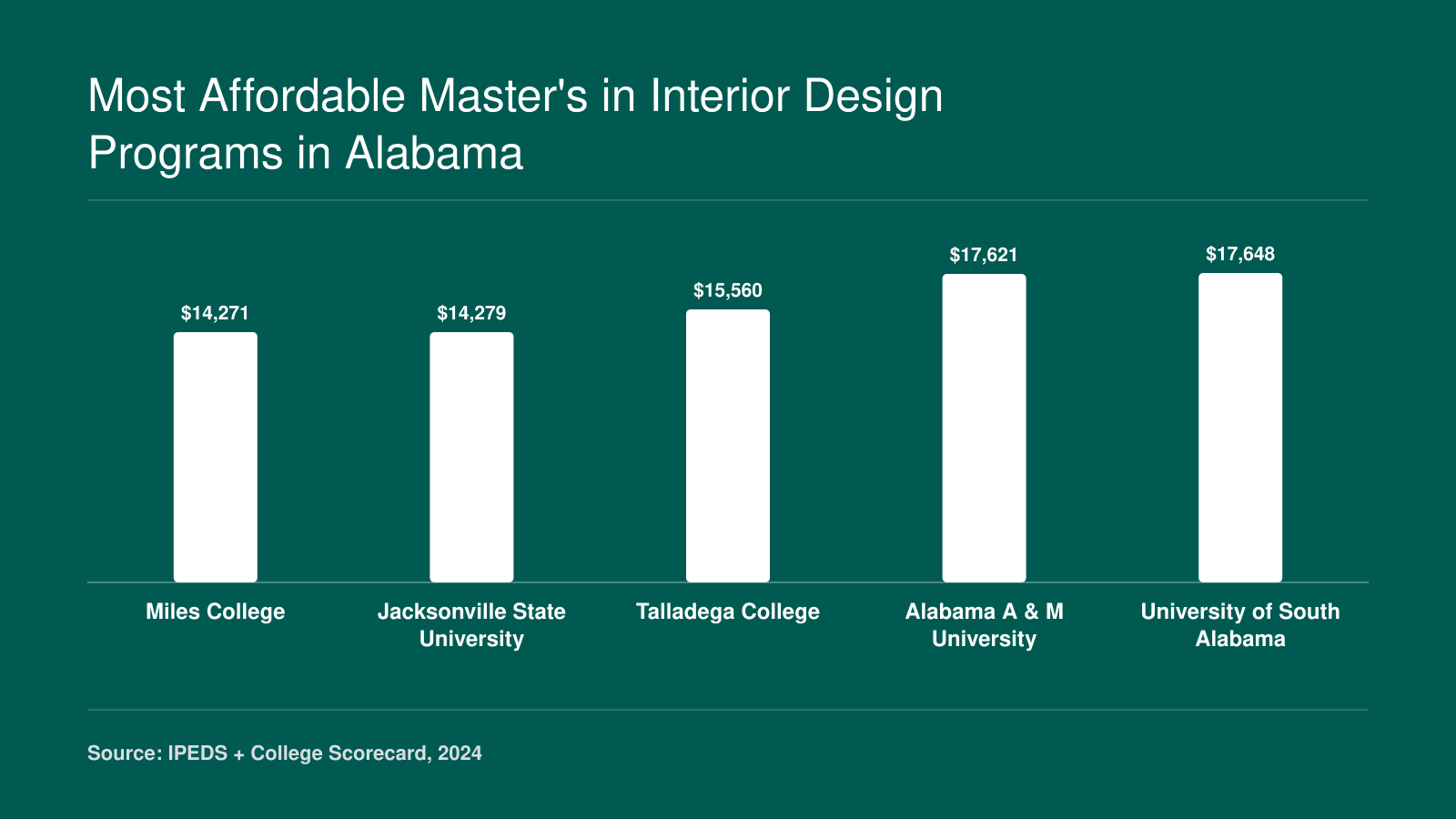
Most Affordable Master's in Interior Design Programs in Alabama
Net price is the average yearly cost after grants and scholarships, and it gives a fairer cost comparison than sticker price. Miles College and Jacksonville State University sit nearly level at the low end, with Talladega College, Alabama A & M University and the University of South Alabama close behind. Net price here is an institution-wide average after aid, not a quote for graduate students, so your own cost will differ. For the sticker price, check each school's published in-state graduate tuition.
Online and Hybrid Master's in Interior Design Options in Alabama
Online convenience and studio rigor pull in opposite directions, and that tension matters for interior design. The ranked Alabama graduate programs carry campus, online, and hybrid labels, but those labels apply to the specific degree programs listed, not to an interior design master's. Auburn and the University of Alabama hold CIDA accreditation for bachelor's-level interior design programs, not for graduate interior design.
Studio work, critiques, and portfolio reviews remain central to interior design, so any hybrid, low-residency, or part-time path should be expected to preserve in-person studio components. Fully online formats are therefore limited.
Some fully online CIDA-accredited master's programs do exist nationally, and Alabama residents may consider the Best Online Master's in Interior Design Programs, but remote enrollment does not bypass Alabama registration rules. Check the cost and licensure section before committing.
Related Articles
Which Alabama Master's in Interior Design Programs Waive or Make the GRE Optional
GRE rules for Alabama interior design master's programs are not one size fits all, and students comparing admissions flexibility may also want to explore No-GRE master's programs. The University of Alabama's graduate catalog lists an MS focused area in Clothing, Textiles, and Interior Design and states that entrance exams are required only when the program specifically calls for one. A waiver can be considered case by case for prior graduate success or extensive related work experience. Regular admission calls for a 3.0 undergraduate GPA. Alabama A&M University's Graduate School requires a bachelor's degree and a 2.75 GPA, and it asks for GRE or GMAT scores only for programs that mandate entrance exams. If scores are required, the baseline is 146 verbal and 140 quantitative.1 Some programs may also request a portfolio, interview, scholarly work, or research, though the published page does not tie that specifically to interior design.
For the other ranked schools, located admissions pages do not publish a clear interior design GRE policy, so students should verify directly with each program. Applicants may also encounter statement of purpose, prior design coursework, or portfolio reviews.
Cost of a Master's in Interior Design in Alabama and Alabama Licensure
What it costs
Published graduate tuition for the schools here runs from about $8,857 at Spring Hill College to $33,972 for out-of-state students at The University of Alabama. Public in-state rates generally land between roughly $9,000 and $12,000, and the most affordable master's in interior design programs can add context. These figures come from each school's listed graduate programs, so confirm the rate for an interior design track directly.
At The University of Alabama, graduate funding can include assistantships, fellowships, scholarships, and on-campus employment, and nearly half of graduate students receive some.1 The Thompson-Bramblett scholarship is restricted to graduate students in clothing, textiles, or interior design.2 Doris Burton serves full-time interior design students,3 and Alford is for undergraduates.4 All three list a 05/31/2027 deadline.234
Alabama registration
The Alabama Board for Registered Interior Designers issues the Registered Interior Designer credential under the 2010 Interior Design Registration Act.5 Applicants need qualifying education, supervised experience (generally two years with a CIDA or non-CIDA interior design degree), a passing NCIDQ score from CIDQ, and a $300 application fee.6
An out-of-state or online master's is not automatically excluded, and CIDA accreditation is not the only route. Eligibility is decided case by case, so get written confirmation from CIDQ and the board before you enroll.5
Alabama Interior Designer Registration at a Glance
Master's in Interior Design in Alabama: Common Questions
Can I become a licensed interior designer in Alabama with an online master's degree?
What is the difference between a master's in interior design and a master's in architecture?
Do I need a bachelor's in interior design to apply to a master's program?
Does a post-professional master's count toward NCIDQ eligibility if my bachelor's was CIDA-accredited?
Compare Interior Design programs on the data that matters
Explore more Arts & Design specializations or browse every graduate field.
All Arts & Design programs