Kansas City, MO · Private nonprofit · Master's · Hybrid
1Program track
19Master's degrees awarded (2025)
8%Of Rockhurst University master's degrees
$20,842Avg. graduate tuition and fees / yr
Rockhurst University awarded 19 master's degrees in analytics in 2025, roughly 8% of the 238 master's degrees it conferred that year, according to IPEDS data. The Kansas City private nonprofit, accredited by the Higher Learning Commission, has also restructured the credential: what prospective students search for as an MSDA now runs as the M.S. in Data Analytics and Artificial Intelligence, with distinct data science and business analytics tracks. Three names circulate for one program, and the one on your diploma depends on when you enroll.
Cost, test policy, attendance rules, and STEM status all shift by track and format. In a program this small, those variables matter more than the branding.
Key Points
Fall 2027 applicants apply to the MSDA-AI, a 33-credit, two-track degree.
Admission is rolling and test-optional, with five entry points yearly.
Rockhurst awarded 19 analytics master's degrees in 2025, per IPEDS.
The program
Master of Science in Data Analytics and AI (MSDA-AI, Hybrid) Master'sHybrid
Rockhurst University offers a Master of Science in Data Analytics and AI as a hybrid, STEM-designated degree with two tracks: Data Science & AI and Business Analytics. The program requires 33 credit hours and takes 1.5 to 2 years, combining online coursework with in-person sessions on the Kansas City campus. A technology practicum covers internships, applied research or independent analytics projects. Tuition runs $825 per credit hour plus fees. The degree sits in the AACSB-accredited College of Business and Technology, also accredited by the Higher Learning Commission. Graduates target roles such as data scientist, machine learning engineer, AI product manager and analytics consultant.
AACSB, Higher Learning Commission accredited
2 concentration options
$825 per credit
Complete in 1.5 - 2 years
33 total credit hours
Median salary $112,590 with 34% projected job growth
Rockhurst's Analytics Master's: Program Names, Tracks, and the MSDA-AI Transition
Is Rockhurst's analytics master's an MSDA, an MSDA-AI, or a track inside the MSIS?
All three names circulate, and only one is current for Fall 2026 applicants: the Master of Science in Data Analytics and Artificial Intelligence, or MSDA-AI. Rockhurst's existing M.S. in Data Analytics becomes the MSDA-AI effective Fall 2026, so anyone applying for that term should use the new name. The MSIS is a separate degree, launched in Fall 2025 with four tracks (AI & Tech Strategy, Business Intelligence, Data Science, and Student-Defined). It is STEM-designated and can lead to analytics work, but it is not the master's in data analytics, and the MSDA-AI is not a concentration inside it.
Two tracks, one degree
The MSDA-AI carries 33 credit hours and typically runs 1.5 to 2 years in a hybrid format, mixing online coursework with in-person sessions in Kansas City. Students choose between two tracks:
Data Science & AI: programming, predictive modeling, big data, machine learning, natural language processing, MLOps, and AI-system development.
Business Analytics: data visualization, performance metrics, AI-enabled decision-making, and data strategy.
The split matters. One track builds systems; the other translates them into business decisions. Rockhurst's catalog does not describe additional MSDA-AI specializations beyond these two.
Where it sits, and what that signals
The degree is offered through Rockhurst's business school, the Helzberg School of Management, and delivered via the College of Business and Technology. That business-school home shapes the curriculum: governance, strategy, and decision framing sit alongside the technical stack, so the degree is not purely computational. Helzberg's wider analytics portfolio reinforces the orientation, including a 30-credit M.S. in Business Intelligence and Analytics, MBA concentrations in Business Intelligence and Data Science, and graduate certificates in Data Science, Business Analytics, and Business Intelligence. Rockhurst has not documented folding that older M.S. into the MSDA-AI, so treat them as separate credentials until the university says otherwise.
Size and standing
IPEDS / U.S. Department of Education College Scorecard data show Rockhurst awarded 19 master's degrees in this field in 2025 (CIP 30.7102), equal to 8% of its 238 master's degrees that year. That volume ranks #63 among the 118 U.S. institutions awarding master's degrees under the same code.
Nationally, mastersprograms.com lists 499 analytics master's programs, 312 of them available as an online master's in data analytics or hybrid option and 15 in Missouri, Rockhurst included. Small-output programs can mean tighter cohorts and more faculty attention; they can also mean fewer electives and less scheduling flexibility. Ask about section sizes before you commit.
Data Science & AI vs. Business Analytics: Curriculum, Tools, and Capstone Compared
The harder choice at Rockhurst is not whether to earn an analytics master's but which of its two 2026 tracks fits the work you want to do: building models or translating them for decision-makers. Both sit inside the same 33-credit, STEM-certified Master of Science in Data Analytics and Artificial Intelligence, so the degree name and credential are identical. The difference is where the coursework puts its weight.
Shared Ground Before the Split
Rockhurst describes the MSDA-AI as core classes plus track electives and a Technology Practicum, finished in roughly 18 to 24 months. A substantial share of the coursework is common to both tracks before you specialize, which helps if you are still deciding. The 2026 catalog does not yet give a complete course-by-course core or a public credit split for each track, so treat any 30-credit course map from the older Helzberg MSDA as historical rather than definitive. Where a current course listing is marked as revised or pending, ask admissions for the final syllabus before you enroll.
Data Science & AI: Build the Systems
This track is the technical path. Rockhurst frames it around machine learning, natural language processing, MLOps, predictive modeling, big data, and AI-system development. The tool stack associated with Rockhurst analytics coursework includes Python and Jupyter, R and RStudio, SQL, Apache Spark, Hadoop, AWS, Tableau, and Power BI. Expect more coding, model evaluation, pipeline work, and deployment concerns. Typical roles this track points toward include data scientist, machine learning engineer, AI engineer, data engineer, and analytics engineer.
Business Analytics: Turn Models Into Decisions
The Business Analytics track is the strategy path. Its stated emphasis is data visualization, performance metrics, AI-driven decision-making, and data strategy grounded in ethical leadership. Students still encounter Python, R, SQL, Tableau, and Power BI, but the work leans toward stakeholder-facing analysis: defining metrics, interpreting model output, and connecting analytics to operating decisions. It suits readers aiming at business analyst, analytics consultant, operations analyst, marketing analytics, or strategy roles.
The Practicum, However You Specialize
Both tracks are described with a Technology Practicum, completed through an internship, applied research, or an independent analytics or AI project. Rockhurst's 2026 materials do not confirm whether the practicum is required in both tracks, its course number, or its credit value, and no separate thesis is identified. Ask for the practicum syllabus and placement process, since that project often becomes the main portfolio piece you bring to employers.
Tuition, Fees, and the Real Total Cost of the Degree
Rockhurst prices its analytics master's by the credit hour. To build this data analytics master's cost, multiply the published rate by the credits the degree requires, then add the mandatory per-credit fees.
Rate Times Credits
The 2026-27 MSDA-AI rate is $835 per credit hour, and the degree requires 33 credits. That computes to $27,555 in tuition alone. Rockhurst does not publish that arithmetic as an official program total, and the per-credit fees sit on top: $54 per credit brings tuition plus per-credit fees to $29,337.
The AACSB Accredited Programs listing for Rockhurst still lists 30 credits and $40,000 in tuition and fees across 18 to 24 months. That listing does not reconcile with the 33-credit, $835-per-credit structure of the MSDA-AI and likely reflects an earlier version of the program. If a recruiter or a web page quotes $40,000 to you, ask which curriculum it describes.
Institutional Average vs. Program Rate
IPEDS / U.S. Department of Education College Scorecard puts Rockhurst's average full-time graduate tuition and fees at $20,842 per year (2024). That is an institution-wide average across all graduate programs, not the analytics rate, and it should not be used to budget for this degree. Rockhurst delivers the MSDA-AI in a hybrid format, and no separate online rate is published, so there is a single per-credit figure to plan around.
Aid a Working Adult Can Actually Use
Federal loans: Graduate borrowing starts with the FAFSA, which Rockhurst confirms is required for aid consideration.
Scholarships: Data Analytics awards are listed at $2,800 to $12,800 per year, merit-based, renewable annually for up to two years with satisfactory academic progress. Confirm your eligibility with the Helzberg School before counting on an award.
Alumni and partner discounts: Rockhurst and AJCU alumni, Benedictine BSN alumni, BJC Health System and Saint Luke's employees, military members and veterans, displaced federal workers, and students 60 and older qualify for reduced tuition. The alumni discount runs half off one class per semester, but the reduced per-credit amount is not published.
Employer reimbursement: Common among Kansas City employers, though Rockhurst publishes no analytics-specific arrangement, so confirm the terms with your HR team.
Assistantships: No analytics-specific assistantship, stipend, or tuition waiver is published, so do not build a budget on one.
The Cost-Per-Credit Sanity Check
One number makes Rockhurst comparable to any peer without the arithmetic: $835 per credit hour, or $27,555 for the 33-credit degree before fees and scholarships. Ask every other program you are weighing for its per-credit rate and credit count, multiply, and compare the floors.
Admissions Requirements, Prerequisites, and the GMAT/GRE Policy
Rockhurst's analytics master's runs on a rolling, test-optional graduate business admission process with five entry points a year. Here is what to prepare, and what to confirm directly with admissions before you apply.
Bachelor's degree and GPA
A bachelor's degree from a regionally accredited institution is required. Rockhurst's general graduate minimum is 2.5 on a 4.0 scale, while graduate business applicants with a 3.0 GPA or three years of progressive work experience receive priority review. Below either threshold, supplemental evidence is encouraged rather than automatic rejection.
Prerequisite coursework
The program states that prerequisites may be required but does not publish course names, levels, or minimum grades. Confirm with admissions whether statistics, calculus, or programming must be completed before your first term.
GMAT/GRE policy
The exam is not required. Scores are optional supplemental materials, and the admissions committee reserves the right to request them. No separate waiver procedure or score threshold is published; applicants below a 3.0 GPA or with under three years of experience are most encouraged to submit scores or other evidence.
Application materials
The application, official transcripts, and a resume or CV are required. Domestic applicants may submit unofficial transcripts for an admission decision but must supply official copies to continue; international applicants submit official transcripts. Optional additions include a recommendation letter, certifications, a personal statement, and test scores.
English proficiency
International applicants must provide proof of English proficiency. Rockhurst does not publish a fixed list of accepted exams or minimum scores for this program, so confirm the tests and thresholds with international admissions before applying.
Deadlines and entry terms
Five starts a year: January, March, June, August, and October, each an eight-week term. Priority deadlines are Aug. 1 (Fall A), Oct. 1 (Fall B), Dec. 1 (Spring A), Feb. 15 (Spring B), and May 1 (Summer), with rolling admission closing about two weeks before a term begins. International applicants should plan around the June 1 fall and Nov. 1 spring documentation dates.
Online, Hybrid, and On-Campus: Attendance Rules and Completion Timelines
The question that decides whether Rockhurst's analytics master's fits your life is not whether it is online, but how much of it you can complete without driving to Kansas City. The answer depends on which format and program variant you choose, and on how much structure you want around a full-time job.
What Online Actually Requires
Rockhurst describes the standard online sections as asynchronous: you complete weekly coursework on your own schedule, with due dates but no required weekly class meeting. The academic catalog does distinguish synchronous online courses that meet at scheduled times, so confirm the section format before you register. No campus residency appears in the standard program's online format.
The newer MS in Data Analytics and AI is different. Rockhurst lists it as hybrid, with online coursework plus immersive in-person experiences in Kansas City. If you are considering that variant, ask whether those visits are required and how often they occur.
Campus and Hybrid Mechanics
On-campus classes meet once a week, Monday through Thursday, from 5:45 to 9:00 p.m., with the night set by the course. Hybrid sections combine online work with in-person meetings, though the program does not advertise a fixed number of campus visits for every hybrid course. A Kansas City-area student can pair an evening campus section with online courses in the same term, then switch formats between terms as schedules change.
Start Dates, Pace, and the Online Majority
Rockhurst runs five eight-week terms a year, with entry points in January, March, June, August, and October. The MSDA-AI requires 33 credits; the earlier MS in Data Analytics carried 30. The listed duration is 18 to 24 months: the accelerated route finishes in about 18 months, while the typical part-time working student takes about 24, a pace built around roughly one course at a time.
Online is mainstream here, not a side channel, the online master's in business analytics format is now a standard point of comparison for working students. IPEDS / U.S. Department of Education College Scorecard data from 2024 show 700 of Rockhurst's 1,446 graduate students (48%) study exclusively online, and another 550 (38%) take some online courses. For a working student, the practical test is whether asynchronous weekly work plus one evening class fits your calendar. If you need live interaction, choose campus or hybrid sections deliberately; if you need schedule control, scrutinize the online route section by section.
Accreditation, STEM Designation, and STEM OPT Eligibility by Format
Is Rockhurst's analytics master's STEM-designated for the 24-month OPT extension?
Rockhurst says yes, and the distinction between two separate credentials matters here. Rockhurst University as a whole is accredited by the Higher Learning Commission, its regional institutional accreditor. Separately, the Helzberg School of Management holds AACSB business accreditation, which is program-level recognition from AACSB International and a different claim entirely.2 Graduate business schools often advertise both; students comparing AACSB accredited business analytics MBA programs should check which one a given page is actually describing.
What STEM OPT Requires
Rockhurst identifies its Master of Science in Data Analytics, a 30-credit degree offered on campus and online, as qualifying for the federal STEM OPT extension. That extension runs 24 months beyond the initial period of post-completion OPT.1
The governing rule, though, is not the program title or a university statement. DHS ties STEM eligibility to the degree's CIP code appearing on the STEM Designated Degree Program List, earned at an SEVP-certified institution.1 A student must also hold valid post-completion OPT, obtain a designated school official's recommendation, work for an E-Verify employer, and file a Form I-983 training plan.1
The Format Catch for F-1 Students
F-1 status requires a full course of study, and only limited online coursework generally counts toward it.1 A degree completed entirely online ordinarily will not support F-1 status, so Rockhurst's online availability does not by itself mean an online student can obtain OPT or the STEM extension. On-campus, full-time enrollment is the path that preserves those options; hybrid students need the in-person share to satisfy the full-course-of-study rules.
Confirm in Writing Before You Deposit
Ask the program and Rockhurst's international student office, in writing, to confirm the CIP code, its current listing on the DHS STEM Designated Degree Program List, and whether your intended format supports F-1 status. Get that before you pay a deposit. Students who assume a title equals a designation are the ones who discover the problem after arriving.
The National Benchmark: What Data Scientists Actually Earn
The most recent federal figure puts the data scientist median at $120,230 a year.
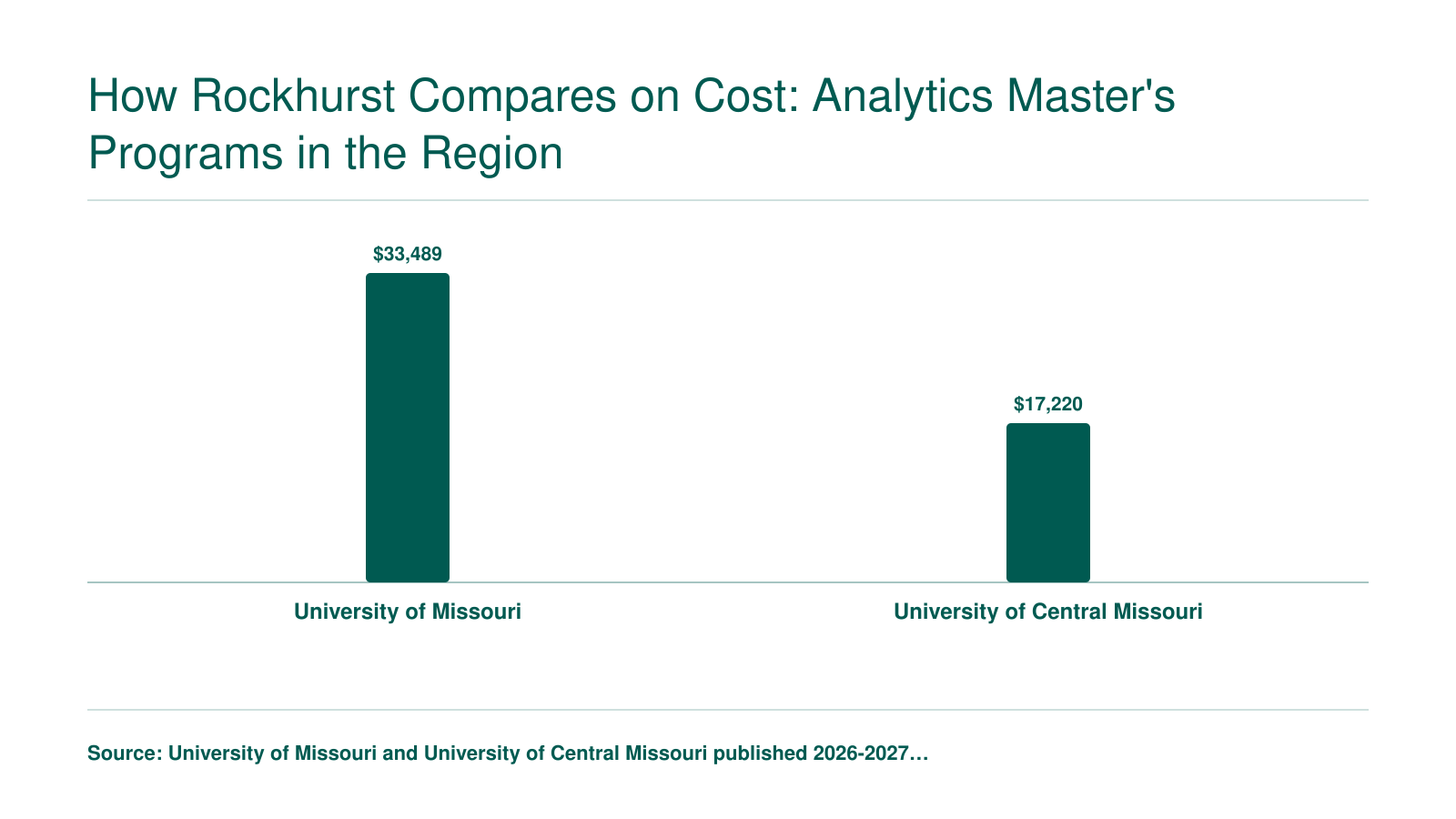
How Rockhurst Compares on Cost: Analytics Master's Programs in the Region
Analytics master's degrees are a genuinely regional market: 312 of the 499 U.S. programs in this field offer an online or hybrid option, 15 of them in Missouri. The two Missouri publics with 2026-2027 figures published both build their degrees on 30 credits, so the price gap shown here is cost, not program length. Rockhurst's own school-wide average graduate tuition and fees come to $20,842 per year (IPEDS 2024), but that is an all-programs average rather than an analytics program rate, so weigh it against the program totals below rather than lining the numbers up directly.
Common Questions About Rockhurst's Analytics Master's
The details that trip up prospective students are rarely the big ones. They are the program name on the diploma, the fee lines under the tuition rate, and whether a hybrid format actually expects you in Kansas City. Here are the answers we could verify against Rockhurst's own published materials.
Is Rockhurst's degree called an M.S. in Data Analytics or an M.S. in Data Analytics and AI?
Rockhurst's current degree is the Master of Science in Data Analytics and AI, shortened to MSDA-AI. Older pages and some third-party listings still call it the Master of Science in Data Analytics, and that earlier version carried 30 credit hours. The program now requires 33 credits, so use the MSDA-AI name and the 33-credit structure when you compare it against other analytics master's programs.
What is the total tuition for Rockhurst's analytics master's?
At the 2026-27 College of Business and Technology rate of $835 per credit hour, the 33-credit degree comes to $27,555 in tuition. Per-credit fees of $54 (student activity, university, and technology) add $1,782, bringing tuition plus per-credit fees to about $29,337. Full-time students may instead pay flat semester fees. Confirm the current rate with Rockhurst before you budget, since the program page has also displayed a different per-credit figure.
Does Rockhurst require the GMAT or GRE for its analytics master's?
Rockhurst's published application materials for the MSDA-AI do not list a GMAT or GRE requirement, placing it among master's programs with no GRE required, and they do not spell out waiver conditions either. Testing policy can change between cycles, so confirm it directly with graduate admissions before you schedule an exam or pay for score reports.
Are online students required to attend campus sessions?
Coursework in the MSDA-AI is delivered online, but the program is a hybrid, and it includes immersive in-person learning on Rockhurst's Kansas City campus. Rockhurst's published materials do not specify how many campus sessions there are, when they fall, how long they run, or whether every session is mandatory. Ask admissions to put the residency expectations in writing before you enroll from another city.
Which courses are in the Data Science & AI track versus the Business Analytics track?
Rockhurst confirms both tracks within the 33-credit MSDA-AI, but its published program materials do not lay out a complete course-by-course list for either one. The split is directional: Data Science & AI leans toward modeling and artificial intelligence methods, Business Analytics toward applying analytics to management decisions. Note that the undergraduate BIA 3201 prescriptive analytics course belongs to a bachelor's program, not the master's Business Analytics track. Request the current syllabi from admissions.