Best Master's in Interior Design Programs in Hawaii
Compare accredited Interior Design master's programs by earnings, cost, and outcomes.

No Hawaii institution offers a graduate degree in interior design; the state's programs stop at the bachelor's level. That leaves residents with two realistic paths: an online master's completed from the islands, or relocation to a mainland campus that admits out-of-state applicants.
Each path carries a different set of costs. A campus move adds airfare, housing, and out-of-state tuition, while online study trades that cost for distance from studios and faculty. Hawaii adds one more wrinkle: the state does not license interior designers, so the credential that matters professionally is NCIDQ certification, not a diploma from any single school.
Key Points
- Hawaii has no master's in interior design, so students attend mainland programs.
- CIDA master's graduates need 3,520 NCIDQ work hours; non-CIDA need 5,280.
- Hawaii does not require interior design licensure; NCIDQ certification is voluntary.
Top-Ranked Master's in Interior Design Programs for Hawaii Students
No Hawaii-based institution appears in this ranking, so earning a master's in interior design or interior architecture means planning for a move to the mainland. Every program here with a confirmed delivery format is campus-based. Budget for relocation, out-of-state tuition, and travel home alongside accreditation, admission requirements, and graduate outcomes. Hawaii is a WICHE member state, so check whether a western program participates in the Western Regional Graduate Program before assuming you will pay full nonresident rates.
Drexel University
#1Philadelphia, PA · ~$38,500/yr (est.)
Best for: Career changers seeking a CIDA-accredited pathway
Drexel's MS in Interior Architecture and Design is accredited by both CIDA and NASAD. It offers three entry pathways, so Hawaii applicants can enter with or without a design background. Admission is portfolio optional, which helps career changers from the islands who lack a design portfolio. Graduates of Drexel's master's programs in this field earned a median of $80,986 four years after completing, the highest program-level figure in this ranking.
- Accredited by CIDA and NASAD; DesignIntelligence ranks it among top programs nationally
- 75-credit, 3-year first professional track for students without design backgrounds
- 43-credit, 2-year track for interior design or architecture graduates
- 33-credit, 1.5-year post-professional track for prior accredited interior design study
- Portfolio optional for admission through Drexel Admissions
- Interior Thesis I and II plus a comprehensive exam
- Studios span public, commercial, residential and institutional projects
- Supports a pathway toward licensure; ties to Construction Management and Urban Strategy
The University of Texas at Austin
#2Austin, TX · $19,857/yr (est. net price)
Best for: Designers pursuing specialized research concentrations
UT Austin offers two distinct master's tracks. One is a first professional degree for newcomers to the field. The other is a post-professional degree for designers who already hold CIDA- or NAAB-accredited credentials. The post-professional track's concentrations, including Sustainable Design and Historic Preservation, suit Hawaii students interested in climate-responsive and culturally significant interiors. The university reports an 89% graduation rate and 96% retention in IPEDS data.
- First professional master's degree in interior design
- About three and one-half years in residence for students without a design background
- Accelerated courses lead into advanced interior design work
- Faculty qualifying review tests design and communication skills
- Requires transcripts, portfolio, statement of intent, résumé and references
- Prior pre-professional design or architecture degrees evaluated for course credit
- Curriculum tailored with the Graduate Office and Graduate Adviser
- Requires a prior professional degree from a CIDA- or NAAB-accredited program
- Core coursework in advanced interior design plus self-directed research
- Concentrations include Sustainable Design, Historic Preservation and Museum Studies
- Other concentrations include Design and Theory; Health, Wellness and Aging
- Design studio includes travel and study with a distinguished scholar
- Electives may come from other departments or the School of Architecture
- Graduation requires a written thesis or a master's design studio
- Degree requirements set individually for each student
The George Washington University
#3Washington, DC · $36,600/yr (est.)
Best for: Design graduates aiming for leadership roles
GW's MA in Interior Architecture is a compact 30-credit, full-time degree for applicants who already hold an interior design, interior architecture or architecture degree. It emphasizes design leadership, sustainability and the psychology of interior environments. Graduates of GW's master's programs in this field earned a median of $54,222 one year and $75,210 four years after completing. Median debt at completion was $75,495, a figure Hawaii students should weigh against relocation costs.
- 30 total credits: 21 required and 9 electives from any GW course
- Requires a prior degree in interior design, interior architecture or architecture
- Full-time enrollment only
- Consecutive studio sequence at the core of the program
- Required design theory and criticism and leadership in design courses
- Coursework in sustainability and psychology of the interior environment
- Applications run through the Columbian College Office of Graduate Studies
Iowa State University
#4Ames, IA · ~$18,600/yr (est. net price)
Iowa State's NASAD-accredited Master of Arts in Interior Design is research-focused and ends in a written thesis. It suits Hawaii students drawn to teaching, research or analytical practice. Graduates of the school's master's programs in this field earned a median of $35,702 one year after completing. IPEDS reports a 75% graduation rate for the university.
- Accredited by the National Association of Schools of Art and Design (NASAD)
- Research-focused degree requiring at least 34 graduate credits
- Written thesis presenting research results in a chosen specialization
- Coursework in research methods, human-centered design and studio
- Minimum 3.0 GPA and three letters of recommendation
- Requires a 500-word statement, digital portfolio and resume or CV
- Priority application date of February 1
- Financial aid available
Arizona State University Campus Immersion
#5Tempe, AZ · $14,967/yr (est. net price)
Tempe is the closest campus to Hawaii in this ranking. Arizona is also a WICHE member state, so Hawaii residents should ask ASU whether its graduate program participates in the Western Regional Graduate Program. Graduates of ASU's master's programs in this field earned a median of $47,217 one year and $69,930 four years after completing, with median debt at completion of $60,449.
- Offered through ASU's Campus Immersion in Tempe, Arizona
- Field graduates earned a median of $69,930 four years after completing
- Field graduates earned a median of $47,217 one year after completing
- Median debt at completion of $60,449
- IPEDS out-of-state tuition listed at $33,139/yr
- University graduation rate of 68% and retention of 86%
Florida International University
#6Miami, FL · $9,000 – $10,000/yr (est.)
FIU has the lowest estimated net price in this ranking, which matters for Hawaii students covering mainland living costs. Miami's warm, coastal climate parallels many of the design conditions found in Hawaii. IPEDS reports a 74% graduation rate and 92% retention.
- Located in Miami, a subtropical coastal setting
- Estimated net price of $9,288/yr, the lowest in this ranking
- IPEDS out-of-state tuition listed at $18,964/yr
- University graduation rate of 74%
- First-year retention rate of 92%
- Acceptance rate of 55%
Chatham University
#7Pittsburgh, PA · $30,000/yr (est. net price)
Chatham offers a graduate interior architecture program at its Pittsburgh university. Its smaller scale may appeal to Hawaii students who want close faculty contact. IPEDS lists tuition of $44,626 per year for all students, so Hawaii residents pay the same rate as Pennsylvanians. The university reports a 63% graduation rate.
- Graduate interior architecture program in Pittsburgh, Pennsylvania
- Same IPEDS tuition rate of $44,626/yr for in-state and out-of-state students
- Estimated net price of $29,954/yr
- University graduation rate of 63%
- First-year retention rate of 78%
- Acceptance rate of 62%
Online and Hybrid Master's in Interior Design Options for Hawaii Students
Can you earn a master's in interior design without leaving Hawaii? Not from a local school, based on current records. The interior design degrees on record in Hawaii stop at the associate and bachelor's level, and no Hawaii college is shown offering a master's in 2026. Island residents will be choosing a mainland program, either remotely or by relocating.
For online master's in interior design programs, Cal Poly Pomona's Online Master of Interior Architecture is confirmed as fully online, with no campus residency, and Hawaii residents are eligible.1 Chatham University's Master of Interior Architecture comes closest among hybrid options. It is a hybrid program that pairs one virtual course per semester with in-person afternoon and evening classes, totaling 54 credits over about two years.2 That recurring attendance means living within reach of campus, not flying in a few times a year. Arizona State's Campus Immersion track is campus-based, and published materials for Drexel, UT Austin and FIU don't describe an online path, so ask admissions directly.
Why CIDA Status Matters
CIDA accredits professional-level programs, including distance programs, and an accredited degree can shorten the route to NCIDQ eligibility. An "online" label alone doesn't guarantee you'll never need to attend studio reviews in person.
Authorization and Time Zones
Confirm the school is authorized to enroll Hawaii residents, typically through NC-SARA. Then check live session times. Hawaii runs five to six hours behind the East Coast, so evening seminars there land around midday in Honolulu.
Which Master's in Interior Design Programs Waive the GRE?
Admissions policies differ among the programs below. The table summarizes current GRE, portfolio, and application requirements published by each school. Confirm the details directly with each admissions office before applying, since policies can change from one cycle to the next.
| School | GRE Policy | Portfolio Required? | Other Key Requirements |
|---|---|---|---|
| George Washington University | Not required | Required: portfolio showing creative work; interior design projects are not required or expected. | Applicants must not have an undergraduate degree in interior design or architecture; undergraduate degree must include 30 credit hours of liberal arts and science courses; two recommendations on business letterhead; interview may be requested. |
| University of Texas at Austin | Not required; applicants who have taken the GRE or other graduate-level standardized tests are encouraged to submit score reports. | Required: portfolio, personal statement, and two letters of recommendation. | N/A |
| Iowa State University | No published policy | Required: digital portfolio in PDF or website format, including examples of creative work. | Official academic transcripts indicating a bachelor's degree or equivalent and a minimum 3.0/4.0 GPA. |
Related Articles
Cost of a Master's in Interior Design for Hawaii Residents
A mainland campus program and an online master's in interior design present very different cost structures for Hawaii residents. Tuition is one part of the total cost for those weighing Master's Programs in Hawaii.
Published graduate tuition for the programs on this page varies, even among the most affordable master's in interior design programs, and not every school reports a complete per-credit rate, total credit hours, and studio fee. Required credits range from about 30 to 87, with most full-time students finishing in two years, and an average annual cost of $19,749 is a general benchmark, not a program quote. Hawaii residents should assume out-of-state rates at mainland public universities unless the school explicitly lists one graduate rate for all students. Florida International University, for example, shows a graduate tuition figure of $8,912, but its total credit requirement and studio fees are not stated in the sources reviewed, so treat that as one data point, not a full program cost. Where a school publishes a per-credit rate, multiply by total credits to estimate tuition, but add mandatory university fees and studio or technology charges before comparing.
Hidden Costs for Campus and Online Paths
- Campus programs: relocation, mainland housing, and periodic airfare to Hawaii add thousands beyond tuition.
- Online programs: expect a current computer, design software licenses, and possibly faster internet.
- Supplies and studio fees: vary by program and are often billed separately from tuition.
Hawaii Interior Design Licensure at a Glance
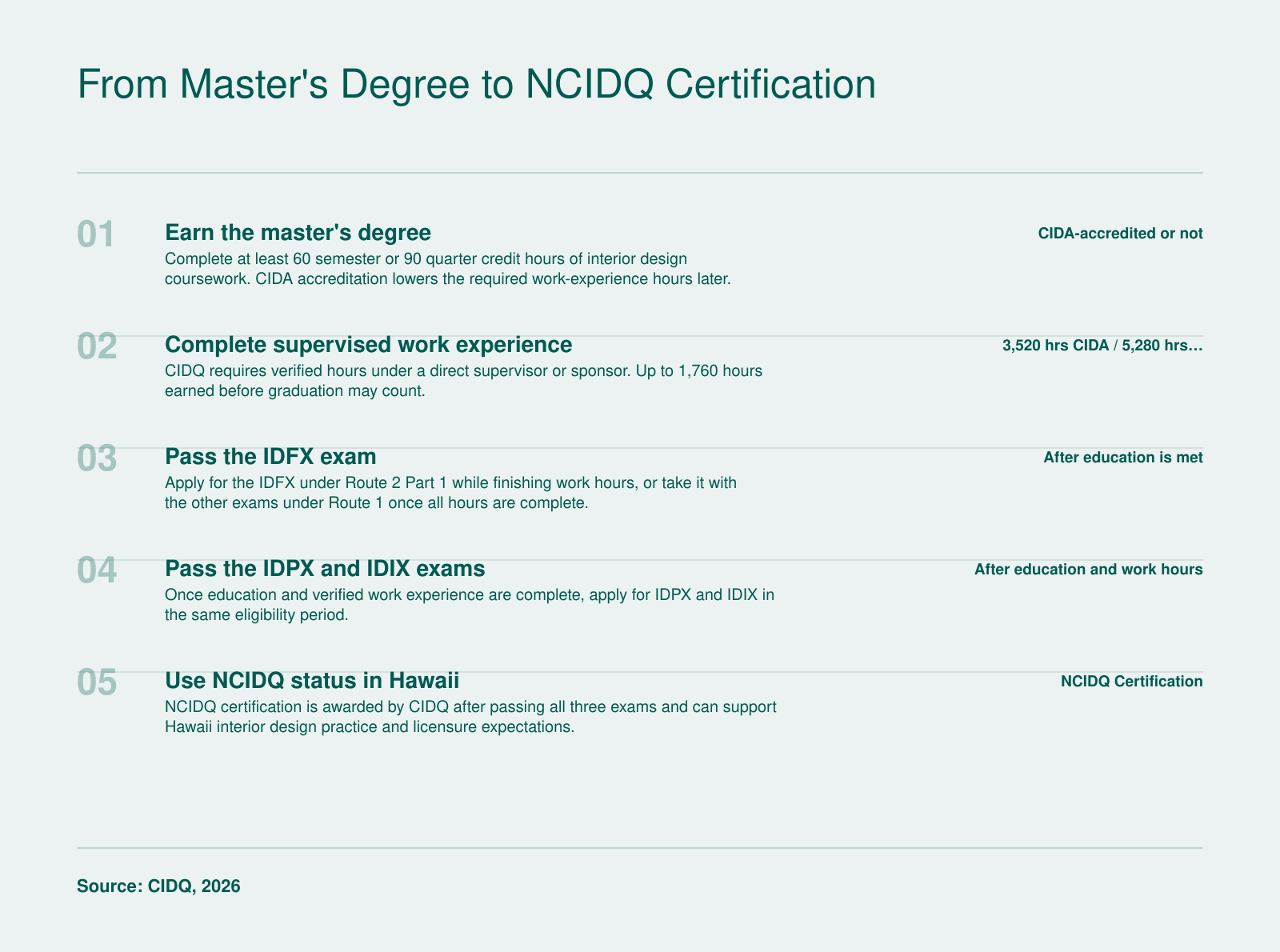
From Master's Degree to NCIDQ Certification
A master's degree affects NCIDQ eligibility mainly through verified work-experience hours: CIDQ requires 3,520 hours for a CIDA-accredited master's and 5,280 hours for a non-CIDA master's, provided the transcript shows 60 semester or 90 quarter credit hours of interior design coursework. Starting in April 2026, the PRAC exam was replaced by IDIX, so the current path is IDFX, then IDPX and IDIX.
Master's in Interior Design vs. Interior Architecture vs. Architecture in Hawaii
Within arts & design master's programs, a Master of Interior Design points toward interior-design practice, while a Master of Architecture points toward architect licensure. The Master of Interior Architecture sits between them and means different things at different schools.
- Master of Interior Design (MID, MFA, MS): Centers on interior environments. CIDA is the specialized accreditor, and graduates work toward NCIDQ certification. CIDA accreditation isn't required to sit for the exam, but it is the simplest way to show educational competency.
- Master of Interior Architecture (MIA): Usually more architecture-oriented, but the title isn't standardized and it does not lead to architectural licensure. Check each program's CIDA status.
- Master of Architecture (MArch): Comprehensive building design, accredited by NAAB.1 It is the principal route to architect licensure, though experience and exams are still required.
Staying in the islands
Hawaii's public flagship university in Mānoa offers a NAAB-accredited Doctor of Architecture (90 credits over 36 months for students with a pre-professional degree)1 and a LAAB-accredited Master of Landscape Architecture.2 Neither is an interior design degree, so they suit architecture or landscape careers, not interior design licensure.
Choose the MID for interior practice, the MIA only after verifying its outcomes, and the MArch to become an architect.
Frequently Asked Questions About Interior Design Master's Degrees in Hawaii
Does any college in Hawaii offer a master's degree in interior design?
Can I become an interior designer in Hawaii with an online master's degree?
Are there CIDA-accredited online master's in interior design programs?
Can Hawaii residents get reduced tuition at mainland schools through WICHE's Western Regional Graduate Program (WRGP)?
Compare Interior Design programs on the data that matters
Explore more Arts & Design specializations or browse every graduate field.
All Arts & Design programs