Best Master's in Interior Design Programs in Louisiana
Compare accredited Interior Design master's programs by earnings, cost, and outcomes.

Louisiana's graduate interior design field is thin. In-state master's options are scarce, so most applicants end up weighing out-of-state campus programs against the cost of relocating. State registration adds pressure: Louisiana requires accredited education, supervised experience, and a passing NCIDQ exam before you can practice as a registered interior designer.
That turns delivery format, GRE and portfolio rules, tuition, and the thesis versus non-thesis choice into financial decisions rather than preferences. Rankings here draw on federal College Scorecard and IPEDS figures, which reward verifiable outcomes over reputation.
Key Points
- LSU's M.S.I.D. makes the GRE optional for applicants in 2027.
- About $5,712 covers 15 resident graduate credits at LSU in Fall 2026.
- LSU's M.S.I.D. lacks CIDA accreditation because CIDA has no post-professional standards.
Best Master's in Interior Design Schools in Louisiana: 2027 Rankings
None of the master's programs in our verified dataset is based in Louisiana, so this ranking covers out-of-state campus programs that Louisiana residents can realistically target. Schools are ordered by CIDA accreditation, published program-level outcomes from the College Scorecard, and estimated cost from IPEDS. Distance from Louisiana is also considered: Florida and Georgia options sit closer to home than programs in the Northeast or Southwest. Before applying, check whether a program is listed in SREB's Academic Common Market, which can reduce out-of-state tuition for eligible residents. Also confirm that the degree fits the Louisiana State Board of Interior Designers' education requirements.
Drexel University
#1Philadelphia, PA · ~$38,500/yr (est.)
Best for: Career changers seeking top-ranked, accredited studio training
Drexel's Interior Architecture and Design MS holds both CIDA and NASAD accreditation, which gives Louisiana residents a strong path toward NCIDQ eligibility and state registration. Graduates of the program earned a median $80,986 four years after completing, the highest program-level figure in this ranking. Three entry tracks let career changers and design graduates alike find a fit. IPEDS reports a 78% institutional graduation rate and 90% retention.
- CIDA and NASAD accredited; supports a pathway toward licensure
- Graduates earned a median $80,986 four years after completing (College Scorecard)
- 75-credit, 3-year first-professional track for students without a design background
- 43-credit, 2-year track for students with interior design or architecture degrees
- 33-credit, 1.5-year post-professional track for prior accredited interior design study
- Studios, lighting, interior systems, and materials, plus Interior Thesis I and II and a comprehensive exam
- Portfolio optional for admission through Drexel Admissions
- Ranked by DesignIntelligence among the top programs in the country
Marymount University
#2Arlington, VA · $29,137/yr (est. net price)
Best for: Non-design graduates targeting NCIDQ eligibility
Marymount's first-professional M.A. in Interior Architecture + Design is CIDA accredited and meets the education requirement to sit for the NCIDQ Exam, a key step toward registration in Louisiana. Graduates of the program earned a median $69,957 four years after completing and $55,169 one year after. Students should weigh those earnings against the program's $95,211 median debt at completion. The STEM designation is a plus for international students.
- First-professional track is CIDA accredited; the post-professional track is not
- First-professional degree meets the education requirement for the NCIDQ Exam
- Graduates earned a median $69,957 four years after completing; $55,169 one year after
- Median debt at completion: $95,211 (College Scorecard)
- STEM-designated, with a 24-month OPT extension for international students (36 months total)
- Thesis required; classes are classroom-based in Arlington, Virginia
- Nondegree students may take up to two IAD courses (six credits)
Arizona State University Campus Immersion
#3Tempe, AZ · $12,223 – $33,139/yr (est. tuition range)
Best for: Value seekers wanting strong four-year outcomes
ASU pairs solid program-level outcomes with lower list tuition than the private schools ranked above. Graduates of its interior design-field master's programs earned a median $69,930 four years after completing and $47,217 one year after. Median debt at completion was $60,449. Louisiana residents would pay the out-of-state rate of $33,139 per year, so compare that figure against Drexel and Marymount when building a budget.
- Graduates earned a median $69,930 four years after completing (College Scorecard)
- Median earnings of $47,217 one year after completing
- Median debt at completion: $60,449
- In-state tuition $12,223/yr; out-of-state $33,139/yr (IPEDS)
- 68% institutional graduation rate and 86% retention (IPEDS)
- 90% institution-wide acceptance rate
- Campus Immersion delivery at ASU's Tempe campus
Florida International University
#4Miami, FL · ~$9,300/yr (est.)
FIU has the lowest estimated net price in this ranking at $9,288 per year, which makes it the budget pick for Louisiana residents. Its Miami campus is one of the closer options to Louisiana in this list. The subtropical, hurricane-prone setting will feel familiar to designers from south Louisiana. IPEDS reports a 74% graduation rate and 92% retention institution-wide.
- Lowest estimated net price in this ranking: $9,288/yr (IPEDS)
- In-state tuition $6,565/yr; out-of-state $18,964/yr
- 74% institutional graduation rate and 92% retention (IPEDS)
- 55% institution-wide acceptance rate
- Institution-wide median debt of $16,500 (IPEDS)
- Subtropical, hurricane-prone setting comparable to coastal Louisiana
- Confirm current CIDA accreditation status on cida.org before applying
Brenau University
#5Gainesville, GA
Brenau publishes a course listing for its Master of Arts in Interior Design. Its Georgia location keeps it within the Southeast and a shorter trip from Louisiana than most programs in this ranking. Prospective students should confirm delivery format, accreditation status, and whether the curriculum meets NCIDQ and Louisiana registration requirements.
- Brenau publishes a full course listing for its MA in Interior Design
- Private university in Gainesville, Georgia
- Southeastern location, closer to Louisiana than most ranked schools
- Compare the course sequence against NCIDQ education eligibility rules
- Verify accreditation status on CIDA's accredited program list
- Ask admissions about delivery format, GRE policy, and portfolio expectations
Boston Architectural College
#6Boston, MA
Boston Architectural College is an independent school focused on architecture and design disciplines. That focus may appeal to Louisiana students who want interior design study grounded in a broader built-environment curriculum. Because we have no verified program or cost data for BAC, confirm the current degree title, tuition, and accreditation directly before applying.
- Independent college focused on architecture and design disciplines
- Located in Boston, Massachusetts
- Confirm current master's degree title and track options with admissions
- Check CIDA's accredited program list for accreditation status
- Ask whether the degree meets NCIDQ education eligibility requirements
- Compare the curriculum against Louisiana State Board of Interior Designers requirements
- Request the current tuition and fee schedule, since no verified net price is listed here
Online and Hybrid Master's in Interior Design Options in Louisiana
On-campus studio culture and online flexibility pull in different directions, and Louisiana applicants considering Master's Programs in Louisiana should confirm format before applying.
LSU's 2026 M.S.I.D. sits in the College of Art & Design's School of Interior Design, but the published materials do not state whether delivery is on-campus, hybrid, or fully online. The curriculum also does not define a separate part-time path. Both thesis and non-thesis tracks require 36 credits: 24 coursework credits plus 12 credits of thesis research or directed design project. LSU does not publish a typical completion time; at roughly 12 credits per semester, 36 credits could fit three semesters, but that is not an official pace.
For working professionals comparing Master's in Interior Design programs, the ranked listings note delivery format individually, so compare campus-only and online or hybrid options before deciding. If no fully online Louisiana-based program fits your schedule, the out-of-state online master's in interior design programs included here may be the more realistic route.
GRE Requirements: Which Louisiana Interior Design Master's Programs Waive or Require the GRE
LSU's Master of Science in Interior Design (M.S.I.D.) makes the GRE optional. Here are the program's published application requirements.
- GRE PolicyLSU's M.S.I.D. does not require GRE scores; the GRE is optional. The LSU Graduate School also does not require official GRE scores from nationally standardized tests, though departments may set separate requirements.
- PortfolioSubmit one PDF portfolio, maximum 30 MB. The admissions page does not specify a required number of pieces, project categories, or captions beyond those two limits.
- Statement of IntentA statement of intent up to 500 words is required.
- Application Deadline & GPAThe program deadline is February 1. Admission without probation requires a minimum cumulative GPA of 3.0, whether from the prior undergraduate degree or the last 60 credit hours; graduate coursework GPA of 3.0 also applies if applicable.
- Prerequisites & LevelingEligible backgrounds include interior design, interior architecture, architecture, landscape architecture, environmental design, or a closely related discipline. Applicants from other disciplines are encouraged but may need interior design foundation courses before full admission; specific course names are not listed.
- Letters of RecommendationThree recommendation letters are required for the M.S.I.D. application.
- English ProficiencyInternational applicants whose native language is not English must submit acceptable TOEFL, IELTS, or PTE scores.
Related Articles
Cost, Funding, and Louisiana Interior Design Licensure
In-state vs out-of-state tuition is the first lever on cost, and the gap is real even among the most affordable master's in interior design programs. At LSU, where the Master of Interior Design falls under standard graduate rates for Fall 2026, a resident taking 15 credit hours pays about $5,712 in tuition and required fees per semester, while a nonresident pays about $10,043, per the LSU tuition and fees schedule. At a lighter 9-hour load, those figures drop to roughly $4,647 and $8,935. Residency status, in other words, raises the sticker substantially for the same seats.
Graduate Assistantships at LSU
LSU awards interior design assistantships selectively, usually at admission. Some assistantships carry a tuition waiver; a 50% appointment (20 hours a week) carries a nonresident fee waiver where applicable and a 75% health-insurance waiver, while a 25% appointment (10 hours a week) waives nonresident fees but leaves you responsible for tuition. LSU lists full-year stipend reference figures of $23,000 (9-month) and $30,667 (12-month), with minimums of $5,400 and $10,800 by effort level. Departments set actual amounts, so ask the program directly.
Licensure in Louisiana
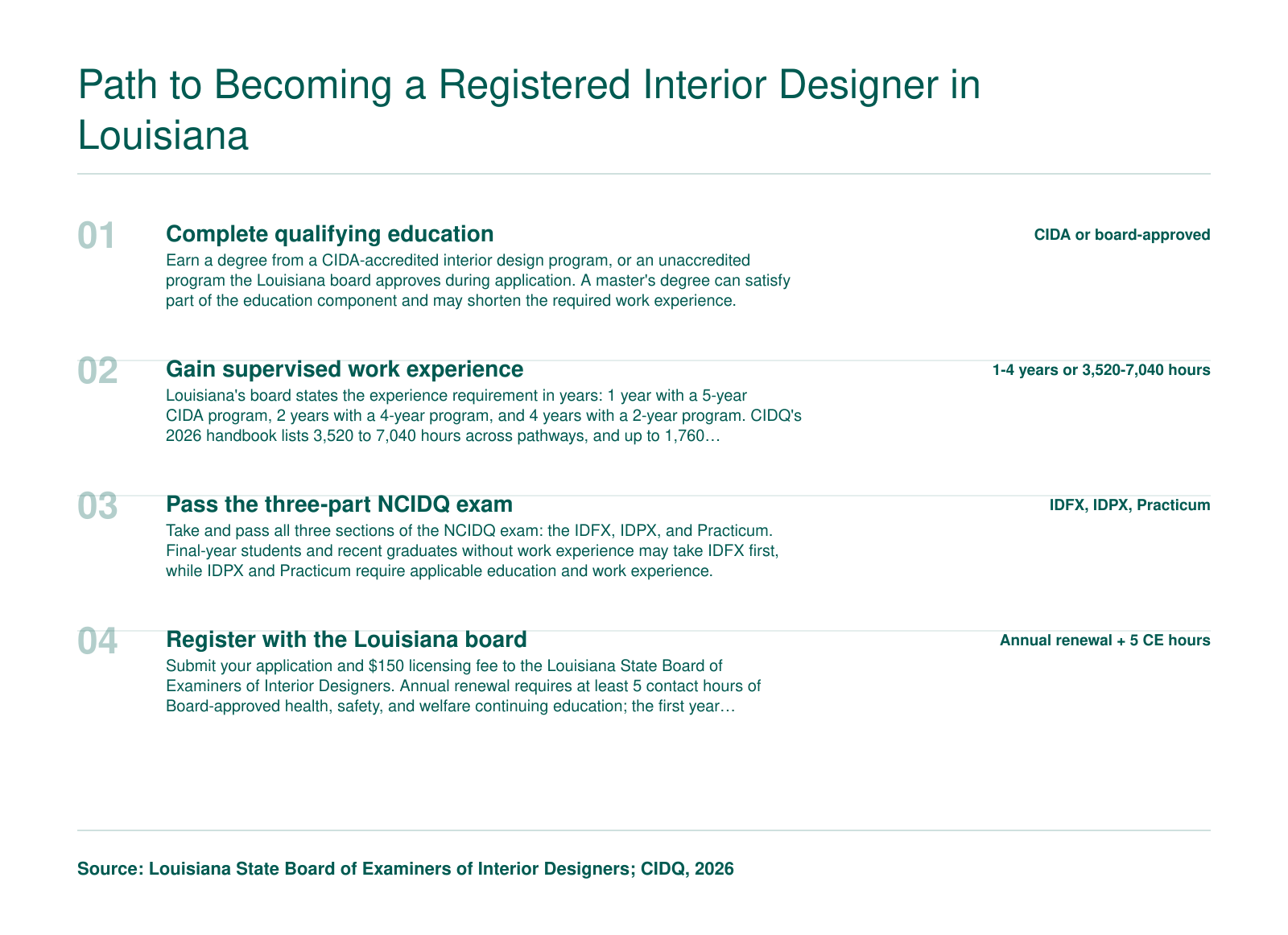
Louisiana regulates the profession through the State Board of Examiners of Interior Designers, with the NCIDQ exam central to registration. See the pathway graphic below. Any institution-wide net price is an average across all students, not a quote for graduate study.
Path to Becoming a Registered Interior Designer in Louisiana
Louisiana requires a combination of accredited interior design education, supervised work experience, and passage of the NCIDQ exam before you can register with the state board. A CIDA-accredited master's degree can count toward the education requirement and may reduce the experience you need. Here is the standard pathway.
Thesis vs Non-Thesis Tracks: Choosing the Right LSU Master's in Interior Design
The real fork in LSU’s Master of Science in Interior Design is not total credits, but what you want the degree to do next. Both tracks sit within a 36-credit structure: 9 core credits, 15 approved electives, and 24 credits overall before the culminating work. Required courses ID 7003 and ID 7005 anchor both paths. The thesis path pairs the core with 12 credits of thesis research through ID 8000, ending in a written master’s thesis. The non-thesis path replaces that with 12 credits of terminal project work through ID 7900, ending in a research-informed design investigation with an oral presentation and final exhibit. Electives must be committee-approved in both routes, but the thesis version ties them to your research goals. Choose the thesis if you are aiming at teaching, research, or a PhD. Choose the non-thesis project if you want to specialize and return to practice.
CIDA accredits only professional-level interior design programs, mostly bachelor's degrees plus some entry-level master's degrees. Per CIDA and LSU, LSU's accreditation covers its Bachelor of Interior Design, not the M.S.I.D., because CIDA has no standards for post-professional study.
What Can You Do With a Master's in Interior Design in Louisiana?
A master's can push you past entry-level drafting toward the two paths that most graduates weigh: specialized practice and leadership or teaching. Which you chase shapes where the degree pays off.
Program-level earnings for the schools ranked here are not consistently published, so treat any single figure cautiously rather than as a promise. For broader context, the Bureau of Labor Statistics' Occupational Employment and Wage Statistics reports a national median wage of $67,190 for interior designers (SOC 27-1025) as of May 2025, with about 71,500 employed workers, a count that excludes the self-employed. BLS does not establish a separate Louisiana figure in the current data, so the national median is the safer benchmark. Employment is projected to grow 3% from 2025 to 2035, about as fast as average, according to the Occupational Outlook Handbook.
Realistic roles include:
- Commercial and healthcare design: offices, clinics, and code-driven spaces.
- Hospitality design: hotels, restaurants, and resorts.
- Design management: leading project teams and client relationships.
- University teaching: a graduate degree is often the minimum credential.
Louisiana Interior Design Master's FAQs
Is LSU's M.S.I.D. the only master's in interior design in Louisiana?
How much does a master's in interior design cost in Louisiana?
Do you need a portfolio for LSU's interior design master's program?
Can a master's degree help you qualify for the NCIDQ exam if your bachelor's is in another field?
Compare Interior Design programs on the data that matters
Explore more Arts & Design specializations or browse every graduate field.
All Arts & Design programs