Best Master's in Science Education Programs in Massachusetts
Compare accredited Science master's programs by earnings, cost, and outcomes.
Sample layout — live rankings and program data appear here once the data source is connected.

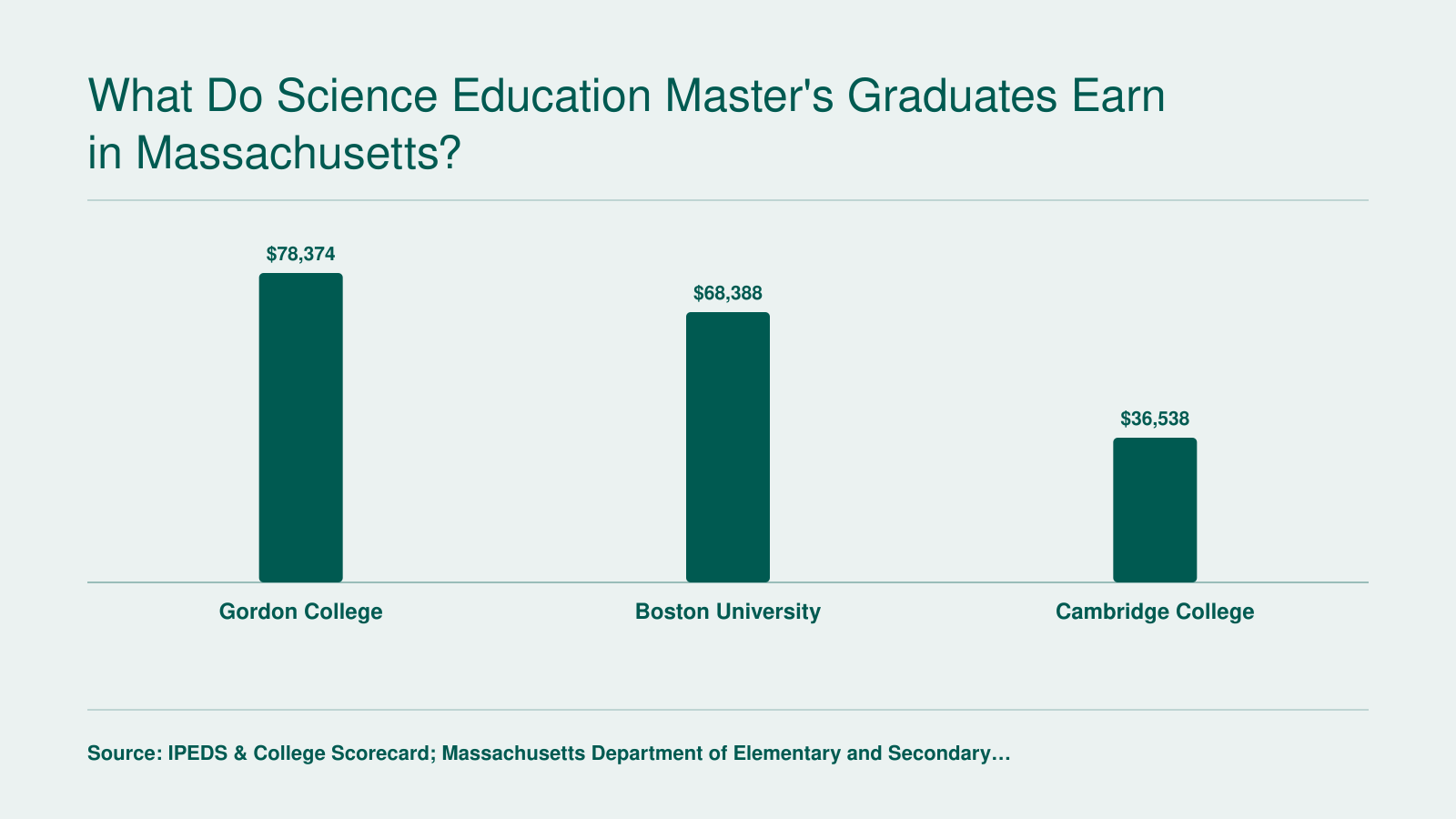
Which master's actually puts you in a Massachusetts science classroom: one designed for an initial teaching license, or one meant to advance a license you already hold? That distinction changes coursework, practicum hours, and the MTEL sequence more than any other factor. Four-year median earnings for science education master's graduates in this set run from about $36,500 to $78,400, a spread that makes license path and program format part of the same money decision as the degree itself. Cost, completion, and those earnings set the terms across campus, online, and hybrid routes for a Master's in STEM Education in Massachusetts. GRE policies and tuition gaps can tilt the value before any classroom placement is guaranteed.
Key Points
- Cambridge College offers a hybrid General Science M.Ed. leading to a Massachusetts initial license.
- Median program debt at Boston University is $28,103, so compare cost against earnings.
- Several schools publish no GRE rule, so confirm admissions requirements before applying for 2027.
Best Master's in Science Education Programs in Massachusetts, Ranked
Four Massachusetts schools made this list, and they differ sharply on licensure, format, and current availability. Check each card for whether the program is built for initial licensure candidates or already-licensed teachers. One program is not currently taking applications, and the card says so.
University of Massachusetts-Amherst
#1Amherst, MA · $15,000 – $20,000/yr (est.)
UMass Amherst offers a fully online Master of Education in Science Education aimed at practicing elementary and middle-school teachers. It is listed as approved for elementary grades 1-6 and general science grades 5-8, and the university graduates about 83% of its students. The program is currently not accepting applications, and no 2026-2027 reopening date or deadline could be confirmed, so check with the college before planning around it. It is described as meeting professional licensure requirements for elementary teachers in Massachusetts, not as an initial licensure route.
- Application status: not accepting applications
- Fully online delivery
- Approved for elementary grades 1-6
- Approved for general science grades 5-8
- Covers biology, earth science, and physical sciences
- Fulfills professional licensure requirements for elementary teachers, not initial licensure
Boston University
#2Boston, MA · $65,000 – $70,000/yr (est.)
Best for: Career changers seeking initial licensure
Boston University's EdM in Science Education is an in-person, 36-credit program housed at BU Wheelock, with full-time and part-time options. Candidates can follow a customized path or pair the degree with a graduate certificate to pursue Massachusetts initial licensure in biology, chemistry, physics, or general science. The university graduates about 89% of its students. BU also offers a full-tuition Robert Noyce Scholarship to eligible science-background candidates who commit to teaching in designated high-need districts.
- 36 total credits, in-person format
- Full-time and part-time options
- Initial licensure in biology, chemistry, physics, or general science via a graduate certificate
- Merit-based scholarships available
- Noyce Scholarship for eligible science-background candidates
- Courses include Science Teaching Methods and Foundations of Science Education
Gordon College
#3Wenham, MA · ~$9,000/yr (est.)
Best for: Aspiring grades 8-12 earth science teachers
Gordon College in Wenham offers an M.Ed. with an initial licensure track in Earth and Space Science for grades 8-12. It is a 36-credit campus program with 12 credits of Earth Science concentration coursework, and the college graduates about 69% of its students. Candidates must pass the Massachusetts Tests for Educator Licensure before practicum, which makes this a licensure-first option rather than one for already-licensed teachers.
- 36 total credits, on campus
- Initial licensure track for grades 8-12
- 12 credits of Earth Science concentration courses
- Pass MTEL tests before starting practicum
- EDU641 Sheltered English Immersion required for licensure
- Content courses can be shaped around student interest
Cambridge College
#4Boston, MA · $10,000 – $15,000/yr (est.)
Cambridge College in Boston offers a hybrid Master of Education in General Science with 1-6 and 5-8 options, combining live Zoom classes with self-paced online work. One track leads to a Massachusetts Initial Teaching License with a supervised practicum, and a second track is non-licensure. Tuition is listed at $639 per credit. The college graduates about 11% of its students institution-wide, a figure worth weighing alongside the lower per-credit price.
- Hybrid: synchronous Zoom plus asynchronous coursework
- Grade-band options: 1-6 or 5-8
- Licensure track with practicum, plus a non-licensure option
- $639 per credit
- Covers earth, life, physical, and engineering sciences
- Minimum of two letters of recommendation
Online and Hybrid Master's in Science Education Options in Massachusetts
Cambridge College runs its Master of Education in General Science as a hybrid program. It pairs live Zoom sessions with asynchronous coursework and prepares students for a Massachusetts initial teaching license in grades 1-6 or 5-8.
- Fully online: UMass Amherst lists an online master's in science education, the M.Ed. in Science Education Online, approved for elementary grades 1-6 and general science grades 5-8. Its official page said the program was not accepting applications as of March 2025, so confirm 2026 availability before planning around it. Published details do not say whether classes meet live or on your own schedule.
- Hybrid: Cambridge College mixes synchronous and asynchronous instruction and builds in a practicum.
- Campus only: Boston University's M.Ed. in Science Education is in person, with full- and part-time options and an optional initial-license track. Gordon College's Earth and Space Science (8-12) M.Ed. is campus-based, includes courses with pre-practicum field components, and requires passing MTEL tests before the practicum begins.
These schools do not clearly state whether the remote formats require campus visits, or whether a practicum can be completed in a school where you already teach. Ask admissions directly. Many licensure programs, especially those at MAT schools in Massachusetts, allow placement at your employing school with an approved supervisor, but policies vary.
Whatever the delivery format, an initial-licensure master's still ends in supervised, in-person classroom fieldwork in a Massachusetts school.
Which Master's in Science Education Programs Waive the GRE?
Policies vary among Master's Programs in Massachusetts, and several schools here publish no explicit GRE rule, placing them among the master's programs with no GRE required. Here is what each admissions source supports.
- Boston University: The EdM in Science Education lists no required exam for 2026-2027, and the university's general graduate policy says the GRE is not required for programs not listed as requiring it. The MAT requires an undergraduate science major in biology, chemistry, general science, or physics, and leads to initial licensure for grades 8-12 or 5-8. Minimum GPA is not stated on the pages reviewed.
- UMass Amherst: The program page for the online Master of Education in Science Education does not state a GRE policy. For licensure routes, MTEL scores are not required before admission. Communication and Literacy is normally passed in the first semester, and subject-matter tests must be passed before practicum. Qualifying candidates may waive Communication and Literacy from April 28, 2026 through June 30, 2029.
- Gordon College: No GRE policy appears on the catalog page for the Earth and Space Science (8-12) M.Ed. with initial licensure. MTEL tests must be passed before practicum, not necessarily before admission.
- Cambridge College: No GRE policy or minimum GPA is published for the Master of Education in General Science. Applicants submit at least two letters of recommendation.
Where a policy is unstated, confirm it with the admissions office before you apply.
Related Articles
Master's in Science Education Tuition and Massachusetts Licensure
Sticker price and the license a program actually delivers rarely line up, and in Massachusetts the gap is wide: the cheapest option here costs a fraction of the priciest, while all of them route through the same state licensure ladder.
Comparing the Cost
From least to most expensive by published graduate tuition:
- Gordon College: The lowest tuition of the group, with an institution-wide average net price (after aid, across all students) near $24,900. Its Earth and Space Science M.Ed. runs 36 credits.
- Cambridge College: Roughly $639 per credit by its own listing, with a net price averaging about $46,000. Hybrid delivery.
- UMass Amherst: In-state graduate tuition around $17,800, with out-of-state notably higher; average net price near $22,400.
- Boston University: The costliest here, reported near $66,670 per year for its 38 to 40 credit MAT, offset for some by the Robert Noyce full-tuition scholarship, which carries a high-need-district teaching commitment.
Treat net price as an average after aid, not a quote for your program. Federal options (TEACH Grant up to $4,000 a year, Public Service Loan Forgiveness after ten years of public-school payments) apply broadly; confirm any teacher discount or assistantship directly with each school.
The Massachusetts Ladder
The state moves teachers from Preliminary to Initial to Professional. Initial licensure requires a DESE-approved preparation program, the Communication and Literacy Skills MTEL, and a subject test (General Science, Biology, Chemistry, Earth and Space Science, or similar). This splits the programs cleanly: initial-licensure tracks suit career changers, while a master's plus 12 related graduate credits, including a Master's in Curriculum and Instruction in Massachusetts, can satisfy the Professional license for teachers already holding Initial status.
Massachusetts Science Teacher Licensing at a Glance
What Do Science Education Master's Graduates Earn in Massachusetts?
Median earnings below are program-level figures for science education master's graduates, measured four years after completion. UMass Amherst is left out because it reports no program-level figure, and institution-wide earnings are not substituted. Median program debt is $28,103 at Boston University and $16,530 at Cambridge College; Gordon College reports none. Boston University's educator preparation program also reported a 92% MTEL pass rate for 2024-25. MTEL results are not designed to judge employment prospects or program quality.
Master's in Science Education in Massachusetts: Common Questions
Which Massachusetts master's in science education program is best for initial licensure?
Can I teach science in Massachusetts on a Preliminary license while earning my master's?
Will a Massachusetts science teaching license transfer to other states?
Which programs work for teachers who already hold an Initial license?
Compare Science programs on the data that matters
Explore more Education & Teaching specializations or browse every graduate field.
All Education & Teaching programs