Best Master's in STEM Education Programs in Nebraska
Compare accredited Stem Science Technology Engineering Math master's programs by earnings, cost, and outcomes.
Sample layout — live rankings and program data appear here once the data source is connected.

A master's in STEM education is a graduate degree for certified teachers who want deeper content knowledge in math or science, an added endorsement, or a path to roles like instructional coach or district STEM coordinator. In Nebraska, most of these programs expect a current teaching certificate and can be finished while you keep your classroom job.
Only five Nebraska institutions made the ranking, spanning campus, online, and hybrid formats and several concentrations. Tuition, GRE requirements, and endorsement fit vary more than the degree titles suggest, and Nebraska's STEM-designated pay premium remains modest.
Key Points
- UNK's online M.S.Ed. in STEM Education costs $12,833.50, the lowest here.
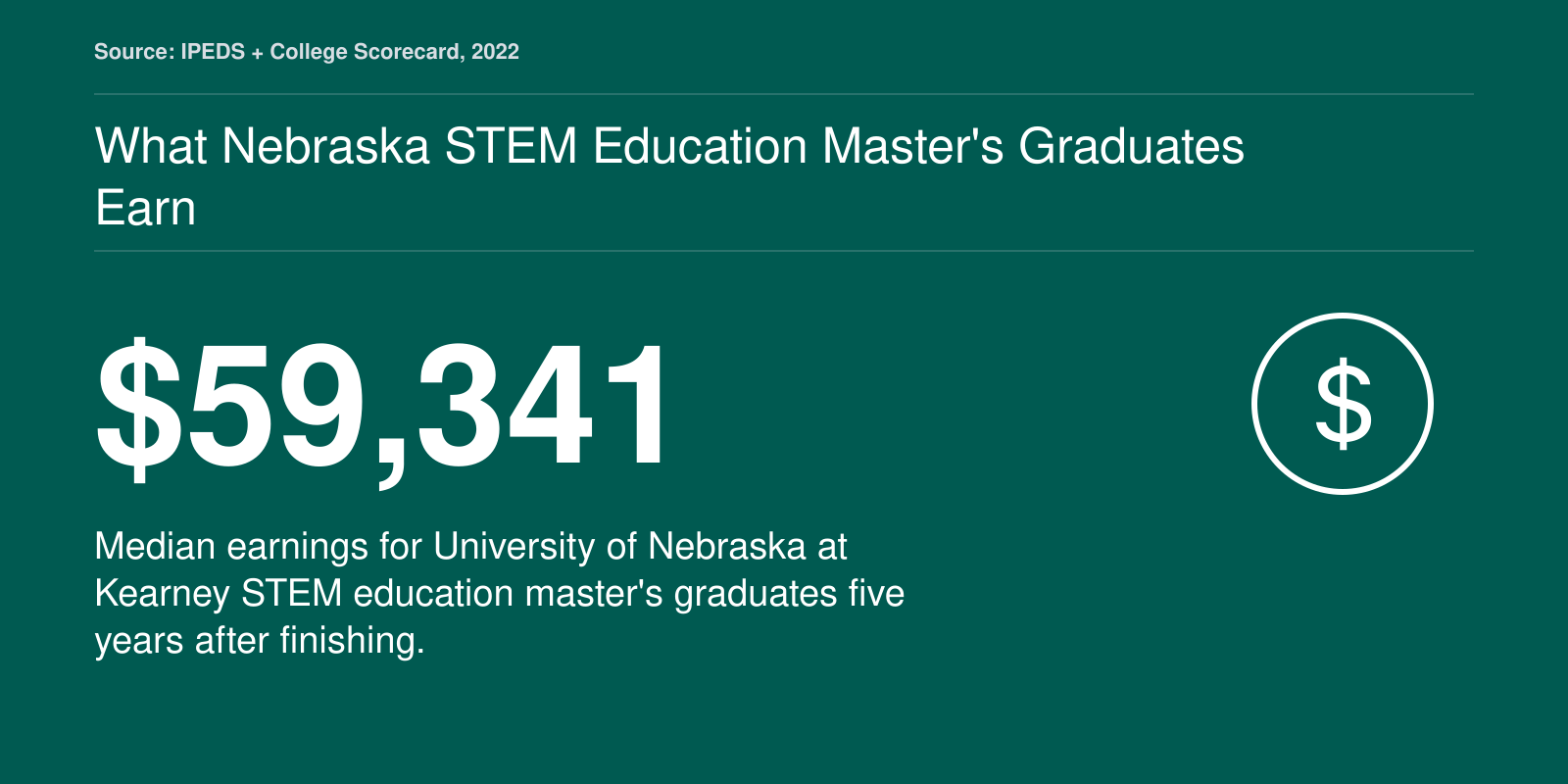
- UNK STEM education graduates report median earnings of $59,341 after five years.
- Nebraska teachers add STEM endorsements by passing Praxis content tests via TEACH.
Best Master's in STEM Education Programs in Nebraska, Ranked
This ranking brings together Nebraska institutions that offer graduate STEM-related master's pathways, with campus and online options compared side by side. Several schools list multiple programs or concentrations, such as science versus mathematics education, and those are grouped under one institutional card so readers do not mistake one school for several.
University of Nebraska at Kearney
#1Kearney, NE · ~$8,000/yr (est.)
Best for: Practicing STEM teachers seeking online depth
University of Nebraska at Kearney's Master of Science in Education in STEM Education is built for certified science and math teachers who want to deepen content and pedagogy. The 30-credit program is fully online, so working Nebraska educators can keep teaching while completing a capstone that connects coursework to classroom practice. Six concentration options span biology, chemistry, mathematics, physics, technology, and integrated tracks. The university graduates 58% of students overall.
- Online only with advisor-guided course selection
- 30 total credit hours and capstone required
- Six concentration options across STEM fields
- Requires current teaching certification
- Six credits in two STEM disciplines
- Letter of intent and exit survey required
- Interdisciplinary faculty committee oversight
- Chemistry option covers four of five areas
- Requires science or math endorsement
- Courses deepen content, technology, and curriculum
University of Nebraska-Lincoln
#2Lincoln, NE · $5,000 – $10,000/yr (est.)
Best for: Rural Nebraska educators seeking STEM leadership
The University of Nebraska-Lincoln combines a STEM-designated Master of Architecture with the NebraskaSTEM Master Teaching Fellows, a rural-focused program for current elementary teachers in high-needs Nebraska schools. The NebraskaSTEM fellowship includes summer coursework and ongoing school-year STEM initiative work, with online classes during the school year. The university graduates 67% of students overall.
- STEM-designated, three-year, 114-credit path
- NAAB accredited with two concentration options
- Thesis or capstone option and study abroad
- Rural STEM Education concentration for current teachers
- Up to $18,500 summer stipend
- $10,500 annual stipend over five-year fellowship
- Online classes during the school year
Creighton University
#3Omaha, NE · $20,000 – $25,000/yr (est.)
Creighton offers a hybrid Master of Science in Business Analytics with rolling admissions and a campus-based master's in pharmacology and neuroscience. The analytics degree is STEM-designed and can be completed in just over two years, while the pharmacology and neuroscience program includes thesis work and research preparation. The university graduates 83% of students overall.
- Hybrid format with rolling admissions
- 33 total credit hours
- STEM-designated by U.S. government
- GMAT exam required and dual MBA option available
- Campus-based with 30 total credit hours
- Eight concentration options
- Thesis required
- Prepares for MD or PhD pathways
Bellevue University
#4Bellevue, NE · ~$13,000/yr (est.)
Bellevue University's online STEM-designated master's degrees in management information systems and data science are built for working adults, with asynchronous classes and no entrance exam for most pathways. MIS concentrations include business administration, business analytics, and cybersecurity. The data science program covers Python, R, and Tableau. The university graduates 33% of students overall.
- No entrance exam required
- 36 total credit hours at $680 per credit
- Asynchronous online classes
- Capstone required and STEM-designated
- Test-optional admissions
- SAS certification aligned in analytics courses
- Internship can fulfill degree requirements
- Non-licensure degree program
- Prepares for mid-level or senior IT leadership
- Internship option available
- 30 total credit hours at $680 per credit
- No prior programming experience needed
- Tools include Python, R, and Tableau
- Focus on AI, big data, and ethics
University of Nebraska Medical Center
#5Omaha, NE · $10,000 – $15,000/yr (est.)
The University of Nebraska Medical Center offers campus-based master's programs in biochemistry and molecular biology, along with biostatistics available in campus or hybrid formats. These degrees prepare students for health-professions careers and graduate-level research. Specific coursework and costs are detailed on program pages.
- Campus-based program
- Prepares for health professions careers
- Campus or hybrid delivery
- Full-time and part-time options
- Thesis or capstone option
- Complete in two to four years
How We Rank Nebraska STEM Education Master's Programs
Every placement on this list of STEM education master's programs traces back to federal data, not reputation. For Master's Programs in Nebraska, we pull graduate tuition, average net price after aid, institution-wide graduation rates, and, where the Department of Education publishes them, program-level earnings and debt for education graduates.
Those figures carry real limits. Graduation rates describe the whole institution, not the STEM education cohort. Net price is a school-wide average after aid, so your own bill may land well above or below it. Smaller graduate programs often have too few completers for earnings to be reported at all.
What numbers cannot capture matters too: curriculum fit, who teaches the methods courses, cohort size, and whether coursework aligns with the endorsement you want. Check those on each school's own pages before you commit.
Online and Hybrid Master's in STEM Education Options in Nebraska
For working teachers in Nebraska, the master's in STEM education has largely moved online; what varies is how much structure a program builds around that flexibility. UNK's M.S.Ed. in STEM Education, a secondary education master's program in Nebraska, is offered online only and runs asynchronously, with no scheduled live meetings described. It is aimed at grades 7 to 12 science and math teachers who already hold a current teaching certificate. UNK's Curriculum and Instruction M.A.Ed., a curriculum and instruction master's program in Nebraska with a STEM concentration or a secondary math or science concentration, follows the same fully online, asynchronous model. Some UNK courses are scheduled for summer, but that reflects when they are offered, not a required on-campus residency.
UNL takes a mixed approach. Its M.A. in Teaching, Learning and Teacher Education blends on-campus, synchronous hybrid and asynchronous classes.1 Its online pathway can be completed entirely online on either a four-semester plan or a longer seven-semester plan, and the seven-semester track is the more realistic fit for a full-time teacher.1 UNL's mathematics department also runs a cohort-based, 36-credit Master of Arts for Teachers.2
Online tuition and e-learning fees can differ from campus rates, so check the cost section below before assuming the online route is cheaper.
Which Nebraska STEM Education Master's Programs Waive the GRE?
Most Nebraska STEM education master's programs rely on transcripts, GPA, and teaching credentials rather than test scores. At the University of Nebraska at Kearney the GRE is not required, while the University of Nebraska-Lincoln's Teaching, Learning and Teacher Education M.A. does not publish a GRE policy on its cited page.
| School | GRE Policy | Minimum GPA | Key Materials | Deadline / Start Terms |
|---|---|---|---|---|
| University of Nebraska at Kearney | Not required | No specified minimum; undergraduate math and science GPA of at least 2.75 is expected | Letter, bachelor's degree with a teaching endorsement, and a standard teaching certificate or license | Spring: early registration late October, general registration mid-November; Summer/Fall: early registration early April, general registration late April |
| University of Nebraska-Lincoln | No published policy | Not published | Not published | Rolling admissions with monthly review; deadline is the first Monday of each month, August through May |
Related Articles
Master's in STEM Education Tuition, Cost, and Nebraska Endorsement Outcomes
The figures below reflect 2026-27 University of Nebraska at Kearney published rates and exclude indirect costs; no separate online fee was identified for either program. The M.S.Ed. in STEM Education is the lowest-cost completed degree shown here at $12,833.50 for Nebraska residents, while its per-credit rate is $369, not an annual total. The M.A.Ed. in Curriculum and Instruction (STEM) costs more because it requires 36 credits, so compare total program cost rather than annual tuition alone.
| Program | Format | Required Credits | Per-Credit Cost (Resident / Non-Resident) | Estimated Total Cost (Resident / Non-Resident) | Nebraska Endorsement Outcome |
|---|---|---|---|---|---|
| M.S.Ed. in STEM Education | Online | 30 | $369 / $591 | $12,833.50 / $19,493.50 | Advanced study for certified teachers; no new endorsement |
| M.A.Ed. in Curriculum and Instruction (STEM) | Online | 36 | $369 / $591 | $15,397 / $23,389 | Advanced study for certified teachers; no new endorsement |
Nebraska Teaching Certification and STEM Endorsements
What Nebraska STEM Education Master's Graduates Earn
The University of Nebraska at Kearney STEM education master's program reports median earnings of $59,341 five years after finishing. A STEM education master's can support advancement into district STEM coordinator, instructional coach, teacher leader, and dual-credit instructor roles; dual-credit teaching generally requires 18 graduate credits in the subject area.
Frequently Asked Questions About Master's in STEM Education Programs in Nebraska
Do I need a teaching license to enroll in a STEM education master's program in Nebraska?
What is the difference between a STEM endorsement and a STEAM emphasis in a master's program?
How long does it take to finish a STEM education master's in Nebraska?
Can I transfer credits or use scholarships to lower the cost?
Compare Stem Science Technology Engineering Math programs on the data that matters
Explore more Education & Teaching specializations or browse every graduate field.
All Education & Teaching programs