Best Master's in Healthcare Administration Programs in Rhode Island
Compare 3 accredited Healthcare Administration programs in Rhode Island, with graduate earnings, cost, debt, and completion data from IPEDS and the U.S. College Scorecard.

Rhode Island's in-state healthcare administration master's options are few enough that tuition, format, and accreditation carry outsized weight. Rhode Island College lists in-state graduate tuition at $546 per credit, while Salve Regina publishes a $16,260 total; its current catalog lists 30 credits and a 2025 brochure lists 36, so confirm which applies.
Campus, hybrid, and online MHA programs sit side by side in the same ranking, so those tradeoffs are easier to compare. Employers in the state's hospital and long-term care systems tend to reward a program's business accreditation and an operations skill set, not the school's name.
Key Points
- Salve Regina MHA graduates earn $69,291 after one year, $92,752 after four.
- Salve Regina publishes the only verified program total: $16,260 for 36 credits.
- Rhode Island nursing home administrator licensure requires 350 hours of internship experience.
MHA at a glance
- Common degrees
- MHA · MSHA · MS in Health Administration · MBA (Healthcare)
- Typical length
- 2 years full-time (1–3 depending on format)
- Formats
- On-campus, online, and hybrid
- Programmatic accreditation
- CAHME (the gold standard for MHA programs)
- Common concentrations
- Hospital administration, health informatics, policy, long-term care
- Typical entry
- Bachelor's degree; GRE increasingly optional
Rhode Island's Top Master's in Healthcare Administration Programs, Ranked
Three Rhode Island institutions offer distinct paths to a healthcare administration master's degree. The University of Rhode Island and Salve Regina deliver online programs, while Rhode Island College offers a campus-based route.
University of Rhode Island
#1Kingston, RI · ~$18,000/yr (est.)
Best for: Working professionals needing accelerated online courses
URI's online M.S. in Healthcare Management sits inside an AACSB-accredited business school and uses seven-week accelerated courses, with no GMAT requirement. The program leans toward analytics, data visualization, process improvement, and financial management for leadership roles across healthcare settings. Institution-wide, about 73% of students graduate, and the typical net price is around $21,400.
- AACSB-accredited program housed in the College of Business
- No GMAT or entrance exam required
- Fully online with seven-week accelerated courses
- Focus areas include analytics, data visualization, process improvement, and financial management
- Ranked No. 18 by U.S. News among online non-MBA master's programs
Salve Regina University
#2Newport, RI · ~$13,000/yr (est.)
Best for: Career changers wanting practical internship options
Salve Regina's online Master of Science in Healthcare Administration spans a broad core that includes healthcare law, finance, policy, ethics, analytics, and public health. A required capstone applies management theory, and students without healthcare experience can add an internship in a hospital, long-term care setting, or regulatory agency. Institution-wide, about 77% of students graduate, while the typical net price runs near $37,000.
- 36-credit, 12-course graduate curriculum
- Fall and spring start dates with capstone requirement
- Covers healthcare law, finance, policy, ethics, analytics, and public health
- Internship option for students without healthcare experience
- Flexible electives in healthcare marketing, team building, and leadership
Rhode Island College
#3Providence, RI · ~$10,000/yr (est.)
Best for: Budget-focused Rhode Island residents seeking campus access
Rhode Island College offers a campus-based MS in Healthcare Administration built around leadership, healthcare finance, law, and performance improvement. Students complete a required internship in a healthcare setting, and faculty connections support networking through seminars and conferences. Institution-wide, about 48% of students graduate, while the typical net price is roughly $9,500, the most affordable of the three options.
- Campus-based program with required healthcare internship
- Curriculum emphasizes leadership, finance, performance improvement, and law
- 89% of faculty hold terminal degrees
- Over 70% of students receive financial aid, including scholarships and grants
- Focus on evidence-based practice, quality improvement, and ethical management
Cost & outcomes by school
Federal data for the highest-earning Healthcare Administration programs, independent of the ranking above. Earnings are this field's master's graduates four years after completing, where the Scorecard reports them.
| School | Earnings | Tuition / yr | Debt | Grads/yr | Format |
|---|---|---|---|---|---|
| Salve Regina University RI | $92,752 | $13,365 | — | 11 | Online |
| Rhode Island College RI | — | $10,112 | — | 14 | Campus |
| University of Rhode Island RI | — | $18,028 | — | 9 | Online |
Sources: U.S. Department of Education. Tuition and graduates: IPEDS. Earnings and debt: College Scorecard, this field's master's graduates; a dash means no figure is reported.
CAHME, AACSB, or IACBE: Where Each Rhode Island Program Stands
Accreditation signals which standards shaped a program. CAHME is the healthcare-management-specific credential that some fellowships and health system employers prefer, while AACSB and IACBE accredit the business school rather than the healthcare curriculum itself. None of the programs listed below hold CAHME accreditation, so prospective students who want that credential may need to weigh program fit and business-school accreditation carefully.
| School | Program | Programmatic Accreditation | Regional Accreditor |
|---|---|---|---|
| Salve Regina University | Master of Science in Healthcare Administration | International Accreditation Council for Business Education (IACBE) | New England Commission on Higher Education (NECHE) |
| University of Rhode Island | Healthcare administration master's program | Not reported in cited source | New England Commission on Higher Education (NECHE) |
| Rhode Island College | Healthcare administration program | No CAHME accreditation identified in cited source | Not established by cited source |
Online and Hybrid Master's in Healthcare Administration Options in Rhode Island
Fully online, asynchronous study and a traditional campus program solve different problems, and the schools in this ranking of master's programs in Rhode Island split along that line. The University of Rhode Island's M.S. in Healthcare Management is fully online and asynchronous, built from 7-week modules with one or two courses per term and starts in fall, spring, and summer. Salve Regina's M.S. in Healthcare Administration is also online, with rolling admission and the same three start terms. Most work can be done at your own pace, though live virtual sessions are part of the mix. Salve Regina's materials use "hybrid" loosely, so ask whether any session is mandatory. Rhode Island College is listed as campus-based, and its page does not spell out meeting times.
None of the sources identifies a required on-campus residency or fixed evening or weekend meetings. They also don't say whether out-of-state online students pay the same rate, so confirm that with admissions before comparing affordable healthcare administration master's programs.
Night-shift clinicians and Massachusetts or Connecticut commuters fit URI or Salve Regina. Career changers who want in-person networking and a required healthcare internship may prefer Rhode Island College.
Related Articles
Which Rhode Island MHA Programs Waive or Make the GRE Optional?
Published admissions pages differ in what they disclose. The table below records each program's GRE or GMAT policy, minimum GPA, work experience, and deadline only where the official page states them. No clear GRE waiver threshold tied to GPA or work experience surfaced in the current research.
| School | GRE/GMAT Policy | Minimum GPA | Work Experience | Deadline |
|---|---|---|---|---|
| Rhode Island College | No published policy | N/A | N/A | No published application deadline |
| University of Rhode Island | No published policy | N/A | N/A | Fall II 2026: September 29, 2026; Spring 2027: November 24, 2026; Spring II 2027: January 26, 2027; Summer 2027: March 30, 2027; Summer II 2027: June 1, 2027; Fall 2027: August 4, 2027 |
| Salve Regina University | No published policy | N/A | N/A | Rolling admission; fall, spring, and summer start dates are available |
Cost, Licensing, and Certification After Your Rhode Island Master's
A low per-credit rate does not always mean a low total bill, which is why published tuition figures for these programs rarely agree. Some sites quote per credit, some a single year, and some the full degree. Public schools such as the University of Rhode Island and Rhode Island College charge different in-state and out-of-state rates, and fees may or may not be included. Salve Regina's current catalog lists 30 credits while a 2025 brochure lists 36, so multiply its per-credit rate against whichever total applies and ask what fees sit on top.
The net price figures ($9,478 at Rhode Island College, $21,440 at URI, $36,967 at Salve Regina) are institution-wide averages after aid, not quotes for the master's.
Rhode Island does not license general hospital administrators.1 Its one state license here is for nursing home administrators, issued by the Department of Health and requiring a bachelor's degree,2 a 350-hour internship, and the NAB exam.1
Most graduates pursue voluntary credentials instead, notably ACHE's FACHE. It requires a master's, five years of management experience,3 and a year of ACHE membership,4 so it comes after graduation.
Total Program Cost at Each Rhode Island MHA School
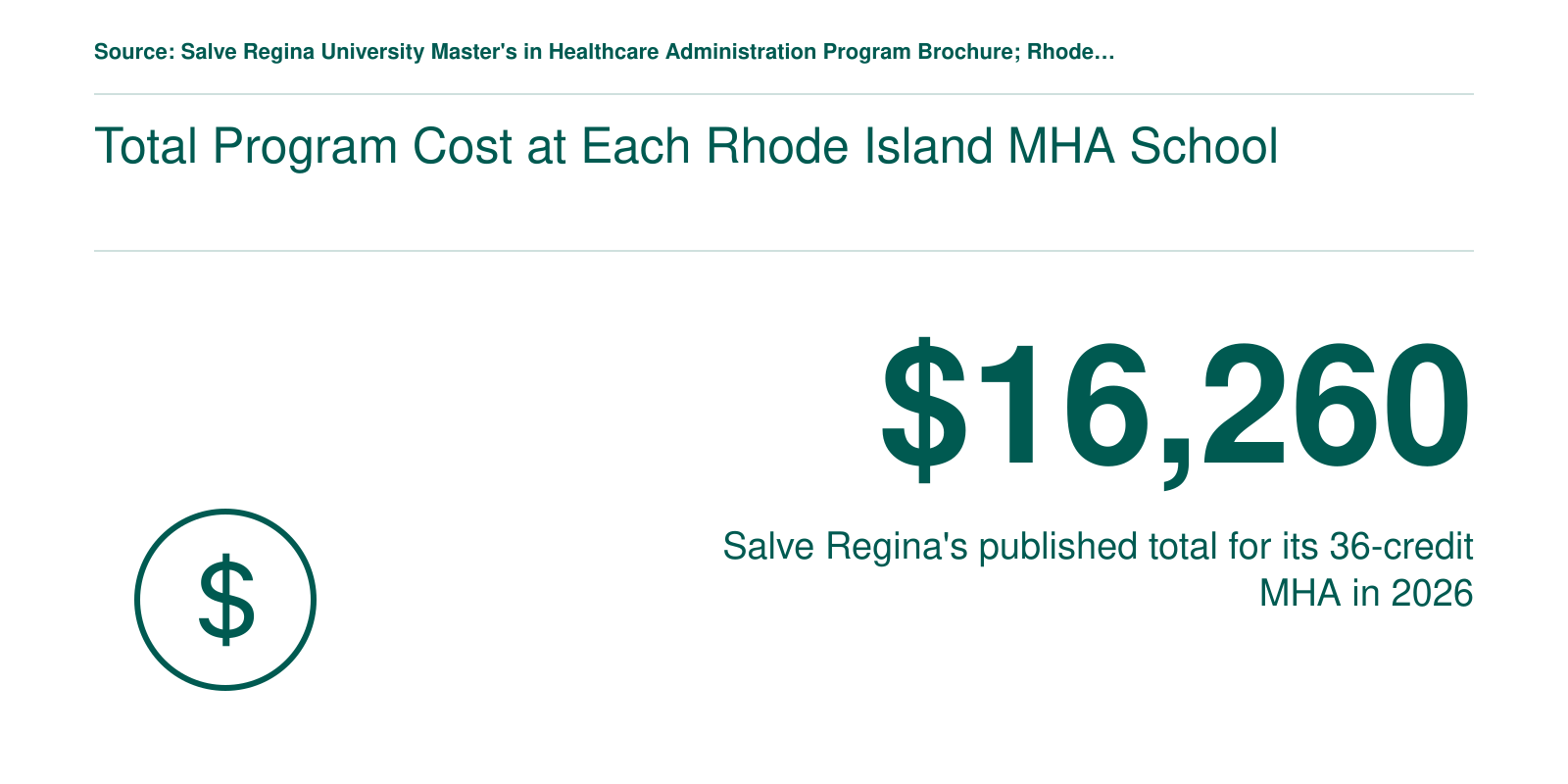
Salve Regina is the only school here that publishes a verified total for its healthcare administration program, $16,260 for 36 credits. Rhode Island College lists in-state graduate tuition at $546 per credit, and URI lists its online healthcare management rate at $875 per credit, but neither publishes a program total. Published tuition excludes financial aid.
Licensing Nursing Home Administrators in Rhode Island
Career Outcomes and Return on Investment for Rhode Island MHA Graduates
Salve Regina University's healthcare administration graduates report median earnings of $69,291 one year after finishing and $92,752 four years after finishing, a strong climb for a program with listed tuition of $13,365. Rhode Island College lists the lowest tuition here at $10,112, and the University of Rhode Island lists $18,028. When you weigh MHA program cost and ROI, look for modest borrowing paired with earnings that rise in the first few years.
Rhode Island Employer Connections
- Rhode Island College: RIC led Healthy Jobs Rhode Island, a workforce partnership with Care New England, Gateway Healthcare, CharterCARE, and South County Hospital that covered recruiting, training, and hiring. It is a career-pathway effort rather than a dedicated MHA placement agreement.
- University of Rhode Island MPH: URI public health students have interned at Care New England in Warwick and South County Hospital in Wakefield, with support from the Center for Career and Experiential Education.
- Salve Regina University: One recent MHA student completed an internship with the federal Healthcare and Public Health Sector Coordinating Council.
Quick Answers for Prospective Rhode Island MHA Students
Is an MHA the same thing as a master's in healthcare management?
Do Rhode Island MHA students have to complete an internship or practicum?
Can an internship be completed at your current employer or outside Rhode Island?
Which Rhode Island program has CAHME accreditation?
Compare Healthcare Administration programs on the data that matters
Explore more Business & Management specializations or browse every graduate field.
All Business & Management programs