Best Master's in Science Education Programs in Alabama
Compare accredited Science master's programs by earnings, cost, and outcomes.
Sample layout — live rankings and program data appear here once the data source is connected.

Class B certification gets you into an Alabama classroom. Class A, the master's-level credential, moves you up the state salary schedule, and that pay increase is the main reason certified science teachers enroll.
The programs here split between traditional M.Ed. tracks for teachers who already hold Class B and alternative routes built for career changers with a science bachelor's degree. Formats run from fully online to campus-based, and resident tuition varies sharply.
Coursework travels well. The supervised classroom internship does not, and that constraint shapes most enrollment decisions.
Key Points
- University of West Alabama posts the lowest published resident graduate tuition, roughly $6,868 a year.
- Coursework can move online, but the supervised classroom internship still happens in a school.
- Alabama issues Class A certificates at the master's level, and other states decide what they accept.
Ranked: Best Master's in Science Education Schools in Alabama
Five Alabama schools offer a master's in science education or a closely related secondary science track. Graduation rates below are institution-wide, not program completion rates, and net price is an approximate average after aid. The University of Alabama's online M.A. in Secondary Education, General Science 6-12 is not currently reviewing applications, so it is left off this list.
Auburn University
#1Auburn, AL · $13,000 – $34,000/yr (est.)
Best for: Campus learners specializing in one science
Auburn offers the Master of Education in Science Education on campus, with concentrations in biology, chemistry, physics, and general science. The M.Ed. leads to eligibility for Alabama Class A certification, and an alternative track serves career changers with a science bachelor's. Institution-wide graduation rate is about 82 percent, and approximate average net price after aid is around $24,300. For 2026-2027 the deadlines are June 15 (fall), October 15 (spring), and March 15 (summer). The GRE is required and no waiver is offered for Science Education.
- M.Ed. on campus, preparing educators for grades 6-12
- Eligible for Alabama Class A certification
- Alternative track for holders of a science bachelor's
- Hands-on teaching experiences and curriculum development
- Biology concentration within the M.Ed.
- Inquiry-based learning with faculty in the field
- Self-evaluation built into the coursework
- Chemistry concentration within the M.Ed.
- Learn to teach by teaching in real classrooms
- CAEP-accredited educator preparation
- Physics concentration within the M.Ed.
- Work directly with outstanding faculty
- Alternative M.Ed. route for science bachelor's holders
University of South Alabama
#2Mobile, AL · ~$9,000/yr (est.)
Best for: Working Class B teachers wanting hybrid flexibility
South Alabama's M.Ed. in Secondary Education with a General Science focus is a 30-credit hybrid program for teachers who already hold a Class B certificate and want Class A, 6-12 certification. Many courses run online or on campus, which suits working teachers. Institution-wide graduation rate is about 53 percent, and approximate average net price after aid is around $17,600. Application deadlines and start terms were not confirmed, so check with the graduate office.
- M.Ed. with a general science focus, hybrid delivery
- 30 total credit hours
- Leads to Class A, 6-12 content area certification
- Requires a valid Class B certificate
- Entrance exam required: GRE or MAT
- 2.5 GPA minimum and a personal statement
- Educator Excellence Scholarship available
University of West Alabama
#3Livingston, AL · $7,000 – $14,000/yr (est.)
Best for: Career changers needing fully online certification
The University of West Alabama offers a fully online Alternative Class A program in General Science, 6-12, as either an M.Ed. or an M.A.T. It is built for career changers with a bachelor's degree and for teachers moving into science. Courses run in accelerated 8-week terms, with field experiences ending in a teaching internship. Institution-wide graduation rate is about 35 percent, and approximate average net price after aid is around $12,700. Confirm current deadlines and start terms with UWA.
- Online, with no on-campus time required
- 39 credit hours, about a two-year program
- $429 per credit hour
- Accelerated 8-week courses
- Praxis exam listed as the entrance requirement
- Field experiences culminate in an internship
- Up to 9 graduate credits may transfer
- Project INSPIRE scholarships for STEM teaching candidates
Alabama State University
#4Montgomery, AL · $10,000 – $15,000/yr (est.)
Alabama State University offers an on-campus M.Ed. in General Science in Montgomery, pairing graduate science content with education theory. It suits current teachers aiming for curriculum leadership, instructional coaching, or science specialist roles. Assistantships and fellowships may help offset costs. Institution-wide graduation rate is about 30 percent, and approximate average net price after aid is around $20,400. Deadlines and start terms were not confirmed, so verify them with the graduate school.
- On-campus M.Ed. in Montgomery
- Blends graduate science content with education theory
- Assistantships and fellowships offered
- Part of ASU's advanced degrees in education lineup
Auburn University at Montgomery
#5Montgomery, AL · $5,000 – $10,000/yr (est.)
Auburn University at Montgomery offers a residential M.Ed. in Secondary Education with a General Science concentration. Coursework covers teaching methods, curriculum design, and classroom management, with field experiences and student teaching. It serves both new and practicing teachers in the Montgomery area. Institution-wide graduation rate is about 33 percent, and approximate average net price after aid is around $13,200. Confirm deadlines and start terms with AUM.
- Residential program on the AUM campus
- General science concentration within the M.Ed.
- Field experiences and student teaching included
Online and Hybrid Master's in Science Education Options in Alabama
Online coursework has loosened where Master's in Science Education candidates in Alabama can study, but the classroom internship still has to happen in a school.
Who Can Finish Without Relocating
University of West Alabama is the fully online option among online master's in science education programs, and it lists no on-campus time. University of South Alabama offers hybrid courses online or on campus, and its Class B certificate requirement suits teachers already employed. Auburn University, Alabama State University and Auburn University at Montgomery are campus programs.
Field Work Does Not Disappear
Alabama's Alternative Class A rule requires an internship of at least a full semester, full-time, in the certification field. The state sets no clock-hour total. University of West Alabama's online program culminates in an internship. Auburn University at Montgomery's Alternative Class A internship carries 6 to 9 credits in an area school, with at least five consecutive days of full-time teaching. Auburn University's science track includes a 1-credit practicum and an 8-credit clinical residency, with at least four observations, the first within a month.
Using Your Own Classroom
This is the deciding factor for most working teachers, and it is conditional. Employment alone does not qualify. Auburn University requires either an Instructional Employment Certificate as teacher of record or a long-term substitute position with a substitute license, plus a written program policy allowing on-the-job placement. Ask each program for that policy before you apply.
Coursework moves online easily; the field experience does not. For working teachers, scheduling supervised classroom hours, not the online classes, is usually the real constraint.
Which Alabama Master's Programs Waive or Make the GRE Optional?
Start with the program type, because it decides most of the requirements. Traditional science education M.Ed. programs generally expect an existing Class B teaching certificate. Alternative Class A tracks are built for career changers with a science bachelor's degree and no certificate. Policies can change by entry term, so check each figure on the school's admissions page before applying, and don't assume a program on a master's programs with no GRE required list still waives the exam.
- Auburn University (Science Education M.Ed./M.S.): GRE required. Minimum GPA 3.0. Science coursework in biology, chemistry, Earth/space science, and physics. Teaching certificate required.
- Auburn University (Alternative M.Ed.): GRE: no published policy. Minimum GPA 2.75 (other Auburn pages cite different thresholds). Same four science areas, with no total hours stated. No certificate required.
- University of South Alabama: No published policy on GRE. GPA, science credit hours, and certificate requirement not confirmed.
- University of West Alabama: No published policy on GRE. GPA is 2.75 for bachelor's holders or 3.00 for master's holders; science credit hours and certificate requirement not confirmed.
- Alabama State University: No published policy on GRE. GPA, science credit hours, and certificate requirement not confirmed.
- Auburn University at Montgomery: No published policy on GRE. GPA, science credit hours, and certificate requirement not confirmed.
Related Articles
What a Master's in Science Education Costs in Alabama
Residency status, not prestige, drives the biggest cost swing among Alabama's science education master's programs.
What you'll pay
The University of West Alabama posts the lowest published Alabama master's degree tuition, roughly $6,868 a year, while Auburn University sits at the top at $12,890.1 The out-of-state gap is far wider: Auburn charges nonresidents $33,986 against West Alabama's $13,546. Auburn University at Montgomery ($9,136), the University of South Alabama ($9,360) and Alabama State University ($10,336) land in between for residents.
Per-credit math gives a cleaner estimate. West Alabama advertises $429 per credit over 39 hours, about $16,700 before fees. Auburn's 2025-2026 schedule lists $630 per credit for residents and $1,890 for nonresidents at part-time loads, plus a $983 per-semester student services fee; online and distance students there pay online course fees under the same $630 per-credit rate.1 South Alabama's program runs 30 credit hours, so multiply by whatever rate your admission letter quotes.
Aid worth chasing
Federal TEACH Grants can cut costs for candidates committing to a high-need subject in a qualifying school. Ask whether the Alabama Math and Science Teacher Education Program applies to your track, and check district tuition reimbursement before enrolling. Published net price figures are institution-wide averages after aid, not a quote for your program, even among Most Affordable Master's in Science Education Programs.
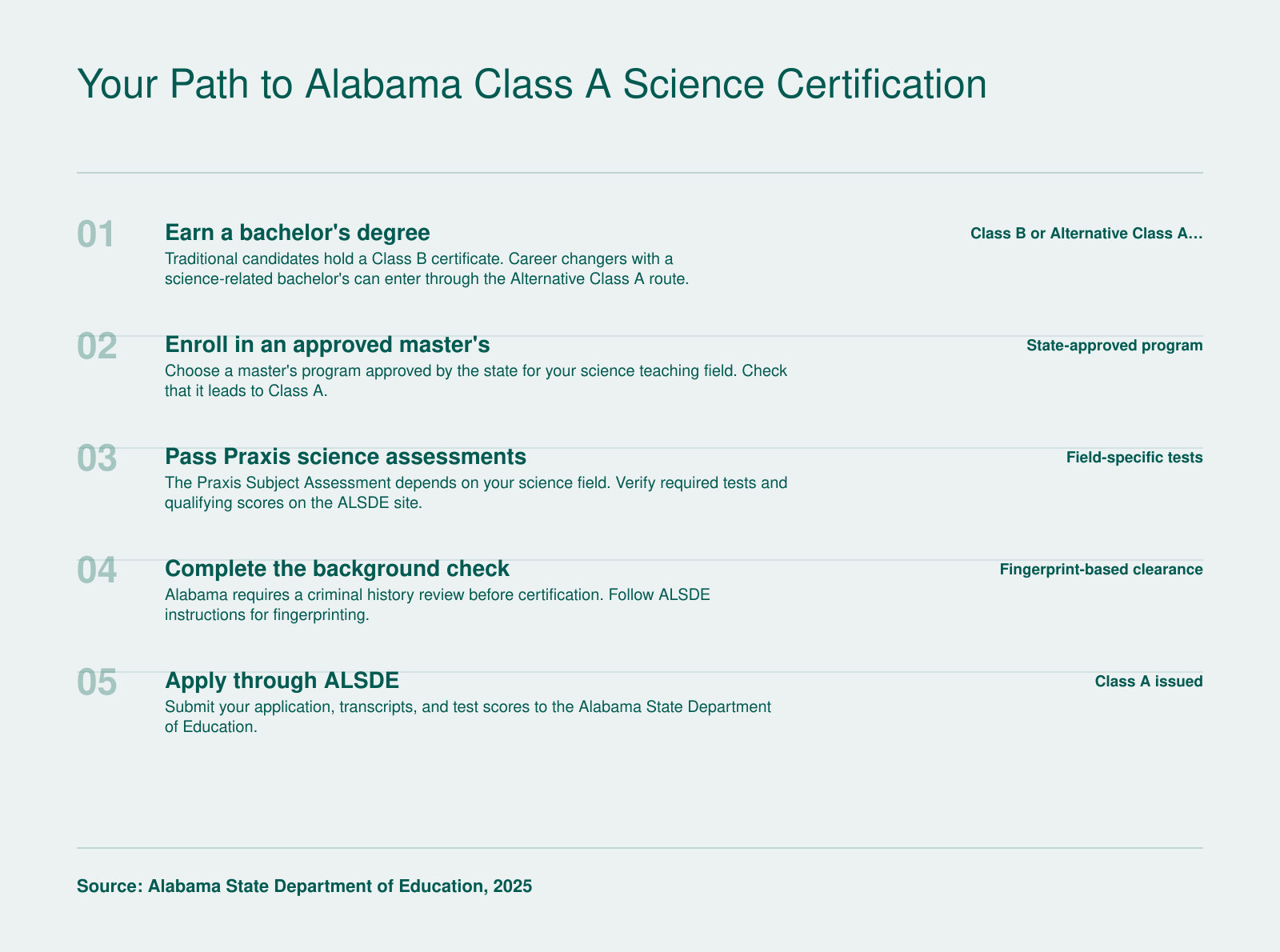
Your Path to Alabama Class A Science Certification
Alabama issues Class B certificates at the bachelor's level and Class A at the master's level. On the traditional route, a teacher holds Class B, then earns a master's and moves up to Class A. Career changers can use the Alternative Class A route, which pairs a non-education bachelor's with an approved master's-level program that leads to Class A directly. Class A typically places a teacher one rank higher on the Alabama salary schedule. Confirm current requirements with ALSDE before enrolling.
Moving Out of State With an Alabama Teaching Certificate
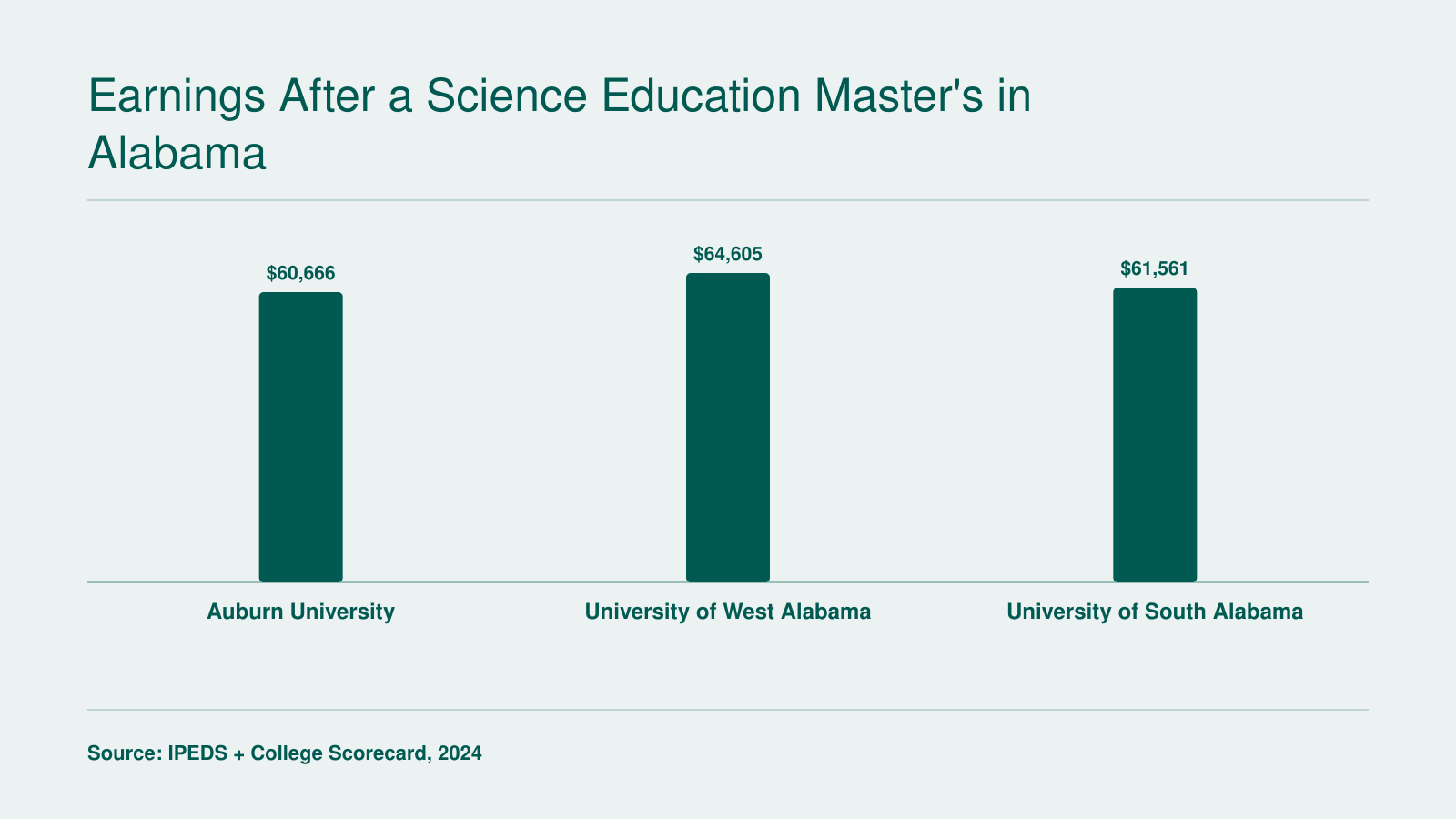
Earnings After a Science Education Master's in Alabama
The chart shows median earnings of graduates of each school's science education master's program, measured four years after finishing. Median program debt was $25,400 at Auburn University (about $289 a month over 10 years) and $27,333 at University of West Alabama (about $311 a month). Earnings in the $60,000 range against debt in the mid-$20,000s make for a manageable payback.
Frequently Asked Questions About a Master's in Science Education in Alabama
What is the difference between an M.S., M.Ed., and M.A. in science education in Alabama?
Do I need a teaching license to enroll in a science education master's in Alabama?
Are Alabama science education master's programs CAEP accredited and ALSDE approved?
Compare Science programs on the data that matters
Explore more Education & Teaching specializations or browse every graduate field.
All Education & Teaching programs