Best Master's in STEM Education Programs in Georgia
Compare accredited Stem Science Technology Engineering Math master's programs by earnings, cost, and outcomes.
Sample layout — live rankings and program data appear here once the data source is connected.

In Georgia, a master's degree is less a credential upgrade than a pay-scale event: moving to a level-five (T-5) certificate typically shifts a teacher onto a higher salary step. A STEM-focused degree can also position you for the state's STEM Education Endorsement and lead-teacher roles.
Campus and online programs appear side by side, with notes on format, GRE policy, cost, certification, and admissions.
One caution: most Georgia STEM master's here are discipline degrees, not teaching degrees, and only Georgia State's online M.Ed. centers on STEM pedagogy.
Key Points
- Georgia State's online M.Ed. is the only dedicated STEM education degree here.
- UGA's Science Education M.Ed. runs 36 credit hours at $431 per in-state credit hour.
- Georgia's STEM Endorsement (Rule 505-2-.186) requires a level four or higher renewable certificate.
The 10 Best Master's in STEM Education Programs in Georgia for 2027
Georgia gives prospective STEM teachers a range of master's pathways, from fully online endorsement programs to campus-based initial certification tracks. The schools below stand out for concentration options, clinical experience, and Georgia certification outcomes. Compare format, in-state graduate tuition, and each school's overall graduation rate as you weigh fit.
Georgia State University
#1Atlanta, GA · $9,000 – $25,000/yr (est.)
Best for: Online certified teachers seeking STEM endorsement
Georgia State offers a fully online M.Ed. in STEM Education with four concentrations in science, mathematics, computer science, and integrated middle-level education. The program embeds a Georgia STEM endorsement and culminates in a capstone focused on equity and justice. In-state graduate tuition is $7,344, and the school graduates about 53% of students; median earnings one year after finishing are about $59,627.
- 36 credit hours completed in four semesters
- Fall and summer start dates available
- Concentrations in science, math, computer science, or integrated middle-level education
- Embedded STEM endorsement included in the degree
- Metro Atlanta practicum placements with faculty supervision
- Prepares for Georgia teacher certification and edTPA
- 2.5 GPA minimum and $50 application fee
Mercer University
#2Macon, GA · ~$15,000/yr (est.)
Best for: Currently certified teachers upgrading Georgia certification
Mercer pairs an online M.Ed. in the Advanced Teacher program with STEM, math K-5, and science K-5 endorsement options. The pathway is designed for certified teachers moving from Level 4 to Level 5 Georgia certification and can be completed in 12 to 16 months. Graduate tuition is $31,265, and the school graduates about 70% of students; median earnings one year after finishing are about $55,169.
- 13 concentration options including STEM, math K-5, and science K-5 endorsements
- Complete in 12 to 16 months with three start dates per year
- Fully online with optional face-to-face faculty meetings
- Designed for Level 4 certified teachers seeking Level 5 Georgia certification
- Eight-week and 16-week course terms available
- Up to two endorsements available in one program
- Eight concentration options through the School of Engineering
- Biomedical engineering concentration with research focus
- 4+1 Integrated Degree Program for current Mercer undergraduates
- 50% graduate tuition benefit in fifth year
- Software systems concentration offered
- Five M.S. disciplines available
- $150 per semester facilities and technology fee
Kennesaw State University
#3Kennesaw, GA · ~$7,000/yr (est.)
Best for: Career changers needing initial secondary certification
Kennesaw State offers a campus-based Master of Arts in Teaching for secondary mathematics and secondary science in biology, chemistry, or physics. The four-semester program leads to initial Georgia teaching certification and includes yearlong clinical experiences. In-state graduate tuition is $4,560, and the school graduates about 52% of students; median earnings one year after finishing are about $57,503.
- Four concentrations: mathematics, biology, chemistry, and physics
- Four semesters beginning summer with about 9 credits per term
- No GRE required and no teaching certificate required
- Leads to initial Georgia teaching certification
- Yearlong clinical experiences
- Up to nine transfer credits accepted
- 2.8 GPA minimum and $60 application fee
Augusta University
#4Augusta, GA · $7,000 – $21,000/yr (est.)
Augusta University offers an online Master of Education in Instruction with secondary education concentrations in science education and mathematics. The program requires no letters of recommendation and no standardized test, making it a streamlined fit for certified teachers or those seeking a certification upgrade. In-state graduate tuition is $7,064, and the school graduates about 49% of students.
- Secondary science and mathematics concentrations available
- Fully online with no GRE or letters of recommendation required
- Eight concentration options across the program
- 2.5 GPA minimum and $55 application fee
- GACE scores required for some applicants
- Spring 2027 application due December 8, 2026
Valdosta State University
#5Valdosta, GA · $5,000 – $10,000/yr (est.)
Valdosta State offers a Master of Arts in Teaching that leads to initial Georgia certification in middle grades or secondary math and science. The hybrid program includes online coursework with required face-to-face field experiences, and employed teachers can complete a two-year track while holding a provisional certificate. In-state graduate tuition is $4,488, and the school graduates about 42% of students; median earnings one year after finishing are about $57,751.
- Math and science concentrations for middle grades or secondary
- 36 credit hours with online or face-to-face coursework options
- Two tracks: employed teachers and full-time students
- Level 4 Georgia certification in first year for employed teachers
- Clear-renewable T-5 certification after passing GACE Content Assessment
- Two full semesters of student teaching
- Starts summer with April 15 application deadline
Clayton State University
#6Morrow, GA · $5,000 – $10,000/yr (est.)
Clayton State offers a campus-based Master of Arts in Teaching with a mathematics concentration for secondary grades 6-12. The program combines content, methods, and professional studies courses with field-based clinical experiences. In-state graduate tuition is $4,176, and the school graduates about 40% of students.
- Mathematics concentration for secondary grades 6-12
- 18 hours of graduate coursework in the discipline
- Field-based clinical experiences required
- Leads to professional certification in secondary education
- Open to bachelor's degree holders in a related area
- Information security and operation management concentrations
- 30 credit hours, as few as three semesters
- Online with GRE waived for GPA 2.7 or above
- 2.5 GPA minimum and three letters of recommendation
- Security administrator and data analyst career paths
Georgia Southern University
#7Statesboro, GA · $5,000 – $10,000/yr (est.)
Georgia Southern is home to an Institute of Interdisciplinary STEM Education focused on rural and underserved Georgia schools. The ranked master's data includes a Master of Science in Computer Science with online, hybrid, and in-person options. In-state graduate tuition is $4,488, and the school graduates about 55% of students; median earnings one year after finishing are about $53,884.
- Four specializations: software engineering, cyber security, machine learning, data and knowledge systems
- 30 credit hours with thesis or applied project option
- Flexible online, hybrid, or in-person formats
- GRE required for admission
- Provisional admission option available
- 2.5 GPA minimum and $50 application fee
LaGrange College
#8Lagrange, GA · ~$23,000/yr (est.)
LaGrange College offers a hybrid Master of Science in Computer Science designed for recent graduates in computing fields. The 35-credit program uses eight-week courses and can be completed in five semesters or an accelerated three-semester pathway. Graduate tuition is $34,460, and the school graduates about 47% of students.
- 35 credit hours with eight-week courses
- Five-semester or accelerated three-semester pathway
- Synchronous and asynchronous online sessions
- Designed for recent computer science or related graduates
- Less than one hour from Hartsfield-Jackson Atlanta International
Fort Valley State University
#9Fort Valley, GA · ~$6,000/yr (est.)
Fort Valley State offers campus-based graduate programs in biotechnology and animal science with a research and professional development focus. These STEM programs prepare students for scientific industry, academia, or doctoral study while providing grant-funded assistantships. In-state graduate tuition is $4,176, and the school graduates about 41% of students.
- 3.0 GPA minimum and GRE required
- Statement of purpose and three recommendation letters
- Grant-funded graduate assistantships available
- 2.75 GPA minimum and GRE required
- Statement of purpose and three recommendation letters
- Grant-funded graduate assistantships available
No school information is available for this ranked position.
Online and Hybrid Master's in STEM Education Options in Georgia
Fully online, campus-based, or a blend of the two: Georgia's master's in STEM education options split roughly three ways, and the delivery label tells you less than the details beneath it.
- Online: Yes, Georgia State's STEM Education M.Ed. is delivered online, with all required classes completed remotely and a STEM endorsement embedded in the coursework. Albany State's Integrated Biotechnology M.S. is also fully online, structured as a two-year sequence.
- Hybrid: Kennesaw State's electrical and computer engineering M.S. pairs online and in-person coursework, and LaGrange College runs eight-week terms with both synchronous and asynchronous options.
- Campus: Mercer, Augusta, Valdosta State, Clayton State, and Fort Valley State keep coursework in person, though Georgia Southern describes its computer science M.S. as flexible across online, hybrid, and in-person study.
One caution: most of these online master's programs in Georgia do not publish whether online sessions meet live or run on your own schedule, so confirm before you enroll if your teaching day is inflexible.
Culminating requirements vary. Georgia State requires a capstone plus faculty-supervised practicum work; whether you can complete that practicum in your own classroom is not stated publicly, so ask admissions directly. Georgia Southern, Augusta, and Clayton State offer a thesis or capstone choice, Valdosta State requires a thesis, and Albany State builds in six internship hours.
Which Georgia STEM Education Master's Programs Waive or Skip the GRE?
The GRE is a standardized graduate entrance exam for Education & Teaching Master's Programs, but several No-GRE master's programs in Georgia no longer make it a hurdle. Each school's official admissions page says the following.
Programs that do not require the GRE
- University of Georgia (M.A.T. in Mathematics Education): The GRE is not required for acceptance. If you submit scores, they may be weighed alongside your coursework, GPA, and recommendations, but they are optional.
- Georgia State University (M.Ed. in STEM Education): The admissions page lists transcripts, a STEM bachelor's or equivalent upper-level coursework, and a 2.5 minimum GPA, but does not list the GRE as required.
- Georgia College & State University: Applicants with an undergraduate GPA of 3.0 or higher are exempt from exams.1 Those in the 2.75 to 2.99 range must submit GRE, MAT, or GMAT scores from the last five years.1
Georgia College also grants a waiver to anyone who has completed another graduate degree.1
Confirm before you apply
Test policies shift from cycle to cycle. Email the admissions office to verify the current requirement for your intended start term before you build your application.
Related Articles
Cost of a Master's in STEM Education in Georgia
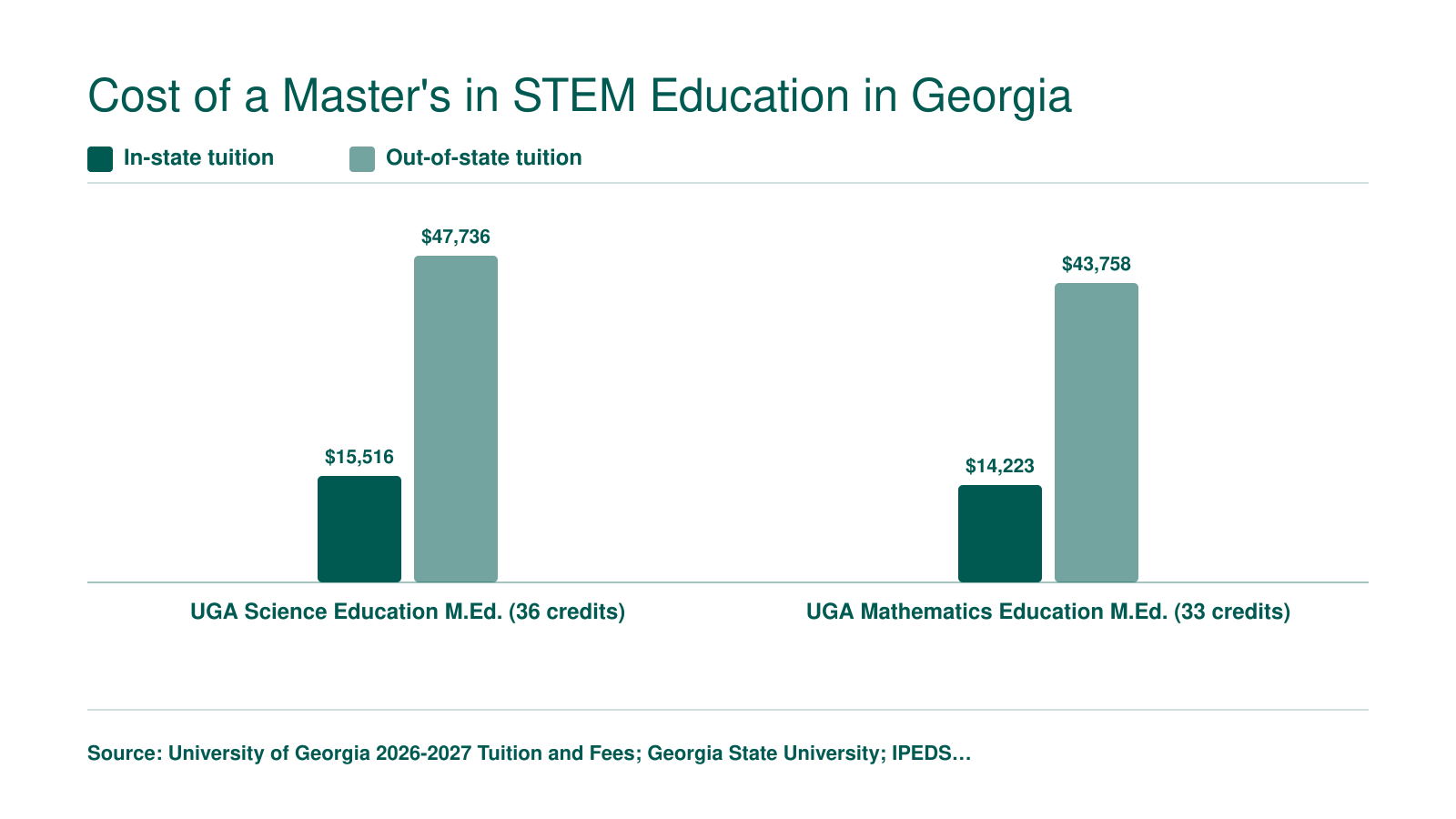
The chart shows estimated tuition-only totals at the University of Georgia for 2026-2027, using the standard College of Education graduate rates of $431 per credit hour in-state and $1,326 out-of-state. The Science Education M.Ed. requires 36 credit hours and the Mathematics Education M.Ed. requires 33, so multiply the per-credit rate by your program's credits to estimate total cost. Mandatory fees are not included. UGA lists a $431 per-semester charge for exclusively online students, but it is not established whether online tuition differs from these standard rates. Georgia State's online M.S. in Chemistry Education with Teacher Certification charges a flat $464 per credit hour to all fully online students regardless of residency, plus a $660 per-semester online learning fee for 6 or more credits. Its total credit hours are not established. Net price is an institution-wide average after aid, so treat it as approximate rather than a program-specific figure.
Georgia STEM Endorsement at a Glance
Georgia Certification and Your STEM Education Master's
For certified teachers, a Georgia master's is often a T-5 certificate and salary-step move. For career changers, the same degree can be an entry point into the classroom. The programs here split along those lines.
UGA's online M.Ed. in Mathematics Education (6-12) and M.Ed. in Science Education (6-12) do not require an existing Georgia certificate for admission, but their T-5 upgrade applies to certified teachers moving from T-4 to T-5 in an in-field subject. The science program is designed for certified secondary science practitioners. UGA's PreK-8 mathematics M.Ed. at Griffin may lead to T-5 depending on the school district.
Georgia State's M.A.T. in Science Education is the clearest initial-certification route: no prior certificate is required, and it leads to a clear renewable T-5 Induction Certificate. The online M.Ed. in STEM Education embeds a STEM endorsement in the curriculum and is framed around teacher certification. University of North Georgia's M.Ed. in Curriculum and Instruction, Innovative Teaching, includes a STEAM endorsement, but candidates upgrading a current Georgia certificate must hold a clear, renewable teaching certificate.1 Kennesaw State's Bagwell master's programs also include a STEM endorsement.2
Admissions Checklist for Georgia STEM Education Master's Programs
Requirements vary by school and even by program within one university, so confirm each program's admissions page before you apply.
- Bachelor's degree and minimum GPAPublished minimums range from 2.5 (Georgia State M.A.T. programs, UNG M.A.T.) to 2.6 (UGA online science education), 2.75 (UNG Middle Grades M.Ed.) and a preferred 3.00 (UGA online mathematics education). UGA's M.A. in Mathematics Education publishes no minimum. Georgia State's science track also expects a science or engineering degree with 24 upper-division science hours.
- Teaching certificate or classroom accessUGA's online science and mathematics M.Ed. programs do not list a certificate as an entry requirement. Georgia State's M.A.T. pages don't list one either. UNG's Middle Grades M.Ed. requires a clear, renewable Georgia certificate plus active teaching of at least 20 hours a week.
- Transcripts and required examsSend official transcripts from every institution attended. Georgia State and UNG M.A.T. applicants need the Georgia Educator Ethics Assessment. UGA's M.A. in Mathematics Education asks for GRE or MAT scores and two semesters of calculus.
- Recommendations and statement of purposeUGA's programs ask for three recommendation letters and a statement of purpose. Georgia State's M.A.T. programs ask for two letters. UNG's pages don't make these requirements clear.
- Deadlines and start termsUGA online science: April 1, July 1 and November 15 for Summer, Fall and Spring. UGA online mathematics: April 1 and July 1. UNG M.A.T.: May 1, August 1 and December 1. UNG Middle Grades M.Ed.: April 15, July 15 and December 1, and it may close early at capacity. Georgia State and UGA's M.A. publish no clear deadlines in the sources reviewed.
How We Rank the Best Master's in STEM Education Programs in Georgia
Affordability and verifiable outcomes drive these rankings, not prestige or name recognition. Each program is weighed on graduate tuition and net price, institution-wide graduation and retention rates, program-level earnings and debt where the College Scorecard publishes them, and format flexibility, including online and hybrid delivery.
The data comes from IPEDS and the U.S. Department of Education College Scorecard, two federal sources that apply the same definitions to every school.
Those sources have limits. Those figures describe the whole institution, not the STEM education master's specifically, so they signal general student success and cost rather than your program's results. Earnings and debt figures are not published for every program, and where they are missing we say so rather than estimate. Before you apply, confirm tuition, program length, delivery format, and admission requirements directly with the school's admissions office or program page.
Compare Stem Science Technology Engineering Math programs on the data that matters
Explore more Education & Teaching specializations or browse every graduate field.
All Education & Teaching programs