Best Master's in Business Analytics Programs in Arizona
Compare 5 accredited Analytics programs in Arizona at 4 schools, with graduate earnings, cost, debt, and completion data from IPEDS and the U.S. College Scorecard.

Arizona employers in Phoenix and Tucson, across tech, finance, and healthcare, hire data analytics professionals who can turn messy data into decisions, yet the state has very few master's programs built for that work. The tension is format and cost: a STEM-designated campus degree in Flagstaff, a Tempe program with a fully online version, and a health-focused online degree differ sharply in price and flexibility.
Because the field is this small, you can weigh every option in one sitting.
The real constraint is fit, since each program serves a different kind of career.
Key Points
- ASU offers the Tempe MS-BA on campus and a 100% online version that runs 16 months.
- ASU requires neither the GRE nor the GMAT for 2026-2027 applicants.
- ASU's STEM designation can extend F-1 work authorization to up to 36 months.
Best Master's in Business Analytics Schools in Arizona, Ranked
Arizona's master's in business analytics options span a STEM-designated campus degree in Flagstaff, a Tempe-based program from W. P. Carey with optional specialization tracks and a fully online version, and one fully online health-focused analytics degree. Compare them on total cost, what graduates can expect after the degree, and how flexibly you can study. Graduation rates cited below describe the whole institution, not a single program.
Northern Arizona University
#1Flagstaff, AZ · ~$13,000/yr (est.)
Best for: Career changers from non-business backgrounds
Northern Arizona University offers its Master of Science in Business Analytics through the W. A. Franke College of Business on the Flagstaff campus. The degree is STEM-designated and welcomes applicants without a business degree, who complete a Business Foundations Course in their first term. Schools offering this program have an institution-wide graduation rate of about 61%. Program fees are approved by the Arizona Board of Regents and may change each July 1.
- 30 credit hours: 24 of analytics coursework and 6 of electives
- Up to 6 elective units may be at the 400 level
- 3.0 GPA minimum for admission and to stay in good standing
- Business Foundations Course for non-business degrees, outside the 30 units
- Priority for bachelor's degrees in business, computer science, engineering
- STEM-designated graduate program
- Complete all work within six consecutive years
- Campus program in Flagstaff
Arizona State University
#2Scottsdale, AZ · ~$11,000/yr (est.)
Best for: Professionals wanting a specialization track
Arizona State University delivers its Master of Science in Business Analytics through the W. P. Carey School of Business, with a core covering analytics, modeling, and data-driven decision-making plus an applied capstone with a partner company. The campus version offers four optional tracks: cloud computing and tech consulting, financial technology, marketing analytics, and supply chain analytics. The online version covers the same degree in a fully remote format but drops the tracks. ASU estimates resident tuition and fees at roughly $41,000 to $59,000 on campus depending on track, and about $45,000 online. These are estimates that vary with credits and circumstances.
- Four optional tracks: cloud and tech consulting, fintech, marketing, supply chain
- Curriculum covers statistics, database management, machine learning, and NLP
- Completed in 9 to 16 months, with fall and spring starts
- No entrance exam required; GMAT or GRE is optional
- Applied capstone alongside a partner company
- STEM-designated, with a dedicated career coach
- Employer tuition reimbursement and military benefits supported
- Fully online version of the degree, without the optional tracks
- 30 credit hours across 10 courses, in five-week classes
- Full-time and part-time options
- 3.0 GPA minimum and one letter of recommendation
- Applied capstone project with real organizations
- AACSB accredited
- Diploma does not specify online
The University of Arizona Global Campus
#3Chandler, AZ · $10,000 – $15,000/yr (est.)
Best for: Healthcare professionals moving into data roles
The University of Arizona Global Campus in Chandler is not a business analytics program in the strict sense. Its Master of Science in Health Informatics and Analytics applies data skills to health care, making it a related option for readers headed toward hospital, insurer, or health-tech roles. It is fully online and taught in accelerated six-week courses, one at a time. Schools offering this program have an institution-wide graduation rate of about 11%, a figure worth weighing alongside its flexibility.
- 39 credit hours with a 3.0 GPA required to graduate
- Fully online, one accelerated six-week course at a time
- Covers biostatistics, epidemiology, data governance, and data visualization
- Capstone taken last in the program
- Up to 9 approved transfer credits accepted
- Listed tuition of $740 per credit, with an estimated total near $32,910
- $0 application fee
Cost & outcomes by school
Federal data for the highest-earning Analytics programs, independent of the ranking above. Earnings are this field's master's graduates four years after completing, where the Scorecard reports them.
| School | Earnings | Tuition / yr | Debt | Grads/yr | Format |
|---|---|---|---|---|---|
| Arizona State University AZ | — | $10,843 | — | — | Campus |
| The University of Arizona Global Campus AZ | — | $12,930 | — | — | Online |
| Northern Arizona University AZ | — | $13,023 | — | 12 | Campus |
| Arizona State University AZ | — | $13,587 | — | 1 | Online |
Sources: U.S. Department of Education. Tuition and graduates: IPEDS. Earnings and debt: College Scorecard, this field's master's graduates; a dash means no figure is reported.
Online and Hybrid Master's in Business Analytics Programs in Arizona
ASU master's programs give Arizona students a clear format choice. The Tempe MS-BA is on campus, full time, and starts in August or January; it can be completed in 9 to 16 months. ASU's 100% online business analytics MS-BA runs 16 months and starts in August, January, or May, which is the more flexible option for working professionals. Both formats lead to the same business analytics master's degree and include a capstone.
NAU offers a campus-based Business Analytics, Master of Science in Flagstaff. UAGC's fully online Master of Science in Health Informatics and Analytics adds an online health-data option, but it is not a business analytics degree. UAGC uses accelerated 6-week courses and takes one course at a time. No ranked Arizona program currently advertises a hybrid split with required on-site meetings.
Format fit for working professionals and international applicants
Working professionals who need to keep a full-time job should look first at ASU's online MS-BA or UAGC's online program, since neither requires a residential schedule. ASU's campus MS-BA and NAU's campus program are better for students who want face-to-face networking and can relocate to Tempe or Flagstaff. International applicants should plan for in-person study: online programs generally do not support F-1 visas, so ASU's campus MS-BA and NAU's campus program are the realistic F-1 pathways in Arizona.
Which Arizona Master's in Business Analytics Programs Waive the GRE or GMAT?
Arizona State University's W. P. Carey MS in Business Analytics has a no GMAT or GRE required policy for 2026-2027 applicants. Scores are optional, and applicants may submit them voluntarily depending on their background. The program does not publish waiver criteria such as a GPA cutoff or a prerequisite course. It describes itself as built for recent graduates with a strong quantitative background, and work experience is not required.
Test Policy and Materials
Applicants who choose to send scores must have them sent directly by the testing organization. The GRE institution code is 4007 and the GMAT code is 0GZ-1R-80. The application fee is $70 for domestic applicants and $115 for international applicants.
The sources reviewed do not confirm ASU's requirements for transcripts, a resume, essays, recommendations, or English proficiency scores, so check the admissions page for the full list before you apply.
No test policy appears for Northern Arizona University or The University of Arizona Global Campus either. Ask each admissions office directly instead of assuming either way.
Deadlines
ASU lists Spring 2027 deadlines of July 1, September 1, November 1, and December 1, 2026. The program can start in August or January. Documents must be on file by the deadline or the application may roll to the next round. The sources do not give a separate Fall 2026 schedule, so verify every date with the school.
Related Articles
Graduate Tuition at Arizona's Ranked Business Analytics Schools
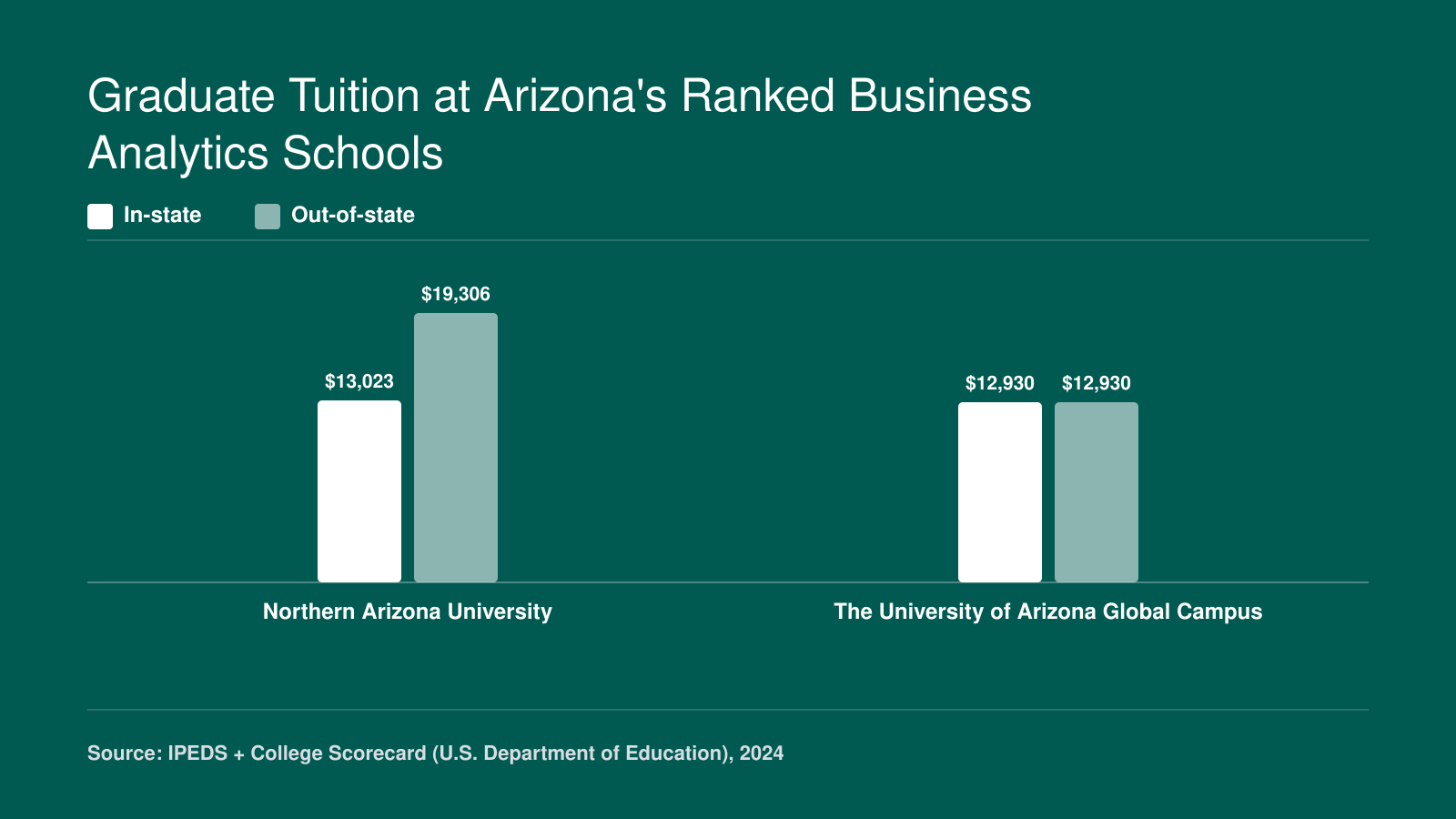
Annual graduate tuition and fees differ most for out-of-state students at Northern Arizona University, while the University of Arizona Global Campus charges one rate to everyone. These are annual tuition and fee figures, not the total cost of a degree, and net price after aid varies by student. The Global Campus figure is for its online Master of Science in Health Informatics and Analytics.
Tuition, Scholarships, and Certification Costs for Arizona MSBA Programs
ASU W. P. Carey publishes estimated total tuition and fees by track rather than a single per-credit rate. The Big Data track is about $41,000 for Arizona residents, $67,250 for nonresidents, and $71,000 for international students. All other MS-BA tracks run higher: $59,000 resident, $94,000 nonresident, and $98,000 international. The online MS-BA is listed at $45,000 for resident, nonresident, and international students.
Scholarships and Employer Tuition Benefits
W. P. Carey competitive scholarships for qualified master's applicants start at $5,000. Employer partnership scholarships range from $2,000 to $25,000 and can combine with employer tuition assistance, though not all awards are MSBA-exclusive. Northern Arizona University's 30-credit program does not publish a single total cost in the materials reviewed; students should confirm current Arizona Board of Regents rates and review the Most Affordable Master's in Business Analytics Programs. The University of Arizona Global Campus lists a 39-credit online analytics master's, one of several data analytics master's programs in Arizona that publish credit totals.
Licensure and Certification Costs
Arizona requires no state license for business analytics work. Graduates often pursue optional credentials such as the INFORMS Certified Analytics Professional. Current 2026 CAP exam fees run $195 to $640 depending on level and membership; CAP-Expert adds a $55 application fee.1 Tableau and Microsoft data certifications carry their own exam fees.
Is a Master's in Business Analytics Worth It in Arizona? Graduate Earnings and Debt
A master's in business analytics pays off when the salary bump or career switch it buys outweighs what you borrow and the income you give up while studying. Federal program-level earnings and monthly repayment figures for these degrees aren't available to quote, so we won't put a salary on any of them. The verdict here rests on debt levels and hiring links instead.
Debt in context
Median graduate debt is institution-wide, not specific to analytics. It is $19,500 at Arizona State University and $19,000 at Northern Arizona University. At The University of Arizona Global Campus it is $31,250. Moderate borrowing is easier to justify when employers actively recruit analytics graduates, which is why the hiring pipeline matters.
Employer connections
ASU's MS-BA requires an applied capstone in which students work on real business problems, and corporate partners sponsor projects. Avnet is the one partner named in ASU's MS-BA materials. The online version allows employer-based capstone projects. The supply chain analytics track says every student has a summer internship opportunity, though that isn't confirmed for the other tracks. ASU's W. P. Carey school reports 650+ recruiting organizations, but that is a school-wide figure, not an MS-BA one.
Who benefits most
Career changers and working professionals look like the strongest fit. Capstones give changers a project to show employers. Working professionals can use employer-based capstone options and ASU's online format. International students gain from the STEM designation at ASU and NAU. If you already have a quantitative job and no plan to move, the case for the cost is weaker.
Compare Analytics programs on the data that matters
Explore more Business & Management specializations or browse every graduate field.
All Business & Management programs