Best Master's in STEM Education Programs in Virginia
Compare accredited Stem Science Technology Engineering Math master's programs by earnings, cost, and outcomes.
Sample layout — live rankings and program data appear here once the data source is connected.

Virginia's STEM education master's degrees split three ways: initial licensure, an advanced credential for licensed teachers, or a non-licensure leadership degree. George Mason University's 30-credit M.Ed. STEM concentration, for instance, serves practicing science teachers and does not grant initial licensure.
The programs here combine campus, online, and hybrid formats, compared on cost and graduate outcomes rather than prestige. Few Virginia degrees are built specifically for STEM teachers, so confirm the licensure outcome before comparing tuition.
Key Points
- George Mason University and Regent University offer the education-focused STEM degrees; others are related STEM fields.
- Multiply each posted per-credit rate by required credits, since out-of-state tuition can more than double.
- Confirm GRE policy and licensure outcome with each admissions office before applying for 2027.
The 10 Best Master's in STEM Education Programs in Virginia
This 2026 ranking puts Virginia's master's programs in STEM education side by side using federal outcome data and program-level details. The list below includes campus, online, and hybrid options, with tuition and format varying by institution. Each card highlights what makes the program distinct, from licensure pathways to advanced teaching concentrations.
William & Mary
#1Williamsburg, VA · $15,000 – $20,000/yr (est.)
Best for: Licensure-seeking secondary science and math teachers
William & Mary offers a secondary education master's with science and mathematics preparation as well as a separate STEM-designated business analytics degree. For licensure seekers, the M.A.Ed. in Curriculum and Instruction includes Virginia secondary teacher licensure and a full student-teaching semester. The business analytics program is an accelerated two-semester option focused on machine learning and data science.
- Two-semester accelerated structure
- STEM-designated curriculum with AI and machine learning focus
- Real-world capstone project
- Dedicated career support via Graduate Career Management Center
- One-year, 41-credit licensure program
- Science and mathematics secondary endorsement options
- Virginia secondary teacher licensure preparation
- 15-week full-time student teaching
- Small cohorts with faculty mentorship
- Noyce scholarships up to $26,000 yearly
George Mason University
#2Fairfax, VA · $15,000 – $20,000/yr (est.)
Best for: Practicing K-12 teachers needing hybrid flexibility
George Mason's Master's in Education with a STEM concentration is designed for current elementary, middle, and high school science teachers who already hold a bachelor's degree. The 30-credit hybrid program combines online coursework with evening classes at the Fairfax campus and aligns with National Board standards. It is advanced professional development, not initial licensure.
- 30-credit program for practicing science teachers
- Hybrid online and evening Fairfax campus classes
- Aligned with National Board for Professional Teaching Standards
- Not an initial licensure program
- Up to 12 transfer credits accepted
- Virginia educator discount available
Regent University
#3Virginia Beach, VA · ~$18,000/yr (est.)
Best for: Busy educators wanting Christian online MEd
Regent University's online M.Ed. in Curriculum and Instruction with a STEM Education concentration is a 33-credit program presented from a Christian worldview. It emphasizes curriculum design, inquiry-based instruction, and real-world problem-based learning. Multiple start sessions and military benefits add flexibility for working educators.
- 33-credit online program
- Christian worldview and multiple start sessions
- Focus on STEM curriculum design and inquiry-based instruction
- Military benefits accepted
- $585 per credit
Liberty University
#4Lynchburg, VA · ~$9,000/yr (est.)
Liberty University offers a Virginia state-approved M.A.T. in Mathematics Education for candidates who do not yet hold an initial teaching license. The program includes early field experiences, a 16-week student teaching semester, and preparation for secondary mathematics licensure. Student teaching may be completed locally or internationally.
- CAEP-accredited and Virginia state-approved
- Praxis Subject Assessment required
- 16-week student teaching semester
- 36-hour or 45-hour degree plans
- Local or international student teaching options
Christopher Newport University
#5Newport News, VA · $13,000 – $23,000/yr (est.)
Christopher Newport University offers a CAEP-accredited Master of Arts in Teaching with a Mathematics 6-12 endorsement option among 12 choices, plus an MS in Applied Physics and Computer Science. The MAT includes a five-year bachelor's-to-master's path and is recognized in 48 additional states. The applied physics and computer science degree emphasizes research and preparation for doctoral study or industry.
- CAEP-accredited teacher preparation
- 12 endorsement options including mathematics
- Five-year bachelor's-to-master's pathway
- Recognized in 48 additional states
- 30-credit thesis or capstone option
- Computer Systems Engineering and Instrumentation concentration
- Research in nuclear physics, astrophysics, and robotics
- Five-year bachelor's-to-master's pathway
Hampton University
#6Hampton, VA · $10,000 – $15,000/yr (est.)
Hampton University offers graduate work spanning applied mathematics, systems engineering, and secondary mathematics teaching. The secondary mathematics teaching degree includes a student-teaching internship and coursework in classroom management and STEM initiatives. The systems engineering program uses a NASA-aligned approach and model-based systems engineering.
- Campus-based quantitative analysis and mathematical modeling
- 1-year traditional or 3-year executive track
- 30 credits with capstone
- NASA-aligned approach
- Model-Based Systems Engineering with SysML
- Cyber-Physical Systems Security elective
- 31 credit hours
- Student teaching internship in a secondary school
- Directed practicum in secondary education
- Coursework in classroom management and diversity
- Focus on technology-enhanced instruction
University of Lynchburg
#7Lynchburg, VA · ~$11,000/yr (est.)
University of Lynchburg lists a Master of Education in Science Education for graduate students interested in science teaching. Its graduate listings also reference a five-year pathway, though published program details are limited. Prospective students should confirm current admission requirements and licensure alignment.
- Campus-based program
- Financial aid and scholarships available
- 3.4 GPA minimum and prerequisite courses required
Marymount University
#8Arlington, VA · ~$23,000/yr (est.)
Marymount University offers a Curriculum and Instruction M.Ed. with a STEM concentration and a separate MS in Information Technology with cybersecurity and data science tracks. The M.Ed. is non-licensure and designed for educators seeking advanced curriculum expertise. The MSIT offers STEM eligibility for international students and draws on its Arlington location near major IT employers.
- 36 credits
- Cybersecurity and Data Science concentration
- STEM eligibility for international students
- On-campus and online formats available
- Washington D.C. area location
- Non-licensure master's program
- STEM concentration
- Four concentration options
Shenandoah University
#9Winchester, VA · ~$27,000/yr (est.)
Shenandoah University offers a campus-based MS in Cybersecurity through its College of Arts and Sciences. The program features small classes, with an average of about 12 students, and close faculty mentorship. It is included here for students exploring STEM graduate study rather than teacher licensure.
- Offered by College of Arts and Sciences
- Average class size around 12 students
- 10:1 student-faculty ratio
Program-level details for this ranked position were not published in the available federal or program catalog records.
How We Rank Virginia's STEM Education Master's Programs, Including Accreditation
A master's in STEM education ranking only helps if it separates what schools publish from what a student will actually pay and earn. We weigh graduate tuition, institution-wide net price, graduation rate, delivery flexibility, and program-level earnings and debt where published, which is not yet the case for most programs here. Net price is an average across an institution's students, not a quote for any individual.
Accreditation comes next. Federal aid requires a recognized accreditor, and Virginia institutions typically hold SACSCOC accreditation, but confirm each school's status and whether its education unit holds CAEP accreditation.
Licensure is a separate question. Only master's programs in Virginia approved by the Virginia Department of Education lead to a license, and approval can affect aid eligibility. George Mason's STEM concentration is not an initial licensure program. Regent is listed as a state career-switcher provider, not for a specific master's. Verify approval with each school.
Online and Hybrid Master's in STEM Education Programs in Virginia
On-campus study and online study split this list unevenly. Most of the master's programs here are campus-based, and several of those are in engineering, computing, or applied science rather than teaching. The education-focused options are where delivery gets flexible.
- George Mason University: The Master's in Education with a STEM concentration is listed as online. GMU says its online courses may be synchronous or asynchronous but does not say which applies here, and no residency is specified.
- Regent University: The M.Ed. in Curriculum & Instruction with a STEM Education focus is delivered online. Whether sessions are live or self-paced is not published, so ask admissions.
Can you finish a STEM education master's fully online in Virginia? Yes, at both schools above. GMU's program is for practicing science teachers and is not an initial licensure program.
If you want a licensure-track route, expect in-person student teaching or a field placement, typically in a Virginia school, even when coursework is online. Confirm placement rules and out-of-state admission directly with each school.
Related Articles
GRE Requirements: Which Ranked Virginia Master's Programs Waive or Skip the Test
Paying for a GRE you may not need is a real cost, but skipping one a program requires can sink your application. For the schools ranked here, we can't responsibly sort them into "no GRE," "optional or waivable," and "required" groups, because we have confirmed published GRE policies for only a few of them. Where a school doesn't state its policy, treat it as unknown rather than assuming a waiver.
Other gatekeepers are clearer for some programs:
- George Mason University: 3.0 minimum GPA, two recommendation letters, and starts in summer, fall, or spring.
- Christopher Newport University: 3.0 minimum GPA for the applied physics and computer science master's.
- Liberty University: 3.0 minimum GPA for the engineering master's.
- University of Lynchburg: 3.4 minimum GPA and required prerequisite courses for the engineering dual degree.
- William & Mary: prerequisite courses required for the business analytics master's.
- Marymount University: starts in fall, spring, or summer.
Application deadlines were not confirmed for these programs, so check each one directly.
Before you register for the test, email the program and ask whether it is one of the master's programs with no GRE required or whether the GRE is required, optional, or waived for your background.
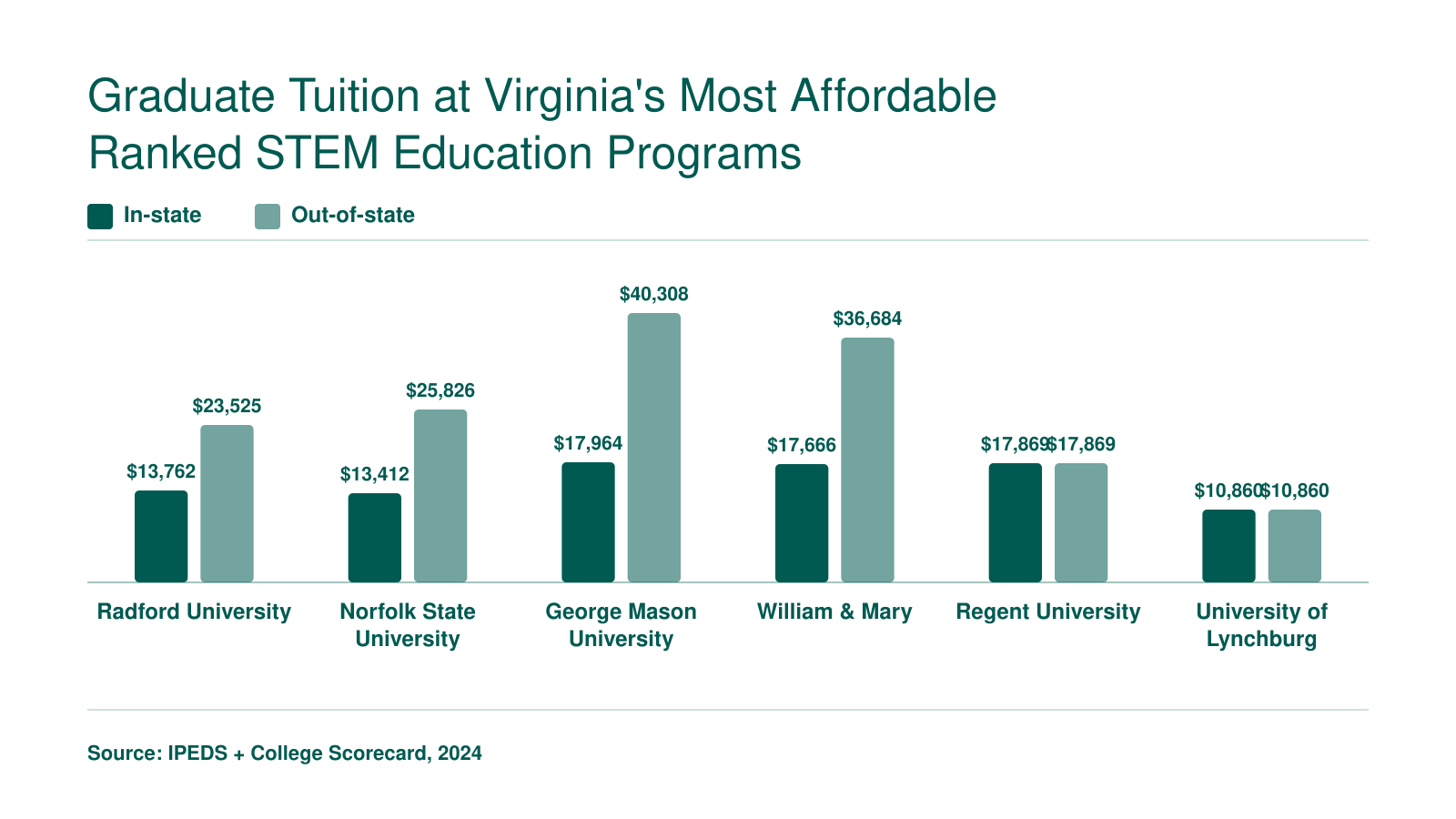
Graduate Tuition at Virginia's Most Affordable Ranked STEM Education Programs
These figures are annual tuition and fees, not total program cost, so multiply by your expected time to degree. The out-of-state gap matters most for on-campus students. George Mason University's out-of-state rate is more than double its in-state rate, while Regent University and the University of Lynchburg charge one rate regardless of residency.
Cost of a Master's in STEM Education in Virginia and What It Means for Licensure
The cheapest sticker price rarely matches the cheapest path to a classroom job, because the total cost of a master's degree depends heavily on which licensure outcome you need.
Turning per-credit rates into a total
Multiply the posted rate by required credits before comparing anything. Regent's online STEM education track lists $585 per credit across 33 credits, roughly $19,300, and the rate does not change by residency, which removes the out-of-state premium entirely. George Mason's online STEM concentration lists about $805 per credit over 30 credits.1 Mason's secondary mathematics concentration posts $596.50 per credit in-state against $1,638 out-of-state for 2026-27, a gap wide enough to reshape your decision; Mason also publishes a reduced per-credit rate for Virginia PK-12 educators. Virginia State's mathematics education concentration runs 36 credits when the licensure course is included.2
What the degree actually licenses you to do
Programs here fall into three groups. Initial licensure tracks, including UVA's Science Education M.T. and Virginia Tech's science education M.A.Ed., are master's in science education programs that prepare career changers who hold a bachelor's degree to teach biology, chemistry, earth science, or physics in grades 6-12. Others add an endorsement or serve already-licensed teachers. Some, such as UVA's online M.Ed. in curriculum and instruction and Mason's STEM concentration, are not initial licensure programs.
Initial licensure usually costs more: extra credits plus a supervised internship semester with little or no income. Check whether the Virginia Teaching Scholarship Loan Program covers your subject before enrolling.
Career and Salary Outcomes for Virginia STEM Education Master's Graduates
Do Virginia master's in STEM education degrees pay off in higher salaries? In many Virginia districts, the clearest near-term payoff is a salary-schedule bump: a master's degree moves teachers to a higher lane, and STEM credentials can support roles such as STEM coach, instructional specialist, or curriculum coordinator.
Program-level median earnings one year after finishing and program-level median debt are not yet published for most programs on this page, including George Mason's MEd with a STEM concentration. Prospective students should ask departments for their latest graduate placement and salary outcomes rather than relying on institution-wide averages.
When comparing costs, request program-level median debt and the estimated monthly payment on a standard 10-year repayment plan, not just tuition. For teachers already licensed, the master's often qualifies for advanced pay steps within a year of completion, though timing varies by district. A modest tuition difference can be outweighed by a district salary bump or a move into an instructional leadership role.
FAQs About Master's in STEM Education Programs in Virginia
Licensure and fieldwork rules vary by program, so confirm details with each admissions office before you apply.
Do I need a teaching license to enroll in a STEM education master's in Virginia?
How many student teaching or field experience hours do Virginia licensure-track STEM education master's programs require?
Can I complete a STEM education master's in Virginia fully online if I need a classroom placement?
Is an online master's in STEM education in Virginia worth it?
Compare Stem Science Technology Engineering Math programs on the data that matters
Explore more Education & Teaching specializations or browse every graduate field.
All Education & Teaching programs