Best Master's in STEM Education Programs in Washington
Compare accredited Stem Science Technology Engineering Math master's programs by earnings, cost, and outcomes.
Sample layout — live rankings and program data appear here once the data source is connected.
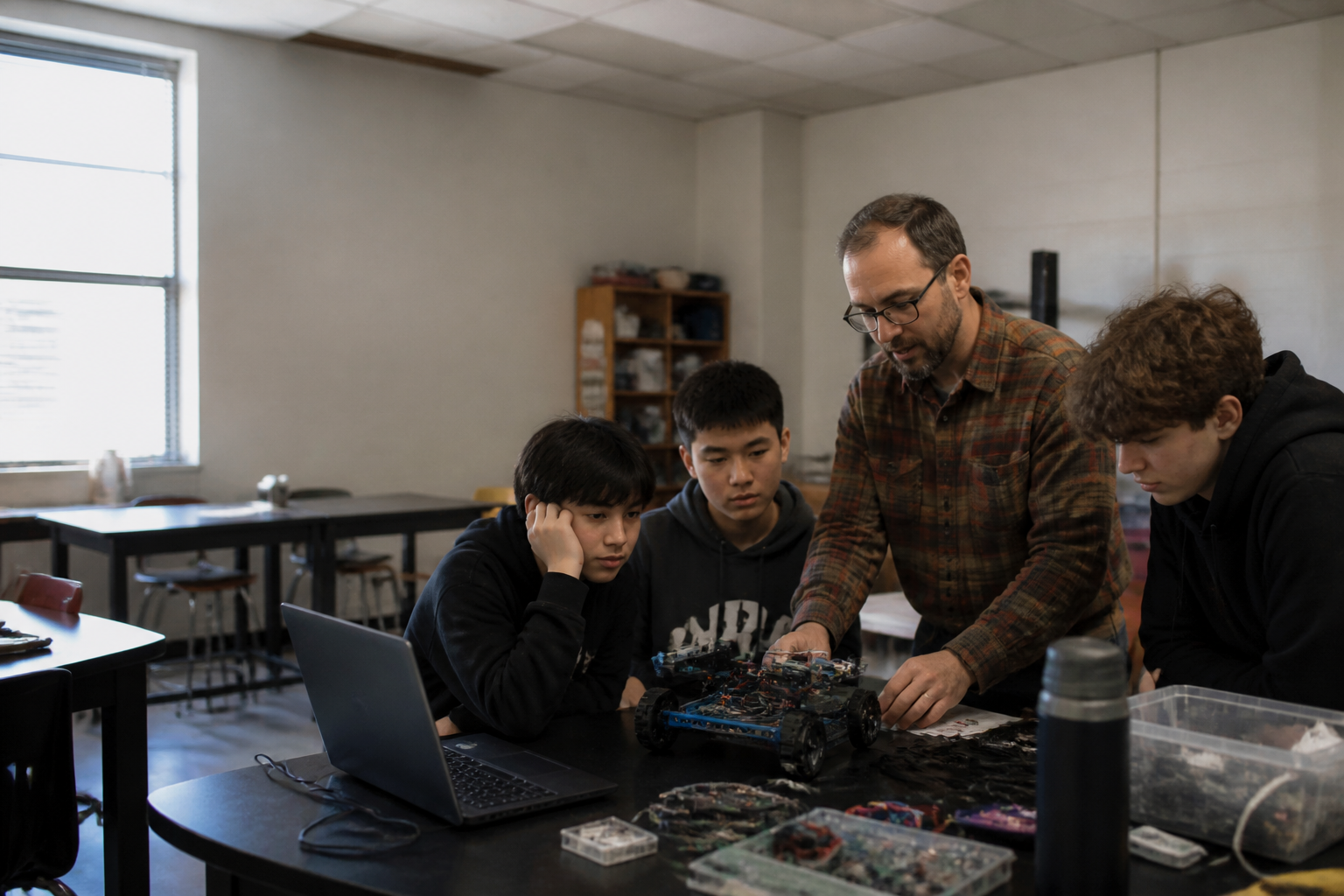
A STEM education master's in Washington pays off only if it matches what you need: a higher placement on the district salary schedule, a math or science endorsement, or a move into educational leadership. Those goals call for different programs, and some of the strongest options here are technical degrees in fields like computer science or engineering rather than M.Ed. programs in Washington.
These programs mix campus and online formats and draw on federal College Scorecard and institutional data. Costs vary widely across public and private schools, so net price and format matter as much as the name.
Washington's endorsement requirements, including content tests, still decide what a degree can do for a classroom teacher.
Key Points
- Washington STEM endorsements require passing WEST-E or NES content tests.
- UW Bothell's 46-credit MS in Electrical and Computer Engineering costs about $48,852.
- Seattle Pacific's campus-based teaching master's focuses on math and science.
Ranked: Washington's Top Master's in STEM Education Programs
Washington's master's options for STEM-interested students span direct teacher preparation, STEM leadership, and technical fields that can strengthen science and math classrooms. Each card below highlights program strengths and practical format details prospective students should compare.
University of Washington-Tacoma Campus
#1Tacoma, WA · $19,000 – $33,000/yr (est.)
UW Tacoma's ranked STEM entry is its Master of Science in Computer Science & Systems, with concentrations in data science, cybersecurity, and distributed systems. The campus-based program emphasizes local high-tech partnerships and lets students choose thesis, capstone, or electives-only paths. The university's graduate catalog also lists a 36-39 credit Master of Education in Secondary Education with science and mathematics tracks for educators interested in K-12 classrooms.
- 40-45 quarter credits
- Data science research center
- Thesis, capstone, or electives-only pathways
- No entrance exam required
- Local high-tech industry partnerships
- 6 concentration options
- Internship for credit available
- Close ties to local high-tech industry
- 3.0 GPA minimum
- Distributed systems concentration
- Real-world capstone project
- Thesis prepares for doctorate study
- Employers: Google, Microsoft, Facebook
Seattle University
#2Seattle, WA · ~$24,000/yr (est.)
Seattle University offers a set of STEM-focused graduate degrees on its urban Seattle campus, including computer science, data science, artificial intelligence, and business analytics. The school emphasizes industry-led projects and strong connections with Seattle-area employers such as Amazon, Boeing, and Microsoft. Evening courses and full- or part-time enrollment make the programs accessible to working professionals, though they are not teacher-preparation degrees.
- Data science concentration
- Rolling admissions
- Evening courses offered
- Full-time and part-time options
- Software engineering concentration
- Industry-led real-world projects
- Certificate pathway for career changers
- Strong Seattle tech employer connections
- Combines statistics, computer science, data analysis
- Project Center has connected students with businesses
- Employers: Amazon, Boeing, Meta, Microsoft
- Ethical and legal aspects of technology
- Online program format
- Machine learning, big data, ethics
- Career path: Machine Learning Scientist
- 19% average salary increase
- STEM-designated business degree
- Online option available
- Emphasis on communicating with business leaders
- Nationally ranked STEM program
- Designed for accounting undergraduates
- Emphasis on analytics for accounting
- STEM-designated accounting degree
- Small classes, low ratios
Washington State University
#3Pullman, WA · ~$15,000/yr (est.)
Washington State University's ranked STEM program is a 30-credit online Master of Engineering and Technology Management designed for working engineers. The curriculum blends engineering management with business coursework and lets students choose from six concentrations including project management and supply chain. A non-thesis capstone applies learning to workplace challenges.
- 30 total credit hours
- 6 concentration options
- 9 total courses
- Designed for working professionals
- Capstone required
- Work experience required
- Offered since 1982
- One or two courses per semester
Western Washington University
#4Bellingham, WA · $14,000 – $27,000/yr (est.)
Western Washington University's ranked entry is a face-to-face Master of Science in Computer Science in Bellingham, open to students from any undergraduate background. The two-year program covers AI, machine learning, big data, and security, and does not require the GRE. Small cohorts and a CS Mentor Program support students preparing for technical and research roles.
- 56-57 total credits
- No entrance exam required
- Test optional
- 2-Year program
- Open to non-CS backgrounds
- Small classes, tight-knit cohort
- CS Mentor Program
- 3.0 GPA minimum
Seattle Pacific University
#5Seattle, WA · ~$21,000/yr (est.)
Seattle Pacific University offers an Accelerated Master in Teaching Math and Science, the ranked list's most direct K-12 STEM teacher-preparation program. The faith-informed program blends subject knowledge with practical teaching skills and offers an online option for flexibility. It is designed for working professionals and career changers who want to move into math and science classrooms.
- Prepares educators for math and science classrooms
- Online option available
- Faith-informed community
- Emphasizes equitable and inclusive teaching
- Accelerated format for working professionals
Walla Walla University
#6College Place, WA · $25,000 – $30,000/yr (est.)
Walla Walla University's ranked STEM offering is a two-year, research-intensive Master of Science in Biology with a 45-credit on-campus curriculum. The program pairs each student with a major professor and caps cohorts at 10, with teaching assistantships that cover tuition and provide a monthly stipend. No GRE is required.
- 45 total credit hours
- 2-Year program
- Cohort limited to 10 students
- Teaching assistantships cover tuition
- Monthly stipend approximately $825
- No entrance exam required
- Dedicated major professor
- Rosario Beach Marine Laboratory
Saint Martin's University
#7Lacey, WA · ~$17,000/yr (est.)
Saint Martin's University's ranked STEM entry is a Master of Science in Mechanical Engineering with a 4+1 BS/MS track for qualified undergraduates. The Lacey campus program emphasizes small classes, faculty research, and semester STEM internship fairs. The university also operates teacher-preparation partnerships with more than 30 South Puget Sound school districts, which can be useful context for educators exploring STEM pathways.
- 4+1 hybrid BS/MS program
- Small class sizes, personalized attention
- STEM internships and career fairs each semester
- LEED platinum certified engineering building
- Engineers Without Borders global projects
- Collaborative faculty research projects
Eastern Washington University
#8Cheney, WA · ~$14,000/yr (est.)
Eastern Washington University's ranked STEM program is a 49-credit Master of Science in Computer Science in Cheney. The curriculum balances practical applications with theory, including advanced algorithms, software engineering, research methods, and electives in machine learning, big data analytics, data mining, cloud computing, game design, and virtual reality. Students complete a thesis or significant project with an oral exam.
- 49 total credit hours
- 3.0 GPA minimum
- Five elective courses, 20 credits
- Thesis or capstone option
- Professional internship elective available
- Machine learning elective available
- Prerequisite courses required
- Covers algorithms, software engineering, research methods
City University of Seattle
#9Seattle, WA · ~$13,000/yr (est.)
City University of Seattle offers online and in-person STEM master's degrees with a professional orientation, including computer science and artificial intelligence. The computer science program is typically completed in two years and uses per-credit tuition of $775, while a Bridge-MSCS option helps non-CS degree holders enter the field. Military discounts and flexible delivery make it accessible for working adults.
- $775 per credit
- Typically completed in two years
- Bridge program for non-tech majors
- Capstone required
- Online or in person
- Internship elective available
- Military benefits accepted
- 39-59 total credits depending on background
- Ethical, human-centered AI techniques
- Machine learning and deep learning courses
- First course free with October enrollment
- One of two newest programs
University of Washington-Bothell Campus
#10Bothell, WA · ~$19,000/yr (est.)
UW Bothell offers STEM graduate programs in cybersecurity engineering, computer science and software engineering, and electrical and computer engineering. The campus is located about 30 minutes outside Seattle, with evening classes and thesis or capstone options designed for working professionals. Holistic review and a 3.0 GPA expectation in the final two years are common entry benchmarks.
- Professional graduate degree
- Collaboration with faculty and industry
- Large Seattle-area employer network
- Diversity, equity, and inclusion focus
- 48-49 credit curriculum
- Thesis or capstone option
- Evening classes for working professionals
- Bridge program for non-CS majors
- 46 total credit hours
- Full-time and part-time options
- Capstone or thesis pathway
- Research opportunities with faculty
Online and Hybrid STEM Education Master's Programs in Washington
Campus and Evening Formats
Seattle Pacific's Accelerated Master in Teaching Math and Science is a campus-based STEM education program, according to the program delivery data used for this ranking. UW Tacoma's M.Ed. with secondary education certification in science or math uses mostly evening study with clinical practice, which fits current teachers and working paraprofessionals. Certification begins in summer, and the full master's path often runs about three years part-time. For a shorter part-time credential, UW Tacoma's certificate-only route is roughly two years.
Balancing Work and Study
Evening and summer cohort structures help full-time educators keep teaching while earning credits. UW Tacoma requires summer attendance at the start of the certification sequence, and its clinical practice is embedded in the program. Seattle Pacific's accelerated model is campus-based, so check whether required sessions conflict with your school calendar.
Credit Loads and Timeline
Per-term credit loads are not fully published across Master's Programs in Washington, so confirm the pace directly with each program. UW Tacoma's 48-credit M.Ed. does not list a fixed per-quarter load, and the full master's route totals about 36 months part-time. No separate residency beyond clinical practice is identified for UW Tacoma, but verify practicum placement locations.
Related Articles
Which Washington STEM Education Master's Programs Waive or Make the GRE Optional
Across graduate education, the GRE has been fading from admissions requirements, and many No-GRE master's programs in teacher education now treat it as optional or skip it entirely.
For the schools ranked here, though, we could not confirm a current, published GRE policy for Seattle University, Washington State University, Western Washington University, Seattle Pacific University, Walla Walla University, Saint Martin's University, Eastern Washington University, City University of Seattle, or the University of Washington Tacoma campus. Treat each as unconfirmed until you read its graduate admissions page or email the program office. Do not assume a waiver.
Other requirements to expect
These are typical patterns for education master's programs in Washington, not verified rules for any one school:
- GPA: A minimum around 3.0 is common, often measured on the last 60 semester or 90 quarter credits, and some programs review applications holistically.
- Certificate or experience: Programs aimed at current teachers often ask for a valid teaching certificate or classroom experience.1
- Prerequisites: Math or science content coursework may be required, especially for secondary endorsements.
- Recommendations: Expect two or three letters, plus a statement of purpose.
Lowest-friction applications
Working teachers with a current certificate, a GPA near 3.0, and a principal willing to write a letter will usually face the lightest process. Confirm test policy in writing before you pay an application fee.
Lowest-Cost STEM Education Master's Programs in Washington
Below are the five schools in this ranking with the lowest net price after grant or scholarship aid. Net price is an institution-wide average, not a program-specific quote. Washington State University's Master of Engineering and Technology Management is the online option among this group.
| School | Program | In-state tuition & fees | Out-of-state tuition & fees | Net price (institution average) | Format |
|---|---|---|---|---|---|
| University of Washington-Tacoma Campus | M.S. in Computer Science & Systems | $13,168 | $43,404 | $10,163 | Campus |
| University of Washington-Bothell Campus | Master of Science in Cybersecurity Engineering | $12,919 | $43,155 | $12,319 | Campus |
| Eastern Washington University | Master's Program in Computer Science | $8,586 | $25,959 | $13,886 | Campus |
| Washington State University | Master of Engineering and Technology Management | $13,391 | $29,950 | $14,971 | Online |
| Western Washington University | Master of Science in Computer Science | $9,582 | $28,707 | $21,193 | Campus |
Master's in STEM Education Cost and Washington Teacher Certification
At UW Bothell's 2026-27 rate of $1,062 per credit, the 46-credit MS in Electrical & Computer Engineering totals $48,852 in tuition. The MS in Computer Science & Software Engineering and the UW Bothell cybersecurity master's charge $999 per credit over 48 to 49 credits, for a total of roughly $47,952 to $48,951. Those totals leave out UW student fees, estimated at $500 per quarter for the electrical engineering program, so your final bill depends on how many quarters you take.
Certification: read this before you enroll
These are technical degrees, not teacher-preparation programs like the Best MAT programs in Washington. Nothing in the program information shows that any of them grants an initial Washington teaching certificate or a math or science endorsement. A Washington certificate requires at least one endorsement.1 and the Professional Educator Standards Board maintains the list of approved providers and the endorsements each may offer.2 Check that list before assuming a degree gets you into a classroom.
Advancement, salary credit, and accreditation
Whether a master's counts toward professional certificate advancement or a district salary-schedule step is decided by the state board and by each district, so ask both in writing. On accreditation, confirm each university's regional standing with NWCCU, and look for CAEP accreditation on any program that prepares educators. CAEP status is not established here for the schools on this page.
How Washington STEM Teachers Earn Endorsements
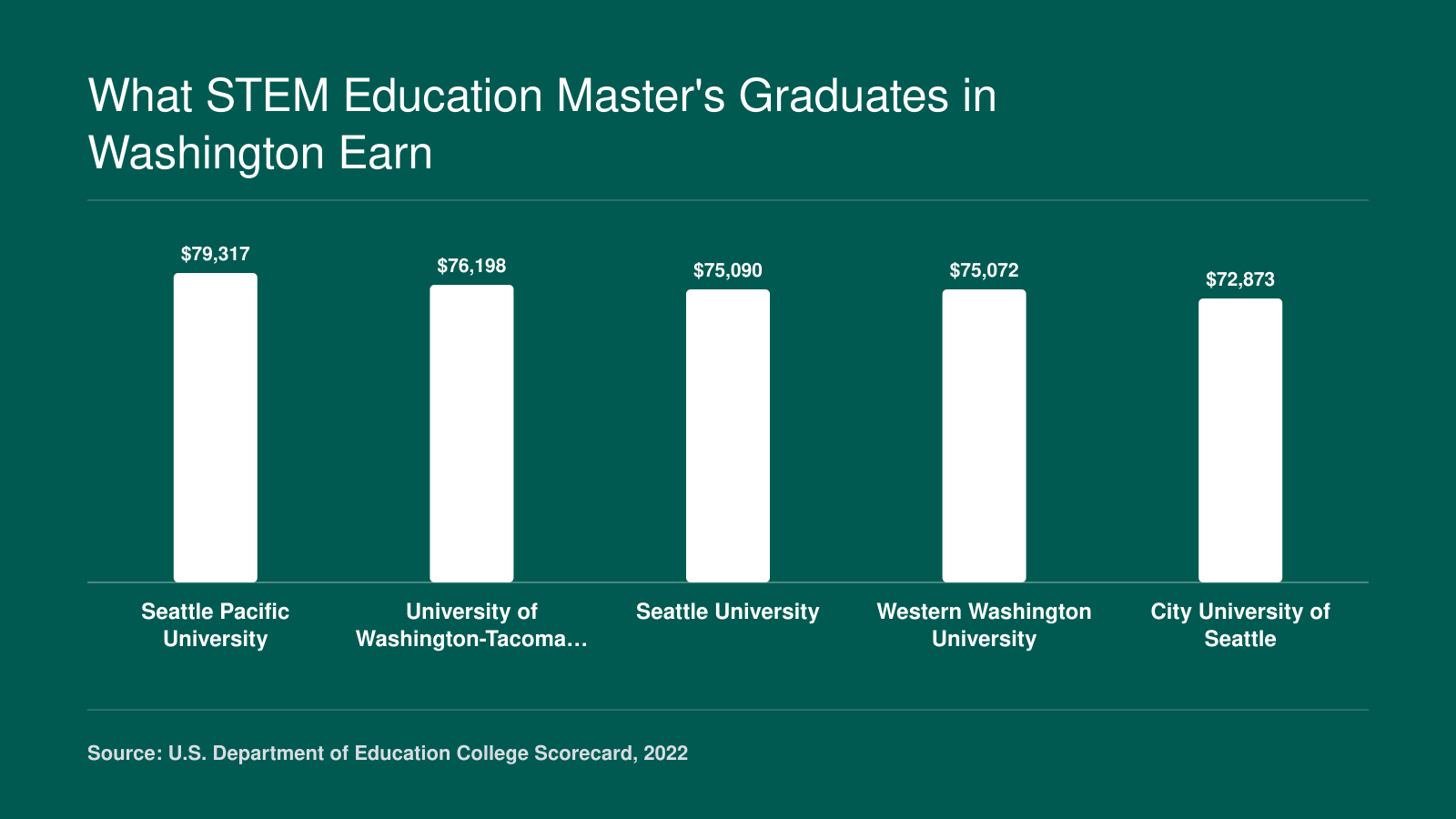
What STEM Education Master's Graduates in Washington Earn
This chart compares median earnings five years after finishing for the top programs in the state. Data comes from the U.S.
FAQ: STEM Education Master's Programs in Washington
Washington master's programs in STEM, science, and math education set their own deadlines, start terms, and aid rules, so treat each application as its own checklist. Use these steps to stay organized and confirm details on official pages.
How do I shortlist Washington STEM education master's programs and track deadlines?
What should I ask each admissions and financial aid office?
Where can I find funding for a STEM education master's in Washington?
How can I verify STEM education career and wage context while comparing programs?
Compare Stem Science Technology Engineering Math programs on the data that matters
Explore more Education & Teaching specializations or browse every graduate field.
All Education & Teaching programs