Best Master's in History Education Programs in Massachusetts
Compare accredited History master's programs by earnings, cost, and outcomes.
Sample layout — live rankings and program data appear here once the data source is connected.

Not every history master's in Massachusetts leads to a classroom license, and that gap is where applicants lose time and money. UMass Lowell's 30-credit M.Ed. in Curriculum and Instruction prepares students for the MTEL and initial licensure, Gordon College offers initial and professional tracks online, and Westfield State offers both an initial-licensure M.Ed. and a non-licensure M.Ed.
Only a small set of best teaching colleges in Massachusetts made the ranked list, so each pick gets a close look at cost and licensure fit.
The degree alone doesn't satisfy the state; the license pathway does.
Key Points
- Gordon College offers an online licensure route; Westfield State's degree is thesis-based and non-licensure.
- UMass Lowell pairs a 30-credit MA in History with a licensure-ready M.Ed. concentration.
- Massachusetts licenses History (5-12) teachers under 603 CMR 7.00, so match the degree to your licensure stage.
Best Master's in History Education Schools in Massachusetts
Massachusetts offers three distinct routes into a history-focused master's: a campus-based licensure program in Lowell, an online licensure program from Gordon College, and a non-licensure, thesis-based degree at Westfield State. Which fits depends on whether you need a teaching license, how you want to attend, and how much you can spend. Graduation rates below are institution-wide, not specific to the program.
University of Massachusetts-Lowell
#1Lowell, MA · ~$16,000/yr (est.)
Best for: Career changers seeking initial licensure on campus
UMass Lowell pairs a history concentration with its Curriculum & Instruction M.Ed., so you finish with initial Massachusetts licensure to teach secondary history. The program is grounded in culturally sustaining pedagogy, includes a practicum and internship, and places you in a cohort with in-service educators. Local history ties run through the Tsongas Industrial History Center, a partnership with Lowell National Historical Park. The university's institution-wide graduation rate is about 65%.
- 30 credit hours, completable in as few as two years
- Leads to initial teaching licensure in Massachusetts
- Prepares secondary history teachers and prepares you for the MTEL
- SEI Endorsement included
- Practicum and internship required
- 3.0 GPA minimum; bachelor's in history or related field expected
- Accelerated bachelor's-to-master's option available
- Culturally sustaining pedagogy and equity focus
Gordon College
#2Wenham, MA · ~$9,000/yr (est.)
Best for: Working teachers needing online flexibility
Gordon College delivers its Master of Education in History Education fully online, which suits working teachers who cannot relocate or attend evening classes. The curriculum runs from local to global history with an emphasis on inquiry-based instruction and civic engagement. You can choose an initial or professional licensure track, and the college's teacher-education programs are approved by Massachusetts DESE. The institution-wide graduation rate is about 69%.
- 100% online format
- Initial and professional licensure tracks
- 2 concentration options
- Curriculum spans local to global history
- Inquiry-based instruction and civic engagement focus
- Career paths: teacher, curriculum developer, museum educator
- Programs approved by Massachusetts DESE
Westfield State University
#3Westfield, MA · $5,000 – $10,000/yr (est.)
Best for: Aspiring scholars wanting thesis-based study
Westfield State's History M.Ed. is a non-licensure degree for students who want deeper historical scholarship rather than a teaching license. It covers European, American, and world history, requires independent research and a thesis, and offers full-time and part-time schedules. Graduate assistantships are available, and graduates move into education, museums, archives, government, and nonprofits. It carries the lowest in-state tuition of the three. The institution-wide graduation rate is about 54%.
- 36 credit hours; does not lead to teaching licensure
- Thesis and independent research required
- Full-time and part-time options
- 3.0 GPA minimum and 3 letters of recommendation
- Prerequisite history coursework required
- Graduate assistantships available
- $50 application fee
- Career paths in museums, archives, law, and government
Online and Hybrid Master's in History Education Options in Massachusetts
Fully online coursework or a campus classroom: that is the first fork for students considering a Master's in History Education in Massachusetts, and the programs here cover both. UMass Lowell's Master's in Curriculum and Instruction in Massachusetts with a History concentration is the most flexible. You can take it fully online, hybrid, or on campus. Gordon College describes its M.Ed. in History as a 100% online program, with both initial and professional licensure tracks. Westfield State's non-licensure M.Ed. in History is a campus program.
Online coursework does not mean online fieldwork. UMass Lowell's initial-license route requires a 300-hour supervised practicum, including at least 100 hours of full teaching responsibility. Online and blended students complete those clinical hours in person. Before you apply, ask each licensure program whether it assigns your placement or expects you to arrange one, and whether it can place you in a school near home.
Also confirm whether online classes meet live at set times or run asynchronously. That detail matters most for working teachers. Westfield State offers part-time study, and UMass Lowell places candidates in cohorts alongside in-service educators, so ask both about evening sections.
Which Massachusetts History Education Master's Programs Waive or Drop the GRE?
A GRE policy is simply the admissions rule on whether you must submit Graduate Record Examination scores; across Master's Programs in Massachusetts, these history education programs rarely state the answer outright, and students checking master's programs with no GRE required may still need to confirm directly with each school.
GRE policy by school
- Westfield State University: The pages for both the History 5-12 Initial M.Ed. and the History Non-licensure M.Ed. do not mention the GRE. That means a waiver is not established, so ask admissions before assuming scores are unnecessary.
- UMass Lowell and Gordon College: No GRE requirement, waiver, or optional policy is established for either history program, so confirm directly with each school.
Common prerequisites
Westfield State asks for a bachelor's degree, at least 18 semester credit hours in history (humanities-related credits can count for the non-licensure track), a 3.0 average over the last 48 undergraduate credits, and a 3.0 in history courses. UMass Lowell lists a 3.0 minimum GPA and a bachelor's in history as a prerequisite.
On the MTEL, Westfield State requires subject-matter tests before the student-teaching practicum. Whether the Communication and Literacy Skills test is needed at application is not established, so plan to take it early. The non-licensure track does not require a teaching license.
Deadlines
Westfield State admits on a rolling basis. Deadlines for UMass Lowell and Gordon are not established here, so check each admissions page.
Related Articles
Master's in History Education Cost and Massachusetts Licensure Value
How much does a master's in history education cost in Massachusetts? The public universities on this list publish the clearest pricing.
Per-Credit Rates and Total Tuition
- Westfield State University: The 39-credit M.Ed. in History, 5-12 (Initial) carries a $416 per-credit Teacher Incentive rate through Fall 2026, subject to change, compared with a $442 standard rate. Tuition lands near $16,224 to $17,238 before fees, which the school has not fully itemized.
- University of Massachusetts-Lowell: The 30-credit M.Ed. in Curriculum & Instruction (History) charges $470 per credit regardless of residency, about $14,100 in tuition. Add a $30 registration fee each term and a possible $150 pre-practicum fee. The school's estimated 2026-2027 on-campus cost is $17,522, varying by specialization.
- Gordon College: This is the private option here, so confirm current graduate rates on its tuition page. Its institution-wide average net price ($24,883) sits above Westfield State ($16,721) and UMass Lowell ($17,163).
Aid Levers and Payoff
Westfield State offers a Supporting Our Schools Scholarship for incoming licensure students and a Teacher Incentive Discount once MTEL requirements are met. UMass Lowell lists federal aid, scholarships, assistantships, employer reimbursement and district partnerships, with aid eligibility starting at 6 credits. If you already teach, ask your district about tuition reimbursement, since terms vary widely.
Institution-wide median earnings 10 years after entry reach $64,874 at UMass Lowell, $57,346 at Westfield State and $52,119 at Gordon. These figures cover all graduates, not history teachers specifically, so treat them as context rather than a salary forecast.
From Initial to Professional License: The Massachusetts History Teacher Path
The Massachusetts Department of Elementary and Secondary Education (DESE) licenses History (5-12) teachers under 603 CMR 7.00. The order of the steps matters, and so does choosing the right type of master's.
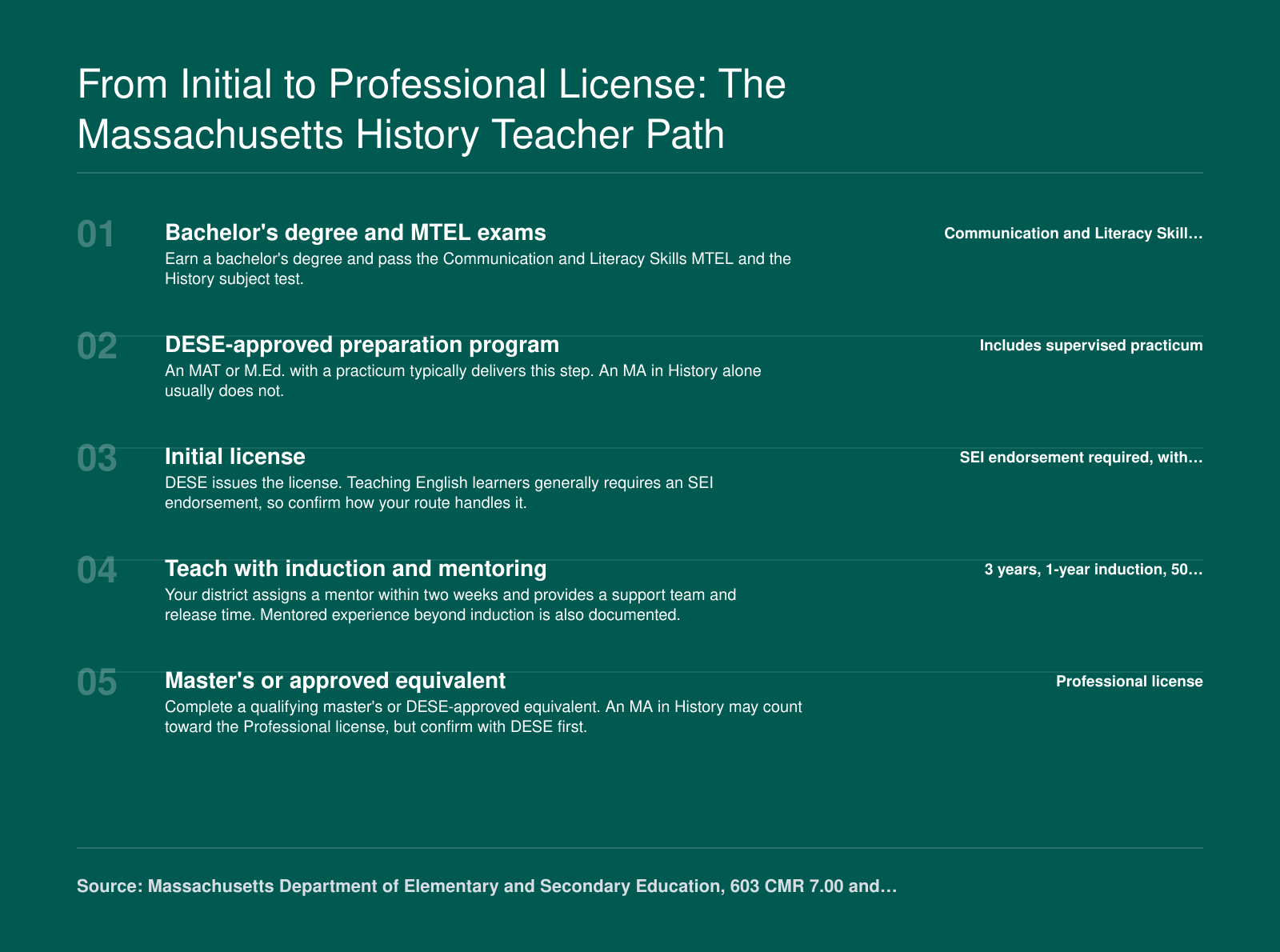
Match the program to your licensure stage: an initial license program if you are entering the classroom, a professional license program if you are already teaching.
What to Look for in a Massachusetts History Education Master's Program
What is the actual difference between an MA, an MAT, and an M.Ed. in history? The MA is content-driven: UMass Lowell's 30-credit, 10-course MA in History deepens subject knowledge and is positioned as an option for already-licensed educators pursuing professional licensure rather than a first license. An MAT is practice-focused and normally built around initial licensure. The M.Ed. sits in between, and in Massachusetts it does both jobs depending on the track, which is why reading the specific track page matters more than reading the degree abbreviation.
Credits, Culminating Work, and Fine Print
- Credits: UMass Lowell's M.Ed. in Curriculum & Instruction with the History 5-12 concentration runs 30 credits; Westfield State's initial-licensure M.Ed. in History Education 5-12 runs 39; its non-licensure M.Ed. runs 36.
- Culminating experience: Westfield's non-licensure route ends in a thesis and defense, while the licensure-track programs center on field placement instead, including 6 practicum credits at UMass Lowell and a 30-hour pre-practicum or student teaching placement with students from diverse backgrounds at Westfield.
- Transfer credit: Westfield's non-licensure M.Ed. permits up to 6 graduate credits at the department's discretion. Confirm limits directly elsewhere.
Treat regional accreditation and DESE program approval as non-negotiable, and ask how placements are secured before you enroll.1
Frequently Asked Questions About History Education Master's in Massachusetts
These answers cover the licensure questions that most often decide which history education master's route fits a working or aspiring teacher. Always confirm details with the program and the Massachusetts Department of Elementary and Secondary Education before enrolling.
Can I earn a Massachusetts history teaching license with an MA in History instead of an MAT or M.Ed.?
Do I need to pass the MTEL before starting a history education master's in Massachusetts?
Will a Massachusetts history teaching license transfer to other states?
How long does it take to finish a history education master's in Massachusetts while teaching full time?
Compare History programs on the data that matters
Explore more Education & Teaching specializations or browse every graduate field.
All Education & Teaching programs