Best Master's in History Education Programs
Compare accredited History master's programs by earnings, cost, and outcomes.
Sample layout — live rankings and program data appear here once the data source is connected.

Choosing among the best master's in history education programs, like elementary education master's programs, means trading off a teaching license against price. Some degrees lead to initial certification, while the non-licensure tracks at Westfield State and Liberty add graduate credit without one. Listed graduate tuition runs from $8,640 at UAB (in-state) to $57,973 at Columbia's Teachers College.
Start with the ranked list, then use the quick answers, cost tables, format and licensure guidance, and career outcomes.
Licensure rules are set state by state, so the cheapest degree is only a bargain if it qualifies you to teach where you live.
Key Points
- Total required credits, usually 30 to 36, can outweigh per-credit tuition rates.
- Licensure-track programs can fail to qualify you in another state, so verify first.
- Dual-credit teaching often requires 18 graduate history credits, which non-licensure degrees can supply.
The 10 Best Master's in History Education Programs Ranked
The strongest master's in history education programs separate themselves by keeping tuition manageable, moving students through to graduation, and producing graduates with earnings that hold up. This list favors programs that fit working teachers, career changers, and future researchers rather than the biggest names alone.
Columbia University in the City of New York
#1New York, NY · ~$58,000/yr (est.)
Best for: Research-driven future doctoral candidates
Columbia's Teachers College offers a History and Education M.Ed. built for students aiming at research, higher education, or policy work. The program describes itself as the largest graduate program of its kind, with mentoring and a research-heavy curriculum that draws doctoral-bound students. The school has a 96 percent graduation rate, and graduates report median earnings of $72,306 four years after finishing.
- Largest graduate program of its kind
- Cutting-edge historical research emphasis
- Personalized mentoring and guidance
- Dynamic global learning community
Truman State University
#2Kirksville, MO · ~$12,000/yr (est.)
Best for: Budget-focused Missouri licensure candidates
Truman State University's Master of Arts in Education with a Social Science/History Education concentration is a Missouri-focused licensure path with unusually direct faculty advising. Applicants need a 3.0 GPA and three references, and students track progress with a dedicated GPA sheet. The school has a 69 percent graduation rate, and in-state graduate tuition is among the most affordable in this ranking.
- 3.0 GPA minimum for admission
- Three letters of recommendation required
- Faculty advisor Dr. Kathryn Brammall
- GPA sheet for tracking progress
- Focus on teaching high school students
University of Massachusetts-Lowell
#3Lowell, MA · ~$16,000/yr (est.)
Best for: Career changers drawn to public-history partnerships
UMass Lowell's M.Ed. in Curriculum and Instruction with a History concentration prepares students for initial teaching licensure in Massachusetts while linking coursework to real classrooms. The 30-credit program includes a practicum and internship, SEI endorsement, and an accelerated bachelor's-to-master's option. Its deep Lowell-area partnerships include more than 50 districts and the Lowell National Historical Park, which gives history candidates unusually direct access to place-based public history. The school has a 65 percent graduation rate.
- 30 total credit hours
- 3.0 GPA minimum
- Prepares for MTEL and Massachusetts licensure
- Practicum and internship required
- SEI Endorsement included
- Accelerated bachelor's to master's option
DePaul University
#4Chicago, IL · ~$23,000/yr (est.)
DePaul's TEACH: Secondary Education History M.Ed. is an accelerated five-year combined bachelor's and master's route to Illinois licensure. The 52-quarter-hour program folds in field hours, student teaching, and an International Baccalaureate Certificate in Teaching and Learning. The school has a 68 percent graduation rate, and DePaul's extensive Chicago partnerships can connect history teaching candidates with urban schools, museums, and community organizations.
- 52 total quarter hours
- 85 clinical hours
- Illinois Professional Educator License preparation
- IB Certificate in Teaching and Learning
- Double-counted undergraduate/graduate courses
- Five-year combined bachelor's and master's route
University of Alabama at Birmingham
#5Birmingham, AL · ~$9,000/yr (est.)
UAB's Master of Arts in Education in Secondary Education with a History concentration is designed for educators who already hold Class B certification and want Class A certification in grades 6-12. The blended format suits working teachers, and coursework emphasizes urban education, critical social issues, and positive behavioral supports. The school has a 64 percent graduation rate.
- For teachers with Class B certification
- Leads to Class A certification for grades 6-12
- Blended online and on-ground format
- Urban education and critical social issues focus
- Research projects with award-winning faculty
- CAEP and Alabama State Department of Education accredited
Liberty University
#6Lynchburg, VA · ~$9,000/yr (est.)
Liberty University's online M.Ed. in Curriculum and Instruction with a History focus is a 36-credit, non-licensure track built for already-licensed teachers or private school educators. The fully online format uses 8-week courses, and the curriculum spans political, economic, religious, cultural, and military history. The school has a 65 percent graduation rate, and median earnings reach $59,708 four years after finishing.
- 36 total credit hours
- 100 percent online, 8-week courses
- Non-licensure track for educators
- No thesis or capstone required
- Covers world, American, and European history
- Transfer up to 50 percent of graduate degree
Slippery Rock University of Pennsylvania
#7Slippery Rock, PA · ~$13,000/yr (est.)
Slippery Rock University's M.Ed. in Teaching History offers two distinct routes: a hybrid Basic Concentration for career changers pursuing initial certification, and an online Advanced Concentration for already-certified teachers. Both paths run 36 credits and can be completed in 12 months of full-time study. The school has a 66 percent graduation rate, and program-level earnings data shows median earnings near $49,768 four years after finishing.
- 36 total credit hours
- 2.8 GPA minimum
- Blended online and on-site delivery
- Designed for initial teacher certification
- Praxis accepted for low GPA applicants
- Fully online for certified teachers
- 3.0 GPA minimum
- 15 elective credits to customize study
- CAEP accredited
Westfield State University
#8Westfield, MA · $5,000 – $10,000/yr (est.)
Westfield State's non-licensure History M.Ed. is for students who want advanced historical research and interpretation without K-12 licensure. The 36-credit program includes a required thesis, independent research, one-on-one faculty mentorship, and graduate assistantships, with career paths in museums, archives, law, government, and nonprofits. The school has a 54 percent graduation rate.
- 36 total credit hours
- Thesis required
- Full-time and part-time options
- 3.0 GPA and three references required
- Independent research and faculty mentorship
- Career paths in museums, archives, law
Eastern Kentucky University
#9Richmond, KY · ~$11,000/yr (est.)
Eastern Kentucky University's Master of Arts in Education with a secondary education in history concentration is an on-campus path for students preparing to teach history at the middle or high school level. The curriculum integrates content knowledge and instructional methods, and students work directly with faculty mentors. The school has a 50 percent graduation rate, and in-state graduate tuition is comparatively low.
- On-campus delivery
- Secondary education in history concentration
- Housed under the College of Education
Gordon College
#10Wenham, MA · ~$9,000/yr (est.)
Gordon College's M.Ed. in History offers initial and professional licensure tracks and can be completed fully online. The program emphasizes inquiry-based instruction, civic engagement, and preparation for roles like history teacher, curriculum developer, museum educator, or school administrator. The school has a 69 percent graduation rate.
- Initial and professional licensure tracks
- 100 percent online program
- Nationally recognized faculty
- Careers: history teacher, curriculum developer
- Careers: museum educator, school administrator
What Went Into This List: Cost, Completion, and Graduate Earnings
A great history education program should leave you a better teacher without leaving you buried in debt, so every school here had to prove value on both counts. Four signals did most of the work, and each one answers a question a working teacher would actually ask.
The Four Signals
- Net price after aid: What students typically pay once grants and scholarships are subtracted from the sticker price.
- Completion rate: How many students at the institution finish what they start.
- Earnings after graduation: What program graduates make in the years after they finish.
- Median federal debt at completion: What students typically owe when they leave.
Read the Numbers With Care
Two caveats matter. Net price is a sector-level average after aid, not a personal quote. Your own bill depends on your aid package, your residency, and any district tuition benefits, so treat the figure as a rough benchmark and confirm real costs with the school. Completion rates describe the whole institution rather than the history education program itself, which makes them a signal of institutional support, not a guarantee about one secondary education cohort.
Program-level earnings for history education are not yet available for many schools here. Where that is the case, we say so plainly rather than substituting a guess, and the cost and debt picture carries more weight in your comparison.
Why Format Flexibility Counted
Most people enrolling in these degrees are already teaching, coaching, or raising families. A program that demands daytime classes on a distant campus may be a poor fit even if it looks strong on paper. For that reason, online master's in education programs, hybrid programs, and on-campus programs were all eligible, and format is noted so you can match a program to the schedule you actually have.
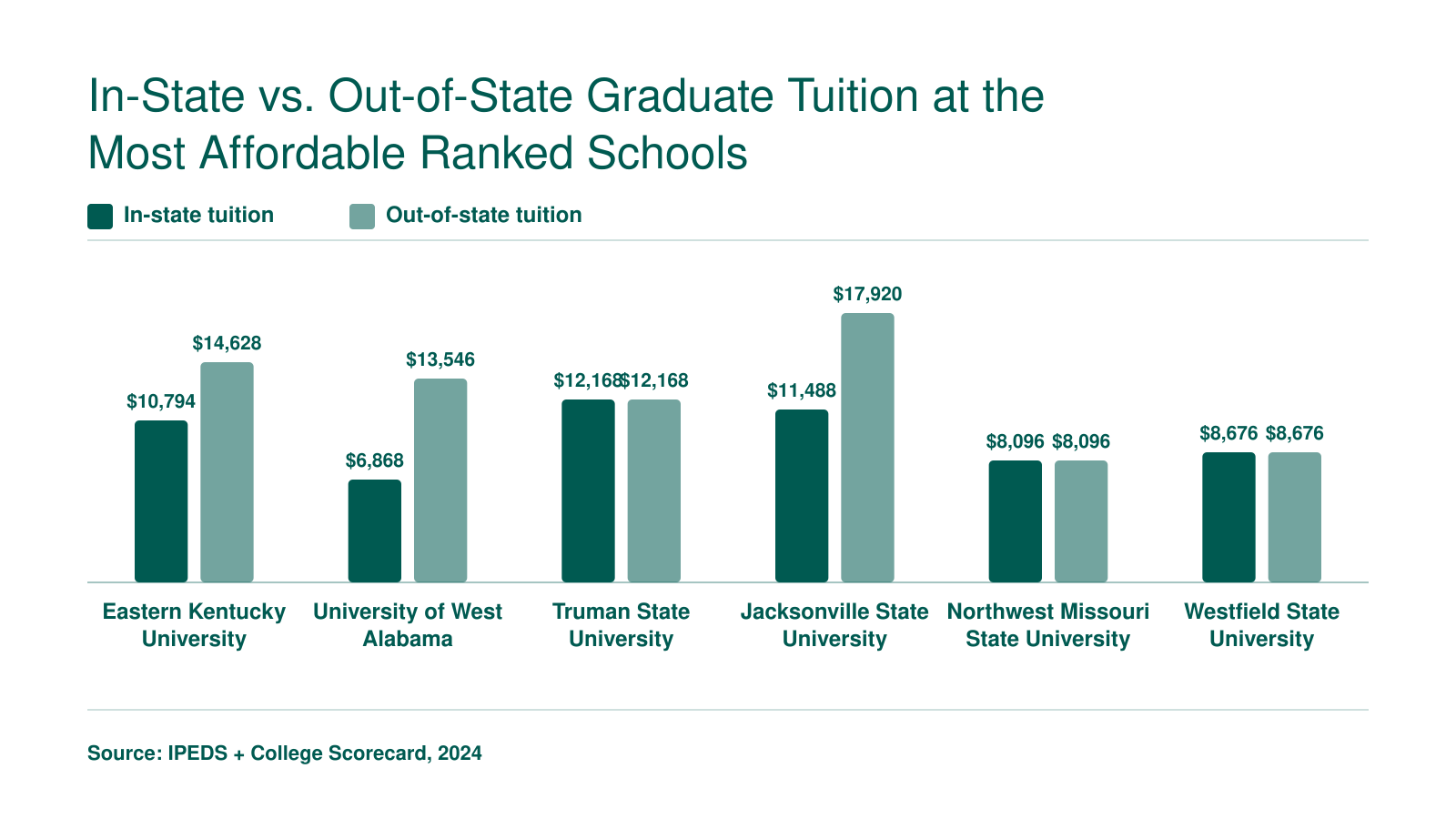
In-State vs. Out-of-State Graduate Tuition at the Most Affordable Ranked Schools
Residency can change what a history education master's costs more than almost any other factor. The chart compares graduate in-state and out-of-state tuition at the lowest-cost schools on this list. It uses graduate tuition figures, not undergraduate sticker prices.
Per-Credit Tuition and Total Program Cost at Top-Ranked Schools
Total required credits, typically 30 to 36, can matter more than the per-credit rate, because a lower rate attached to a longer program can cost nearly as much as a pricier, shorter one. Every tuition figure below comes from the school's published 2026-27 tuition or program page, and mandatory fees vary by term, so confirm the current rate with the bursar before you budget. If you are already teaching, ask your district about tuition reimbursement and whether graduate credits move you to a higher salary lane, since either can offset a meaningful share of the cost.
| School | Per-Credit Tuition | Total Credits | Estimated Total Tuition | Format |
|---|---|---|---|---|
| American College of Education (Online M.Ed. in History Education) | $235 (2026-27) | 34 | $7,990 (2026-27) | Online |
| University of Nebraska at Kearney (Master's in History) | $369 (2026-27) | 30 | $12,833.50 (2026-27) | Graduate program (two-year timeline estimate) |
| Liberty University (Online M.Ed. in History Education) | $450 (2026-27) | N/A | N/A | Online |
| American Public University (Online M.A. in History) | $470 (2026-27) | 36 | N/A | Online |
| Southern New Hampshire University (Online M.A. in History) | $659 (2026-27) | 33 | $21,747 (2026-27) | Online |
| University of Minnesota (Social Studies Education M.Ed. and Teaching License) | $913 (2026-27) | N/A | N/A | M.Ed. with teaching license |
Related Articles
Online, Hybrid, or On-Campus: How Delivery Formats Stack Up
Format changes your schedule and how you meet people, but it does not change the degree's standing. Employers and state licensing boards look at accreditation and whether the program matches your state's licensure requirements, not whether you studied online. If you want an initial license, any format still requires in-person, supervised classroom placements, often in your home state.
| Factor | Online | Hybrid | On-Campus |
|---|---|---|---|
| Scheduling style | Mostly asynchronous. Missouri State has no required live sessions, and Jacksonville State and Northwestern College (Iowa) are asynchronous. Texas Tech is the exception, with synchronous live instruction. | Middle Tennessee State offers a hybrid format alongside its remote and on-ground options. Confirm which meetings are live. | Fixed class meetings on campus, as at Troy (Troy Campus), Boston University, and Middle Tennessee State. |
| Evening and weekend options | Short terms are common: Liberty and Grand Canyon use mostly 8-week courses, and Northwestern College (Iowa) runs one course every 8 weeks. | Middle Tennessee State offers afternoon and evening class schedules. | Evening availability depends on the school. Middle Tennessee State lists afternoon and evening on-ground classes. |
| Field experience or student teaching | Troy's Alternative-A track places you in a secondary history classroom in your local community. Jacksonville State's Alternative-A candidates complete field experiences in approved school settings. | Licensure placements are still in person. Ask the program how it arranges them. | Boston University requires an in-person supervised field experience for students pursuing licensure. |
| Cohort interaction | Limited in asynchronous courses. Live formats such as Texas Tech's offer more real-time discussion. | Mix of in-person and remote contact, depending on how the program schedules meetings. | Most face-to-face contact with peers and faculty. |
| Residency-based tuition | Rates vary by school. Check whether the online rate differs for in-state and out-of-state students. | Usually follows the school's standard graduate rate. Confirm with the bursar. | Out-of-state students at public schools often pay more, so compare each school's tuition schedule. |
| Best fit | Working teachers who need flexibility. Liberty and Boston University also have 8-week or any-semester start options. | Students who want some campus contact without relocating full time. | Career changers who want a structured, local placement network. |
Initial Licensure vs. Non-Licensure Tracks: Matching the Program to Your Goal
The rapid expansion of dual-credit and concurrent-enrollment courses in high schools has quietly turned graduate history credit hours into a credential of their own, separate from any teaching license. That makes track selection the single most consequential choice you make before applying.
The Three Tracks
- Initial licensure: Built for career changers and recent bachelor's graduates who need certification to teach in public schools. Virginia Tech's one-year M.A.Ed. in History and Social Science Education splits into an initial licensure path for Grades 6-12 and a separate advanced path, and Troy University's online Master's in History Education, Grades 6-12 similarly offers an initial licensure option alongside one for already-certified teachers.12
- Advanced study for licensed teachers: These assume you already hold a license and want deeper content knowledge, a salary-schedule bump, or preparation for educational leadership. Troy's certified-teacher track and Virginia Tech's advanced option fit here.
- Non-licensure content degrees: Liberty University's M.Ed. in Curriculum and Instruction with a History concentration states plainly that it does not lead to teacher licensure, making it a fit for private school faculty or licensed teachers adding depth. North Dakota State's History Education degrees also do not confer licensure; prospective licensure candidates are told to work directly with an adviser.
The 18-Hour Threshold
Texas law requires anyone teaching dual-credit or community college courses to hold a master's degree in any field plus 18 graduate hours in the subject taught, and Indiana University's graduate certificate cites the same Higher Learning Commission expectation. Texas Tech structures its Dual Credit Credential around this directly: 36 total hours, 18 in online curriculum and instruction and 18 in graduate-level history, with five specific history courses excluded from the count. If you already hold a master's, standalone 18-credit certificates from Indiana State (fully online), Texas Woman's University, and Northwestern College of Iowa reach the threshold without a second degree.
Thesis or Project
Virginia Tech's advanced track requires a thesis or applied professional project, and North Dakota State pairs an M.S. thesis route with an M.Ed. practicum or project.1 Choose the thesis if a doctorate is plausible; choose the applied project if your classroom is the destination.
Admission Requirements and Application Deadlines to Plan Around
Requirements vary more than the programs' names suggest, so check each school's current admissions page before you apply. Deadlines below come from the 2026 and 2026-27 cycles where schools published them.
- Core documentsExpect an accredited bachelor's degree, official transcripts, and an application, often with recommendation letters and a statement of purpose. Some schools did not list letters or statements in the sources we reviewed, so confirm directly. American College of Education, for example, asks for official transcripts from a recognized accreditor, an application, and enrollment agreements.
- Minimum GPAPublished minimums run from about 2.5 to 3.0. Liberty University and American College of Education list 2.5, Grand Canyon University 2.8, Northwest Missouri State University 2.75, and Northwestern College 3.0. Some schools admit below the line conditionally or case by case.
- GRE and other testsMost programs here don't require an exam. Northwestern College requires none, though Northwest Missouri State lists a GRE writing score of 3.5 or higher as one of several options, and Grand Canyon University asks for a GMAT 500 or GRE 300 only if your GPA falls below 2.8.
- Teaching licenseNorthwestern College and Northwest Missouri State require a valid teaching license or certificate; Northwestern also expects a history or social studies endorsement unless the chair approves an exception. Liberty's history specialization doesn't lead to licensure, and Teachers College doesn't list a license as a requirement in the sources reviewed.
- Deadlines and start termsTeachers College, Columbia lists a November 15, 2026 deadline for 2026-27. Northwest Missouri State lists August 10, 2026 for its 2026 term, and American College of Education lists November 13, 2026. Liberty University starts terms on October 26, 2026 and January 18, 2027. Rolling or term-based entry is common online, so apply early.
- Prerequisite courseworkIf you're seeking initial licensure, check whether the school wants prior history or social studies credits. The sources reviewed didn't state specific prerequisite hours for most schools, so ask admissions. Northwest Missouri State may admit a 2.50 to 2.74 GPA if you earn a B in its first history course.
Quick Answers Before You Compare Programs
Three questions come up most often when teachers and career changers start comparing history education degrees. The answers below point to the sections later in this article where each topic gets a fuller look.
Do you need a teaching license before enrolling in a history education master's?
How does a history education master's differ from a traditional M.A. in history?
Do school districts take online history education degrees seriously?
Compare History programs on the data that matters
Explore more Education & Teaching specializations or browse every graduate field.
All Education & Teaching programs