Best Online Master's in History Education Programs
Compare accredited History master's programs by earnings, cost, and outcomes.
Sample layout — live rankings and program data appear here once the data source is connected.
Licensure-track programs satisfy student teaching and content exam requirements; advanced tracks assume you already hold a license. That distinction, not the online delivery of these online master's programs, decides whether you enter a classroom or move up a district salary schedule.
Every program below is 100% online, with no hybrid or campus residency, a common structure among online master's in education programs. In-state graduate tuition runs from $6,790 to $12,720 before aid, so licensure status, not format, carries most of the financial risk.
Key Points
- Every ranked program here is fully online with no campus residency.
- NASDTEC interstate agreement does not transfer any teaching license automatically.
- Slippery Rock and Liberty publish federal earnings and debt outcomes.
Top 100% Online History Education Master's Programs, Ranked
Every program on this list can be completed fully online, with no required campus residency or hybrid attendance. The six programs span advanced-certification, non-licensure, and initial or advanced teacher-preparation routes in history and social studies education.
Slippery Rock University of Pennsylvania
#1Slippery Rock, PA · ~$13,000/yr (est.)
Best for: Certified teachers seeking advanced history expertise
Slippery Rock's education-focused history master's is built for certified teachers who want to lead social studies instruction without leaving the classroom. The fully online advanced concentration combines core education coursework with 15 elective credits across leadership, technology, special education, and instructional foundations, and can be finished in about a year. Program completers report median earnings around $52,644 five years after finishing.
- CAEP-accredited program
- 36 total credit hours
- 12-month completion path
- Designed for certified teachers
- 15 elective credits across leadership, technology, and special education
- Career paths include department chair, curriculum developer, instructional coach, or AP history teacher
Northwestern College
#2Orange City, IA · ~$7,000/yr (est.)
Best for: Practicing educators needing asynchronous history content
Northwestern College's online Teaching History program is a good fit for practicing educators who need asynchronous coursework and a content-heavy history load. The 33-credit degree includes 18 credits in history and offers both capstone and research pathways, which can support dual-enrollment or community college teaching eligibility. It is approved by the Iowa Department of Education and can be completed in about two years.
- 33 total credit hours
- $360 per credit hour
- No entrance exam required
- 100% asynchronous online coursework
- 18 credits of history content
- Capstone or research pathway
- Iowa Department of Education accredited
- Designed for practicing teachers and dual-enrollment eligibility
Liberty University
#3Lynchburg, VA · ~$9,000/yr (est.)
Best for: Already-licensed teachers wanting non-licensure flexibility
Liberty's non-licensure history concentration is aimed at educators who are already certified or teaching in settings that do not require state licensure. The 36-credit online program uses eight-week courses and blends foundational education theory with United States, world, and European history content, with start dates scattered across the year. Full-time tuition starts at $430 per credit hour, and the university is regionally accredited by SACSCOC. Program-level median earnings reach about $59,708 four years after finishing.
- 36 total credit hours
- $430 per credit hour
- Non-licensure track for already certified educators
- 8-week online courses
- SACSCOC regionally accredited
- Military tuition rate available
- Transfer up to 50% of graduate degree
Northwest Missouri State University
#4Maryville, MO · $5,000 – $10,000/yr (est.)
Northwest Missouri State's Teaching History master's is designed for working teachers seeking dual-credit or advanced content expertise, with accelerated seven-week fully online courses and a capstone teaching portfolio. The 30-credit program is AAQEP-accredited and includes history electives such as the Holocaust, Civil War, environmental history, and ancient civilizations. It does not provide initial teacher certification, so applicants should bring a current certificate or alternative-certification enrollment.
- 30 total credit hours
- $407 per credit hour
- AAQEP-accredited
- Accelerated 7-week fully online courses
- Capstone teaching portfolio required
- History electives include Holocaust, Civil War, environmental history, and ancient civilizations
- Does not provide initial teacher certification
East Texas Baptist University
#5Marshall, TX · ~$8,000/yr (est.)
East Texas Baptist's history concentration pairs 12 hours of education foundations with 18 hours of history, including historiography, colonial North America, the transatlantic world, and modern Europe. Offered fully online with synchronous and asynchronous options, the 30-credit degree can be completed in as few as 12 months and is grounded in a Christian educational framework. It is fully accredited by the Texas Education Agency and can support college-level teaching, including dual-credit roles.
- 30 total credit hours
- 12-month completion path
- Synchronous and asynchronous online options
- 12 hours of education foundations and 18 hours of history specialization
- Texas Education Agency accredited
- Christian educational framework
- Prepares for college-level and dual-credit teaching
University of West Alabama
#6Livingston, AL · $7,000 – $14,000/yr (est.)
West Alabama's online M.Ed. in High School Education (6-12) with a history concentration is built for Alabama teachers seeking Advanced Professional Certification. The 33-credit degree combines professional education courses with 15 hours of history coursework, costs $429 per credit hour, and can be completed in about one year through eight-week terms. Students get a dedicated success coach and enrollment support.
- 33 total credit hours
- $429 per credit hour
- One-year completion path
- 8-week course terms
- Alabama Advanced Professional Certification track
- 15 hours of history coursework
- Personal success coach assigned
- Comprehensive examination required
None of the ranked History programs match the online lens yet. The full ranking is at the link above.
Can This Degree Put You in a History Classroom? Initial vs. Advanced Licensure
The NASDTEC Interstate Agreement covers teachers, administrators, support personnel, and career or technical educators,1 yet it does not transfer any license automatically.2 That caveat shapes how to read every program below.
Two Camps
Initial-licensure tracks serve career changers. They combine state-approved coursework, pedagogy, content preparation, and supervised student teaching.2 Finishing one can lead to teacher certification through master's degree, but it guarantees nothing,3 since the state can still require exams and background checks. Advanced tracks serve teachers who already hold a license. They build content depth and move you up the salary schedule, but they do not lead to an initial license.3
Education Degree vs. History MA
A Master's in History Education adds pedagogy and, on licensure tracks, clinical practice. A history MA is content-only and usually does not license you to teach K-12.
State Approval and Reciprocity
A school's authorization to enroll students in your state is not the same as your licensing board approving the program.4 A license earned through an out-of-state online program must still be accepted by your home state.2 NASDTEC eases that review, but receiving states may add testing, coursework, experience, or background checks.1 Vermont, for example, accepts licenses from all U.S. jurisdictions,5 yet its own rules decide which certificates qualify.
Does It Lead to Licensure?
Some online history education master's programs do, and many do not. The program's professional licensure disclosure page tells you which.6 Look for a determination for your state (meets, does not meet, or no determination), and confirm it with your state's licensing agency before you enroll.
Lowest-Cost Picks: Graduate Tuition, Net Price, and Total Program Cost
Below are the three programs with the lowest combined in-state graduate tuition and net price in this cost-sorted comparison. Net price is an institution-wide average after aid, so treat it as an approximation rather than a guaranteed out-of-pocket cost. Across these rows, in-state graduate tuition ranges from $6,868 to $12,720, out-of-state tuition from $8,096 to $18,287, and net price from $12,684 to $19,608. To estimate your total, multiply the published per-credit rate by required credits and add any course or technology fees; some programs in the research confirm online students pay in-state rates regardless of residence, but check each school's current fee schedule.
| School | In-State Graduate Tuition | Out-of-State Graduate Tuition | Net Price After Aid | Published Per-Credit Rate | Estimated Total Program Cost |
|---|---|---|---|---|---|
| University of West Alabama (MEd High School Education, 6-12 History) | $6,868 | $13,546 | $12,684 | $429 | N/A |
| Northwest Missouri State University (MSEd in Teaching History) | $8,096 | $8,096 | $16,244 | $407 | $12,210 |
| Slippery Rock University (MEd in Teaching History, Advanced Concentration) | $12,720 | $18,287 | $19,608 | N/A | N/A |
Live Seminars, Self-Paced Modules, and Student Teaching: How the Online Format Works
Synchronous programs meet live at set times. Asynchronous programs let you log in whenever your week allows. For a working teacher, that difference decides whether your evenings stay your own.
Live vs. Self-Paced Coursework
The University of Northern Iowa's 30-credit online M.A. in History is self-paced, with optional Zoom sessions and optional four-week modules for students who want to move faster.1 UT Permian Basin also runs asynchronously,2 though some graduate courses may meet live. East Texas A&M takes the opposite approach with synchronous online classes held in weekly evening sessions, which adds structure but fixes your schedule.3
Fieldwork Still Happens Locally
"Fully online" usually describes coursework, not everything. Licensure tracks, such as an Online Master of Arts in Teaching (MAT), generally require student teaching in a nearby school. Content-focused degrees for practicing teachers, like an Online Master's in Curriculum and Instruction, often rely on a capstone, internship, or exam instead. UGA's 36-hour M.Ed. ends in a comprehensive exam,4 and UNC Wilmington's educator-focused M.A. includes a one-week campus summer institute. If you need a placement, ask admissions whether the program arranges it or whether you must find your own school and mentor teacher.
How Long It Takes
Most programs fall between 30 and 36 credits. American College of Education lists 34 credits over 12 to 16 months. UGA expects most students, typically full-time teachers, to finish in about two years by pairing summer courses with one or two per fall and spring semester.4 Fitchburg State's 30-credit M.A. can take three to six years. Your pace, more than the credit total, sets the calendar.
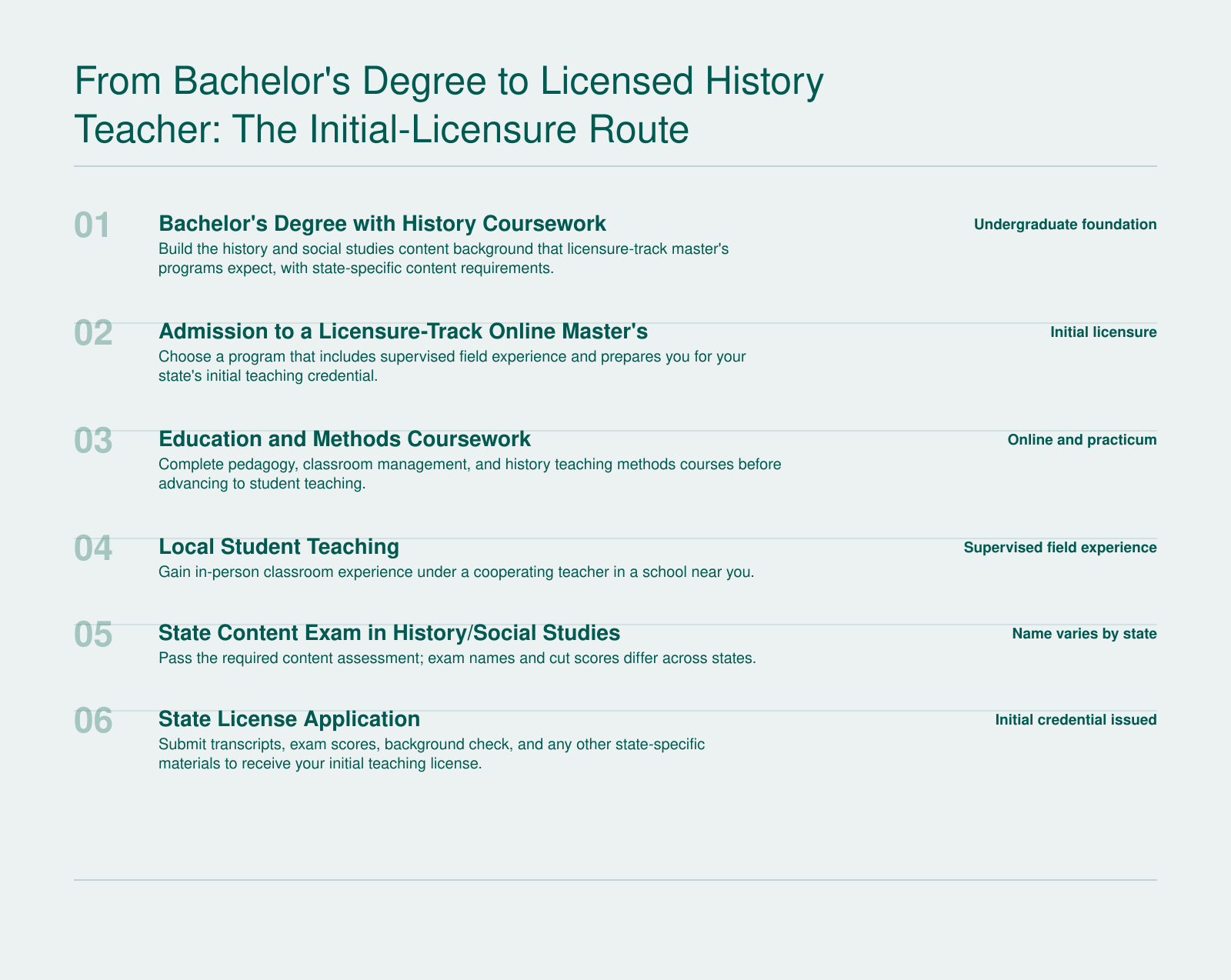
From Bachelor's Degree to Licensed History Teacher: The Initial-Licensure Route
Career changers follow a state-specific sequence to enter the classroom through a licensure-track online master's. Already-licensed teachers can skip student teaching and the content exam and pursue an advanced track instead.
Related Articles
Admission Requirements and GRE Policies to Check Before You Apply
Before applying, confirm each program's specific requirements. Most online history education master's ask for a bachelor's degree from an accredited institution, but GPA, prerequisite credits, licensure, and GRE policies vary.
- Bachelor's degree and history creditsStart with a bachelor's degree from an accredited institution. Some programs expect history or social studies coursework, for example, the University of Louisiana at Monroe lists 18 semester hours in social sciences or humanities, with at least half in history.
- Minimum GPA and conditional admissionGPA floors typically sit between 2.5 and 3.0. American College of Education gives full admission at 2.5 and provisional at 2.0, while Grand Canyon University asks for 2.8 or higher. Northwest Missouri State offers conditional admission for 2.50–2.74, and the University of Georgia and Michigan State use a 3.0 threshold.
- GRE requirement or waiverThe GRE is commonly waived or not required. Michigan State does not require it, and Northwest Missouri accepts alternatives such as a 3.5 analytical writing score, a prior master's with a 2.75 GPA, or a writing sample. Grand Canyon may use a GRE score only for lower-GPA applicants.
- Teaching license for advanced tracksAdvanced tracks may require a valid teaching certificate or endorsement. Northwestern College expects a history or social studies endorsement and a valid license; Northwest Missouri requires a certificate, two years of teaching, or alternative certification enrollment. Liberty's program does not lead to initial licensure.
- Background check and application materialsLicensure-track programs typically require a background check. Plan to submit transcripts, a résumé, a statement of purpose, and recommendation letters. Eastern Washington asks for a statement of purpose for applicants below a 3.0 GPA or from other disciplines.
Is an Online History Education Master's Worth It? Earnings, Debt, and Payback
What Graduates Earn and Borrow
Slippery Rock University and Liberty University both publish program-level federal outcomes for their history education master's degrees, so you can test the payoff question with real numbers rather than marketing claims.
- Slippery Rock University: Median earnings are $45,838 one year after completion, $49,768 after four years, and $52,644 after five. Median federal debt at completion is $30,875, about $351 a month on a 10-year repayment plan.
- Liberty University: Median earnings are $46,189 one year after completion and $59,708 after four years. Median debt is $31,075, roughly $353 a month over 10 years.
Estimating Your Payback
A $351 monthly payment works out to about $4,200 a year. Hold that figure against the master's lane on your own district's salary schedule. If the step up matches or beats $4,200, the raise covers the loan from your first year back in the classroom. A smaller bump stretches payback across most of the 10-year term. Borrowing less shortens the timeline: Northwest Missouri State lists total program tuition of $12,210, well below the debt medians above.
The Verdict
The degree pays off fastest for licensed teachers in districts that reward a master's with a higher salary lane, and for career changers who choose an affordable licensure track. It pays off least for anyone whose district offers no salary lane for the degree, where the debt buys knowledge but not a raise.
Compare History programs on the data that matters
Explore more Education & Teaching specializations or browse every graduate field.
All Education & Teaching programs