Best Master's in STEM Education Programs in Rhode Island
Compare accredited Stem Science Technology Engineering Math master's programs by earnings, cost, and outcomes.
Sample layout — live rankings and program data appear here once the data source is connected.

A master's in STEM education solves different problems depending on who enrolls, and Rhode Island programs reflect that split. Licensed teachers want content depth and a pay-scale step. Career changers need a path to a Rhode Island Department of Education certificate, which a degree alone does not provide.
The programs here span campus and online formats, and tuition runs far higher at private schools than at public ones. Licensure fit, not price, is the first filter.
Key Points
- No GRE is required for Roger Williams' dedicated STEM education master's.
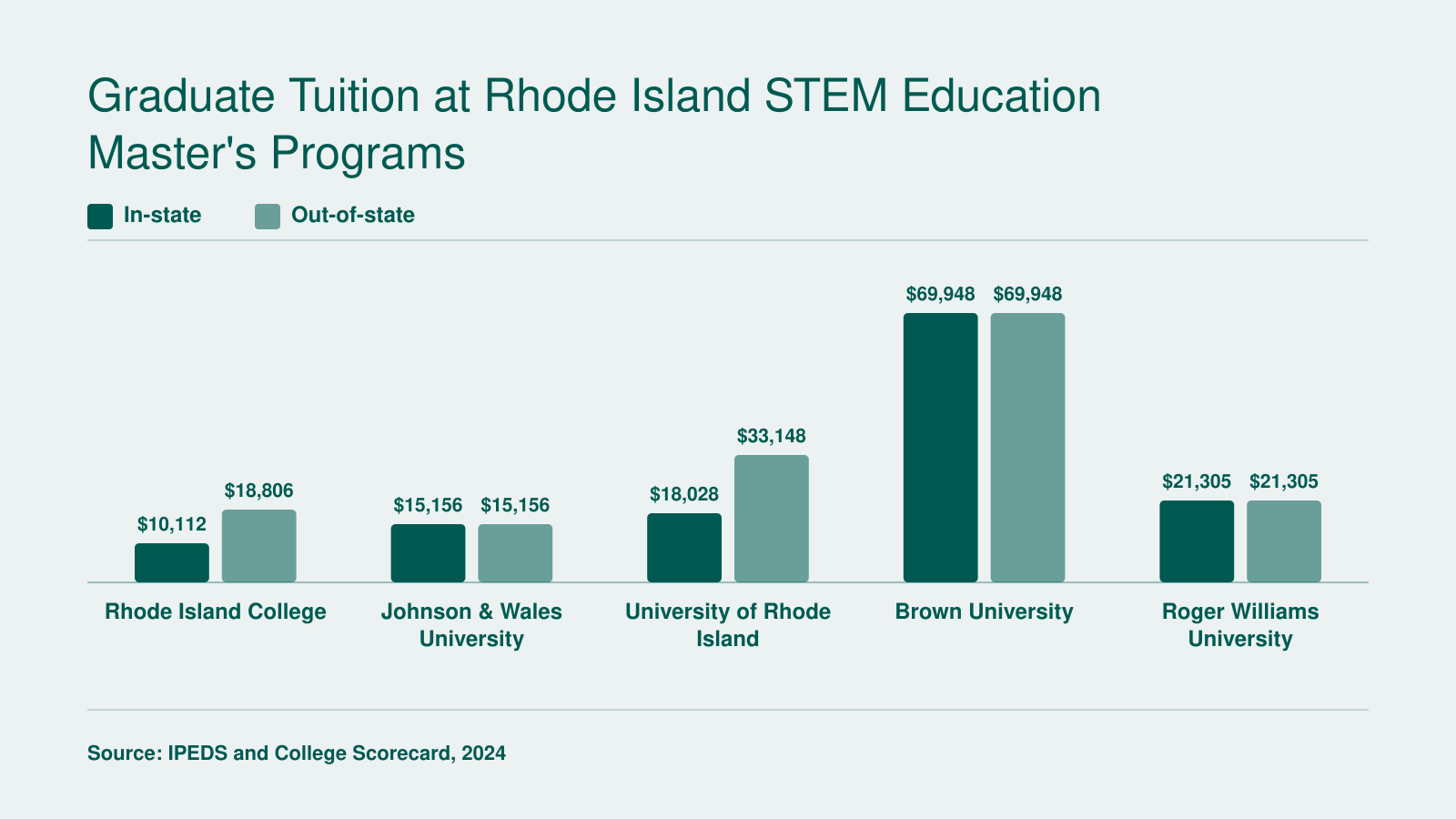
- The lowest in-state graduate tuition here is Rhode Island College's $10,112.
- At $69,948, Brown University has the highest graduate tuition.
Top-Ranked STEM Education Master's Programs in Rhode Island
The programs below show how different a Rhode Island STEM education master's can be: some lead to teacher certification, while others focus on informal education or food systems leadership. We compared cost, institution-wide graduation rates, and published program outcomes to identify the strongest options.
University of Rhode Island
#1Kingston, RI · ~$18,000/yr (est.)
Best for: Career changers wanting Rhode Island certification
University of Rhode Island pairs graduate study with initial teacher certification, so STEM-minded students can prepare for Rhode Island classrooms while earning a master's. The secondary education track includes science and mathematics subject areas, with supervised student teaching and a teaching seminar built into a suggested two-year sequence. URI is a public research university with a 73 percent graduation rate, and it holds regional accreditation from NECHE, which affects federal aid eligibility and licensure portability.
- Leads to initial Rhode Island teacher certification
- Science and math are available subject areas
- Requires 30 subject-area credits for certification
- At least 15 credits at the 500 or 600 level
- Includes 12-credit supervised student teaching and 3-credit teaching seminar
- Licensure alignment disclosed for Rhode Island, Connecticut, Massachusetts, Vermont, Maine, and Maryland
- Advisor sets Program of Study after admission
- Three concentration options
- Coursework-oriented master's degree
- Electrical, computer, and biomedical engineering focus
Roger Williams University
#2Bristol, RI · ~$21,000/yr (est.)
Best for: Working educators needing hybrid flexibility
Roger Williams University offers a dedicated Master of Arts in STEM Education for educators and informal learning professionals who want to deepen STEM practice without a teacher-licensure path. The hybrid program combines asynchronous online coursework with select Saturday sessions in Bristol and includes robotics, coding, 3D printing, and a STEM education internship. RWU is regionally accredited by NECHE, which affects federal aid eligibility and licensure portability.
- 37 total credit hours
- Hybrid delivery with asynchronous online classes and select Saturday meetings in Bristol
- Full-time map in 1.5 years; part-time in 2.5 years
- $780 per credit for 2026-27
- Educators receive 15 percent tuition discount
- Includes 4-credit internship and 3-credit capstone
- Coursework covers robotics, coding, 3D printing, and STEM policy
- Does not meet Rhode Island licensure requirements
Rhode Island College
#3Providence, RI · ~$10,000/yr (est.)
Best for: Budget-conscious future high school STEM teachers
Rhode Island College prepares future high school STEM teachers through a Master of Arts in Teaching in Secondary Education that leads directly to Rhode Island certification. Candidates can focus on mathematics or general science and add endorsements in English as a Second Language or Special Education, with field work and student teaching woven throughout. RIC is regionally accredited by NECHE, which affects federal aid eligibility and licensure portability, and seven in ten Rhode Island teachers graduated from RIC.
- Leads to full certification for Rhode Island high school teaching
- Subject areas include general science and mathematics
- Additional endorsements available in ESL or Special Education
- Field work in schools or community organizations
- Student teaching or internship experience included
- $50 application fee
- 70 percent of Rhode Island teachers graduated from RIC
Brown University
#4Providence, RI · $65,000 – $70,000/yr (est.)
Brown University offers a one-year, campus-based Master of Arts in Teaching with concentrations in secondary math and secondary science. The program includes a summer teaching experience at Brown Summer High School, a full-year practicum, and student teaching, and it leads to Rhode Island certification with a multilingual learner endorsement. Brown holds regional accreditation from NECHE, which affects federal aid eligibility and licensure portability.
- One-year, on-campus program beginning in summer
- Concentrations in Secondary Math and Secondary Science
- Requires 8 courses (8 total credit hours)
- Full-year practicum and student teaching placement
- Six-week summer term at Brown Summer High School
- Leads to Rhode Island teaching certificate with multilingual learner endorsement
- 100 percent licensure pass rate
- No GRE required; TOEFL or IELTS for international applicants
Johnson & Wales University
#5Providence, RI · ~$15,000/yr (est.)
Johnson & Wales University's Providence campus offers a STEM-approved master's in food systems that will appeal to STEM-minded professionals aiming at leadership in sustainability and food policy, rather than classroom teaching. The 30-credit program includes an action research capstone and is designed for working professionals, with a one-year full-time path. JWU holds regional accreditation from NECHE, which affects federal aid eligibility and licensure portability.
- 30 total credit hours
- Can be completed in one year
- Designed for working professionals
- Action research capstone on food waste and community food access
- STEM-approved with 24-month OPT extension
- Primarily in-person with some online courses
- Careers include food systems policy analyst and sustainability manager
Online and Hybrid STEM Education Master's Options in Rhode Island
An online or hybrid STEM education master's keeps most coursework off campus, letting working teachers study around their school schedules. In Rhode Island, the delivery label varies by listing. University of Rhode Island and Brown University entries are tagged online, while Roger Williams University, Rhode Island College, and Johnson & Wales University entries are tagged campus. Brown's listing notes both on-campus and online options, and Johnson & Wales describes its program as primarily in-person with some online courses.
Roger Williams University's hybrid format
Roger Williams offers an M.A. in STEM Education that is hybrid and low residency. Online coursework is asynchronous, so you can complete it on your own schedule. The program page says students attend a few select Saturday meetings in person. It does not give the number, dates, or location of those meetings, and no summer residency is identified, so ask admissions for the current calendar. The program also states it does not meet Rhode Island licensure requirements.
Out-of-state students
Published materials do not confirm that students outside Rhode Island can enroll. State authorization rules can restrict enrollment, and so can field placements tied to Rhode Island schools. Ask the program directly about your state.
Practical tip: before applying, confirm whether practicum or student-teaching hours can be completed in your own district.
Related Articles
Which Rhode Island STEM Education Master's Programs Waive the GRE?
Do Rhode Island STEM education master's programs require the GRE, or do no-GRE master's programs exist in the state?
Roger Williams University's M.A. in STEM Education does not require the GRE. Applicants with an overall GPA below 3.0 are strongly encouraged to add a GRE or MAT score. The program lists a March 1 application deadline.
The University of Rhode Island and Rhode Island College do not publish a clear, program-level GRE policy for their STEM education master's programs on the admissions pages reviewed. Rhode Island College's graduate admissions page lists the GRE or MAT as a required exam1, but it does not identify whether the STEM education master's is one of the programs covered, and the college does not post a 2026 deadline.
When no test score is required, a typical file includes undergraduate transcripts, a statement of purpose, a teaching license if you hold one, and two or three recommendations. Because policies and deadlines can shift by term, confirm the current requirements on the admissions page for each master's in education in Rhode Island program you're considering.
Graduate Tuition at Rhode Island STEM Education Master's Programs
These are annual published graduate tuition and fees, not total degree cost or net price. Rhode Island College has the lowest in-state rate at $10,112, while Brown University is the most expensive at $69,948, a gap of $59,836.
What a Master's in STEM Education Costs and Whether It Leads to Rhode Island Licensure
Before comparing price tags, understand the difference between a Master of Arts in Teaching (MAT) in Rhode Island and one built for licensed teachers.
Turning Tuition Into a Total
The clearest figure here belongs to Roger Williams University. Its Master of Arts in STEM Education runs $780 per credit for 2026-2027, and at 37 required credits that comes to $28,860 in tuition before fees. Semester fees add $490 full-time or $165 part-time. That makes it the most straightforward program to budget on this list, since the per-credit rate and credit total are both published.
For an Online Master's in STEM Education, an institution-wide net price is an average across all students after aid, not a quote for graduate study; treat it cautiously. If you teach in a Rhode Island district, ask whether tuition reimbursement is available, and check TEACH Grant eligibility before you enroll.
Certification vs. Advanced Study
This is the part prospective career changers most often misread. Roger Williams states plainly that its STEM Education master's does not meet Rhode Island certification requirements and does not lead to a public-school teaching license. It is advanced study, not an entry path.
For the RIDE endorsement, Roger Williams offers a separate STEM Education Certificate (not the master's) that aligns with a RIDE endorsement pathway. If your goal is initial licensure, confirm the specific credential, not just the degree title.
Rhode Island Teacher Certification at a Glance
Career Outcomes and Earnings for STEM Education Master's Graduates
A master's in STEM education pays off mainly through pay-scale movement and leadership roles, not a dramatic jump in first-year salary. Rhode Island College is the clearest example in the rankings data. Its graduate teacher-education completers earned a median of $46,143 one year after finishing and $56,181 four years after finishing. That cohort is small (11 completers), so treat it as a rough signal. A median debt figure is not available for that row, so a full return-on-investment read is not possible.
Graduates of STEM education master's programs typically move into roles such as STEM coordinator, instructional coach, curriculum specialist, or department head. Nationally, instructional coordinators earned a median of $77,440 in May 2025, and a master's is the typical entry credential. Rhode Island pay for that role is not established here.
For classroom context, BLS lists Rhode Island high school teacher pay for May 2025 at $84,120 on average, within a range of $51,670 to $100,370. A master's usually moves teachers up the district salary schedule. Pawtucket's 2025-26 scale runs from $49,699 to $99,768, and Warwick's 2026-27 schedule starts at $54,192. Check each district's master's column for the exact premium.
FAQs About STEM Education Master's Programs in Rhode Island
Does a master's in STEM education lead to teacher certification in Rhode Island?
What is the cheapest master's in STEM education in Rhode Island?
Can I enroll in a Rhode Island STEM education master's online if I live in another state?
Can career changers without a teaching license apply to these programs?
Compare Stem Science Technology Engineering Math programs on the data that matters
Explore more Education & Teaching specializations or browse every graduate field.
All Education & Teaching programs