Best Adult-Gerontology Acute Care Nurse Practitioner (AG-ACNP) MSN Programs in Massachusetts
Compare 4 accredited Adult Gerontology Acute Care Nurse Practitioner programs in Massachusetts, with graduate earnings, cost, debt, and completion data from IPEDS and the U.S. College Scorecard.
The AG-ACNP role has sharpened since Massachusetts granted full practice authority, but the acute care track still demands one year of critical-care experience that few other NP paths require, a Family Nurse Practitioner (FNP) MSN in Massachusetts does not. The practical goal is specific: moving from bedside RN to independently managing physiologically unstable adults in hospitals, ICUs, and specialty units.
In-state options for this specialty are few, which actually helps. With only a handful of Massachusetts schools offering the track, you can compare them directly on tuition, format, clinical support, and GRE policy rather than guessing. The entry routes diverge sharply, from post-BSN tracks requiring acute care experience to direct-entry curricula, and so does the cost.
Key Points
- Regis requires 800 precepted clinical hours, while Northeastern requires at least 600.
- Regis does not require the GRE for its online acute care track.
- Regis charges $1,025 per credit, so total tuition depends on entry route.
Ranked: Massachusetts AG-ACNP MSN Programs Worth Your Application
Three Massachusetts schools in our dataset offer an Adult-Gerontology Acute Care Nurse Practitioner track at the master's level, and they differ a lot in cost and entry route. Clinical partner details below come from school pages and are not always specific to the AG-ACNP track, so confirm placement sites with each admissions office. Graduation figures describe the whole institution, not AG-ACNP students.
Northeastern University
#1Boston, MA · ~$26,000/yr (est.)
Best for: Working RNs wanting part-time campus study
Northeastern runs its Adult-Gerontology Acute Care MSN on the Boston campus, with full-time and part-time paths over two to three years and fall-only entry. Students complete 600 clinical hours at Boston hospitals, though the sources we reviewed did not name specific partner sites for this track. Applicants need a BSN, an active RN license, and two years of acute care experience, and estimated tuition is about $83,678. That makes it the priciest sticker price here, so weigh it against the program's strong early-career earnings in the federal data.
- On-campus Boston program, full-time or part-time, 2 to 3 years
- 600 clinical hours required
- Fall term entry only; applications due July 1
- Requires BSN, current RN license, and two years of acute care experience
- CCNE-accredited
- Estimated tuition of about $83,678
- Curriculum includes advanced pathophysiology, health assessment, diagnostic reasoning
Regis College
#2Weston, MA · $15,000 – $20,000/yr (est.)
Best for: Nurses leaning on Massachusetts hospital partnerships
Regis College in Weston offers an MSN AGACNP concentration built around 600 precepted hours in emergency, intensive and critical care, urgent care, and subspecialty settings, with an emphasis on physiologically unstable and technologically dependent patients. The college graduates about 72% of its students overall, an institution-wide figure and not an AG-ACNP outcome. Regis names UMass Memorial Health as a Preferred Partner, and its partner listing includes Boston Medical Center and Mass General Brigham. Not every listed partner is confirmed as an AG-ACNP rotation site, so ask about placements. It also has the lowest published tuition of the three, with discounts for Massachusetts Nurses Association members.
- 600 precepted clinical hours across two practicums
- Practicum settings include urgent care, emergency department, and intensive/critical care
- Telehealth and subspecialty practicum options
- Meets ANCC and AACN certification criteria
- Focus on technologically dependent, physiologically unstable patients
- One of six MSN nurse practitioner concentrations
MGH Institute of Health Professions
#3Boston, MA · ~$69,000/yr (est.)
Best for: Career changers entering nursing directly
MGH Institute of Health Professions in Boston has the most flexible entry routes: direct-entry acute care, post-BSN full-time or part-time, and post-MSN or post-NP. The track prepares nurses to care for patients 13 and older in hospital-based settings, and graduates are eligible for the ANCC or AACN acute care exam. The Institute has admissions-pathway partnerships tied to the Mass General Brigham system, but these are not confirmed as AG-ACNP clinical placement agreements. Its federal data show the highest median graduate debt of the three, so check cost carefully.
- Four routes: direct-entry, post-BSN, post-BSN part-time, post-MSN/post-NP
- Prepares for care of patients ages 13 and older in inpatient settings
- Eligible for the ANCC or AACN AG-ACNP certification exam
- One of seven School of Nursing specialty tracks
- Applications go through NursingCAS
Cost & outcomes by school
Federal data for the highest-earning Adult Gerontology Acute Care Nurse Practitioner programs, independent of the ranking above. Earnings are this field's master's graduates four years after completing, where the Scorecard reports them.
| School | Earnings | Tuition / yr | Debt | Grads/yr | Format |
|---|---|---|---|---|---|
| Northeastern University MA | $143,345 | $26,020 | $57,068 | — | Campus |
| Northeastern University MA | $143,345 | $29,174 | $57,068 | 54 | Campus |
| MGH Institute of Health Professions MA | $123,082 | $69,158 | $168,086 | 105 | Campus |
| Regis College MA | $123,036 | $17,910 | $47,833 | 371 | Campus |
Sources: U.S. Department of Education. Tuition and graduates: IPEDS. Earnings and debt: College Scorecard, this field's master's graduates; a dash means no figure is reported.
Cost, debt & payoff
Median earnings of this field's master's graduates (4 yrs after completing) vs. their median federal loan debt · U.S. College Scorecard
Across these programs the median graduate earns about $133,214 and finishes with roughly $57,068 in debt — a ratio that clears a common rule of thumb (keep debt below first-year salary). Tuition and debt vary widely school to school, so check the per-school figures in the table above before you shortlist.
How We Sized up Massachusetts AG-ACNP Master's Programs
Among Master's Programs in Massachusetts, an acute care track earns a spot here only when its cost, graduate outcomes, and credentials hold up at licensure time. Prestige does not make the cut; verifiable numbers do.
The inputs are straightforward:
- Cost: Graduate tuition and the institution-wide average net price after aid, used as a rough guide rather than a personal quote.
- Outcomes: The institution-wide graduation rate, plus program-level earnings and debt wherever College Scorecard publishes them.
- Credentials: Current CCNE or ACEN accreditation. Regis College's nursing programs, for instance, carry ACEN accreditation. We note a published AGACNP-BC or ACNPC-AG pass rate only where a school reports one; many do not, so we lean on national benchmarks (the AGACNP-BC first-time rate ran about 83 percent in 2023) for context, never as a school's own figure.
Scope is Massachusetts-based AG-ACNP MSN programs only. DNP, pediatric acute care, and post-master's certificate routes sit outside this list; if you already hold a master's, check each school's certificate options directly.
Online and Hybrid AG-ACNP Master's Options in Massachusetts
The tradeoff in this specialty is almost always flexibility versus supervised reps with acutely ill adults. Some didactic work in adult gerontology nurse practitioner programs can move online, but procedural training and hospital preceptorships do not transfer to a screen.
Regis College runs its AG-ACNP MSN fully online with no campus visit required, while MGH Institute of Health Professions uses a hybrid format that combines online learning with on-campus instruction. Northeastern University's program is campus-based. None of these formats changes the clinical requirement: MGH lists 630 supervised clinical hours and placement access through more than 600 Mass General Brigham sites, Regis requires at least 200 hours in a supervised clinical preceptorship, and Northeastern expects 600 clinical hours. Online coursework means online classes, not online clinicals.
Out-of-state online acute care NP programs may enroll Massachusetts nurses, but those programs fall outside this in-state list and should be confirmed for Massachusetts clinical placement authorization before you apply.
Clinical Hours and Placement Support by School
The national NTF minimum is 500 direct patient care hours, and two schools here go beyond it. Northeastern requires at least 600 precepted hours across three practicum courses, and Regis requires 800. MGH Institute does not publish a total for this track. Placement support matters in Boston's crowded clinical market, because a school that arranges sites spares you months of cold outreach to acute care preceptors. Regis students help find their own sites, with coordinator assistance.
| School | Required Clinical Hours | Placement Arranged By | Key Hospital Partners |
|---|---|---|---|
| MGH Institute of Health Professions | Not published | School-arranged (the school coordinates all placements) | Named across the school's programs: Massachusetts General Hospital, Brigham and Women's Hospital, Spaulding Rehabilitation, Boston Children's Hospital, Beth Israel Deaconess Hospital |
| Regis College | 800 hours (two 300-hour clinical seminars plus a 200-hour final immersion) | Student-secured, with coordinator assistance | Not published |
| Northeastern University | 600 hours minimum (precepted, across three practicum courses) | School-arranged through faculty advisors | Not published (placements draw on 100+ affiliated institutions) |
Related Articles
Which Massachusetts AG-ACNP Master's Programs Waive the GRE?
Entering as a licensed RN and entering with no nursing credential are very different applications, but the GRE barely figures in either at Regis College. Regis states it does not require the GRE for its online Adult-Gerontology Acute Care Nurse Practitioner MSN, placing it among No-GRE master's programs, so there is no waiver to request. Applicants need an active, unencumbered RN license. ADN, non-nursing bachelor's, and BSN holders are all accepted. A 3.0 cumulative GPA is the minimum, and the track expects one year of critical-care experience.
MGH Institute of Health Professions describes direct-entry and post-BSN acute care curricula. The admissions material we found does not state a GRE policy, GPA minimum, or RN experience expectation, and it does not say whether direct entry is for non-nurses or for RNs.1 Confirm all of that with admissions. For Northeastern University, we found no reliable AG-ACNP MSN admissions page, so no GRE policy can be reported. Verify it directly.
Regis also runs a separate Accelerated Direct Entry MSN for applicants without a nursing degree. It requires a 3.0 GPA and leads to RN-licensure eligibility, but nothing we found shows it leads to AG-ACNP.
One practical tip: ICU or ED experience strengthens an application even where a school does not require it.
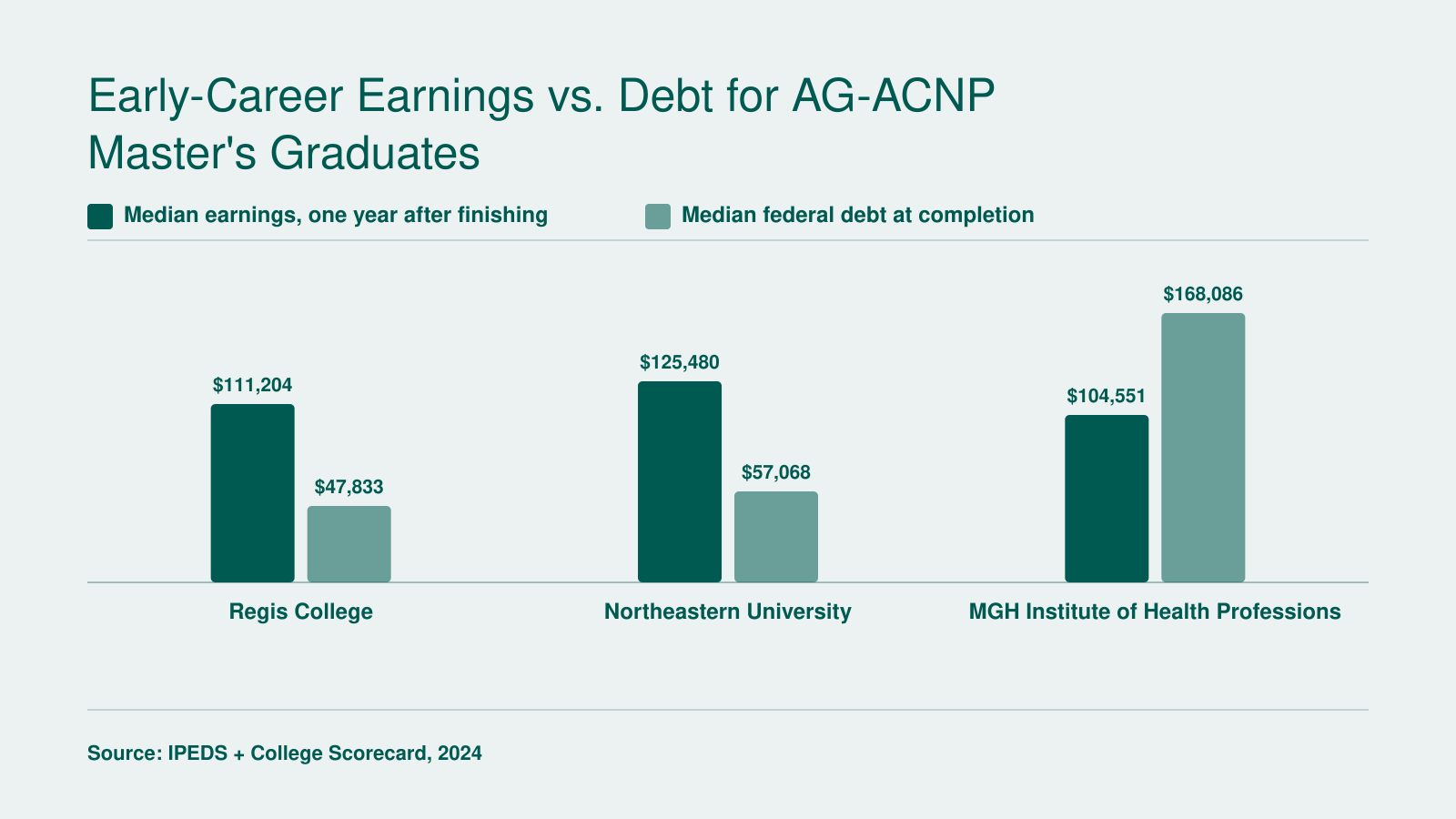
Early-Career Earnings vs. Debt for AG-ACNP Master's Graduates
These figures come from federal College Scorecard data for each school's master's-level nursing graduates, the closest program-level measure published. They cover the whole nursing master's category and are not limited to AG-ACNP students. Earnings are medians one year after finishing, and debt is median federal loan debt among completers.
Massachusetts APRN Authorization at a Glance
Master's Tuition, Fees, and the Road to a Massachusetts License
The Massachusetts AG-ACNP master's programs diverge sharply on cost, and the gap runs well beyond tuition.
Published Costs and Where They Diverge
Regis College charges $1,025 per credit across a 39- to 63-credit program, so total tuition runs about $39,975 to $64,575. Mandatory fees include a $580 technology fee, $300 graduation fee, and $25 per-semester activity fee, plus clinical exchange and compliance fees. Northeastern University lists an estimated $84,000 total but does not publish per-credit, fee, or credit details. MGH Institute of Health Professions has no standalone AG-ACNP MSN cost; its published figures cover a dual primary care track. Federal data shows Regis's average net price for graduate students is about $27,477, below the program sticker because that figure spans all programs and includes aid. Regis at 39 credits is the lowest-cost option here; Northeastern at $84,000 is the highest. Credit count and program length drive the spread.
Certification to Massachusetts License
First, pass a national exam: ANCC AGACNP-BC costs $290 to $395 plus a $140 administrative fee; AACN ACNPC-AG costs $275 for members or $385 for nonmembers, with retests at $215 or $320. Then apply for Massachusetts APRN authorization ($150 fee). Prescriptive authority follows state authorization and typically requires a collaborative practice agreement with a physician. Confirm current tuition and fees with each school's bursar before applying.
Quick Answers on Massachusetts AG-ACNP Master's Programs
These short answers cover the questions applicants ask most often. Confirm every date and format with each school's admissions office before you apply.
How is AG-ACNP training different from AG-PCNP training?
When do Massachusetts AG-ACNP master's cohorts start, and when are applications due?
Are there online AG-ACNP MSN programs in Massachusetts?
Compare Adult Gerontology Acute Care Nurse Practitioner programs on the data that matters
Explore more Nursing specializations or browse every graduate field.
All Nursing programs