Best Master's in STEM Education Programs in Minnesota
Compare accredited Stem Science Technology Engineering Math master's programs by earnings, cost, and outcomes.
Sample layout — live rankings and program data appear here once the data source is connected.
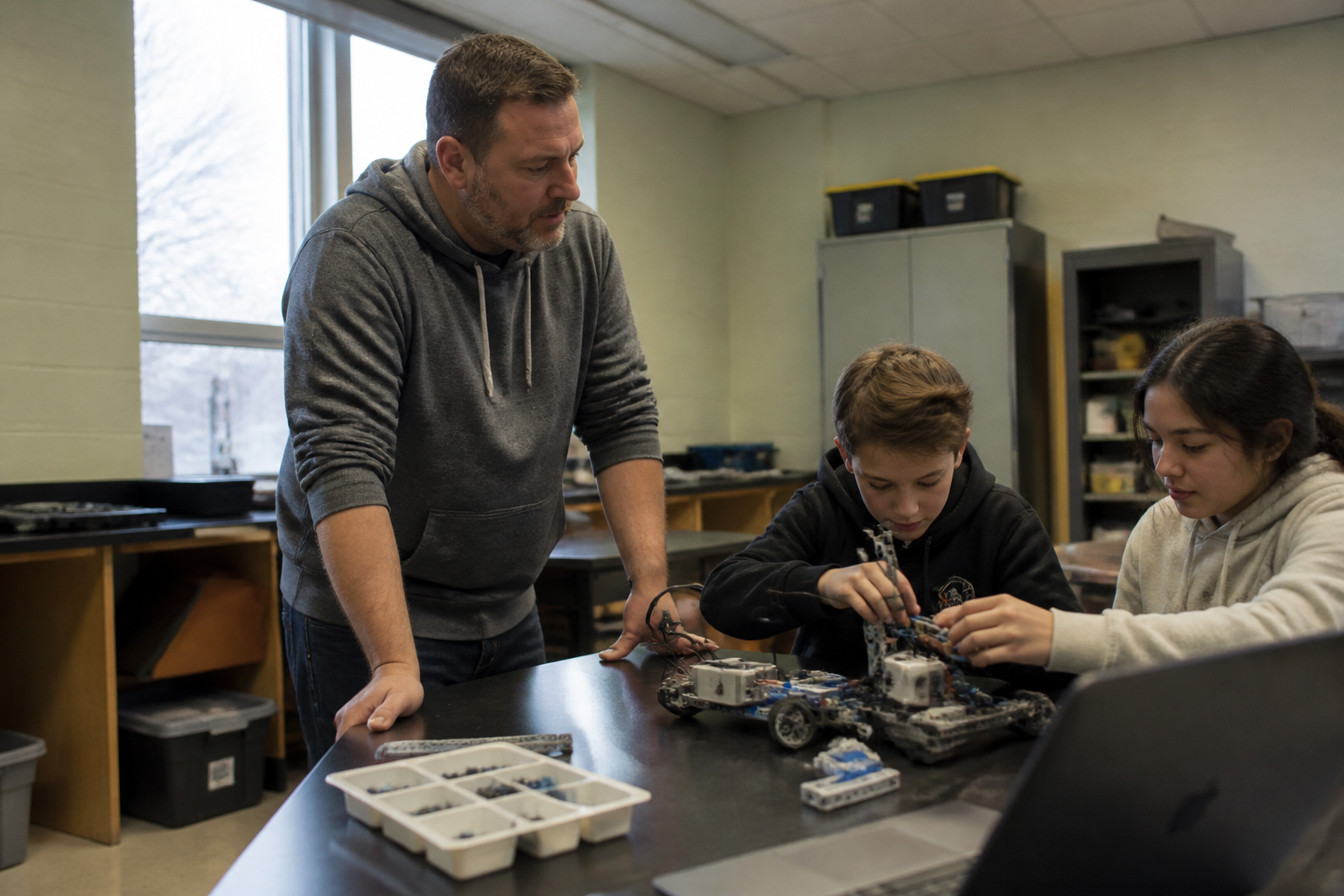
A master's that adds a Minnesota teaching license and one that only deepens subject knowledge can look alike on a brochure, even among accelerated master's in STEM education programs, yet only one lets a career changer lead a classroom. Net price at the schools ranked here runs from $13,529 at Saint Cloud State University to $29,155 at the University of St Thomas, across campus, hybrid, and online formats.
Budget and schedule matter, but licensure comes first. PELSB issues Minnesota teaching licenses by subject and grade band, and most STEM master's degrees in the state are advanced degrees, not initial licensure routes.
Key Points
- Check the license type first: many STEM master's here are advanced degrees, not initial Minnesota licenses.
- Saint Cloud State's MS in Computer Science has the lowest tuition here, at $10,924 a year.
- University of Minnesota-Twin Cities does not review GRE scores for its math education master's.
Ranked: The 10 Best Master's in STEM Education Programs in Minnesota
The University of St. Thomas, Minnesota State University Moorhead, and Southwest Minnesota State University lead this list for their direct STEM education or mathematics education pathways, while other schools appear with STEM-related master's programs. Formats range from on-campus and hybrid to fully online, so the right fit depends on whether you need licensure, flexibility, or a research-focused subject master's.
University of St Thomas
#1Saint Paul, MN · ~$21,000/yr (est.)
Best for: In-service P-12 educators exploring engineering
The University of St. Thomas is a private Saint Paul institution whose MA in Educational Studies with an Engineering Concentration serves in-service P-12 educators seeking to integrate engineering into STEM instruction. The hybrid program combines four core education courses with engineering coursework taught in School of Engineering facilities, and it offers year-round starts with on-campus or online options in Minneapolis and St. Paul.
- Focus on STEM education with engineering
- For in-service P-12 educators
- Four core 3-credit education courses
- Choose three engineering courses
- On-campus or online in Minneapolis and St. Paul
- Transcript review for prior coursework
- Independent study option
Minnesota State University Moorhead
#2Moorhead, MN · ~$12,000/yr (est.)
Best for: Online math teachers needing classroom research
Minnesota State University Moorhead offers a fully online MS in Curriculum & Instruction built for practicing P-12 teachers, with a mathematics emphasis among nine options. The program includes core coursework in curriculum theory and research, plus a 15-16 credit emphasis, and it reports 100% related job placement.
- Mathematics emphasis among nine options
- Fully online option available
- 100% job placement rate
- 15-16 credit emphasis required
- Apply 18 Online credits toward the MS
- Core covers curriculum theory and research
- Research and reflection in your classroom
- Built for P-12 teachers
Southwest Minnesota State University
#3Marshall, MN · ~$10,000/yr (est.)
Best for: Asynchronous learners pursuing mathematics emphasis
Southwest Minnesota State University delivers an online Master of Science in Education with a mathematics emphasis, built on a Professional Education Core plus a field emphasis and an action research capstone. The math track expects an undergraduate major in mathematics or mathematics education, and students can transfer up to nine graduate credits.
- Mathematics emphasis within 12 options
- Fully online with all field emphases
- 3.0 GPA minimum
- Transfer up to nine graduate credits
- Seven years to finish the degree
- Math courses expect a math major background
- Action research capstone
University of Minnesota-Twin Cities
#4Minneapolis, MN · ~$22,000/yr (est.)
The University of Minnesota Twin Cities is Minnesota's public research flagship and appears here with its interdisciplinary Master of Science in Stem Cell Biology, a 30-credit program combining core coursework and hands-on research training at the Stem Cell Institute. The university's master's degrees in mathematics education and science education are currently paused, so applicants should contact the graduate school before applying.
- 30 total credit hours
- Full-time and part-time options
- 2.8 GPA minimum
- Interdisciplinary program at Stem Cell Institute
- World-renowned faculty
- Hands-on research training
- Wide range of elective courses
- Prepares for academic and bioscience careers
Bethel University
#5Saint Paul, MN · ~$10,000/yr (est.)
Bethel University is a private Saint Paul institution whose STEM-related graduate offering in this list is the M.S. in Medical Sciences, an accelerated 42-credit program that mirrors the first year of medical school. The program can be completed in as few as 11 months and offers face-to-face or hybrid learning.
- 42 total credit hours
- 11-month program option
- Two start dates per year
- 3.0 GPA minimum
- Prerequisite courses required
- Face-to-face or online formats
- Guaranteed interview opportunities
- Average student GPA 3.75
The College of Saint Scholastica
#6Duluth, MN · ~$15,000/yr (est.)
The College of Saint Scholastica in Duluth offers graduate coursework in chemistry, with a master's program that builds on undergraduate foundations and explores advanced topics such as thermodynamics, spectroscopy, kinetics, and computational chemistry. The program emphasizes analytical problem-solving and scientific communication for research careers or doctoral study.
- Advanced topics include bonding and materials
- Covers thermodynamics, spectroscopy, and kinetics
- Prepares for research positions in industry, government, or academia
- Emphasizes scientific communication
Metropolitan State University
#7Saint Paul, MN · ~$11,000/yr (est.)
Metropolitan State University is a public institution in Saint Paul that offers a STEM-designated Master of Science in Management Information Systems, combining management theory with hands-on technical skills in areas like data analytics, AI, and IT security. The program is designed for working adults and includes a capstone project with Twin Cities organizations.
- STEM-designated CIP 11.XX program
- 36 total credit hours
- Six concentration options
- Designed for working adults
- Capstone with Twin Cities organizations
- Applied AI and machine learning
- Application fee waiver for veterans
Concordia University-Saint Paul
#8Saint Paul, MN · ~$9,000/yr (est.)
Concordia University, St. Paul offers online graduate programs in computer science and artificial intelligence, with asynchronous coursework designed for working professionals. The computer science program includes 30 credit hours, no application fee, and a capstone or internship option; the artificial intelligence program uses a low-residency format and requires entrance exams such as TOEFL or IELTS for international applicants.
- $525 per credit
- 30 total credit hours
- Asynchronous online classes
- 18-month program option
- Capstone required
- No CS undergrad degree required
- Up to 15 transfer credits accepted
- $0 application fee
- Entrance exam required (TOEFL or IELTS)
- Starts fall, spring, or summer
- Low-residency format
- STEM eligible program
- Scholarships available
Saint Cloud State University
#9Saint Cloud, MN · ~$11,000/yr (est.)
St. Cloud State University offers graduate programs in computer science and software engineering, with the computer science program delivered on campus in St. Cloud and the software engineering program available fully online for working professionals. Both include capstone or research components and prepare students for roles in software, systems, and technology leadership.
- 3 concentration options
- Prerequisite courses required
- On-campus St. Cloud delivery
- Prepares for Ph.D. programs
- Employers: Amazon, Google, Medtronic
- Three references required
- Fully online for working professionals
- Entrance exam required (GRE or GMAT)
- Work experience required
- Capstone required
- 20% MBA courses for leadership roles
- GRE or GMAT may be waived
University of Minnesota-Duluth
#10Duluth, MN · $22,000 – $33,000/yr (est.)
The University of Minnesota Duluth's Swenson College of Science and Engineering offers research-intensive master's programs in applied materials science, chemical engineering, and computer science. Many students receive fully funded research or teaching assistantships with tuition waivers, stipends, and health insurance, and recent graduates report strong job placement and starting salaries.
- Research-intensive program
- 1-on-1 attention from a principal investigator
- Fully funded assistantships available
- 98% job placement rate
- Average starting salary $77K
- MSChE option in Swenson College
- Graduate assistantships include tuition waivers and stipends
- Opportunities to publish and attend conferences
- MS in Computer Science with research emphasis
- Supportive graduate student community
- Campus views of Lake Superior
Cheapest Master's in STEM Education Programs in Minnesota
Saint Cloud State University is the most affordable option in this table, with an institution-wide net price of $13,529. At Metropolitan State University, the researched per-credit rate is $345.14 with fees, or $11,734.76 for the 34-credit program. Net price is an institution-wide estimate, so your actual cost will depend on credits, fees, and financial aid.
| School | Program | Published Tuition | Institution-Wide Net Price | Per-Credit Rate (with Fees) | Estimated Total Program Cost |
|---|---|---|---|---|---|
| Saint Cloud State University | Computer Science | $10,924 | $13,529 | N/A | N/A |
| Southwest Minnesota State University | Master of Science in Education, Mathematics | $10,360 | $15,291 | N/A | N/A |
| University of Minnesota-Twin Cities | Master of Science in Stem Cell Biology | $22,017 | $16,778 | N/A | N/A |
| Metropolitan State University | Management Information Systems (MSMIS) | $11,323 | $16,863 | $345.14 | $11,734.76 |
| Minnesota State University Moorhead | MS in Curriculum & Instruction, Mathematics emphasis | $11,902 | $17,997 | N/A | N/A |
Online and Hybrid Master's in STEM Education Options in Minnesota
An online master's in STEM education can lead to a Minnesota teaching license, but it cannot be fully remote: student teaching or a practicum must still occur in a Minnesota classroom. None of the ranked STEM education programs here is fully online; delivery splits into in-person, hybrid, and flexible or unclear formats.
- In person: University of Minnesota Twin Cities offers its MEd in mathematics education and MEd in science education on campus, including the initial teaching license tracks.
- Hybrid: University of Minnesota Duluth's MEd combines online coursework with a weekly online session and a required on-campus component in Duluth.
- Flexible/unclear: Southwest Minnesota State University lists online, on-campus, and learning-community delivery for its MS Education mathematics emphasis, but its catalog does not confirm that every course is offered in every format.1
For licensure, the online coursework is only one part. Minnesota requires student teaching or field experience in a K-12 classroom. Several programs here are advanced degrees for teachers who already hold a license; initial licensure tracks add a full student teaching semester. Check the program page for on-campus residencies or synchronous class schedules before assuming a fully online format.
Related Articles
Which Minnesota Master's in STEM Education Programs Waive or Skip the GRE?
At the University of Minnesota-Twin Cities, the School of Mathematics offers one of the No-GRE master's programs: it states plainly that it does not review GRE scores, general or subject, for its math education master's. Even if you submit them, they will not be looked at. That removes a common barrier for applicants who have been out of school for years.
Common Requirements
Expect the standard graduate checklist across the Master's Programs in Minnesota:
- Bachelor's degree: Completed before you matriculate, from a regionally accredited institution.
- Minimum GPA: Typically 3.0, with some programs weighing applicants in the 2.5 to 2.9 range individually rather than rejecting them outright.
- Transcripts: Official copies from every college attended, often sent directly from the issuing school.
- Statement of purpose and references: Standard for most applications, though specific document lists vary by program.
Licensure Prerequisites
At the University of Minnesota-Twin Cities, admitted students apply in December of their first year to the Math Teaching MEd and initial licensure track to complete teaching-licensure coursework. Check each admissions page directly: when a program publishes no GRE policy, assume nothing and contact the department.
What a Master's in STEM Education Costs in Minnesota, and How It Leads to Licensure
Minnesota teaching licenses are issued by subject and grade band, not as a single "STEM" credential, which shapes both what you study and what you pay for it.
What It Costs
In-state graduate tuition among the programs here spans a wide range. Public universities cluster near the low end, with annual in-state tuition in the roughly $9,800 to $11,000 range at schools like Metropolitan State University and Saint Cloud State University, making them among the Most Affordable Master's in STEM Education Programs. Private options run higher, from about $15,000 a year at The College of Saint Scholastica up to the $40,000-plus range at Bethel University and the University of St Thomas.
Several funding sources can offset this. Robert Noyce scholarships support STEM-degree holders moving into secondary teaching, and federal TEACH Grants are available to candidates committing to high-need subjects and schools. Minnesota also offers a tax credit for already-licensed teachers who complete a master's tied to their license field.5
How It Leads to Licensure
Minnesota uses a tiered system (Tiers 1 through 4) under PELSB. Tier 1 and Tier 2 licenses generally require a job offer from a Minnesota public or charter school, with applications opening July 1.1 The standard application fee is $89.2 Licenses are granted in specific fields, math (grades 5-8 or 5-12)4, the sciences, and computer-related assignments, each a statewide shortage area.3 Once you already hold a Tier 3 or Tier 4 license, you can add endorsements rather than starting over.
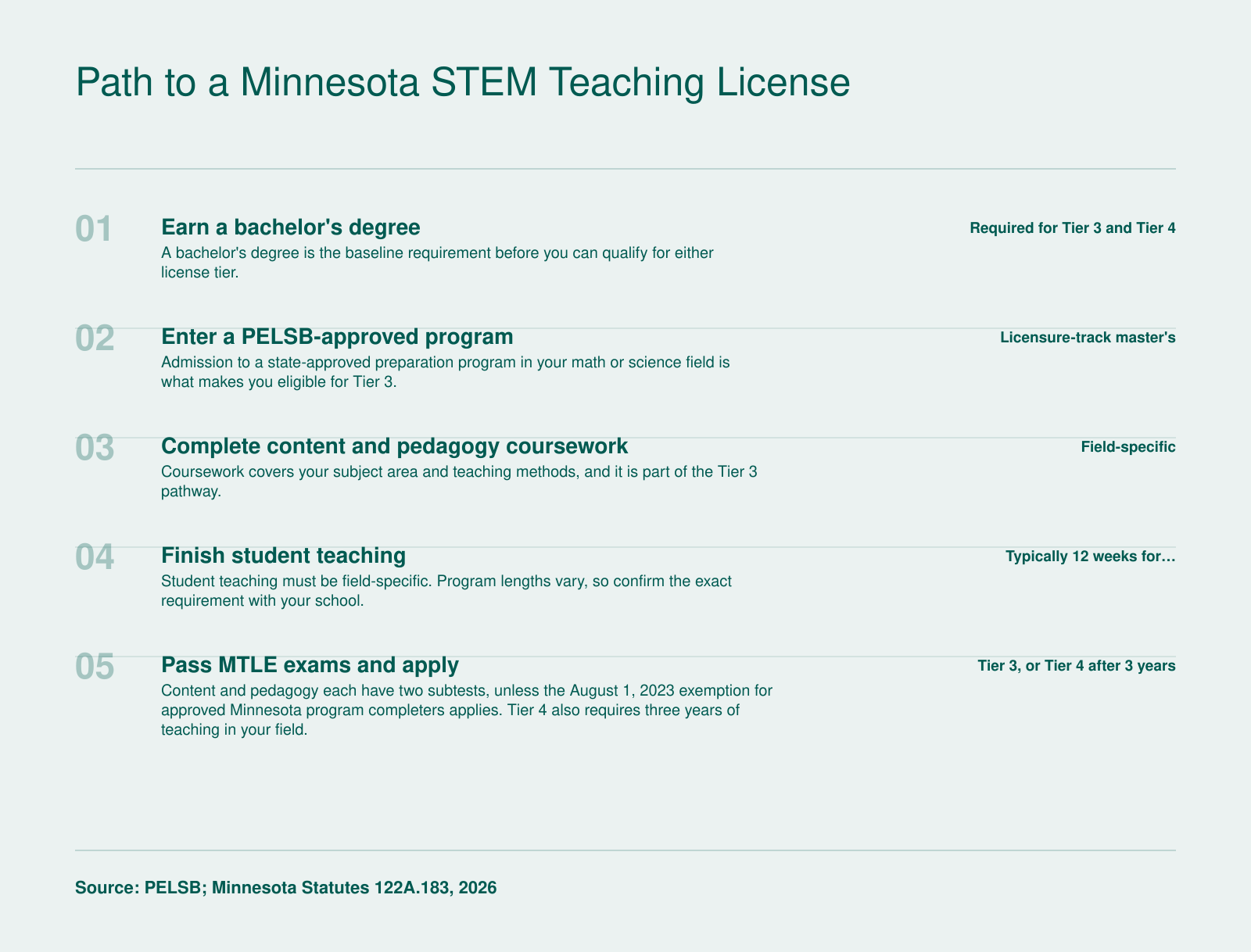
Path to a Minnesota STEM Teaching License
Minnesota's Professional Educator Licensing and Standards Board (PELSB) issues math and science teaching licenses. The sequence below reflects its current requirements. Teachers who are already licensed skip directly to the advanced degree.
Earnings After a Master's in STEM Education in Minnesota
The table below lists median earnings for master's degree completers in STEM education-related programs at Minnesota institutions, measured four years after completion. Debt figures show median program debt where the U.S. Department of Education has published it.
| School | Median earnings four years after completion | Median program debt |
|---|---|---|
| University of St Thomas | $66,763 | N/A |
| The College of Saint Scholastica | $61,491 | $28,271 |
| University of Minnesota-Twin Cities | $58,755 | $23,230 |
| Concordia University-Saint Paul | $54,947 | $38,441 |
| Walden University | $55,860 | $38,929 |
Master's in STEM Education in Minnesota: Common Questions
Can I get a Minnesota teaching license with an online STEM education master's?
What is the difference between a master's in STEM education and a master's in science education in Minnesota?
Will a Minnesota teaching license transfer if I move to another state after my master's?
Compare Stem Science Technology Engineering Math programs on the data that matters
Explore more Education & Teaching specializations or browse every graduate field.
All Education & Teaching programs