Best Master's in Psychopharmacology Programs in California
Compare 6 accredited Psychopharmacology programs in California at 4 schools, with graduate earnings, cost, debt, and completion data from IPEDS and the U.S. College Scorecard.

A postdoctoral MSCP for already-licensed psychologists and a non-prescribing master's for counselors and therapists sit under the same "clinical psychopharmacology" label in California, and they serve different people. The first assumes a doctorate; the second is built for mental health practitioners who want medication fluency, not a prescription pad.
Here is the fact that shapes every decision: California does not grant psychologists prescriptive authority. Business and Professions Code §2904 excludes prescribing, and no 2026 bill changes that. The degree buys clinical expertise and credibility in collaborative care, not independent prescribing.
The California programs below are few, and both campus and online formats sit side by side.
Key Points
- California psychologists cannot prescribe, and no psychopharmacology master's here changes that under current law.
- Postdoctoral programs suit licensed psychologists, while non-prescribing master's programs serve counselors and therapists without a doctorate.
- The Chicago School at Los Angeles lists roughly $35,000 per year for its fully online program.
Best Master's in Psychopharmacology Schools in California
California offers a small set of master's in psychopharmacology options, and they serve different audiences: postdoctoral programs for licensed psychologists and non-prescribing master's programs for counselors and therapists. California does not currently grant psychologists prescriptive authority through completing any of these degrees, and APA designation does not grant it either. Institution-wide graduation rates were not reported in the data we reviewed for these schools, so we do not cite one for any of them. APA status below follows the APA designation listing.
Alliant International University-San Diego
#1San Diego, CA · ~$20,000/yr (est.)
Best for: Licensed psychologists wanting live weekend classes
Alliant offers a postdoctoral Master of Science in Clinical Psychopharmacology for licensed clinical psychologists, delivered online with live weekend classes and a community-based practicum. It describes itself as the nation's first postdoctoral program of this kind, with nearly 700 graduates as of 2025. Program tuition was recently reduced to just over $20,000, and the institution lists graduate tuition of $19,265. The APA designation listing shows this program as under review, which means no final APA decision, so confirm current status with the program. Alliant frames the degree as preparation for states that grant prescriptive authority, which California does not.
- Postdoctoral program for licensed clinical psychologists
- 30 credit hours over about two years, in eight-week terms
- Online with synchronous weekend classes and a cohort structure
- Community-based practicum included, no residency required
- Two start dates per year, so confirm the cohort calendar
- Faculty include physicians, pharmacists, and prescribing psychologists
- Doctoral students can enroll concurrently
- Military benefits, financial aid, and scholarships available
The Chicago School at Los Angeles
#2Los Angeles, CA · ~$35,000/yr (est.)
Best for: Part-time learners wanting a fellowship option
The Chicago School's Los Angeles campus is the Southern California access point for its online M.S. in Clinical Psychopharmacology, built for doctoral-level psychologists. The APA designation listing shows this program as designated, with its next renewal review in 2028. The institution lists graduate tuition of $33,816, well above Alliant's, so cost is a real tradeoff. Two tracks are offered, and the Illinois-focused track does not translate into prescribing authority in California.
- Requires a doctoral degree in clinical psychology
- Fully online, with part-time study available
- Two years part time, with a capstone required
- Three start dates per year, starting summer or fall
- Fellowship in psychopharmacology available
- $50 application fee, financial aid and scholarships available
- 67 total credit hours over about two years
- Clinical rotations across eight specialties, including psychiatry and pediatrics
- Designed for licensed psychologists in Illinois
- Online coursework with a required capstone
- 31 total credit hours, completed in two years part time
- 100% online coursework
- Sample courses in anatomy, pathophysiology, and neurochemistry
- Suited to community mental health, hospital, and private practice settings
The Chicago School at San Diego
#3San Diego, CA · ~$35,000/yr (est.)
Best for: Counselors and therapists without a doctorate
The Chicago School's San Diego location offers an online M.A. in Psychopharmacology for counselors, therapists, and other practitioners who are not doctoral-level psychologists. It builds medical and pharmacology knowledge but does not lead to prescriptive licensure. It is not listed on APA's psychopharmacology designation page, which covers postdoctoral programs. The institution lists graduate tuition of $33,816.
- 18-month online program, full-time or part-time
- 3.0 GPA minimum, with prerequisite courses required
- No entrance exam required
- Applied research capstone covering drug approval and ethics
- Case-based learning in neurochemistry, biochemistry, and pharmacology
- Does not lead to prescriptive licensure
- $50 application fee, financial aid and scholarships available
The Chicago School at Anaheim
#4Anaheim, CA · ~$35,000/yr (est.)
The Chicago School's Anaheim campus offers the same online M.A. in Psychopharmacology, giving Orange County practitioners a Southern California base. It strengthens existing practice and collaboration with prescribers rather than creating a path to writing prescriptions. It is not listed on APA's psychopharmacology designation page. Institution-wide graduate tuition is listed at $33,816, and no Anaheim-specific cohort or partnership was identified.
- About 18 months, fully online, ending in an applied research capstone
- 3.0 GPA minimum, with prerequisite courses required
- Covers medical anatomy, biochemistry, and neurochemistry
- Built for practitioners, not psychologists seeking to prescribe
- Does not lead to prescriptive licensure
- Careers in hospitals, clinics, integrated care, and nursing homes
Cost & outcomes by school
Federal data for the highest-earning Psychopharmacology programs, independent of the ranking above. Earnings are this field's master's graduates four years after completing, where the Scorecard reports them.
| School | Earnings | Tuition / yr | Debt | Grads/yr | Format |
|---|---|---|---|---|---|
| Alliant International University-San Diego CA | $116,546 | $19,690 | — | 14 | Online |
| The Chicago School at Los Angeles CA | — | $35,328 | — | 21 | Online |
| The Chicago School at Anaheim CA | — | $35,328 | — | — | Online |
| The Chicago School at San Diego CA | — | $35,328 | — | — | Online |
Sources: U.S. Department of Education. Tuition and graduates: IPEDS. Earnings and debt: College Scorecard, this field's master's graduates; a dash means no figure is reported.
Online and Hybrid Master's in Psychopharmacology Options in California
Postdoctoral psychopharmacology training has shifted heavily toward live online delivery, which lets practicing psychologists study without relocating, a common setup for online masters programs in California. The California programs on this list fit that pattern, though they differ in how much in-person work they require.
Delivery format
Alliant International University runs its Master of Science in Clinical Psychopharmacology fully online, with live real-time classes and no required campus residency. The Chicago School at Los Angeles also delivers most coursework online but builds in required on-site intensives1, so plan for travel at set points even as an online student.
Length and credit load
Alliant's program carries 30 credits across ten sequential 3-unit terms on an 8-week calendar, with roughly 400 instructional hours; the published completion time is 24 months, matching the two-year structure. The Chicago School lists a two-year, part-time plan.1 Credit requirements there vary by track, and the standard California credit total is not clearly stated in the available materials.
Coursework and clinical requirements
Expect a core built around neuroscience, pharmacology, pathophysiology, and the psychopharmacology of specific disorders, plus anatomy and neurochemistry. Alliant requires an 80-hour clinical psychopharmacology practicum, though its format and location are not specified. Factor any required intensives or practicum hours into your schedule before enrolling.
According to APA Services, only seven states let appropriately trained psychologists prescribe medication: New Mexico, Louisiana, Illinois, Iowa, Idaho, Colorado, and Utah, which became the seventh in 2024. Each attaches its own training and supervision conditions. California is not on the list, so a psychopharmacology master's does not grant prescribing rights here.
GRE Waivers and Admission Requirements: Can You Enroll Without a Doctorate?
Two different degree types sit under the psychopharmacology label in California. The credentials you already hold decide which one you can enter.
Postdoctoral MSCP vs. Non-Postdoctoral M.A.
A postdoctoral master's in clinical psychopharmacology (MSCP) is built for psychologists who already hold a doctorate and want training tied to prescriptive authority in states that grant it. A non-postdoctoral M.A. teaches pharmacology and neuroscience to other practitioners, such as counselors, but does not lead to prescriptive licensure.1 If you lack a doctorate, the M.A. track is your realistic entry point.
Requirements by School
- Alliant International University-San Diego: This is a postdoctoral MS. Alliant asks for a relevant graduate degree in psychology or a related field. It notes that some programs may also require clinical experience and psychologist licensure, and doctoral students can enroll concurrently. We found no published GRE policy or prerequisite coursework list.
- The Chicago School at Los Angeles: The M.S. requires a doctoral degree in clinical psychology. We found no published GRE policy.
- The Chicago School at San Diego: The M.A. requires no entrance exam, sets a 3.0 GPA minimum, and lists required prerequisite courses, putting it among No-GRE master's programs. It is designed for non-psychologist practitioners.
- The Chicago School at Anaheim: This M.A. lists a 3.0 GPA minimum and prerequisite courses, and it suits applicants with mental health counseling backgrounds, such as Clinical Mental Health Counseling Master's in California. Its listing does not state a GRE policy, so confirm with admissions.
Neither Chicago School M.A. listing specifies which prerequisite subjects apply or whether NPs, PAs, or RNs qualify. Ask for that detail in writing before you apply.
Related Articles
Tuition and Total Cost of a Master's in Psychopharmacology in California
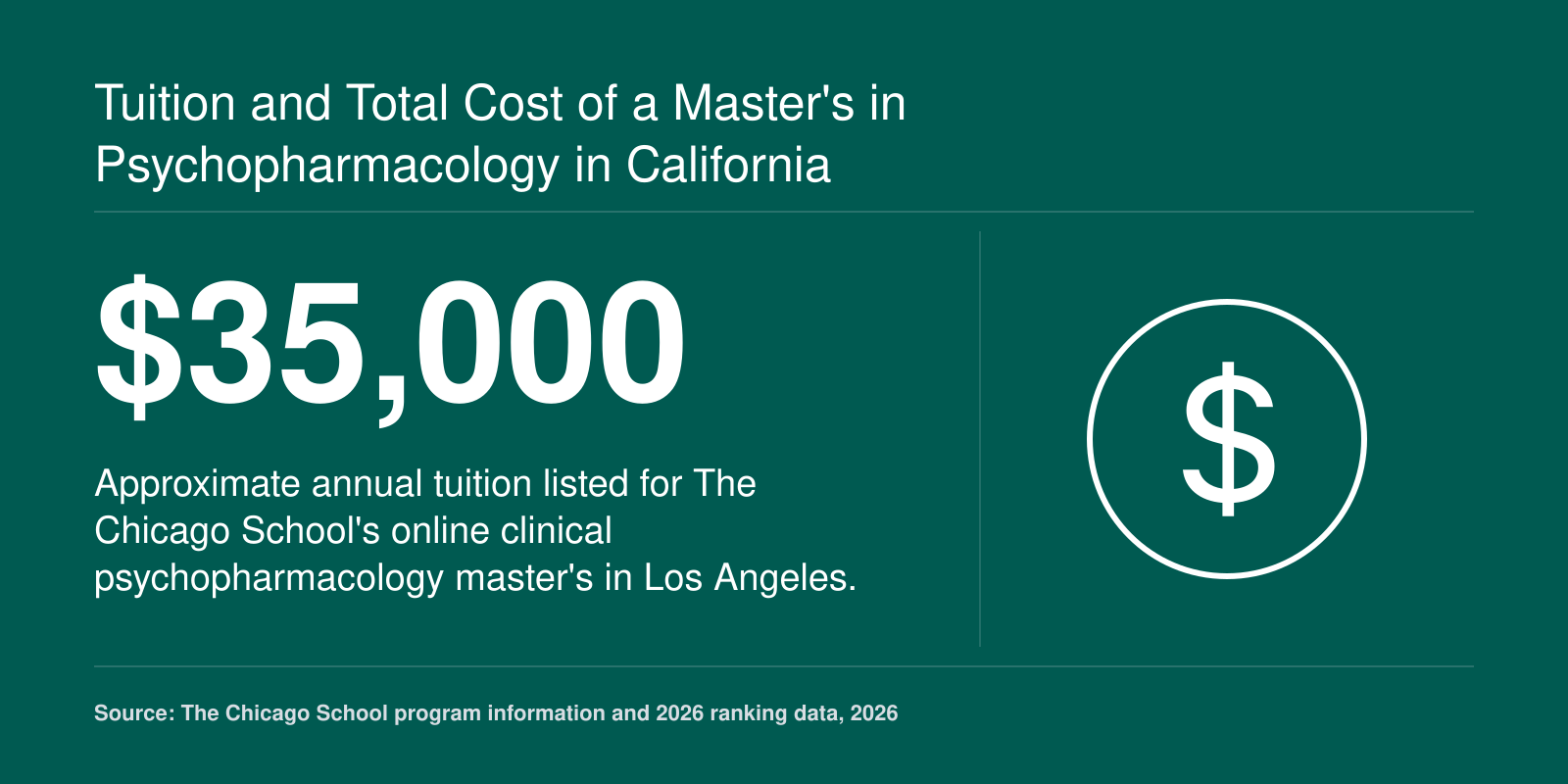
Only one program here has a published annual tuition figure: The Chicago School at Los Angeles, which is fully online and private, lists roughly $35,000 per year. A per-credit rate, full program cost, and mandatory fees are not established, so a side-by-side chart or public versus private comparison would be misleading. It is also unclear whether the figure covers the coursework-only track or the longer prescriptive-authority track with clinical rotations, which would change the total. Any net price from federal data is an institution-wide average after aid, not a program quote. Ask admissions for a written cost breakdown, and ask about federal loans, employer or military benefits, and credit for prior graduate coursework, since transfer-credit policy is not confirmed.
California Licensure and Prescriptive Authority for Psychopharmacology Graduates
Master's in Psychopharmacology FAQ
These answers cover the questions prospective students ask most about eligibility, prescribing, and how program types differ. Rules for prescribing are set by each state, so always confirm current requirements with the relevant licensing board.
Can you get a master's in psychopharmacology without a doctoral degree?
Does a master's in psychopharmacology allow you to prescribe medication in California?
What is the difference between a postdoctoral master's and a standard master's in psychopharmacology?
Can you use a California psychopharmacology master's to pursue prescribing privileges in another state?
Compare Psychopharmacology programs on the data that matters
Explore more Psychology specializations or browse every graduate field.
All Psychology programs