Best Sport Psychology Master's Programs in Texas
Compare 3 accredited Sports Psychology programs in Texas, with graduate earnings, cost, debt, and completion data from IPEDS and the U.S. College Scorecard.

In-state graduate tuition across Texas sport psychology master's programs runs from $6,157 at Texas A&M-Kingsville to $38,658 at TCU, a spread that forces a sharp cost-versus-outcome calculation. Texas offers a small set of these programs, so the practical ranking question is format, cost, and CMPC alignment rather than prestige.
A master's degree alone cannot confer psychologist licensure in Texas. Most graduates pursue CMPC certification as mental performance consultants or LPC licensure for athlete-focused practice, which makes applied training and resident tuition the real filters.
Key Points
- Texas A&M-Kingsville is the lowest-cost option here at $6,157 a year for residents.
- A master's alone won't earn the protected "psychologist" title in Texas; that requires a doctorate.
- University of the Southwest offers a fully online, 36-credit M.S. in Sports Psychology.
Ranked: Texas Sport Psychology Master's Programs Worth Your Application
This list weighs graduate cost, delivery format, and institution-wide outcomes, and it covers campus and hybrid options together. Our data returned three Texas programs with a sport or performance psychology focus, and we list all three rather than pad the page. Where a school does not publish a deadline or start term, we say so.
Texas Tech University
#1Lubbock, TX · $5,000 – $10,000/yr (est.)
Best for: Texas residents watching tuition costs
Texas Tech graduates about 69% of its students, and its published graduate tuition is $6,956 in-state and $15,356 out-of-state, the lowest in-state figure after Kingsville among these three. The two-year kinesiology master's pairs applied sport psychology coursework with research and teaching opportunities, and scholarships and conference travel stipends are available. A program-specific 2026-2027 deadline and start term were not confirmed, so check with the department before planning your timeline.
- 36 credit hours, designed as a two-year program
- 18 hours of required coursework plus 18 hours of electives
- Courses include Applied Sport Psychology, Motor Control, and Motor Learning
- Research Methods I and II in the core
- Teaching and research opportunities available
- Scholarships and conference travel stipends available
- Electives require adviser approval
- Deadline and start term not confirmed for this program
Texas A&M University-Kingsville
#2Kingsville, TX · ~$6,000/yr (est.)
Best for: Future consultants seeking internship-based training
Texas A&M-Kingsville graduates about 42% of its students, a lower rate than the other two schools, but it has the lowest published graduate tuition on the list at $3,409 in-state and $10,968 out-of-state. Its Performance Psychology concentration is built around preparing students for the CMPC exam, and the internship option makes that pathway explicit. Applications open August 1 with a February 1 deadline listed. A start term was not stated.
- Three paths: 36 credits course-only, 36 with project or internship, or 30 with thesis
- Internship option designed to prepare students for the CMPC exam
- Hybrid delivery with some required face-to-face courses
- Minimum 3.0 undergraduate GPA listed for consideration
- Expects a kinesiology or equivalent bachelor's; natural-science majors may be considered
- Anatomy and Physiology I and II and Exercise Physiology expected, often completed in year one
- Listed in the 2026-27 graduate catalog
Texas Christian University
#3Fort Worth, TX · $35,000 – $40,000/yr (est.)
Best for: Research-minded students eyeing doctoral study
TCU graduates about 86% of its students, the strongest rate here, but its graduate tuition of $38,610 is far above the public options. The scientist-practitioner program in Fort Worth offers small cohorts, hands-on lab research, and a route to begin logging mentored hours toward CMPC certification. It suits students aiming at consulting or doctoral study who can absorb the cost. No application deadline or start term was found in available material.
- On-campus program in Fort Worth
- Scientist-practitioner training model
- Hands-on research through the Sport & Exercise Psychology Lab
- Can begin accumulating mentored hours toward CMPC certification
- Six concentration options within the kinesiology master's
- Prepares for doctoral study or work as a mental performance consultant
- Small cohorts with personalized mentorship
- Deadline and start term not confirmed
Cost & outcomes by school
Federal data for the highest-earning Sports Psychology programs, independent of the ranking above. Earnings are this field's master's graduates four years after completing, where the Scorecard reports them.
| School | Earnings | Tuition / yr | Debt | Grads/yr | Format |
|---|---|---|---|---|---|
| University of North Texas TX | $75,626 | $9,091 | $32,709 | 133 | Campus |
| Texas A&M University-Kingsville TX | — | $6,157 | — | 1 | Hybrid |
| Texas Christian University TX | — | $38,658 | — | — | Campus |
Sources: U.S. Department of Education. Tuition and graduates: IPEDS. Earnings and debt: College Scorecard, this field's master's graduates; a dash means no figure is reported.
Online and Hybrid Sport Psychology Master's Options in Texas
Can you earn a sport psychology master's in Texas entirely online? Among the schools here, University of the Southwest is the clearest fit. Its M.S. in Sports Psychology is delivered online and requires 36 credits. Texas A&M-Kingsville is hybrid and traditional, and its Performance Psychology concentration within the M.S. in Kinesiology requires some face-to-face courses on campus. Texas Tech and TCU are campus programs.
The details that matter most for CMPC-bound students are less clear. Neither University of the Southwest nor Texas A&M-Kingsville publishes enough for us to say how online or hybrid students complete applied or practicum hours, whether they can do so locally, or how often they must be on campus. Kingsville offers an internship option within its 36-credit plan, but we could not confirm how it is arranged for students at a distance. Synchronous session requirements are also unconfirmed for both.
The same gap applies to pricing. We found no published statement on whether online students pay in-state or out-of-state rates, so ask each admissions office directly before you apply.
Related Articles
Which Ranked Texas Master's Programs Waive or Skip the GRE?
A master's program with no GRE required and a GRE-required one can sit in the same department type, so the policy is worth checking school by school. For the Texas Tech kinesiology program (Motor Behavior and Exercise and Sport Psychology), the Texas A&M-Kingsville Performance Psychology concentration, and the TCU Sport Psychology program, no published GRE policy is available. We are not going to guess. Check each admissions page, and email the program coordinator if the page is silent or outdated.
Requirements that commonly appear across kinesiology and psychology master's programs include:
- GPA: Often a minimum near 3.0, sometimes measured on the last 60 credit hours.
- Letters: Usually two or three, with at least one from a faculty member.
- Personal statement: Often expected to name your interests, and sometimes a preferred thesis or faculty mentor.
- Prerequisites: Some undergraduate coursework in psychology, statistics, or exercise science, with leveling courses possible.
Treat these as typical patterns, not confirmed rules for any single school.
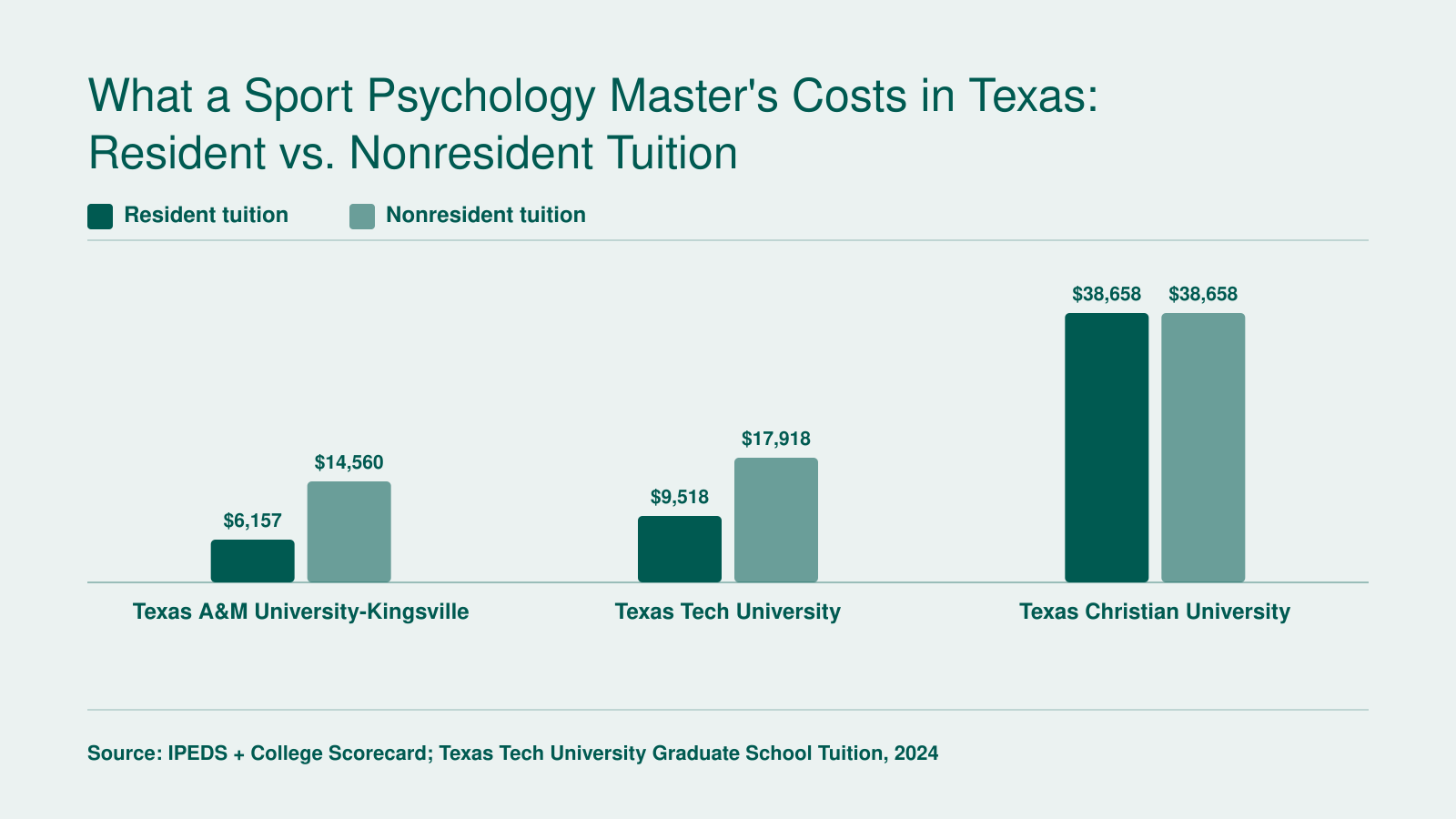
What a Sport Psychology Master's Costs in Texas: Resident vs. Nonresident Tuition
Texas A&M University-Kingsville is the lowest-cost option here at $6,157 a year for residents, and nonresidents pay $14,560, a gap of $8,403. Texas Tech shows a similar gap of about $8,400, while TCU, a private school, charges $38,658 regardless of residency. Annual tuition is not a program quote, so confirm per-credit rates and fees with each school. Texas Tech's 36-credit degree over two years would run roughly $17,980 for residents at its published 2026-27 full-time estimate of $8,990 a year, before course fees. Institution-wide average net price after aid is $12,090 at Kingsville, $19,070 at Texas Tech, and $36,660 at TCU. Those are averages across all students, not program prices.
Decide whether you are aiming for CMPC certification or LPC licensure before you compare tuition, because your career endpoint should drive which program you choose.
Texas Licensure and CMPC Certification: What This Master's Prepares You For
Can a sport psychology master's lead to a license in Texas? Not to a psychologist license. "Psychologist" is a protected title regulated by the Texas Behavioral Health Executive Council, and licensure requires a doctorate, the EPPP, the Texas jurisprudence exam, and 1,750 supervised hours during the doctorate plus 1,750 after it.
The LPC Route
Graduates who want clinical practice typically pursue the Licensed Professional Counselor credential through a Master's in Counseling in Texas. The rulebook requires a counseling or counseling-related graduate degree with at least 48 semester hours (many programs run 60), the NCE or NCMHCE, a Texas jurisprudence exam, and an LPC Associate license. Associates then log 3,000 supervised hours, including 1,500 direct counseling hours. A program title alone does not qualify you, because your transcript must meet the board's coursework rules. None of the ranked programs here states LPC eligibility, so compare the board's coursework rules directly with the clinical mental health counseling master's programs in Texas you are considering.
The CMPC Route
The Association for Applied Sport Psychology's CMPC credential involves required coursework areas, mentored applied hours, and an exam. Confirm current specifics with AASP.
- Texas A&M University-Kingsville: states AASP alignment and exam preparation. It does not specify mentored hours.
- Texas Christian University: lists a CMPC certification pathway. Mentored hours are not specified.
- Texas Tech University: offers an Applied Sport Psychology course but does not state CMPC alignment.
The rule: performance consulting goals point to a CMPC-aligned program, and clinical goals point to an LPC-eligible one.
Quick Answers About Sport Psychology Master's Degrees in Texas
These answers draw on published program details and federal data. Policies and tuition change, so confirm specifics with each program's admissions office before you apply.
What separates a sport psychology master's from a performance psychology master's?
Can a sport psychology master's lead to a counseling license in Texas?
How many credit hours and semesters do Texas sport psychology master's programs usually require?
Where do graduates of Texas sport psychology master's programs typically work or go on to study?
What is the most affordable way to earn a sport psychology master's in Texas?
Do I need an undergraduate psychology degree to apply?
Does a Texas sport psychology master's count toward CMPC certification?
Compare Sports Psychology programs on the data that matters
Explore more Psychology specializations or browse every graduate field.
All Psychology programs