Best Sport Psychology Master's Programs
Compare 50+ accredited Sports Psychology programs at 40+ schools, with graduate earnings, cost, debt, and completion data from IPEDS and the U.S. College Scorecard.

Sport psychology master's degrees now split into two tracks that can look identical on a program page.
Boston University's EdM in Counseling requires 74 units and 700+ clinical hours, and it prepares students for Massachusetts licensure. Fresno State's Master of Science in Sport and Performance Psychology is 30 units and points toward CMPC preparation instead. Both carry the sport psychology label, yet they lead to different careers.
The campus-based programs ranked here are compared on tuition and graduate outcomes. A consulting degree will not count toward clinical mental health counseling licensure without additional graduate coursework.
Key Points
- Ball State charges $12,342 in state but $30,052 out of state.
- Your program must match AASP coursework rules to qualify for CMPC.
- Supervised hours, not classes, can add a year beyond the usual two.
The 10 Best Sport Psychology Master's Programs, Ranked
These 12 programs rose to the top when we weighed what graduates actually pay and earn against what each school delivers. The list includes counseling-oriented options, sport science programs, and performance consulting pathways, so the right pick depends on whether you need licensure, research training, or applied field hours.
Florida State University
#1Tallahassee, FL · ~$11,000/yr (est.)
Best for: Aspiring researchers seeking applied athlete experience
Florida State University combines sports psychology with educational psychology, giving students a research-focused home in Tallahassee. The master's program requires at least 36 credits and offers both coursework-only and thesis paths. Students can gain hands-on experience with athletes and pursue an optional CMPC certification pathway.
- Offers master's and doctoral pathways in sport psychology
- Focuses on performance and athlete welfare science
- Research and hands-on experience with athletes
- Optional CMPC certification pathway
- At least 36 credits; no transfer credit accepted
- Coursework-only or thesis option with oral defense
- Master's GRE waived; fall entry with January 15 deadline
San Jose State University
#2San Jose, CA · ~$10,000/yr (est.)
Best for: California residents wanting affordable campus study
San Jose State University offers a sport psychology concentration inside a kinesiology master's program focused on psychosocial aspects of sport and physical activity. The 30-unit curriculum is campus-based, requires no GRE, and accepts fall and spring applications.
- 30-unit Master of Science degree
- Emphasis on psychosocial aspects of sport and physical activity
- Campus-based delivery in San Jose
- No GRE required
- Apply via Cal State Apply
- Fall and spring admissions
Boston University
#3Boston, MA · $65,000 – $70,000/yr (est.)
Best for: Future licensed counselors needing clinical sport hours
Boston University's EdM in Counseling with a Sport/Performance Psychology concentration pairs clinical mental health training with sport-specific internships. The two-year full-time program includes 700+ clinical hours and meets Massachusetts counseling licensure and CMPC coursework requirements. It is a strong fit for students who want to work as licensed counselors with athletes in the Boston area.
- Two-year, full-time campus program
- 74 units plus a summer session
- Prepares for Massachusetts mental health counseling licensure
- Meets CMPC certification coursework
- 700+ clinical training hours and sport psychology internships
- Focus on child, adolescent, and young adult populations
- Part-time option available
California State University-Fresno
#4Fresno, CA · ~$9,000/yr (est.)
California State University, Fresno offers a 30-unit master's in sport and performance psychology with a dedicated Sport Psychology Lab and local internship opportunities. The curriculum aligns with Certified Mental Performance Consultant core competencies and includes research methods, coaching psychology, and injury psychology. Students finish with a thesis, project, or comprehensive exam.
- 30-unit Master of Science program
- Prepares for Certified Mental Performance Consultant (CMPC)
- Research methods and statistics coursework
- Psychology of coaching and injury content
- Culminating thesis, project, or comprehensive exam
- Sport Psychology Lab and local sport internships
- Three reference letters and qualifying exam required
The University of Tennessee-Knoxville
#5Knoxville, TN · ~$16,000/yr (est.)
The University of Tennessee, Knoxville offers an MS in Kinesiology with a Sport Psychology and Motor Behavior concentration focused on performance enhancement. The campus program admits a competitive cohort of 10-20 students annually and does not require the GRE, though a 3.2 GPA is expected. Graduate assistantships can offset costs for some students.
- Campus-based kinesiology master's program
- No GRE required
- Minimum 3.2 GPA expected
- Three recommendation forms and writing samples
- Admits 10-20 students from 75-100 applicants annually
- Graduate assistantships with fee waivers and stipends possible
Arizona State University
#6Tempe, AZ · ~$14,000/yr (est.)
Arizona State University offers a Master of Science in Psychology with a Sport Psychology concentration that blends psychology foundations with sports applications. The campus program requires a 3.0 GPA in the last 60 undergraduate hours and a statement of purpose. It prepares graduates to support athlete performance and mental health.
- Campus-based Master of Science in Psychology
- Minimum 3.0 GPA in last 60 undergraduate hours
- Two to three letters of recommendation and statement of purpose
- Professional resume requested
- Focus on athlete performance and mental health
University of Denver
#7Denver, CO · ~$42,000/yr (est.)
The University of Denver's MA in Sport and Performance Psychology is a two-year campus program housed in the Graduate School of Professional Psychology. Students receive applied training through the Center for Performance Excellence and complete a supervised capstone project. Electives in entrepreneurship, biofeedback, and psychophysiology allow for specialized paths.
- Two-year campus-based program
- Housed in Graduate School of Professional Psychology
- Applied training through Center for Performance Excellence
- Capstone project with consultation review and supervision
- Electives in entrepreneurship, psychophysiology, biofeedback, and high-risk occupations
Illinois State University
#8Normal, IL · ~$10,000/yr (est.)
Illinois State University offers a 33-hour MS in Kinesiology and Recreation with a Psychology of Sport and Physical Activity sequence. The campus program includes a research core, sport psychology coursework, and a choice of thesis or professional practice. It is a practical option for students who want a structured sequence with faculty advisement.
- 33-hour Master of Science program
- 6-hour research core and 9 hours of sport psychology coursework
- Thesis or professional practice culminating option
- Campus-based delivery in Normal, IL
- Part of Kinesiology and Recreation department
University of Kentucky
#9Lexington, KY · ~$15,000/yr (est.)
The University of Kentucky's MS in Sport and Exercise Psychology offers applied and research tracks across 39 credit hours. The two-year campus program integrates theory with performance enhancement and allows students to pursue assistantships and fellowships. Graduates typically move into sport psychology, performance coaching, or fitness consulting.
- Two-year campus-based program
- Applied or research track
- 39 total credit hours
- Fall start; January 15 application deadline
- Resident $842 per credit; nonresident $2,100.50 per credit
- Assistantships and fellowships available
- Career paths: sport psychologist, performance coach, fitness consultant
East Carolina University
#10Greenville, NC · ~$8,000/yr (est.)
East Carolina University offers an MS in Kinesiology with a Sport and Exercise Psychology concentration that follows a science-practitioner model. Students work closely with faculty on research and can apply skills in community and sport settings. Small class sizes support individualized attention.
- Science-practitioner model approach
- Faculty research involvement and applied projects
- Applied skills development in community and sport settings
- Small group learning environment
- Campus-based delivery in Greenville, NC
Cost & outcomes by school
Federal data for the highest-earning Sports Psychology programs, independent of the ranking above. Earnings are this field's master's graduates four years after completing, where the Scorecard reports them.
| School | Earnings | Tuition / yr | Debt | Grads/yr | Format |
|---|---|---|---|---|---|
| Minnesota State University-Mankato MN | $99,934 | $10,449 | — | 24 | Campus |
| Dominican University of California CA | $85,372 | $21,071 | $61,500 | 23 | Hybrid |
| National University CA | $78,497 | $16,416 | $28,854 | 1,098 | Online |
| University of North Texas TX | $75,626 | $9,091 | $32,709 | 133 | Campus |
| Boston University MA | $70,842 | $67,626 | $80,000 | 53 | Campus |
| California Baptist University CA | $69,787 | $15,562 | $61,500 | 313 | Online |
| University of Denver CO | $68,815 | $42,173 | $103,418 | 101 | Campus |
| Seton Hall University NJ | $67,563 | $37,470 | $55,666 | 2 | Campus |
| University of Wisconsin-Milwaukee WI | $66,931 | $12,728 | $41,000 | 52 | On campu |
| Arizona State University AZ | $66,491 | $10,843 | $35,423 | 425 | Campus |
| Arizona State University AZ | $66,491 | $13,587 | $35,423 | 44 | Campus |
| East Carolina University NC | $66,394 | $7,658 | — | 9 | Campus |
Sources: U.S. Department of Education. Tuition and graduates: IPEDS. Earnings and debt: College Scorecard, this field's master's graduates; a dash means no figure is reported.
Cost, debt & payoff
Median earnings of this field's master's graduates (4 yrs after completing) vs. their median federal loan debt · U.S. College Scorecard
Across these programs the median graduate earns about $66,394 and finishes with roughly $50,697 in debt — a ratio that clears a common rule of thumb (keep debt below first-year salary). Tuition and debt vary widely school to school, so check the per-school figures in the table above before you shortlist.
Our Scoring Approach: Outcomes First, Reputation Second
Reputation tells you how a program is perceived, while outcome data tells you what its graduates actually got. In a niche field like sport psychology, we lean on the second, much as we do when ranking Clinical Psychology programs.
Rankings draw on federal IPEDS and College Scorecard figures: graduate tuition, net price, institution-wide graduation rate, and, when available, program-level earnings and debt. Few sport psychology programs enroll large cohorts, so word of mouth and brand recognition can mislead. A famous athletics school may run a small, thinly resourced master's track, while a lesser-known university delivers comparable coursework for far less money. Numbers let that difference show.
Limits worth knowing
- Small cohorts: Some programs graduate too few students for earnings or debt figures to be published, so those details may be missing.
- Graduation rates: These cover the whole institution, not the sport psychology program alone, so treat them as a rough signal of student support.
Scope
This list covers US programs, the same scope as our best master's in psychology programs in USA ranking. If you are searching for the best sports psychology programs in the world, check how well an international degree transfers before committing, especially if you plan to pursue the CMPC credential or US licensure. Confirm coursework equivalency with the credentialing body first.
CMPC Coursework and Mentored Hours: What to Check in Each Curriculum
Sport psychology master's programs do not automatically make you eligible for the Certified Mental Performance Consultant (CMPC) credential. The Association for Applied Sport Psychology (AASP) sets separate coursework, supervised experience, and exam requirements, and the program you choose must line up with all three.
The core CMPC requirements
Under the current AASP framework, CMPC applicants need a master's or doctoral degree from a regionally accredited institution, plus coverage of all eight knowledge areas. Several of those areas, commonly including K1, K2, K5, K6, and K8, are expected at the graduate level. Applicants also need 400 mentored hours under an AASP Registry-approved mentor, with direct client contact, support activities, and mentorship built into that total. Certification is finalized by passing the computer-based, proctored CMPC exam.
Auditing the course list
Ask each program for a course mapping that matches its syllabi to the eight AASP knowledge areas. A school might say it is "CMPC-aligned," but stated alignment is not the same as AASP approval. If a required course does not clearly cover a knowledge area, you may need to take a supplemental AASP course later. Verify the mapping before you enroll, and keep the document. AASP can change requirements, and you will need to prove your coursework if you apply after a revision.
Supervised hours: built in or on your own?
This is often the biggest differentiator. Some programs, like the University of Illinois Chicago's Performance, Sport, and Exercise Psychology concentration, structure the full 400-hour mentored experience into the degree. Others leave you to find an AASP-approved mentor and arrange your own practicum, which adds time and risk. If a program does not place you, ask how current students typically secure their mentors and what support the faculty provides.
Yes, a master's can lead to the CMPC credential when the degree, knowledge-area coverage, 400 mentored hours, and exam line up. The program's curriculum alone is not enough; you own the final eligibility check.
Licensure or Performance Consulting? Accreditation Decides
A sport psychology master's can lead in two very different directions, and accreditation is what separates them. If your goal is counseling licensure, the program's department home matters more than the sport psychology label in the brochure.
The Licensure Split Starts With the Department Home
Programs housed in CACREP-accredited counseling departments are built on clinical mental health counseling coursework, practicum, and supervised internship, which makes them the clearest master's route to LPC or LMHC licensure. A sport or athletic counseling concentration is a specialization layered on that counseling foundation. Programs housed in kinesiology or exercise science departments generally prepare students for mental performance consulting instead, with no state license attached.
APA Accreditation Is Doctoral, Not Master's
The American Psychological Association accredits PhD and PsyD psychology programs, not master's programs in sport psychology or counseling. For any master's program, institutional or regional accreditation is the baseline that validates the degree. It does not by itself prove the clinical curriculum and supervised training a state counseling board will require.
When You Need a License, and When You Do Not
You do not need a license to provide performance enhancement or mental skills coaching as a Certified Mental Performance Consultant. You do need a license to diagnose or treat mental health conditions or to hold yourself out as a psychologist, which is reserved for doctoral-level professionals. CACREP is specifically required for counselor licensure in Ohio, Kentucky, North Carolina, and Florida, with Florida's requirement effective July 1, 2025; other states may accept non-CACREP programs if the curriculum meets board rules.
Confirm Before You Apply
Sport psychology and clinical/counseling psychology differ in scope: performance enhancement versus diagnosis and treatment of mental illness. Before applying, verify the program's department home, its CACREP status if licensure is your goal, and the destination state's licensing rules. A non-licensure program can still be a strong choice for performance consulting, but it will not substitute for a counseling degree if your career requires clinical practice.
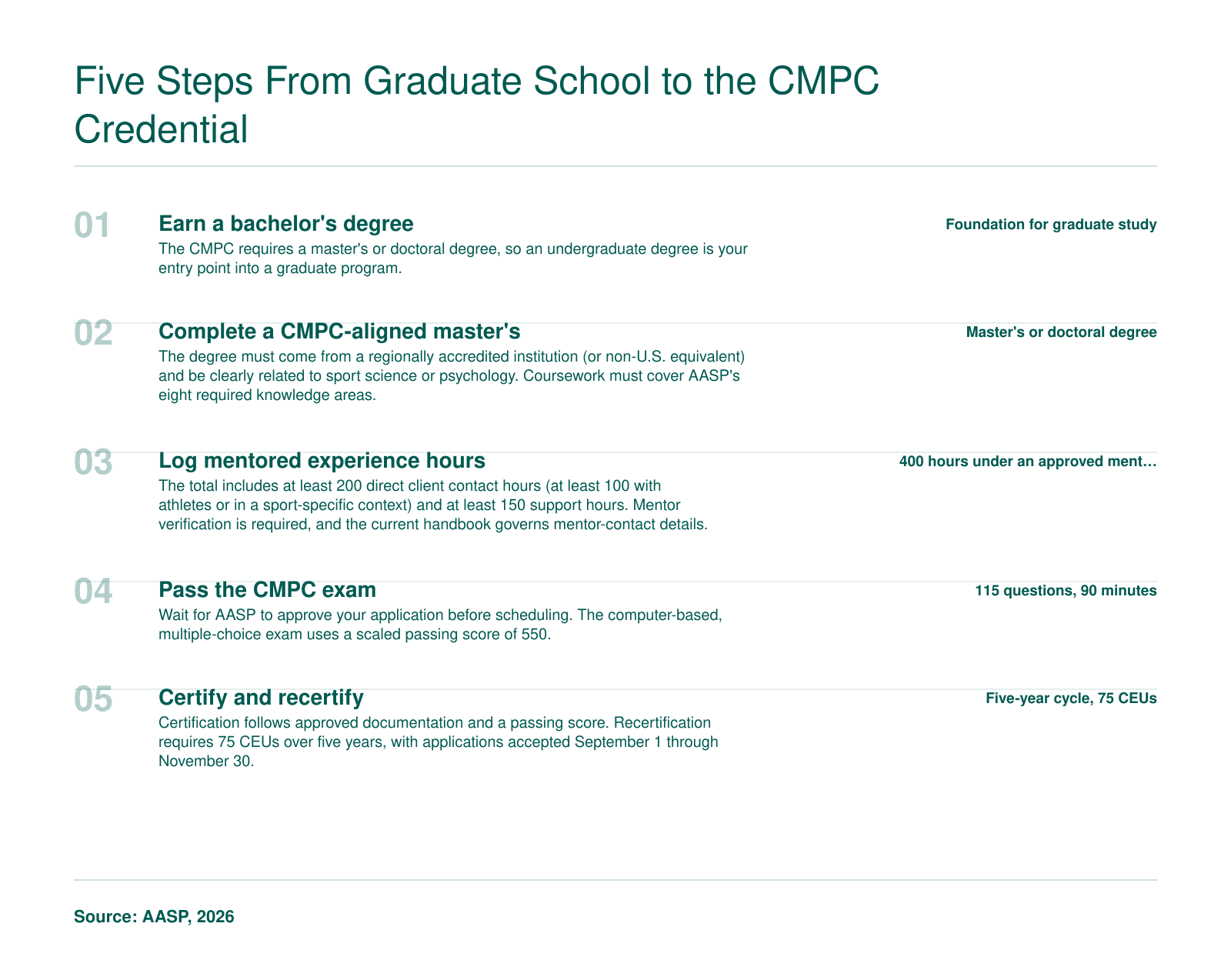
Five Steps From Graduate School to the CMPC Credential
Most students stall at step three, not in the classroom. Coursework is built into your program, but the mentored hours must be supervised by an approved CMPC mentor, and those mentors are scarce and often not on your campus. Start the search in your first semester, ask each program how it connects students with approved mentors, and confirm that your mentor can verify your hour logs. Sources also differ on the exact mentor-contact hour breakdown, so check the current AASP Candidate Handbook and application form before you begin logging. Keep detailed records from day one, because the application requires mentor verification of every hour you claim.
Related Articles
Sport Psychology Masters Programs Tuition and Total Cost
A public university can charge an out-of-state student more than double what it charges a resident for the same degree. Ball State lists graduate tuition of $12,342 in state and $30,052 out of state. Adams State, an online master's in psychology option, charges $5,898 to everyone, the lowest annual figure among the schools here. East Central's annual tuition is $6,008 for residents and $12,236 for non-residents, so residency matters as much as the school you pick.
Turning Per-Credit Rates Into a Total
Annual tuition is not program cost. Multiply the per-credit rate by the credits required:
- East Central (online): $400.80 per semester credit across 45 credits comes to $18,036 for Oklahoma residents. The non-resident rate of $762.80 puts the same program near $34,300, unless a waiver applies.
- University of the Southwest: $684 per quarter credit across 58 quarter credits is $39,672 before fees. That is about 39 semester credits (a quarter credit is roughly two-thirds of a semester credit), or about $1,026 per semester-equivalent credit.
- Capella GuidedPath: $31,480, including a $160 resource kit. FlexPath is billed by 12-week session, so the total ranges from roughly $12,000 to $28,000 depending on your pace. Those estimates can change.
- Springfield College: $1,212 per semester credit, but the published information omits total credits, so a full price cannot be calculated.
National University does not publish a current per-credit rate. Its M.S. requires 36 semester credits, and its M.A. tracks require 39 to 51.
Debt and Hidden Costs
Most of these programs do not yet publish program-level median debt or a 10-year monthly payment. Institution-wide median debt covers all students at a school and skews toward undergraduates, so do not treat it as the cost of this degree. Ask each program for its own borrowing data.
Then add what tuition leaves out: travel to practicum sites, fees for CMPC mentorship, and the cost of attending any required on-campus residency in an online program. Request an itemized estimate before you commit.
What Admissions Committees Expect From Applicants
Requirements vary by school, so treat these as patterns to verify on each program's admissions page, not a national standard.
- Bachelor's degree and GPAMinimum GPAs range from 2.3 at Capella to 3.0 at Arizona State, Northern Michigan, Ball State, UW–Green Bay, and Commonwealth. University of Western States sits at 2.75. Some schools offer flexibility: Commonwealth conditionally admits 2.75–2.99, and UW–Green Bay may admit provisionally if you earn a 3.0 in your first 9 credits.
- Major and prerequisitesArizona State asks for psychology or a related field. Northern Michigan prefers exercise science, psychology, or related areas but does not mandate them. Commonwealth accepts any undergraduate major. Programs rarely publish prerequisite course lists, and no universal leveling policy exists, so ask admissions directly if you are changing fields.
- Tests, statement, and referencesNorthern Michigan, UW–Green Bay, Commonwealth, and Capella state that the GRE is not required. Policies for other schools were not confirmed, so check each one. Expect a personal statement and recommendations as well; relevant athletic or coaching experience can strengthen your case.
- Deadlines and start datesArizona State lists July 15 for its in-person intake. University of Western States enrolls in October, January, and April and charges a $50 application fee plus a background check. UW–Green Bay reviews on a rolling basis after its deadline. Confirm current dates before planning.
- Program lengthArizona State requires 30 credits and National University's MS requires 36. Published pages do not state typical duration, so divide credits by your planned course load and add practicum time.
Sports Psychology programs by state
Compare Sports Psychology programs on the data that matters
Explore more Psychology specializations or browse every graduate field.
All Psychology programs