Best Sport Psychology Master's Programs in California
Compare 7 accredited Sports Psychology programs in California at 5 schools, with graduate earnings, cost, debt, and completion data from IPEDS and the U.S. College Scorecard.

Which California schools offer a sport psychology master's, and how much should one cost? Fewer than you'd expect, and the price gap is steep: San Jose State lists in-state tuition and fees of $8,410 a year, while Dominican University of California's hybrid program bills $1,283 per credit across 53 credits.
The programs below mix campus and online formats. California issues no license for mental performance consulting, so the 400 supervised hours behind CMPC certification matter more than the program's name.
Key Points
- Dominican University of California's hybrid M.A. still requires a two-week summer residency.
- California has no state license for sport psychology consulting; most graduates pursue AASP's CMPC credential.
- CMPC certification requires 400 supervised applied hours, so practicum access matters more than brand.
Top Sport Psychology Master's Programs in California, Ranked for 2027
California's strongest sport psychology master's options reward students who finish, move into applied work, and avoid crushing debt, not the ones with the loudest brand. The five programs below span public campuses, private universities, and fully online formats, so you can compare cost, format, and certification preparation side by side. Each entry draws on graduate tuition, institution-wide completion rates, and program details published by the schools.
San Jose State University
#1San Jose, CA · ~$10,000/yr (est.)
Best for: Campus students wanting interdisciplinary breadth
San Jose State University is a public campus that graduates about 69% of its students, and it pairs a low-cost public tuition structure with an interdisciplinary kinesiology home for sport psychology. Students can draw on sport sociology, cognitive psychology, exercise physiology, and coaching pedagogy, and the department supports a qualitative research lab. The 30-unit program fits students aiming at coaching, counseling-adjacent work, teaching, or doctoral study.
- 30-unit Master of Science with a Sport Psychology concentration
- Campus-based, with no online delivery
- GRE scores are not required
- Applications go through Cal State Apply; April fall deadline, October spring
- Five specializations available within the kinesiology master's
- Access to the Kinesiology Qualitative Research Lab
- Scholarships and faculty mentorship opportunities
California State University-Fresno
#2Fresno, CA · ~$9,000/yr (est.)
Best for: Aspiring consultants working across competition levels
California State University, Fresno is a public university that graduates about 57% of its students and launched its on-site Master of Science in Sport and Performance Psychology in 2024. The curriculum is built to meet core competencies for the Certified Mental Performance Consultant designation. A dedicated Sport Psychology Lab and local internship opportunities support preparation for work with youth, collegiate, and elite performers.
- 30-unit Master of Science, campus-based
- Curriculum meets CMPC and AASP core competencies
- Courses in coaching psychology, injury psychology, and research methods
- Thesis, project, or comprehensive exam as culminating experience
- Undergraduate kinesiology preparation expected; 12 to 15 prerequisite units possible
- Three reference letters and a qualifying exam required
- Sport Psychology Lab and internship opportunities
Dominican University of California
#3San Rafael, CA · ~$21,000/yr (est.)
Best for: Working adults needing hybrid flexibility
Dominican University of California in San Rafael graduates about 78% of its students, the highest completion rate on this list. Its Master of Arts in Applied Sport and Performance Psychology can be completed on campus, online, or in a hybrid format, though every student attends a mandatory two-week summer residency. Structured, faculty-supervised placements are designed to help students build the hours needed to sit for the CMPC exam.
- 53 units over 24 to 36 months at $1,283 per unit
- On-campus, online, or hybrid study with a required two-week summer residency
- Three supervised field placements, the first on campus
- Curriculum aligned with CMPC certification requirements
- Portfolio project replaces a thesis; optional Coaching Track
- Requires a 3.0 GPA, two recommendations, a 500-word statement, and an interview
- Deadlines: August 1 for fall, December 1 for spring
- Program is an applicant for GPAC accreditation
California Baptist University
#4Riverside, CA · $15,000 – $20,000/yr (est.)
California Baptist University in Riverside graduates about 62% of its students and offers a fully online Master of Science in Sport and Performance Psychology. Courses are accelerated and asynchronous, and the degree is taught from a faith-based perspective, which suits some students and not others. Four practicum courses and local internships help students work toward the 400 hours required for the CMPC credential.
- 43 units over four semesters at $780 per unit plus fees
- 100% online, accelerated, asynchronous courses
- Four practicum courses with internship placements
- Supports the 400 hours needed for the CMPC credential
- No prior work experience required for admission
- Fall start; May 15 priority and August 1 standard deadlines
- Psychology and kinesiology taught from a biblical perspective
National University
#5San Diego, CA · ~$16,000/yr (est.)
National University in San Diego graduates about 43% of its students institution-wide, the lowest rate on this list, so weigh that against its flexibility. It offers three fully online sport psychology master's options, including two Master of Arts tracks. Admission is low-friction, with no application fee or essays, and year-round starts suit working adults.
- 36 credit hours across 12 eight-week courses
- 100% online, completed in about 18 to 21 months
- Up to 12 transfer credit hours accepted
- Aligns with AASP certification standards
- Capstone or optional fieldwork
- FastForward pathway to a PhD available
- 67.5 quarter units, finished in about 14 to 22 months
- Online; GRE not required
- 200+ direct client contact hours
- Meets CMPC certification requirements
- Comprehensive written exam and applied project
- 58.5 quarter units, as little as 14 months
- Online; GRE not required
- Specialization includes psychopathology assessment and a motor behavior course
- Meets CMPC academic requirements
- Capstone project; written exam after nine courses
Cost & outcomes by school
Federal data for the highest-earning Sports Psychology programs, independent of the ranking above. Earnings are this field's master's graduates four years after completing, where the Scorecard reports them.
| School | Earnings | Tuition / yr | Debt | Grads/yr | Format |
|---|---|---|---|---|---|
| Dominican University of California CA | $85,372 | $21,071 | $61,500 | 23 | Hybrid |
| National University CA | $78,497 | $16,416 | $28,854 | 1,098 | Online |
| California Baptist University CA | $69,787 | $15,562 | $61,500 | 313 | Online |
| California State University-Fresno CA | — | $8,865 | — | 11 | Campus |
| Menlo College CA | — | $19,960 | — | — | Campus |
Sources: U.S. Department of Education. Tuition and graduates: IPEDS. Earnings and debt: College Scorecard, this field's master's graduates; a dash means no figure is reported.
Cost, debt & payoff
Median earnings of this field's master's graduates (4 yrs after completing) vs. their median federal loan debt · U.S. College Scorecard
Across these programs the median graduate earns about $78,497 and finishes with roughly $28,854 in debt — a ratio that clears a common rule of thumb (keep debt below first-year salary). Tuition and debt vary widely school to school, so check the per-school figures in the table above before you shortlist.
Online and Hybrid Sport Psychology Master's Programs in California
Dominican University of California's hybrid sport psychology master's, the M.A. in Applied Sport and Performance Psychology, requires a two-week summer residency, even for students taking most coursework online. That pattern does not repeat across the programs on this page. San Jose State University and California State University, Fresno are campus-based, with schedules built around in-person classes rather than a separate short residency. California Baptist University runs a fully online M.S. in Sport and Performance Psychology and also offers a separate on-campus version, while National University's M.A. in Sport and Performance Psychology is 100% online. Neither California Baptist nor National University publishes state authorization restrictions for out-of-state online enrollment, so confirm eligibility before applying.
For online learners, the harder issue is often placement. Clinical hours and supervised practicum sites are still local, and an out-of-state program may not have a California placement network. Ask the program coordinator specifically how they help online students arrange a qualified local mentor and practicum before you commit.
Which Ranked California Master's Programs Waive the GRE?
GRE status below comes from each school's admissions pages. Where a page doesn't state a policy, we say so. Confirm details with the school before applying.
- CSU Long Beach: GRE not requiredNo prerequisite degree or courses. Abnormal Psychology is recommended for CMPC-track applicants. Fall deadline is Feb. 15. Cohort size is 18–25 per year.
- San José State University: GRE not requiredBachelor's degree and recommendation letters required. The program page lists April fall deadlines.
- California Baptist University: Policy not publishedRequires General Psychology, Anatomy or Physiology, and Statistics, each with a C or better. Minimum GPA is 2.75. Fall priority deadline is May 15, standard is Aug. 1.
- Dominican University of California: Policy not publishedBachelor's degree required. GPA is 3.0 over the last 60 units. Fall deadline is Aug. 1, spring is Dec. 1.
- Fresno State: Policy not publishedApplicants without a kinesiology or related degree may need nine or more prerequisite units. GPA and deadline were not found.
- National University: Policy not publishedThe program page mentions no admission essays or exams but doesn't name the GRE. Other requirements were not found.
Related Articles
What a Sport Psychology Master's Costs in California, and the Licensure Catch
Price spread in this field is wide, and the gap between public and private sticker prices is the first thing to weigh before a single recommendation letter goes out.
Tuition, Cheapest to Most Expensive
Public campuses anchor the low end. California State University-Fresno is the most affordable option here, with resident graduate tuition near $7,350 and non-resident rates close to $19,950. San Jose State University sits just above it for in-state students. Private institutions run far higher: National University (online) lands in the mid-teens, California Baptist University charges $780 per credit for a 43-unit program, and Dominican University of California tops the group above $52,000. Where published, institution-wide net price (an approximate average across all students, not just this program) runs from the low $60,000s to the mid $80,000s over a full degree. Program-level federal debt and monthly payment figures are not yet reported for these master's programs, so budget from tuition and net price, the total cost of a master's degree, instead.
The Licensure Catch
Here is the reality applicants miss: a master's in sport psychology does not qualify you for psychologist licensure in California. The Board of Psychology requires a qualifying doctorate, 3,000 supervised hours, and passage of the EPPP and CPLEE.1 Only licensed psychologists may call themselves a "psychologist" or "sport psychologist."1 Two paths remain open to master's graduates: the CMPC credential from AASP, and LPCC licensure requirements, but only if the program's coursework, units, and practicum satisfy the Board of Behavioral Sciences.2 Degree title alone never qualifies you.
CMPC Certification: The Credential California Grads Actually Pursue
Career Outcomes for Sport Psychology Master's Graduates
AASP's Certified Mental Performance Consultant credential requires 400 hours of supervised applied work. For now, those hours say more about your career prospects than any salary table can. Program-level earnings and employment rates are not yet published for the sport psychology master's programs ranked here. Be wary of salary promises, and don't assume a university-wide average reflects this field.
What the programs do document is where you'll build experience:
- California Baptist University: practicum with CBU's own teams and nearby college and high school teams, an internship at its Center for Sport and Performance Psychology, and outreach in after-school and bullying-prevention programs.
- Fresno State: applied work with school and college student-athletes, youth and college coaches, and university athletics.1
- Dominican University of California: supervised field experience with teams, performers and organizations in sporting arenas, businesses, performing arts and health care, plus electives that include military settings.
Graduates typically move toward mental performance consulting, collegiate athletic department or performance staff roles, coaching, tactical and military performance programs, or doctoral study. National University advertises a pathway into a PhD. Pick the program whose placements match the job you want, because those supervised hours become your résumé.
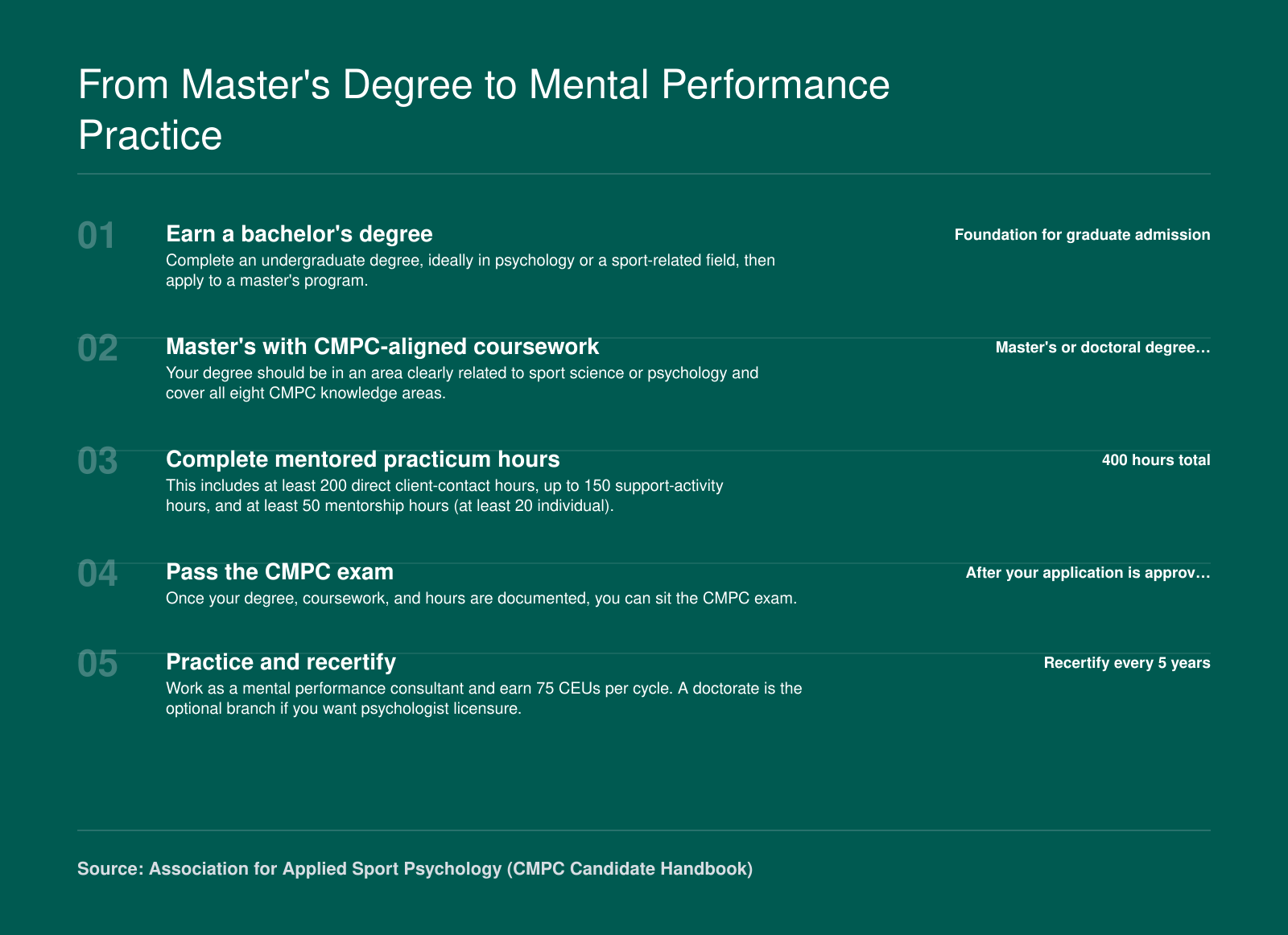
From Master's Degree to Mental Performance Practice
Each step below builds on the one before it, so the program you pick shapes how smoothly you reach certification. Choose a master's with CMPC-aligned coursework and supervised practicum access, and the later hour and exam requirements become far easier to meet.
Sport Psychology Master's in California: Your Questions Answered
Quick answers to the questions prospective students ask most about sport psychology master's programs in California. Details such as tuition, program length, and admissions policies can change, so confirm them with each school before applying.
Which school ranks first for a sport psychology master's in California?
What is the most affordable sport psychology master's program in California?
Can I earn a sport psychology master's online while living in California?
Do California sport psychology master's programs require the GRE?
Will a sport psychology master's qualify me for CMPC certification?
How long does a sport psychology master's take to finish, full-time vs. part-time?
Compare Sports Psychology programs on the data that matters
Explore more Psychology specializations or browse every graduate field.
All Psychology programs