Accelerated MHA Programs
Compare 1,100+ accredited fastest Health Administration (MHA) programs at 650+ schools, with graduate earnings, cost, debt, and completion data from IPEDS and the U.S. College Scorecard.

A traditional MHA takes about two years of full-time study. Several programs here finish in 12 to 16 months, which suits a working professional who can't step away from a management or clinical role.
The ranked list comes first, then cost, format, admissions, and earnings, with direct answers on program length, total cost, and CAHME accreditation.
Speed and price don't track each other. Institution-level net prices run from $3,033 at Baruch College to $44,338 at Fordham, and Fordham's one-year program sits at the top of that range.
Key Points
- LSU Shreveport's 30-credit MHA finishes in about 12 months full time.
- CUNY Baruch is among the lowest net price schools here.
- One-year median earnings for Baruch MHA graduates hit $128,189.
10 Accelerated MHA Programs Ranked by Speed to Completion
These ten programs reward students looking for the shortest credible route to a healthcare leadership degree, ordered by how quickly a full-time learner can realistically move from enrollment to graduation. We gave the most weight to one-year and other accelerated formats, then compared published graduate tuition and net price so cost stays visible next to speed.
Yale University
#1New Haven, CT · ~$50,000/yr (est.)
Best for: Ivy-bound dual-degree candidates
Yale's accelerated joint MBA/MPH in health care management is built for students who want both management and public health credentials on a fast timeline, with the 22-month sequence starting each summer. The curriculum requires 52 School of Management course units and 14 School of Public Health units, including a healthcare leadership colloquium and international experience. Published graduate tuition and fees are $67,250 for both in-state and out-of-state students, and Yale reports a 95.7% graduation rate institution-wide.
- 22-month joint MBA/MPH completion
- Starts with an intensive summer session
- 52 SOM units plus 14 YSPH units required
- Required health care management practicum
University of Southern California
#2Los Angeles, CA · ~$72,000/yr (est.)
Best for: Aspiring Los Angeles health system leaders
USC's Price School MHA pairs a policy, finance, operations, and information technology core with a required 1,000-hour residency in hospitals, clinics, or health startups. The program reports a 97% job placement rate, and published graduate tuition and fees are $72,097 for both in-state and out-of-state students. The university's institution-wide graduation rate is 91.8%.
- 1,000-hour residency required
- 97% job placement rate reported
- Dual degree option with gerontology
- Curriculum spans policy, finance, operations, IT
University of Florida
#3Gainesville, FL · ~$13,000/yr (est.)
Best for: Budget-conscious Florida residents
The University of Florida's MHA offers a full-time residential track and a weekend hybrid option, with learning opportunities inside the integrated UF Health system. In-state graduate tuition and fees are $6,381; out-of-state students pay $28,659. The university reports a 91.1% graduation rate institution-wide.
- Full-time residential and weekend hybrid options
- Integrated UF Health system experience
- 100% employment rate within three months
- Average starting salary $70,000
Boston College
#4Chestnut Hill, MA · ~$38,000/yr (est.)
Boston College's 36-credit MHA uses seven-week asynchronous courses and optional concentrations in artificial intelligence and human flourishing, plus sports and restorative health leadership. A one-year accelerated option and rolling admissions make it flexible for working professionals. Published graduate tuition and fees are $70,702 for both in-state and out-of-state students, and the institution reports a 90.8% graduation rate.
- 36 total credit hours
- Two optional concentrations
- Seven-week asynchronous course format
- One-year accelerated option
- Capstone with external clients
CUNY Bernard M Baruch College
#5New York, NY · $11,000 – $21,000/yr (est.)
Baruch's Executive MBA in Healthcare Administration is an accelerated part-time cohort program completed in four semesters, about 22 months, through the Zicklin School of Business. The curriculum blends core business disciplines with healthcare strategy, finance, operations, and policy. In-state graduate tuition and fees are $7,464, out-of-state $15,414, and the college reports a 72.1% institution-wide graduation rate.
- Four-semester accelerated cohort
- Complete in about 22 months
- Part-time executive format
- Healthcare strategy, finance, operations focus
- New York City healthcare network access
Fordham University
#6Bronx, NY · ~$27,000/yr (est.)
Fordham's Master of Science in Health Administration is a one-year, 31-credit cohort program that meets biweekly on weekends at the Lincoln Center campus, with online instruction and intensives in between. The program lists CAHME accreditation, but a 2026 report notes the program was on probation, so confirm current status directly with CAHME. Published graduate tuition and fees are $64,915 for both in-state and out-of-state students, and Fordham reports an 81.9% institution-wide graduation rate.
- One-year, 31-credit, 14-course sequence
- Biweekly weekend classes at Lincoln Center
- Yearlong case study and mentored capstone
- Complimentary ACHE student membership
- Verify current CAHME status directly with CAHME
College of Our Lady of the Elms
#7Chicopee, MA · ~$18,000/yr (est.)
Elms College's MBA in Healthcare Leadership is a 36-credit program delivered in eight-week courses, with a 14-month completion timeline for busy professionals. The curriculum blends managerial finance, data analysis, and strategic management with healthcare budgeting, operations, human capital, and information systems. Published graduate tuition and fees are $43,325 for both in-state and out-of-state students, and Elms reports a 68.1% institution-wide graduation rate.
- 14-month completion timeline
- Eight-week accelerated courses
- 36 total credit hours
- Healthcare Leadership concentration
- Small class sizes and faculty mentorship
Elizabethtown College
#8Elizabethtown, PA · ~$37,000/yr (est.)
Elizabethtown College's MBA offers a Healthcare Administration concentration and can be completed in one year full-time or two-plus years part-time. The program includes practical case studies and electives focused on health information systems or human resources. Published graduate tuition and fees are $37,950 for both in-state and out-of-state students, and the college reports a 76.2% institution-wide graduation rate.
- Healthcare Administration concentration
- One-year full-time or part-time options
- 36 total credit hours
- Health information systems or HR electives
- Practical case studies throughout
University of North Carolina Wilmington
#9Wilmington, NC · $8,000 – $24,000/yr (est.)
UNCW's Master of Healthcare Administration is a 48-credit program that students meeting preferred admission requirements can finish in as little as one year, with part-time students allowed up to five years. The curriculum includes a capstone and two practicum courses, and up to 12 transfer credits may be accepted. In-state graduate tuition and fees are $7,277, out-of-state $24,152, and UNCW reports a 70.6% institution-wide graduation rate.
- 48-credit curriculum
- Finish in one year with preferred admission
- Part-time completion allowed up to five years
- Capstone plus two practicum courses
- Up to 12 transfer credits accepted
- Seven-week course format available
University of Illinois Chicago
#10Chicago, IL · ~$18,000/yr (est.)
UIC's Master of Healthcare Administration is a 40-credit, 13-course program delivered in eight-week terms, with a 16-month full-time timeline and part-time options. The curriculum covers healthcare finance, population health, strategic planning, and operational leadership. In-state graduate tuition and fees are $14,338, out-of-state $29,884, and UIC reports a 61.6% institution-wide graduation rate.
- 40 total credit hours
- 13 courses plus capstone
- Eight-week accelerated terms
- 16-month full-time timeline
- Healthcare finance, population health, operations focus
Cost & outcomes by school
Federal data for the highest-earning Health Administration (MHA) programs, independent of the ranking above. Earnings are this field's master's graduates four years after completing, where the Scorecard reports them.
| School | Earnings | Tuition / yr | Debt | Grads/yr | Format |
|---|---|---|---|---|---|
| Western Governors University UT | — | $9,320 | — | 50,258 | Online |
| Plaza College NY | — | $21,450 | — | — | Campus |
| Louisiana State University-Shreveport LA | — | $7,349 | — | 6,496 | Online |
| Southeastern Oklahoma State University OK | — | $5,220 | — | 2,478 | Online |
| Fitchburg State University MA | — | $6,246 | — | 2,418 | Online |
| East Texas A&M University TX | — | $7,338 | — | 3,020 | Hybrid |
| University of West Alabama AL | — | $6,868 | — | 2,222 | Online |
Sources: U.S. Department of Education. Tuition and graduates: IPEDS. Earnings and debt: College Scorecard, this field's master's graduates; a dash means no figure is reported.
How Long Does an Accelerated MHA Take? Full-Time, Part-Time, and BS/MHA Timelines
Most full-time accelerated MHAs take 12 to 19 months and require roughly 30 to 45 credit hours. Still, "accelerated" is a school-specific label, not a standard format. LSU Shreveport's 30-credit program runs about 12 months full time, while IU Indianapolis asks for 42 credits over 18 months.
Accelerated vs. Traditional and Part-Time Pacing
Traditional MHAs usually carry heavier credit loads over two years. UAMS requires 51 credits across 24 months, and the University of Missouri's 2026-2027 catalog lists 54 credits. Short terms alone don't guarantee speed: Wayne State uses 7-week accelerated courses, yet its 40-credit program still runs 24 to 27 months.
The same accelerated curriculum also stretches when you slow down. At LSU Shreveport, the 12-month estimate assumes four 7-week courses per semester. Taking two at a time pushes completion to about 18 months. Part-time students at IU Indianapolis finish in 2 to 3 years online or 2 to 5 years in person. George Washington spells out three pathways: 24 months accelerated, 30 months standard, and 48 months decelerated.
How BS/MHA Pathways Save a Year
Combined bachelor's-to-master's tracks let undergraduates start graduate coursework early. IU Indianapolis's Accelerated BSHA-MHA finishes both degrees in five years instead of six because the first MHA year replaces final bachelor's courses. Shared credits vary widely, though. Tulane lets seniors take up to 12 graduate credits but counts only 6 toward both degrees, and its MHA still takes about 1.5 to 2 years after graduation.
What Stretches the Clock
- Residencies: Tulane's administrative residency is one reason its timeline depends on more than credit totals.
- Capstones: These projects usually sit at the end of the curriculum, after core courses are complete.
- Sequencing: Prerequisite chains and fixed intakes can limit start dates, so missing one may cost a full term.
Related Articles
Accelerated MHA Program Cost: Where Net Price Runs Lowest
Net price is an institution-wide average after grants and scholarships, so the published per-credit rate is not always the cheapest final bill. Among the lowest-net-price schools in this table are CUNY Bernard M Baruch College, CUNY Lehman College, and University of Florida. Published accelerated and online MHA costs vary widely: University of Illinois Urbana-Champaign lists $575 per credit for 48 credits ($27,792 total), West Coast University lists $795 per credit for 30 credits ($23,850 tuition, or $24,900 to $25,400 with a $1,000 to $1,500 technology fee), Western University of Health Sciences lists $945 per credit for 46 credits ($43,470 tuition, or $49,839 with a $500 technology fee), UCLA lists $950 per credit for 66 credits ($62,700 total), and Dartmouth College lists $81,375 tuition with an $86,183 total program cost including residential fees; on a compressed schedule, total program cost matters more than the per-credit rate because required credit counts, technology or residency fees, and aid eligibility shape what you actually pay.
| School | In-State Tuition | Out-of-State Tuition | Net Price After Aid |
|---|---|---|---|
| CUNY Bernard M Baruch College | $11,452 | $20,882 | $3,033 |
| CUNY Lehman College | $11,570 | $21,000 | $3,148 |
| University of Florida | $12,737 | $30,130 | $6,541 |
Speed only lowers your total cost when the program charges by term or credit load, not when the per-credit price stays fixed.
Seven-Week vs. Eight-Week Terms: What the Weekly Workload Looks Like
Accelerated MHA programs have largely converged on term lengths of seven or eight weeks, but the universities themselves disagree sharply on how much time those compressed courses actually demand.
Terms, Courses, and the Weekly Hours Gap
The standard building block is a 3-credit course run over seven or eight weeks. How many you take per term is what sets your finish date. At MUSC, students typically carry one to two courses per 7-week period (two to four per semester), moving through 49 credits across five semesters. USI's online MHA uses the same 7-week structure: its one-year option stacks two courses per bi-term, while the two-year track drops to one. UNT Health Fort Worth builds its 48-credit program on 8-week courses and five terms a year, with part-time students taking one class per term and finishing in two to three years.
The weekly hours are where published estimates diverge. MUSC pegs a 3-credit, 7-week course at 15 to 20 hours per week. LSU Shreveport's online MHA estimates 24 to 30 hours for a comparably structured course, roughly double the pace of a 15-week class. Several programs, including the Wayne State MHA curriculum, publish no weekly estimate at all. Take those figures at face value and doubling up to two courses at once implies somewhere between 30 and 60 hours a week, so confirm the real load with a program director before committing.
Matching Format to a Working Schedule
Most of the fastest options here are delivered online and asynchronously, meaning lectures and assignments are posted rather than scheduled live. That flexibility is why full-time employees tend to take one course per session and stretch the degree closer to 18 months. Programs with synchronous or hybrid sessions trade some of that flexibility for live interaction.
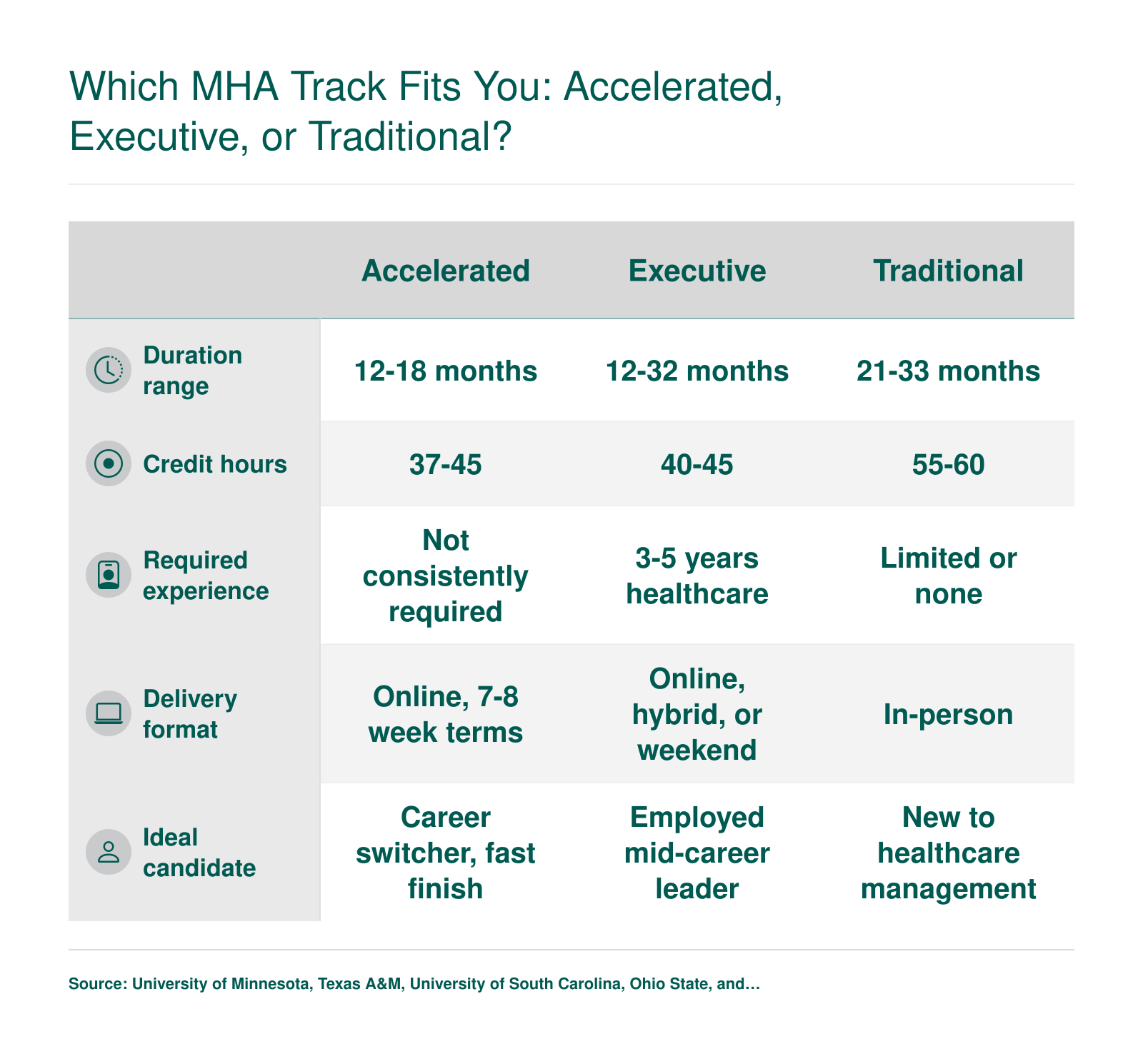
Which MHA Track Fits You: Accelerated, Executive, or Traditional?
The fastest route depends on experience. Accelerated options compress coursework for quick completion, executive tracks acknowledge years of healthcare leadership, and traditional paths build management skills from the ground up.
What Admissions Committees Expect: Standalone vs. BS/MHA Pathways
- GPA and BS/MHA entryStandalone floors in the programs below range from 2.75 to 3.25; several ask 3.0, and La Verne sets no formal minimum but expects graduate-level ability. For the documented BS/MHA 4+1, La Verne opens eligibility after 90 undergraduate semester units.
- GRE/GMAT and waiversMost programs here do not require a test; VCU waived the GRE/GMAT for the 2025–2026 cycle. Weber State offers a waiver with five or more years of healthcare or management experience.
- Work experienceStandalone applicants may face a 1–2 year preference, and UMass Amherst requires two years of healthcare experience. BS/MHA entrants generally need none, advisor approval and strong grades carry the application.
- Prerequisites and application materialsUIW lists no prerequisite courses and no required major; where quantitative work is light, statistics, accounting, or economics can help. Include a résumé, statement of purpose, and recommendations.
First-Year Earnings Snapshot
One year after completing the program, Baruch graduates' median earnings reached $128,189.
Health Administration (MHA) programs by state
Accelerated MHA Questions Applicants Ask Most
These are the questions prospective students ask most before committing to an accelerated MHA. Short answers follow, with deeper comparisons in the timeline and cost sections below.
How long does an accelerated MHA take?
How much does an accelerated MHA program cost?
Can I complete an accelerated MHA online while working full time?
Do accelerated MHA programs require the GRE or GMAT?
What is the difference between an accelerated MHA and an executive MHA?
Do 1-year online MHA programs hold CAHME accreditation?
Is an accelerated MHA viewed differently by healthcare employers?
Compare Health Administration (MHA) programs on the data that matters
Explore more MHA specializations or browse every graduate field.
All MHA programs