Most Affordable MHA Programs
Compare 1,100+ accredited most affordable Health Administration (MHA) programs at 650+ schools, with graduate earnings, cost, debt, and completion data from IPEDS and the U.S. College Scorecard.

Published graduate tuition for an MHA runs from under $5,000 a year in-state at Florida Atlantic University to roughly $30,000 out of state, and the sticker figure rarely matches what a student pays. Program fees, technology charges, and unpaid administrative residencies all sit outside the tuition line.
The harder comparison is cost against outcome. CAHME accreditation, credit count, and graduate earnings vary sharply among low-priced programs: Baruch College's health care administration graduates reported median earnings of $128,189 one year out, while graduates elsewhere land closer to $50,000.
Affordable means little until you know the credit total, the residency requirement, what that specific program's graduates earn, and whether it's among the best MHA programs no GRE or GMAT.
Key Points
- Texas A&M University-Central Texas posts an average net price of $1,300.
- CUNY Baruch College graduates earn a median $128,189 one year after finishing.
- Health services managers face 24% job growth from 2025 to 2035.
The 10 Most Affordable MHA Programs for 2027
These 10 programs stand out for pairing manageable graduate tuition with solid completion signals and flexible formats. We looked at in-state and out-of-state costs, graduation rates, and delivery options, then highlighted the specific details that make each a value pick. The entries below are ordered from most to least affordable within this comparison.
Texas A&M University-Central Texas
#1Killeen, TX · $5,000 – $10,000/yr (est.)
Best for: Working adults needing online healthcare MBA
Texas A&M University-Central Texas offers an MBA with a Healthcare Administration concentration built on 36 credit hours of business core and specialized healthcare courses. Students take courses in healthcare systems, strategic planning and financial management, policy, law and ethics, and health informatics. The curriculum closes with a Business Strategy Seminar capstone, and leveling is available for students without a business background.
- 36 total credit hours
- 11 concentration options
- Healthcare systems and administration foundations
- Strategic planning and financial management
- Healthcare policy, law, and ethics
- Health informatics and data analytics
- Business Strategy Seminar requires minimum B
CUNY Bernard M Baruch College
#2New York, NY · $11,000 – $21,000/yr (est.)
Best for: New Yorkers seeking part-time executive MBA
Baruch College's Executive MBA in Healthcare Administration is an accelerated part-time program designed for experienced professionals aiming for leadership roles. The four-semester cohort format blends business strategy, finance, operations, and policy with healthcare-specific decision-making. New York residents can access lower CUNY resident tuition rates, and the program is housed in the Zicklin School of Business.
- Four-semester accelerated program
- Complete in 22 months
- Part-time enrollment available
- Executive cohort model
- Develops analytical and decision-making skills
- Current healthcare industry knowledge
California State University-Los Angeles
#3Los Angeles, CA · ~$9,000/yr (est.)
Best for: Experienced clinicians seeking campus leadership training
Cal State LA's Master of Science in Healthcare Management has prepared healthcare administrators since 1975. The 36-unit program covers leadership, financial decision-making, healthcare law and ethics, information governance, and strategic innovation. Students benefit from executive guest lectures and access to the American College of Healthcare Executives network.
- 36 total credit hours
- 2.5 GPA minimum
- Work experience required
- Frequent executive guest lectures
- American College of Healthcare Executives network involvement
- Program running since 1975
California State University-San Bernardino
#4San Bernardino, CA · ~$10,000/yr (est.)
California State University-San Bernardino's Master of Science in Health Services Administration blends leadership, health economics, law, strategic planning, and information systems. Students complete a residency or project and may add a certificate in Finance, Accounting, and Information Systems. The program emphasizes diversity, equity, and ethical management while serving the Inland Empire.
- 3.0 GPA minimum
- Administrative residency or project option
- ACHE student chapter membership
- Certificate in finance, accounting, and information systems
- Emphasis on diversity and inclusion
CUNY Lehman College
#5Bronx, NY · ~$12,000/yr (est.)
CUNY Lehman College offers a fully online M.S. in Health Services Administration that can be completed in one year through 7-week courses. The 30-credit, cohort-based program emphasizes health equity, technology, and patient-centered care. Working professionals can balance study with employment, and a 4+1 pathway is available for CUNY undergraduates.
- 30 total credit hours
- 10 total courses
- Complete in one year
- 7-week course schedules
- Synchronous and asynchronous options
- 3.0 GPA minimum
- Work experience required
- 4+1 bachelor's to master's pathway
California State University-Bakersfield
#6Bakersfield, CA · $5,000 – $10,000/yr (est.)
California State University-Bakersfield's Master of Science in Health Care Administration is a 36-credit program focused on evidence-based management for hospitals, clinics, nonprofits, and government agencies. Students complete an applied research thesis and, when needed, an internship or practicum. Rolling admissions and conditional admission options make the program accessible for applicants with lower GPAs.
- 36 total credit hours
- Rolling admissions
- 2.8 GPA minimum
- Thesis required
- Internship for students without healthcare experience
- Conditional admission available
Florida International University
#7Miami, FL · ~$11,000/yr (est.)
Florida International University's CAHME-accredited Master of Health Services Administration prepares leaders through a 48-credit curriculum that includes Lean Six Sigma and a final capstone or internship. The program offers an 18-month hybrid format and a 24-month fully online option with identical courses. Small hybrid cohorts and no entrance exam requirement support a direct path to healthcare leadership.
- CAHME accredited
- 48 total credit hours
- 18-month completion option
- No entrance exam required
- Lean Six Sigma methodologies covered
- Culminating capstone or internship
University of Florida
#8Gainesville, FL · ~$13,000/yr (est.)
The University of Florida's Master of Health Administration combines a rigorous health services and business curriculum with direct exposure to the UF Health system. Students can choose full-time residential or weekend hybrid formats, and the program is CAHME accredited. A network of more than 1,000 alumni supports early careerists entering healthcare management.
- CAHME accredited
- Full-time and part-time options
- Integrated UF Health system
- Weekend hybrid option
- More than 1,000 alumni network
- Prepares for management and leadership roles
Florida Atlantic University
#9Boca Raton, FL · $7,000 – $18,000/yr (est.)
Florida Atlantic University's Master of Health Administration is an AACSB and SACS accredited program taught in person on the Boca Raton campus. The 30- to 31-hour curriculum covers healthcare systems, finance, law, policy, and quality management, with internships for most students. A Provost Fellowship provides merit tuition funding to two incoming candidates.
- AACSB and SACS accredited
- 31 total credit hours
- Full-time and part-time options
- Internship waived for experienced managers
- Daytime classes on Boca Raton campus
- Provost Fellowship for two incoming students
American Public University System
#10Charles Town, WV · $5,000 – $10,000/yr (est.)
American Public University System's Master of Science in Healthcare Administration is an online, 40-credit program built around leadership, business acumen, and healthcare systems competencies. Students study healthcare finance, operations, legal and ethical issues, human resources, and technology applications. A capstone project integrates the curriculum for mid-management roles.
- 40 total credit hours
- 2.8 GPA minimum
- Capstone project required
- Three competency domains: leadership, business, healthcare systems
- No GMAT requirement
- Prepares for mid-management roles
Cost & outcomes by school
Federal data for the highest-earning Health Administration (MHA) programs, independent of the ranking above. Earnings are this field's master's graduates four years after completing, where the Scorecard reports them.
| School | Earnings | Tuition / yr | Debt | Grads/yr | Format |
|---|---|---|---|---|---|
| Albright College PA | — | $1,540 | — | 96 | Online |
| University of the Cumberlands KY | — | $3,195 | — | 8,772 | Online |
| Columbia Southern University AL | — | $3,936 | — | 4,312 | Online |
| Park University MO | — | $4,783 | — | 916 | Online |
| Fort Hays State University KS | — | $4,949 | — | 1,544 | Campus |
| Albany State University GA | — | $5,008 | — | 344 | Campus |
| Southeastern Oklahoma State University OK | — | $5,220 | — | 2,478 | Online |
| Fitchburg State University MA | — | $6,246 | — | 2,418 | Online |
| Valdosta State University GA | — | $6,316 | — | 2,018 | Online |
| American College of Education IN | — | $6,600 | — | 9,876 | Online |
| Georgia Southern University GA | — | $6,646 | — | 2,464 | Hybrid |
| Florida Atlantic University FL | — | $6,693 | — | 3,718 | Campus |
Sources: U.S. Department of Education. Tuition and graduates: IPEDS. Earnings and debt: College Scorecard, this field's master's graduates; a dash means no figure is reported.
What Earned a Spot: Net Price, Completion, and Graduate Outcomes
Texas A&M University-Central Texas lists in-state tuition and fees of $7,363, yet the average net price in its federal data is $1,300. That gap is why a low sticker price is not the same as a low real cost, and why these schools are judged on what students actually pay.
What Counts Most
Net price and financial aid carry the most weight, because they show what a typical student pays once grants and scholarships are subtracted, the core of MHA program cost and ROI. Supporting that are graduation rates, plus program-level earnings and debt wherever the federal government publishes them. Several programs here have no published earnings or debt figures, so those schools are judged on cost and completion alone.
Limits Worth Knowing
Two caveats matter when you read the numbers:
- Graduation rates: These cover the whole institution, not the MHA specifically, so treat them as a signal of how well a school keeps students enrolled.
- Net price: This is an average for the school's sector, not a personal quote. Your own aid offer, residency status, and credit load will move the number.
Why Not Tuition Alone?
A tuition-only ranking rewards whichever school posts the lowest sticker price among affordable online MHA programs, even if aid is thin, students leave without finishing, or graduates carry heavy debt. Pairing cost with aid and outcomes gives you a more honest comparison.
All figures in this MBA healthcare administration tuition comparison come from the College Scorecard and federal graduate tuition data, using the latest available snapshot.
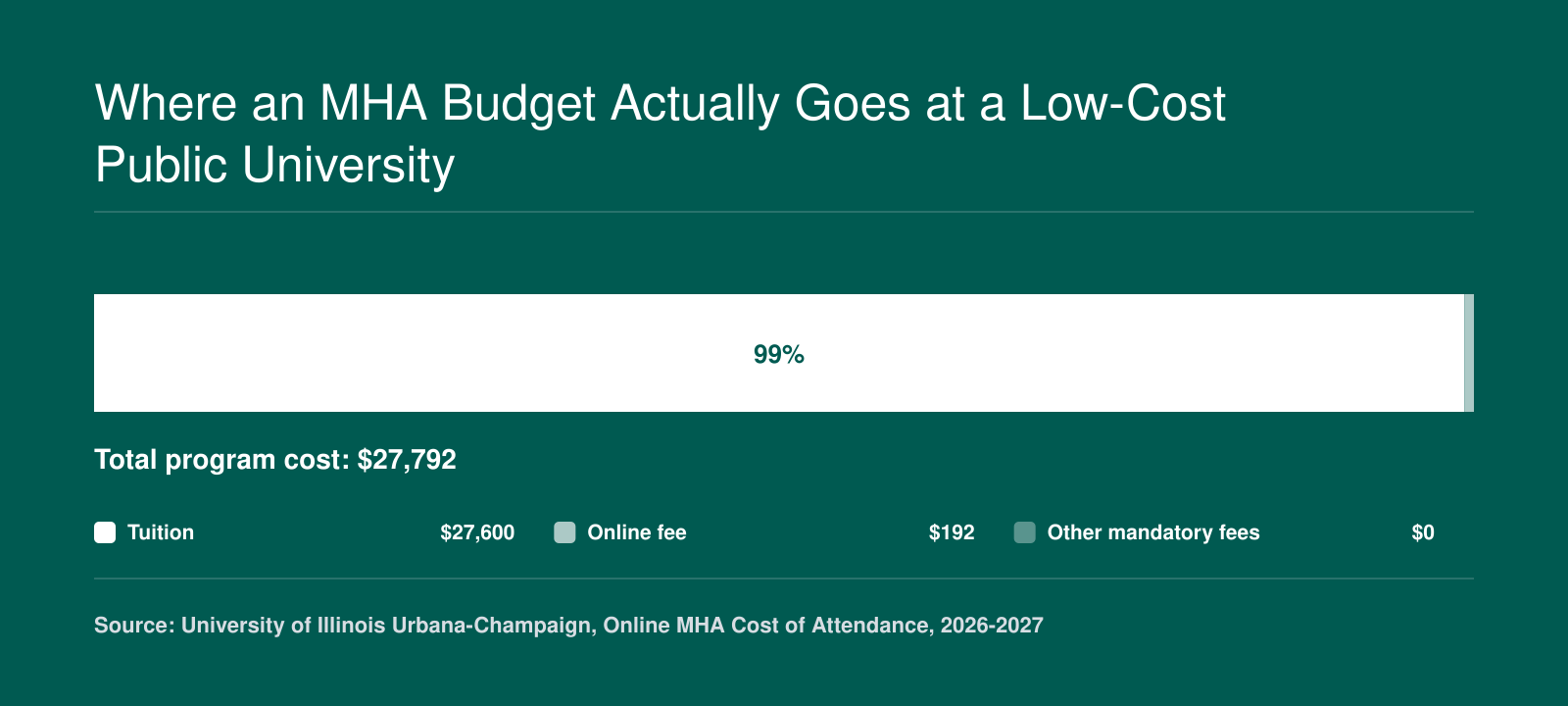
Where an MHA Budget Actually Goes at a Low-Cost Public University
At the University of Illinois Urbana-Champaign, the 2026-2027 online MHA lists $575 per credit, but the full 48-credit program costs $27,792 once the $4-per-credit online fee is added. Per-credit tuition alone understates the real bill.
Sticker Price or Net Price? Reading MHA Costs the Right Way
Some online MHA programs advertise one flat per-credit rate for every student, while others publish separate resident and nonresident schedules that can more than triple the bill. Knowing which model a program uses before you apply is the first real cost step.
Sticker tuition vs. net price
Sticker tuition is the published graduate rate. Net price is what students pay after grants. That distinction matters, but graduate students should not expect the same grant aid undergraduates receive; many master's students rely more heavily on loans, employer reimbursement, or savings than on Pell-style grants. A school's published net price is an institution-wide average, so treat it as a helpful approximation, not your specific MHA quote.
How residency changes the math
At Texas A&M University-Central Texas, published in-state graduate tuition runs about $6,242, while out-of-state tuition is roughly $13,586. By contrast, Louisiana State University-Shreveport lists about $7,349 for both groups, so residency does not change its base tuition. The same contrast appears among named online programs: Wichita State charges $367.92 per credit regardless of state, while University of West Florida lists $385.85 in state and $1,144.43 full out of state before waiver options.
What to request before committing
Some public campuses charge flat e-tuition for online MHA students, but fees may still vary. Ask the program for a written cost-of-attendance sheet covering the MHA specifically: per-credit rate, mandatory fees, tech charges, and any nonresident surcharge. That single document keeps sticker prices from becoming surprises.
Related Articles
Which Low-Cost MHA Programs Hold CAHME Accreditation
Which CAHME accredited affordable MHA programs actually keep tuition low?
What CAHME accreditation signals
CAHME accredits individual graduate programs, not entire universities. Employers and hospital administrative fellowships often treat CAHME as shorthand that a program's curriculum, faculty, and fieldwork meet the field's standards. Some fellowships favor or require CAHME graduates, so checking status matters before you commit.
Accredited names at public-university prices
Several lower-cost public programs currently hold accreditation or candidacy. UAB, Texas Woman's University, and UCF are accredited. Ohio State was reaccredited in 2026 for seven years with no progress report required. UIUC received initial accreditation in 2026 for four years, and IU Indianapolis was reaccredited for eight years. Governors State and Des Moines University also hold 2026 accreditation actions; Des Moines is initially accredited for three years. Not every affordable MHA holds CAHME accreditation, and that is the tradeoff: solid affordable master's programs may rely on regional accreditation alone, which can still be fine for many roles but may close some fellowship doors.
Candidate is not accredited
A.T. Still University appears in CAHME's online non-executive part-time category as a candidate, not fully accredited. Candidate means the program is inside CAHME's process, with no final Board decision yet. Do not call it CAHME-accredited unless the directory separately shows an accreditation decision.
How to verify status yourself
Go to the CAHME program directory and check exact degree, format, and campus. A university may have one accredited MHA while its online MHA programs, executive MHA, or concentration-based MHA is not covered. As of September 2026, CAHME listed 143 programs at 105 schools, with 56 online. Use the directory's accredited versus candidate labels rather than a school's marketing page. Western Governors University was not on CAHME's accredited-program list as of September 2026, so verify before assuming a well-known online name carries the mark.
The Bureau of Labor Statistics projects employment for medical and health services managers to grow 24% from 2025 to 2035, with about 62,300 job openings each year over that period. That consistent demand makes an affordable MHA a practical bet on a stable healthcare leadership career.
Graduate Earnings and Loan Payments at Low-Cost MHA Schools
Graduates of CUNY Baruch College's Health Care Administration master's reported median earnings of $128,189 one year after finishing, $140,615 at four years, and $169,078 at five. That is the highest earnings trajectory among the affordable programs here, and it comes paired with median program debt of $47,411 and a reported 10-year monthly payment of $539.
Where the Earnings Land
The University of Florida's MHA shows $67,497 one year out, climbing to $107,445 at four years and $105,472 at five. The University of South Florida's MHA reports $93,064 four years after completion. The University of Central Florida lands at $97,350 at four years and $87,158 at five, while Cal State LA's healthcare management master's shows $90,351 at four years. Florida Atlantic graduates reach $86,396 at four years, and the University of North Florida reports $84,976 at the same mark.
Reading Debt Against Pay
The debt side is where several of these programs separate themselves. LSU Shreveport's online MHA carries median program debt of $25,179 and a 10-year monthly payment of $286 against five-year earnings of $84,169, one of the tightest debt-to-earnings ratios at this price point. Cal State LA reports $32,050 in median debt and a $365 monthly payment; North Florida, $32,750 and $373; Florida Atlantic, $33,180 and $377. UCF sits higher at $48,000 and $546 a month, and UF at $54,485 and $620. USF does not publish program-level debt figures.
Size and Placement Context
LSU Shreveport is by far the largest producer here, with 411 completions in the reporting year and full employment among graduates a year out. North Florida (62) and UCF (57) are mid-sized. Baruch (19), USF (12), and Clayton State (21) run small cohorts, which makes their earnings figures worth reading as directional rather than definitive.
Health Administration (MHA) programs by state
Your Questions on Cost, Admissions, and Program Speed
Cost questions drive most MHA decisions. These short answers cover fees, residencies, test waivers, online pacing, executive formats, and accreditation tradeoffs so you can compare affordable programs without oversimplifying.
What is the realistic all-in cost of a low-tuition MHA once fees and residencies are added?
Can I get into an affordable MHA program without healthcare work experience or GRE scores?
Are there fully online, asynchronous MHA programs with no campus visits?
Is a 1-year or accelerated online MHA cheaper overall than a traditional two-year track?
How does an executive MHA differ from a traditional MHA in price and prerequisites?
Does choosing a non-CAHME program limit job prospects?
Compare Health Administration (MHA) programs on the data that matters
Explore more MHA specializations or browse every graduate field.
All MHA programs