Best Master's in Technical Communication Programs
Compare 30+ accredited Technical Communication programs at 20+ schools, with graduate earnings, cost, debt, and completion data from IPEDS and the U.S. College Scorecard.

A master's in technical communication trains writers to turn complex software, equipment, and processes into documentation, interfaces, and instructions people can follow. Programs go by technical communication, technical writing, or professional writing, and the label says little about cost or outcomes.
Listed in-state tuition runs from about $7,800 at Utah State University to nearly $30,000 at the University of San Francisco. Formats vary: UCF, North Texas, and Utah State are online master's in communication programs, Missouri S&T and Minnesota State are hybrid, and NC State and Auburn are campus-based.
A nearly fourfold price gap for a similar credential is the central tradeoff.
Key Points
- New Mexico State, UCF, and Houston-Downtown post the lowest listed tuition here.
- Most degrees require 30 to 36 credits, about two years full-time.
- Program-level graduate earnings are not yet published, so compare costs carefully.
The 10 Best Master's in Technical Communication Programs
A technical communication master's earns its place here when it combines reasonable cost, flexible delivery, and a clear path to technical writing, UX, or information design work. The programs below stand out for what they do after the classroom, from funded assistantships and internships to alumni networks at major technology employers. Use this list as a shortlist, not a final verdict: the right program is the one whose format and price fit your current life.
North Carolina State University at Raleigh
#1Raleigh, NC · $12,000 – $33,000/yr (est.)
Best for: Working professionals seeking a campus cohort
NC State pairs a rigorous M.S. in Technical Communication with unusual access to Research Triangle employers and cross-campus electives. The 33-hour program lets you shape electives around web design, UX, software documentation, or medical communication, while small evening cohorts and funded assistantships make it practical for working students. Alumni land at IBM, Lenovo, SAS, and Red Hat.
- 33 credit hours with 18 hours of electives in UX, web design, and medical writing
- Evening classes with a small cohort of 10 to 20 students
- Fully funded graduate teaching assistantships available
- IBM Pathfinder mentoring program
- Inter-institutional electives at Duke and UNC-Chapel Hill
- Internship course with 120 field hours
- Alumni at IBM, Lenovo, SAS, and Red Hat
University of Central Florida
#2Orlando, FL · ~$9,000/yr (est.)
Best for: Online learners wanting affordable Florida options
UCF's fully online English M.A. with a technical communication track is built for affordability and schedule flexibility, with full-time or part-time options and thesis or capstone choices. The curriculum blends technical writing, visual design, usability, and ethics, and award-winning faculty lead courses. Graduates pursue technical writing, information design, web development, and UX roles.
- Fully online 33-credit-hour curriculum
- Thesis or non-thesis capstone options
- Full-time or part-time enrollment
- Spring and fall start dates
- $369.65 per credit hour
- Career paths in technical writing and UX
Auburn University
#3Auburn, AL · $13,000 – $34,000/yr (est.)
Best for: In-state students wanting a portfolio-based curriculum
Auburn offers Alabama's only technical and professional communication master's, with a practical mix of writing, editing, web development, document design, and project management. The 32-credit program substitutes an academic portfolio and oral exam for a thesis, and an internship elective supports real-world application. Faculty bring both academic and industry experience, and students join professional development through conferences and publishing.
- 32 credit hours across 11 courses
- Requires an academic portfolio and oral exam, not a thesis
- Internship course available
- Only technical and professional communication master's in Alabama
- Faculty with academic and workplace experience
- Professional development through conferences and publishing
University of San Francisco
#4San Francisco, CA · ~$30,000/yr (est.)
San Francisco's professional communication M.A. with a technical communication concentration emphasizes translating complex scientific and technical information into user-friendly content. Evening courses and a 32-unit curriculum with a hands-on capstone fit working professionals in tech, healthcare, and engineering. Students choose a portfolio, research paper, or work-related project to close the degree.
- 32-credit-hour curriculum with a technical communication concentration
- Weekday evening classes at 6 p.m.
- Full-time two-year format
- Capstone portfolio, research paper, or work-related project
Missouri University of Science and Technology
#5Rolla, MO · ~$15,000/yr (est.)
Missouri S&T blends communication theory with its engineering and science identity, preparing students for technical editing, usability, proposal writing, and communication management. The 30- to 33-credit master's offers thesis or non-thesis paths and can be completed online or on campus, with a one-year option for focused students. Graduates step into technical writer, editor, usability specialist, and communication manager roles.
- 30 to 33 credit hours with thesis or non-thesis tracks
- Available online or on campus
- Courses in usability, technical editing, and proposal writing
- Designed to finish in as little as one year
- Financial aid and scholarships available
University of North Texas
#6Denton, TX · $9,000 – $16,000/yr (est.)
UNT houses its program in a dedicated Department of Technical Communication, yielding a practice-heavy online M.A. that covers UX research, content strategy, digital literacies, and XML. The 30-credit program includes an internship at a major organization and a professional portfolio, and reports a 100% job placement rate with alumni at AT&T, Apple, and Microsoft. Students can also earn a Graduate Academic Certificate in Teaching Technical Writing.
- 30-credit online program, one to two years
- 100% job placement rate reported
- Internship at a major organization
- Professional portfolio for review
- Graduate Academic Certificate in Teaching Technical Writing option
- Alumni at AT&T, Apple, and Microsoft
Mercer University
#7Macon, GA · ~$15,000/yr (est.)
Mercer's online M.S. in Technical Communication Management is distinct for its School of Engineering home and managerial focus, preparing you to lead teams and direct communication strategy rather than only produce content. The practice-oriented curriculum uses real-world projects that transfer directly to current jobs, and the program has graduated more than 200 students since 1997. It is designed for working professionals who can complete flexible online study in about two years.
- Fully online, management-focused technical communication master's
- Housed in the School of Engineering
- Practice-oriented coursework with real-world projects
- Complete in as little as two years
- Ranked fourth among online communication master's programs
- 200+ graduates since 1997
Utah State University
#8Logan, UT · $8,000 – $25,000/yr (est.)
Utah State's online Master of Technical Communication combines asynchronous coursework with no out-of-state tuition, making it unusually accessible for working professionals nationwide. The curriculum spans social media technologies, editing, inclusive communication, and ethical writing, with opportunities at Logan and statewide campuses. Graduates move into technical editing, social media management, grant writing, and usability roles.
- Fully online asynchronous format
- No out-of-state tuition
- Part-time scheduling available
- Available at Logan and statewide campuses
- Covers social media, editing, inclusive communication, and ethics
Texas State University
#9San Marcos, TX · ~$9,000/yr (est.)
Texas State's online M.A. in Technical Communication offers thesis and internship tracks in a 30-credit, 10-course structure with no GRE requirement. The program pairs a humanities-based curriculum with a state-of-the-art usability lab, and alumni work at Google, Microsoft, Dell, and Tesla. Competitive out-of-state tuition and full-time or part-time enrollment make it a flexible option for career changers and future doctoral students.
- No GRE required
- 30 credit hours and 10 courses
- Thesis and internship tracks available
- State-of-the-art usability lab
- Alumni at Google, Microsoft, Dell, and Tesla
- Competitive out-of-state tuition
- Optional minor
- Thesis required
- Starts fall and spring
- Humanities-based interdisciplinary curriculum
- 2.8 GPA minimum
- Portfolio submission required
- Financial aid and scholarships available
- No thesis or capstone required
- Rolling admissions
- Full-time and part-time options
- $55 application fee
Minnesota State University-Mankato
#10Mankato, MN · $10,000 – $20,000/yr (est.)
Minnesota State Mankato's technical communication M.S. emphasizes writing, editing, visual design, and user experience, with a 32-credit hybrid format that includes synchronous and asynchronous options. Rolling admissions and no GRE requirement invite candidates from varied backgrounds, while most course readings are free to reduce costs. Graduates pursue technical writing, UX design, and documentation specialist roles or continue to doctoral study.
- 32 credit hours, typically completed in two years
- Hybrid format with synchronous and asynchronous options
- Rolling admissions with no GRE required
- Three start dates each year: fall, spring, and summer
- Most readings and textbooks free
- No letter of recommendation minimum
Cost & outcomes by school
Federal data for the highest-earning Technical Communication programs, independent of the ranking above. Earnings are this field's master's graduates four years after completing, where the Scorecard reports them.
| School | Earnings | Tuition / yr | Debt | Grads/yr | Format |
|---|---|---|---|---|---|
| Texas Tech University TX | $81,195 | $9,518 | $22,489 | 46 | Online |
| Arizona State University AZ | $76,478 | $10,843 | $44,159 | 24 | Hybrid |
| Arizona State University AZ | $76,478 | $13,587 | $44,159 | 28 | Hybrid |
| Drexel University PA | $70,518 | $39,261 | — | 16 | Campus |
| New Mexico State University NM | — | $6,605 | — | — | Online |
| Tarleton State University TX | — | $7,527 | — | — | Campus |
| Utah State University UT | — | $7,828 | — | — | Online |
| University of North Carolina at Charlotte NC | — | $8,037 | — | — | Campus |
| University of Central Florida FL | — | $8,872 | — | — | Online |
| Sam Houston State University TX | — | $8,954 | — | — | Campus |
| Texas State University TX | — | $8,997 | — | — | Online |
| University of New Mexico NM | — | $9,860 | — | — | Campus |
Sources: U.S. Department of Education. Tuition and graduates: IPEDS. Earnings and debt: College Scorecard, this field's master's graduates; a dash means no figure is reported.
Cost, debt & payoff
Median earnings of this field's master's graduates (4 yrs after completing) vs. their median federal loan debt · U.S. College Scorecard
Across these programs the median graduate earns about $76,478 and finishes with roughly $44,159 in debt — a ratio that clears a common rule of thumb (keep debt below first-year salary). Tuition and debt vary widely school to school, so check the per-school figures in the table above before you shortlist.
Behind the List: What Earned a Program Its Spot
A program earns a place here by showing what it costs you and what it returns, not by how famous its name is.
The Factors That Matter
The list leans on practical measures a prospective student can actually use:
- Tuition: Graduate tuition for the master's itself, not undergraduate sticker prices.
- Net price: The average out-of-pocket cost after grants and scholarships.
- Outcomes: Program-level graduate earnings and debt, where federal figures have been published.
- Completion: The school's overall graduation rate.
- Flexibility: Whether you can finish without relocating. Arizona State, Utah State, and Texas Tech all offer the degree online.
Net price is an institution-wide average that blends many kinds of students; treat it as a benchmark, not a quote. Your real bill depends on residency, credit load, and any assistantship or employer tuition support you secure.
Why Institutional Accreditation Is the Signal
Arizona State University, whose online MS in Technical Communication requires 36 credit hours, is accredited by the Higher Learning Commission (HLC). For schools such as Metropolitan State University and Minnesota State University, Mankato, program pages confirm the degrees but do not state the institutional accreditor, so confirm each one yourself rather than assuming.12
As of 2026, no dedicated programmatic accreditor exists for technical communication master's programs. Unlike nursing, clinical mental health counseling, or speech-language pathology, the field has no discipline-specific seal of approval. That makes institutional (often called regional) accreditation the credential that counts. It governs your eligibility for federal financial aid, whether your credits transfer, and whether employers and doctoral programs will recognize the degree. Membership in a professional society or a standalone technical writing certification is useful, but neither substitutes for accreditation.
Check Before You Apply
Look up any school in the Council for Higher Education Accreditation (CHEA) directory or the U.S. Department of Education's accreditation database. Confirm the accreditor is recognized and the status is current, not on probation. It takes five minutes and protects an investment that can run well into five figures.
Most Affordable Master's in Technical Communication Options
The most affordable options here are public universities, and the resident versus nonresident tuition gap is substantial. University of Central Florida shows the largest spread, $19,785, while University of Houston-Downtown has the narrowest at $6,480. Net price is an institution-wide average, so treat it as an approximate comparison rather than a guaranteed bill.
| School | In-State Tuition | Out-of-State Tuition | Net Price | Format |
|---|---|---|---|---|
| New Mexico State University | $6,605 | $19,448 | $8,889 | Online |
| University of Central Florida | $8,872 | $28,657 | $10,411 | Online |
| University of Houston-Downtown | $10,029 | $16,509 | $10,542 | Campus |
Online vs. On-Campus Tech Comm Master's: Format and Time to Degree
Most technical communication master's degrees run 30 to 36 credit hours and take about two years of full-time study. Arizona State University and Texas Tech University both require 36 credits, and Texas State University's legacy online MA requires 30. The programs on this page include fully online, on-campus, and dual-format options, so the real differences are in pacing, live-session requirements, and how much campus access you need.
| Factor | Online | On-Campus |
|---|---|---|
| Delivery style | Ranges from fully asynchronous to partly live. Arizona State's online MS is entirely online, while Texas Tech's online MA includes synchronous class discussion on one designated weekday each semester. | Scheduled in-person class meetings. Texas Tech's onsite MA parallels its online version except for the medium. |
| Typical credit hours | 30 to 36 credit hours. Arizona State and Texas Tech require 36, and Texas State's Online Legacy MA requires 30. | Generally the same 30 to 36 credit range as the online versions. |
| Full-time completion | About 24 months for most Arizona State online students, with 7.5-week classes. | Usually about two years of full-time study across traditional semesters. |
| Part-time completion | Longer than two years, set by how many courses you take each term. Arizona State notes the timeline depends on course load. | Also longer than two years, but limited by when required courses are offered on campus. |
| Weekly time commitment | Texas Tech's online MA estimates roughly 10 hours per week. | Class time plus study time, tied to a fixed campus schedule. |
| Networking and assistantships | Networking happens through discussion boards, live sessions, and virtual events. Assistantships are generally less common for online students, so confirm with each school. | Easier access to faculty, cohort peers, and campus-based assistantships, where a program offers them. |
| Residency and tuition considerations | Some online programs require short on-campus residencies or set live sessions, so check before enrolling. Ask whether online tuition differs from in-state and out-of-state rates. | No residency issues, but you must live near campus, and tuition may depend on residency status. |
Related Articles
Graduate Earnings, Debt, and Whether the Degree Pays Off
Federal tracking of master's-level outcomes still lags behind the programs themselves, and technical communication is one of the clearest gaps in the broader master's in communication landscape. For the programs on this list, program-level graduate earnings and median borrowing for tech comm completers are not yet published, largely because graduating classes are small. You won't find program pay figures here for that reason, and you should be skeptical of any site that presents a university's campus-wide salary number as if it described tech comm graduates.
What the Available Numbers Do Tell You
School-wide measures exist, but they mostly reflect undergraduates, so treat them as a rough signal of institutional strength rather than a forecast for your degree. On that broad view, former students at the schools ranked here typically earn about three to four times their median debt roughly a decade after enrolling. The University of San Francisco sits at the top of that range, with Metropolitan State University, Utah State University, and Missouri S&T close behind. That ratio favors schools whose students borrow modestly, which is exactly where most public programs shine.
Cost is the variable you can actually verify. The University of Central Florida charges $369.65 per credit for its 33-credit online track, which works out to about $12,200 in tuition for the full degree at in-state rates. Utah State, North Texas, and NC State list in-state tuition in a similar range. The University of San Francisco lists $29,960, roughly two to three times what those public programs charge.
Translating Debt Into a Monthly Bill
Because program-specific repayment figures aren't reported, an illustration helps. On a standard 10-year federal plan at an interest rate near 8 percent (close to recent graduate loan rates), every $20,000 borrowed costs about $240 a month. Borrowing $60,000 pushes that past $700 a month, which is a meaningful share of take-home pay in an early-career documentation or content role.
Is It Worth It?
For most students, yes, if you choose the right price point. A public program in the low-to-mid $10,000 range is easy to justify for anyone moving into technical writing, UX content, or documentation management, and several online options here let you keep working while you study. A private program like San Francisco's can still make sense if you value its evening schedule, Bay Area network, and capstone, but the higher price has to be offset by scholarships or employer tuition support for the math to match public alternatives.
A practical rule of thumb:
- Total borrowing: Keep it below the salary you realistically expect in your first year after graduating.
- Funding first: Ask about assistantships before borrowing; NC State, James Madison, and Tennessee Tech all advertise them.
- Employer help: If you already work in tech or engineering, check for tuition reimbursement before applying anywhere.
Admission Requirements and Application Deadlines
Requirements vary by school, so confirm every detail on the program's own application page. The details below come from Texas Tech and Arizona State, where current 2026 information is available. This page could not verify current requirements or deadlines for NC State or Minnesota.
- Bachelor's degreeBoth Texas Tech's M.A. and Arizona State's M.S. require a bachelor's degree. Texas Tech does not require a particular undergraduate major. ASU accepts a bachelor's or master's in any field from a regionally accredited institution. English, communication, engineering, and science backgrounds are all common, but a technical background is not required at these two schools.
- GPA and GREASU requires a 3.00 on a 4.00 scale in the last 60 hours of a first bachelor's degree, or a 3.00 in a relevant master's. Texas Tech's MATC pages do not state a minimum GPA. ASU does not list the GRE among its required materials, and Texas Tech's MATC requirements do not say whether it is required. Texas Tech's separate Communication Studies M.A. lists the GRE as optional, but that policy does not necessarily apply to technical communication.
- Writing sample and portfolioBoth schools require writing samples. Texas Tech asks for 10–20 pages (2,000–4,000 words), preferably analytical or critical, though a functional sample such as a report, proposal, manual, or tutorial is acceptable. ASU asks for a letter of application with a detailed statement of purpose and a 15–30 page portfolio of at least three documents in varied genres. The documents may be academic or professional, and they need not be in technical communication.
- DeadlinesTexas Tech's online MATC deadlines are March 29 for summer, June 1 for fall, and November 1 for spring. Its onsite option admits for fall only, with a January 15 deadline and one review per year. ASU's program page does not list fall or spring deadlines, so check with the admissions office directly. Online programs often admit on a rolling or multi-term basis, but confirm that school by school.
- English proficiencyInternational applicants should expect to submit English proficiency scores, such as TOEFL or IELTS, unless they qualify for an exemption. The sources reviewed here do not give minimum scores, so confirm the cutoffs with each graduate admissions office.
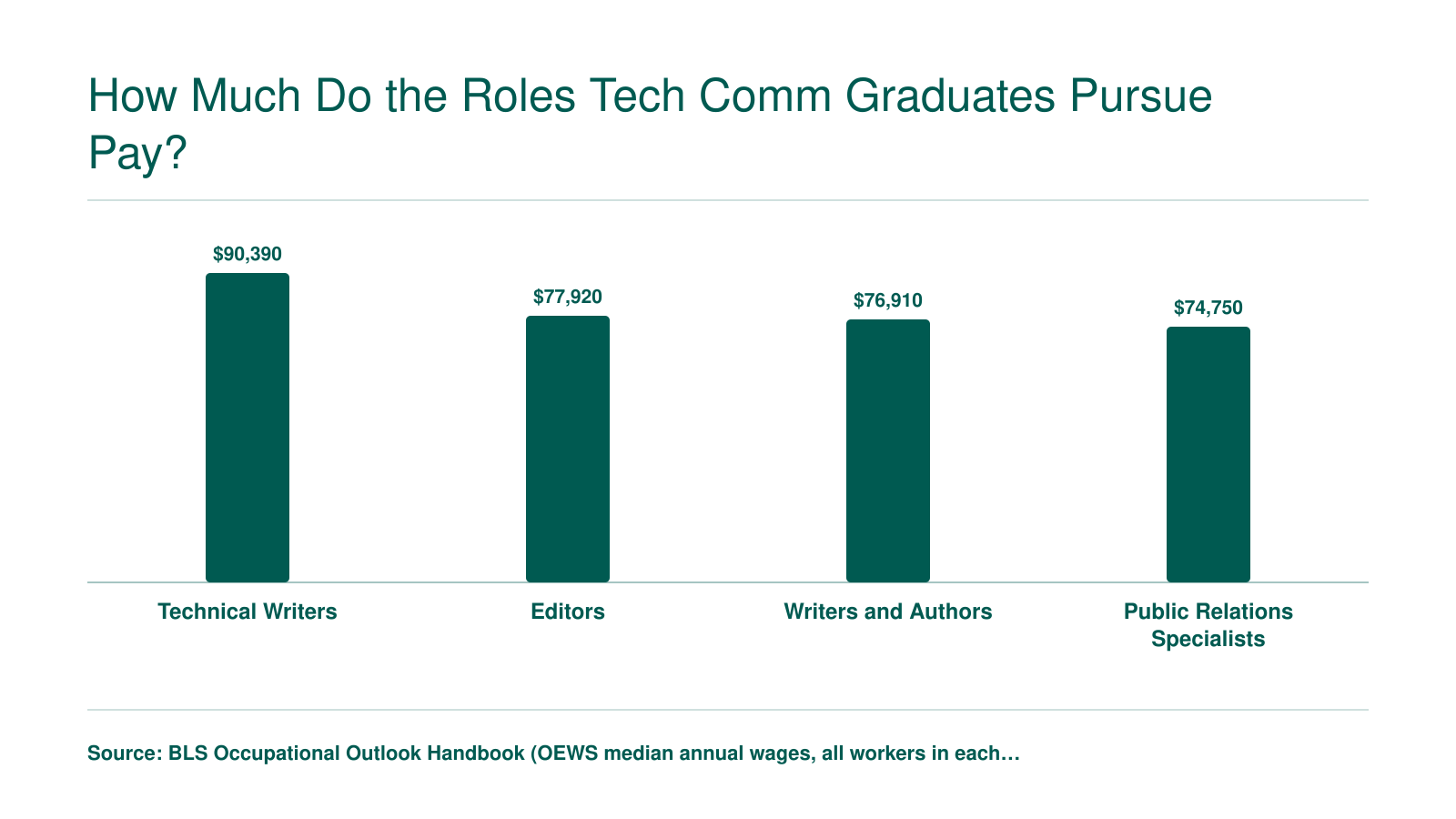
How Much Do the Roles Tech Comm Graduates Pursue Pay?
A master's in technical communication opens doors to several related occupations, and their pay varies. These figures are occupation-wide national medians from the Bureau of Labor Statistics, not earnings of graduates from any program on this page.
According to the Bureau of Labor Statistics (BLS), about 39% of technical writers worked in professional, scientific, and technical services, based on 2025 data. Manufacturing and information each employed 13%, and administrative and support services another 8%. Government, excluding state and local education and hospitals, accounted for 4%.
Technical Communication programs by state
Compare Technical Communication programs on the data that matters
Explore more Communications & Media specializations or browse every graduate field.
All Communications & Media programs