Best MBA in Supply Chain Management Programs in North Carolina
Compare 9 accredited MBA in Supply Chain Management programs in North Carolina, with graduate earnings, cost, debt, and completion data from IPEDS and the U.S. College Scorecard.

North Carolina moves freight. Deepwater ports at Wilmington and Morehead City feed the I-85 and I-40 corridors, where furniture, pharmaceutical, and automotive manufacturers keep supply chain managers in steady demand.
The programs ranked here include campus, hybrid, and fully online MBA paths with a supply chain focus. Residency decides most of the price gap: in-state tuition at the public schools runs a fraction of out-of-state, while one private program charges a flat rate.
What separates these programs is curriculum depth, not the concentration label. Two schools can both advertise supply chain and teach very different coursework behind it.
Key Points
- UNC Pembroke's online supply chain MBA costs $11,092 for North Carolina residents.
- NC State's residency gap runs $20,773, while High Point charges one rate.
- Only NC State, UNC Wilmington, and UNC Pembroke show test-optional or waiver policies.
The Best Supply Chain MBA Programs in North Carolina, Ranked
These six North Carolina programs offer an MBA with a supply chain focus, in campus, hybrid, and online formats. Graduation rates shown are each institution's overall rate, not the MBA program's. STEM designation is noted only where a school publishes it, and accreditation is noted as the program materials describe it.
North Carolina State University at Raleigh
#1Raleigh, NC · $12,000 – $33,000/yr (est.)
Best for: Career builders wanting corporate practicum experience
NC State's Jenkins MBA stands out for its semester-long practicum, in which student teams solve live problems for partner companies through the Supply Chain Resource Cooperative. The campus program in Raleigh is AACSB-accredited, and the school lists its full-time MBA as STEM-designated; it does not establish STEM status for the concentration separately. The university's overall graduation rate is about 85%.
- Campus-based Raleigh program with a required capstone
- Semester-long practicum with company mentors on real problems
- Supply Chain Resource Cooperative partnership with industry sponsors
- Full-time MBA listed as STEM-designated by the business school
- Business analytics and SAP University Alliance credentials available
- MBA Supply Chain Club for networking
- Prepares for management roles in manufacturing, retail, logistics, consulting
University of North Carolina Wilmington
#2Wilmington, NC · $8,000 – $24,000/yr (est.)
Best for: Working professionals needing fully online flexibility
UNC Wilmington offers a fully online, asynchronous MBA with a supply chain specialization built for working professionals. Program materials describe it as AACSB-accredited and taught by the same faculty who teach on campus, though we could not confirm accreditation on an official page. No STEM designation is published. The university's overall graduation rate is about 71%.
- 100% online, asynchronous, 36 credits across 12 courses
- Can be completed in as few as 12 months
- Accelerated 7-week courses with six start dates per year
- No GMAT required; rolling admissions
- 3.0 GPA minimum, two years of work experience, two recommendations
- Program tuition listed at about $19,920 total
- Covers logistics, procurement, operations, and supply chain data analytics
Appalachian State University
#3Boone, NC · $9,000 – $25,000/yr (est.)
Best for: Campus students focused on sourcing and quality
Appalachian State's campus MBA in Boone is a 36-credit program with a nine-credit supply chain concentration focused on sourcing, logistics, quality, and modeling. It suits students who want hands-on analytical coursework rather than an online format. We found no published STEM designation or AACSB confirmation in the program materials. The university's overall graduation rate is about 75%.
- Campus-based, 36 total credit hours
- 27 hours of general requirements plus 9 concentration hours
- Strategic Sourcing and Logistics Management course
- Six Sigma and Quality Management course
- Analytical Models for Supply Chain Management course
- Real-world case studies and analytical tools
High Point University
#4High Point, NC · ~$36,000/yr (est.)
High Point University's online MBA with a supply chain concentration is asynchronous, with rolling admissions and a new start every eight weeks. As a private institution, its tuition does not change with residency, so it is generally the costlier route on this list. STEM status and AACSB accreditation are not published in the materials we reviewed. The university's overall graduation rate is about 74%.
- Online and asynchronous, no campus visits required
- Six start dates per year with rolling admissions
- Three concentration options within the MBA
- Covers logistics, operations management, and project management
- Aligned with eight NACE Career Competencies
- Full-time and part-time options
University of North Carolina at Greensboro
#5Greensboro, NC · ~$9,000/yr (est.)
UNC Greensboro delivers its supply chain MBA in a hybrid format, with both synchronous and asynchronous options. The business school promotes dual AACSB accreditation in business and accounting, though we could not verify it on an official page, and it publishes no STEM designation. Elective choice is broad, with more than 30 electives and 18 certificates. The university's overall graduation rate is about 56%.
- Hybrid format combining online and in-person classes
- Full-time and part-time options
- More than 30 electives across nine concentration areas
- 18 certificate options
- Analytics for logistics and project management coursework
- One-week study abroad courses available for credit
- $65 application fee waiver available
University of North Carolina at Pembroke
#6Pembroke, NC · ~$7,000/yr (est.)
UNC Pembroke is the lowest-cost option here, with a fully online MBA in supply chain management priced at about $268 per credit hour for in-state students. Program materials describe it as AACSB-accredited, though we could not confirm this on an official page, and no STEM designation is published. The university's overall graduation rate is about 44%, the lowest on this list.
- 100% online, 36 credit hours, as few as 12 months
- Eight core courses, three supply chain courses, one elective
- 7-week terms with five start dates per year
- No GMAT or GRE required with a 2.5 GPA or higher
- Total in-state tuition listed at $11,092 with a locked rate
- Capstone required; prerequisite courses may apply
- Application fee waived for military applicants
Cost & outcomes by school
Federal data for the highest-earning Supply Chain Management programs, independent of the ranking above. Earnings are this field's master's graduates four years after completing, where the Scorecard reports them.
| School | Earnings | Tuition / yr | Debt | Grads/yr | Format |
|---|---|---|---|---|---|
| North Carolina State University at Raleigh NC | $127,702 | $12,101 | $41,000 | 14 | Campus |
| University of North Carolina Wilmington NC | $118,289 | $8,112 | $24,000 | 1 | Online |
| University of North Carolina at Greensboro NC | $104,581 | $8,614 | $33,363 | 96 | Hybrid |
| Appalachian State University NC | $94,138 | $8,570 | $27,533 | 60 | Campus |
| Fayetteville State University NC | $94,069 | $6,791 | $31,571 | 129 | Campus |
| North Carolina A & T State University NC | $87,800 | $8,368 | $39,996 | 43 | Online or campus |
| University of North Carolina at Pembroke NC | $69,372 | $6,928 | $25,064 | 370 | Online |
| North Carolina Wesleyan University NC | — | $12,700 | — | 45 | Online |
| High Point University NC | — | $35,755 | — | 46 | Online |
Sources: U.S. Department of Education. Tuition and graduates: IPEDS. Earnings and debt: College Scorecard, this field's master's graduates; a dash means no figure is reported.
Cost, debt & payoff
Median earnings of this field's master's graduates (4 yrs after completing) vs. their median federal loan debt · U.S. College Scorecard
Across these programs the median graduate earns about $94,138 and finishes with roughly $31,571 in debt — a ratio that clears a common rule of thumb (keep debt below first-year salary). Tuition and debt vary widely school to school, so check the per-school figures in the table above before you shortlist.
Online and Hybrid Supply Chain MBA Options in North Carolina
Most supply chain MBA paths on this list are available as an Online MBA, so the real differences come down to pace and how much time you must spend on campus.
- Fully online: UNC Pembroke's 36-credit MBA in Supply Chain Management runs two 7-week terms per semester and can be completed in as few as 12 months. UNC Wilmington advertises a 12-month asynchronous format built on 7-week courses. High Point University offers asynchronous online classes with six start dates a year.
- Online or blended: NC State's Online MBA can be taken fully online or mixed with in-person courses in Raleigh. It runs 21 months to six years, and most students take about three.1
- Hybrid: UNC Greensboro offers its concentration courses both in person and online. A full-time MBA typically takes about two years, and some students finish in 21 months.
- Campus: NC State's Full-time MBA in Raleigh takes 21 months.2 Appalachian State's concentration is campus-based in Boone.
Schools do not spell out how online concentrations differ from campus versions. NC State's campus track features a semester-long company practicum, so ask what online students can access.
If your work schedule shifts often, favor asynchronous programs. Choose blended only if you can reliably reach campus.
Which Ranked NC Supply Chain MBA Programs Waive the GMAT or GRE
NC State, UNC Wilmington, and UNC Pembroke are test-optional or waive scores for qualifying applicants, while High Point, Appalachian State, and UNC Greensboro have no policy we could confirm from the pages we reviewed. The table marks those cases as "No published policy" rather than guessing. Waiver rules change, so confirm the policy for your specific entry term and program format with the admissions office before you apply.
| School | GMAT/GRE Policy | Waiver Criteria | Format the Policy Applies To |
|---|---|---|---|
| North Carolina State University at Raleigh | Optional | No waiver needed. Applicants may submit a score as a supplement or apply without one, with no stated preference. No GPA or work experience threshold published for this policy. | Jenkins MBA (the online option has a separate 2-year work experience requirement) |
| University of North Carolina Wilmington | Optional | No criteria published. Program materials state no entrance exam is required. | Online |
| Appalachian State University | No published policy | No published policy | N/A |
| High Point University | No published policy | No published policy | N/A |
| University of North Carolina at Greensboro | No published policy | No published policy | N/A |
| University of North Carolina at Pembroke | Optional / waivable | Undergraduate GPA of 2.5 or higher | Online |
Related Articles
Cost and North Carolina Employer Demand for Supply Chain MBA Graduates
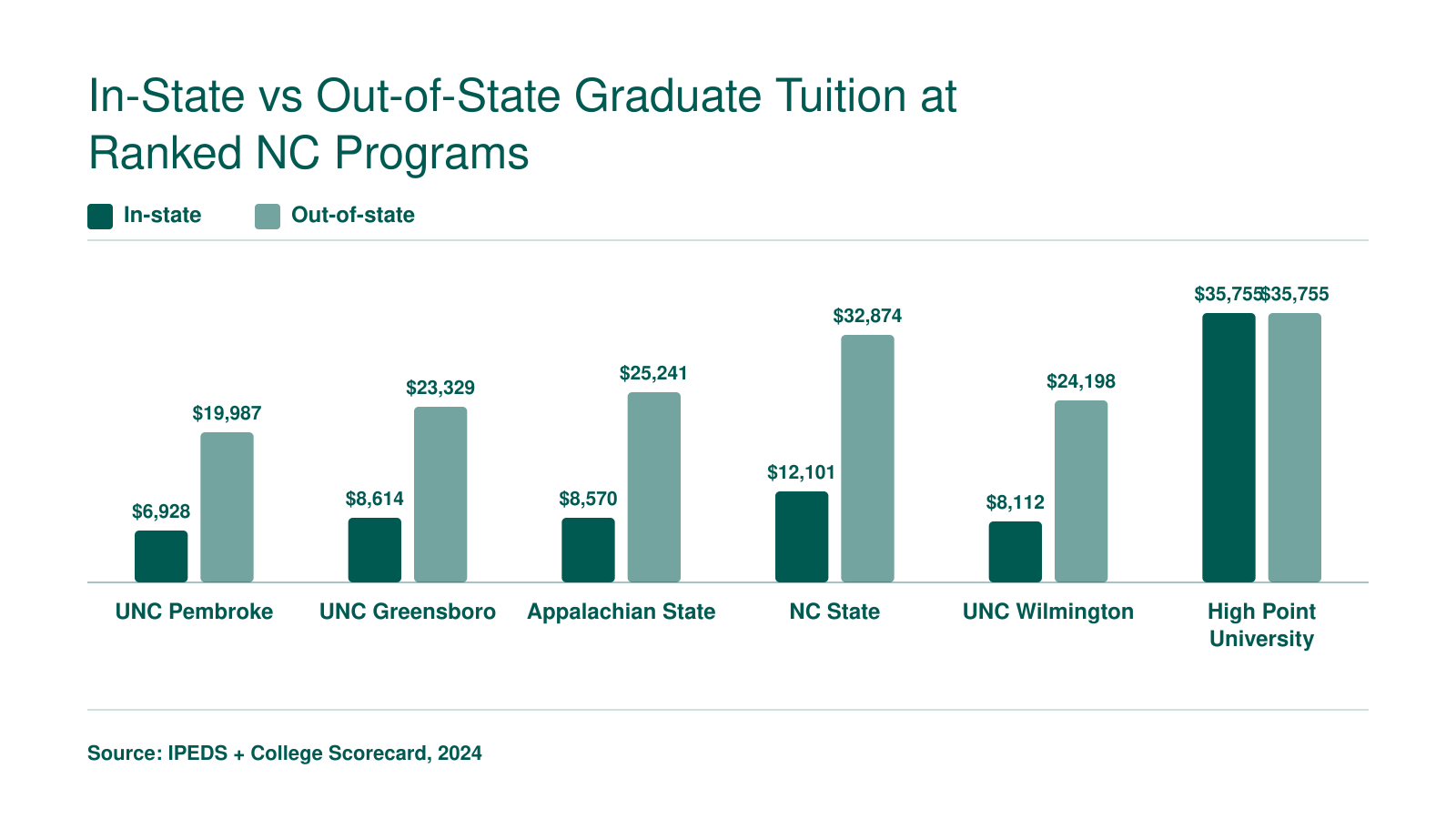
UNC Pembroke publishes the clearest price: $11,092 for its 36-credit online supply chain MBA at $268.11 per credit for residents, against $23,580 out of state at $615 per credit. Online students pay different rates depending on residency. UNC Wilmington lists about $20,257 for North Carolina residents and $55,381 for out-of-state residents, and High Point University charges one private rate of $35,755.
On annual in-state versus out-of-state tuition, UNC Greensboro runs $8,614 and $23,329, Appalachian State $8,570 and $25,241, and NC State $12,101 and $32,874. In-state status generally requires 12 months of North Carolina domicile before the term starts, so compare masters programs in North Carolina and confirm eligibility with each registrar. Institution-wide net price is only a rough average, not a quote: about $10,260 at Pembroke and $17,303 at NC State.
Who Hires
Lowe's, Honeywell and GlaxoSmithKline are among the North Carolina employers that hire supply chain leaders, mostly around Charlotte, Raleigh-Durham and Greensboro. State pay for supply chain managers in 2025 ran from $66,090 at the 10th percentile to $191,650 at the 90th, a wide spread that rewards experience.
Takeaway: a lower-cost in-state program can match the demand a pricier one serves, so compare affordable MBA programs and let price decide between close options.
In-State vs Out-of-State Graduate Tuition at Ranked NC Programs
NC State shows the widest residency gap: $12,101 in-state against $32,874 out-of-state, a difference of $20,773. High Point University charges $35,755 regardless of residency, the only school here with no gap. The other public programs sit between roughly $13,000 and $17,000 apart. Figures come from federal data, so check each school's current published rate and fees before budgeting.
Career Outcomes and Salary Data for Supply Chain MBA Graduates
The figures below come from IPEDS and College Scorecard (2024) and cover graduates of each school's master's-level business program in this field, measured four years after finishing. University of North Carolina Wilmington shows the strongest earnings-to-debt profile here: a $24,000 median debt against $118,289 in median earnings, or about 4.9 times debt. North Carolina State University at Raleigh reports the highest earnings, though its larger debt and $466 monthly payment pull its ratio down to about 3.1. Monthly payments ranging from $273 to $466 are worth setting against your expected take-home pay before you commit. The earnings-to-debt ratio is median earnings divided by median federal debt.
| School | Median Earnings (four years after finishing) | Median Federal Debt | Median Monthly Payment (10-year plan) | Earnings-to-Debt Ratio |
|---|---|---|---|---|
| North Carolina State University at Raleigh | $127,702 | $41,000 | $466 | 3.1 |
| University of North Carolina Wilmington | $118,289 | $24,000 | $273 | 4.9 |
| University of North Carolina at Greensboro | $104,581 | $33,363 | $380 | 3.1 |
| High Point University | Not reported | Not reported | Not reported | Not reported |
| Appalachian State University | $94,138 | $27,533 | $313 | 3.4 |
| University of North Carolina at Pembroke | $69,372 | $25,064 | $285 | 2.8 |
How Supply Chain Curriculum Depth Differs Across Ranked NC MBA Programs
Curriculum depth is simply how many courses in the best MBA programs carry real supply chain content, and whether those courses reach analytics, ERP systems, procurement, and global logistics rather than circling operations basics.
NC State's Jenkins MBA goes deepest. A three-credit enterprise systems course covers ERP, SAP, process mapping, and robotic process automation, and pairs with another course toward an SAP certificate.1 Another course addresses global supply chains, and a three-credit practicum puts students on company problems alongside the Supply Chain Resource Cooperative.1
UNC Greensboro's Bryan School builds its concentration from four SCM courses, one of which spans analytics, procurement, logistics, and distribution. UNC Pembroke's online concentration runs 12 semester hours2: three specified courses covering supplier development, outsourcing, quality, and global systems, plus a Professional Enhancement elective.
Appalachian State, UNC Wilmington, and High Point publish less course-level detail for their concentrations. Request the full course list before enrolling, and confirm whether analytics and management information systems coursework is required or optional.
How We Rank North Carolina Supply Chain MBA Programs
A low sticker price means little if the program does not lead to strong earnings, and a flexible format means little if it costs too much. The rankings here weigh both sides. Each school is judged on graduate tuition and net price, institution-wide graduation rate, program-level earnings and debt from College Scorecard where those figures are published, and how flexibly the MBA can be completed.
Cost and graduation figures come from IPEDS and College Scorecard. Graduation rate and net price describe the whole institution, not the MBA in Supply Chain Management alone, so they are approximations. Admissions rules, formats, and curriculum details were checked against each school's website as of October 2026. Where a school does not publish something, we say so rather than guess.
Compare Supply Chain Management programs on the data that matters
Explore more MBA specializations or browse every graduate field.
All MBA programs