Most Affordable MPA Programs
Compare 590+ accredited most affordable Public Administration (MPA) programs at 390+ schools, with graduate earnings, cost, debt, and completion data from IPEDS and the U.S. College Scorecard.

Reported first-year earnings for MPA graduates from the programs ranked here run from about $51,000 to $79,400, and that spread, not campus prestige, determines whether the degree is worth the debt. Public-sector pay rarely justifies six-figure borrowing, so price matters more for an MPA than for most master's degrees.
Program-level in-state tuition and fees for these same schools range from $6,605 to $11,452 a year, a gap that only widens after residency rules, fees, and online pricing. The ranking, NASPAA and online-format checks, aid options, and earnings-versus-debt outcomes all point to the same bottom line: compare the final net price, not the brochure rate.
Key Points
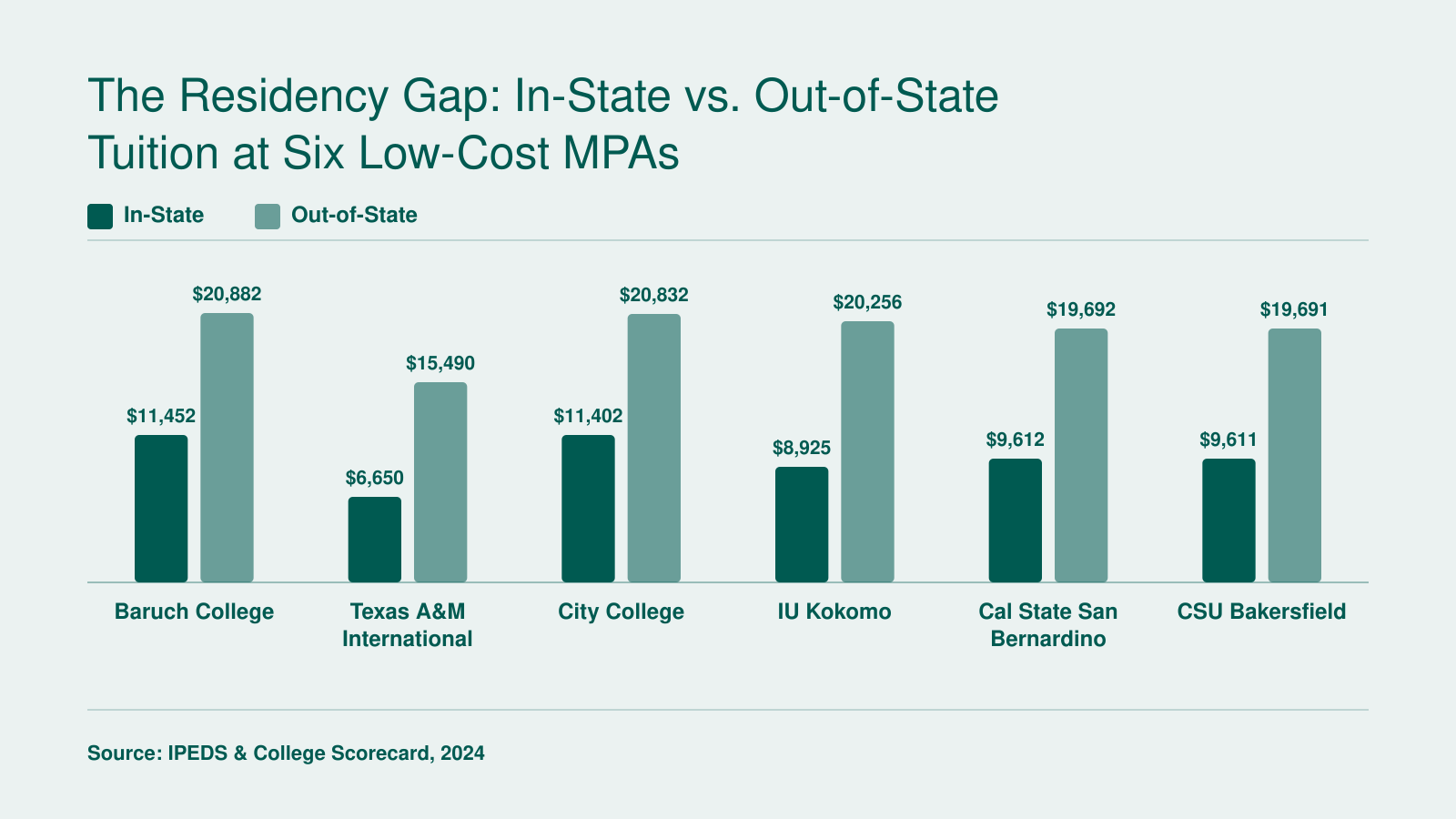
- Baruch and City College charge nonresidents roughly double resident MPA rates.
- Rankings here weight net price, debt, and federal earnings over prestige.
- Online e-rates can bypass residency tuition surcharges entirely.
The 10 Most Affordable MPA Programs for 2027
Low tuition only matters when the degree is accessible and the career path is real. This list favors programs where public affairs students can keep total cost down without trading away the practical skills, concentrations, and flexibility that public service careers demand.
CUNY Bernard M Baruch College
#1New York, NY · $11,000 – $21,000/yr (est.)
Best for: New Yorkers targeting urban policy and nonprofit leadership
CUNY Baruch's Marxe School combines a nationally ranked, NASPAA-accredited MPA with seven specializations, from health care policy to urban sustainability. Evening and fully online scheduling options make it workable for working professionals, and students can pursue internships in New York City and Washington, D.C. or a Washington Semester.
- NASPAA and COPRA accredited
- Seven concentrations including health care policy and nonprofit administration
- 42 total credit hours and capstone project
- Evening, full-time, part-time, and asynchronous online options
- Presidential Management Fellows Program nominations
- Internship opportunities in New York City and Washington, D.C.
CUNY City College
#2New York, NY · ~$11,000/yr (est.)
Best for: Mid-career professionals wanting hybrid community-engaged study
CUNY City College's MPA is based at the Moynihan Center and built for government and community organizations, with a focus on strategic management, data-driven decision making, and leadership. Admission expects relevant work experience, and the hybrid program includes a capstone project with community partners. It serves a diverse student body including first-generation graduates and mid-career professionals.
- Hybrid delivery through the Colin Powell School
- Based at the Moynihan Center
- Work experience requirement for admission
- Capstone project with community partners
- Emphasis on strategic management and data-driven decisions
Texas A & M International University
#3Laredo, TX · ~$7,000/yr (est.)
Best for: Online learners seeking nonprofit leadership skills
Texas A&M International University offers a NASPAA-accredited MPA entirely online, designed for mid-career professionals and new public servants. The 42-credit program includes 33 core hours and nine electives, and students can use electives to earn a Nonprofit Leadership & Management certificate. No GRE is required.
- Entirely online delivery, 42 credit hours
- 33 core credits plus 9 elective credits
- NASPAA-accredited program
- No GRE required; 3.0 GPA and personal interview
- Nonprofit Leadership & Management certificate option
- Comprehensive exam and continuous enrollment
California State University-Northridge
#4Northridge, CA · ~$9,000/yr (est.)
CSUN's MPA in Public Sector Management and Leadership is built for working professionals, with 36 units covering public administration foundations, research methods, human resources, public finance, policy making, and electives. Students finish with a comprehensive exam and can choose open enrollment or a cohort of about 25 that progresses through the program together. Admission requires two years of public sector experience and a 3.0 GPA.
- 36 total credit hours
- Public Sector Management and Leadership concentration
- Cohort-based structure, about 25 students per cohort
- Open enrollment and cohort formats
- Requires two years of public sector experience
- Comprehensive examination required
- Classes offered off campus through The Tseng College
California State University-San Bernardino
#5San Bernardino, CA · ~$10,000/yr (est.)
Cal State San Bernardino's NASPAA-accredited MPA is organized around a single concentration chosen at application: Leadership, Public Financial Management, or Nonprofit Management. The hybrid program combines core public administration courses with specialized electives, and students may select only one concentration to keep the degree focused.
- Leadership concentration for management and executive roles
- Select concentration during graduate application
- Hybrid delivery with in-person and online components
- NASPAA-accredited program
- Concentration in applied public financial management
- Combines core MPA coursework with specialized finance courses
- Prepares for government and nonprofit budget roles
- Application through CSU Apply
- Concentration in Nonprofit Management
- Specialized coursework in nonprofit leadership challenges
- Business knowledge adapted to nonprofit settings
- Students choose one concentration only
California State University-Fresno
#6Fresno, CA · ~$9,000/yr (est.)
Cal State Fresno's MPA requires 36 units, including 21 core units across administration, quantitative methods, human resources, budgeting, and policy. Students complete a comprehensive exam, capstone, or thesis, and the GRE is not required for current cycles. The program emphasizes ethical public governance.
- 36 units required, including 21 core units
- Core courses in administration, quantitative methods, budgeting, and policy
- No GRE required for recent admission cycles
- Comprehensive exam, capstone, or thesis options
- NASPAA-accredited program
California State University-Stanislaus
#7Turlock, CA · ~$10,000/yr (est.)
Cal State Stanislaus offers an MPA for public service professionals, requiring 36-39 semester units with a 3.0 GPA and nine core courses covering public finance, ethics, policy analysis, and budgeting. Pre-service students complete a 300-hour internship, and students finish with a comprehensive case analysis or thesis. The program focuses on Northern and Central California government needs.
- 36-39 semester units required
- Minimum 3.0 GPA
- Nine core courses including public finance and ethics
- 300-hour internship for pre-service students
- Comprehensive case analysis or thesis option
California State University-Bakersfield
#8Bakersfield, CA · $5,000 – $10,000/yr (est.)
CSU Bakersfield offers a primarily in-person, NASPAA-accredited MPA focused on government, nonprofit, and healthcare leadership. The program publishes two-year and three-year roadmaps and connects students with internships and scholarships, making cost and timeline planning transparent.
- Primarily in-person at the Main Campus in Bakersfield
- NASPAA-accredited program
- Focus on government, nonprofit, and healthcare sectors
- Two-year and three-year roadmaps available
- Internship and scholarship opportunities
California State University-Sacramento
#9Sacramento, CA · $10,000 – $20,000/yr (est.)
Sacramento State's Master of Public Policy and Administration is a 36-credit program at the Capital Campus, placing students near California state agencies. The curriculum blends political analysis, quantitative methods, applied economics, public budgeting, and public management, and ends with a capstone addressing a real policy or administrative issue. No GRE is required.
- 36 total credit hours
- No entrance exam required
- 2.8 GPA minimum for admission
- Located at Sacramento Capital Campus
- Collaborative governance electives
- Capstone project on a real policy issue
New Mexico State University
#10Las Cruces, NM · $7,000 – $19,000/yr (est.)
New Mexico State University's NASPAA-accredited MPA is a 42-credit, 5-semester program with evening courses and a small cohort model. Students complete six core courses, an internship or thesis, and a final oral exam, with joint degree options and an accelerated MAP track for qualified undergraduates.
- 42 total credit hours, 5-semester format
- NASPAA-accredited program
- No entrance exam required
- Evening courses for working professionals
- Joint degree options with Criminal Justice and History
- Accelerated MAP track double-counts 12 credits
Cost & outcomes by school
Federal data for the highest-earning Public Administration (MPA) programs, independent of the ranking above. Earnings are this field's master's graduates four years after completing, where the Scorecard reports them.
| School | Earnings | Tuition / yr | Debt | Grads/yr | Format |
|---|---|---|---|---|---|
| Columbia Southern University AL | — | $3,936 | — | 4,312 | Online |
| University of West Georgia GA | — | $6,046 | — | 2,558 | Online |
| Georgia Southern University GA | — | $6,646 | — | 2,464 | Hybrid |
| Florida Atlantic University FL | — | $6,693 | — | 3,718 | Campus |
| Kennesaw State University GA | — | $6,702 | — | 3,708 | Campus |
| Arkansas State University AR | — | $7,322 | — | 3,362 | Online |
| East Texas A&M University TX | — | $7,338 | — | 3,020 | Hybrid |
| University of North Carolina at Charlotte NC | — | $8,037 | — | 4,156 | Campus |
| Northwest Missouri State University MO | — | $8,096 | — | 3,066 | Online |
| The University of Texas Rio Grande Valley TX | — | $8,589 | — | 3,408 | Online |
| University of Alabama at Birmingham AL | — | $8,640 | — | 4,976 | Campus |
| Lamar University TX | — | $8,642 | — | 7,008 | Online |
Sources: U.S. Department of Education. Tuition and graduates: IPEDS. Earnings and debt: College Scorecard, this field's master's graduates; a dash means no figure is reported.
Behind the List: Net Price, Debt, and Earnings Over Prestige
Prestige rankings ask who gets admitted; this list asks what admitted students actually owe and earn. The ranking gives the most weight to net price and financial aid measures, then layers in program-level median debt and earnings from the federal College Scorecard where that data is published. Tuition figures are drawn from IPEDS. No school paid for placement. Institutional figures can mask variation across departments, so the split below matters.
Why the Data Split Matters
Some figures describe the whole institution: average net price, graduation rate, and loan repayment patterns. Others are specific to MPA completers: median federal student debt and early-career earnings. Program-level numbers are often more revealing for students comparing MPA programs, including online MPA programs, but they are not published for every school. When a program-level figure is missing, the list leaves that statistic blank rather than substituting the schoolwide number. That keeps a cheap-looking school with weak MPA outcomes from slipping through on institutional averages alone.
Prestige Left Out
Selectivity, endowment size, and reputation surveys were deliberately excluded. Those signals reward schools for turning applicants away, not for serving students on a budget. A low-cost MPA at a regional public university can leave a graduate with far less debt than a famous flagship, and the earnings gap is often smaller than the tuition gap suggests. For public servants planning careers in local government, nonprofits, or state agencies, that tradeoff usually matters more than a name on a sweatshirt. This is not a ranking of the hardest schools to get into; it is a ranking of the smartest public service investments.
How Much Does an MPA Degree Cost After Fees and Aid?
The real cost of an MPA is the per-credit rate multiplied by the credits required, plus every fee the sticker price leaves out. The multiplication is easy, and the schools here show how wide the spread gets.
Total Program Cost, Credit by Credit
- Arkansas State: $340 per credit, with a stated degree cost of $12,240 (about 36 credits), according to its MPA Public Administration FAQ.
- Missouri: $567.80 per credit for online students regardless of residency. That works out to $17,034 for the 30-credit mid-career track and $20,440.80 for the 36-credit track (2026-2027).1
- UMass Lowell: $610 per credit across 36 credits comes to roughly $21,960 in tuition alone (Fall 2026), according to its online MPA degree page.
- LSU: $730 per credit across 36 credits, a stated total of $26,280 that includes fees, according to its online MPA page.
That is a gap of more than $14,000 between the cheapest and priciest of these.
Fees the Sticker Price Hides
Tuition rarely tells the whole story of how much does a sustainability MBA cost. UMass Lowell adds a $30 term registration fee and a $50 application fee. Missouri's estimate excludes the application fee, textbooks, and course materials, and says department course fees vary. Delaware's online MPA is a useful warning: at $645 per credit for 36 credits, it layers on $60 registration and $55 technology fees every semester, plus $50 per class in distance-education fees. Ask any program about technology, online or distance-learning, graduation, and per-term student services charges, because they compound over a multi-year degree.
Published Tuition vs. Per-Credit Reality
Annual graduate tuition and per-credit rates are not interchangeable. Baruch College, for example, publishes graduate tuition of $11,452 in-state and $20,882 out-of-state per year, while online programs like Missouri and LSU charge one flat rate to everyone. The net price attached to each school is institution-wide, so it is only a rough approximation for a graduate student. It is not the bill you will actually receive.
The Practical Takeaway
Before comparing programs, ask each one for the full cost per credit with every mandatory fee included, then multiply by the credits you will actually need. That single number is the only fair basis for comparison.
Paying In-State Rates From Out of State: WRGP and Flat Online Tuition
Whether you pay in-state rates depends on your address or your enrollment format. Online MPA students sometimes assume they automatically get in-state pricing, but that is only true at programs that explicitly set a single online rate.
Where the Online Rate Does Not Depend on Residency
Several public universities charge one online MPA tuition no matter where the student lives. University of Idaho lists a flat $3,750 per semester rate ($7,500 per academic year) for its online MPA in 2026-27, plus a $35 per-credit web course fee; the on-campus out-of-state rate is $31,272, so the online route removes that premium.1 UMass Lowell charges the same $610 per credit online to in-state, out-of-state, and international students in Fall 2026, with a separate $30 term registration fee.2 Arkansas State prices its all-online MPA at $340 per credit, or $12,240 for the 36-credit curriculum, and presents that as in-state tuition for out-of-state online students; fees may be additional.3
How WRGP Can Lower the Bill
The Western Regional Graduate Program (WRGP) allows graduate students from participating western states to pay resident tuition at member schools when their specific program is approved. WICHE states include Alaska, Arizona, California, Colorado, Hawaii, Idaho, Montana, Nevada, New Mexico, North Dakota, Oregon, South Dakota, Utah, Washington, and Wyoming, plus the Commonwealth of the Northern Mariana Islands. Because approval is program-by-program and changes by year, an MPA may not be included in any given cycle; confirm with the school's financial aid or graduate admissions office before relying on WRGP pricing.
Where the Price Can Climb Back Up
Flat online pricing can disappear when a program expects campus time. At Augusta University, for example, the listed in-state rate is $238 per credit and the out-of-state rate is $863 per credit.4 If a residency, orientation, or internship requires on-campus enrollment, that higher nonresident rate can apply to those credits. Ask whether all requirements can be completed remotely and whether any in-person hours bill as online or on-campus.
The Residency Gap: In-State vs. Out-of-State Tuition at Six Low-Cost MPAs
Published graduate tuition and fees show a wide residency gap. At Baruch and City College, nonresidents pay roughly double the resident rate; at Texas A&M International and IU Kokomo, the gap is smaller but still four figures. Online e-rates may differ, so check each school's bursar page before budgeting.
Related Articles
Credits, Timelines, and Transfer Policies: Can You Finish in a Year?
The total cost of an MPA depends on more than sticker tuition. Programs that require fewer credits or accept more transfer credits can lower the amount you pay before any aid. The table below compares credit loads, timelines, and transfer limits for several affordable options, including one true one-year path at Boise State University.
| School | Credits Required | Typical Completion Time | Fastest Option | Transfer Credits Accepted |
|---|---|---|---|---|
| Arkansas State University (Online MPA, Public Management) | 36 credit hours | As few as 18 months | N/A | Up to 9 graduate credit hours |
| Boise State University | 36 to 39 credits, depending on internship | One academic year after admission | N/A | Up to 9 credits |
| West Chester University of Pennsylvania | 36 credit hours, or 39 if an internship is required | Two to three years | N/A | Three to twelve credits may be transferred if approved |
| Kansas State University | 37 semester hours for pre-career students; 36 for mid-career students | Two years | Four semesters plus one summer course | N/A |
| Georgia College & State University (Online MPA) | 36 credits | Four semesters | N/A | Up to 9 graduate credit hours |
| Northern Arizona University | 39 graduate credits | 18 months of full-time study with coursework in both summer terms | Four semesters if students do not take classes in the summer | Up to 9 credits |
Sticker tuition is only the opening number. Your residency status and the fees stacked on top decide what an MPA really costs, so compare the final bill, not the brochure rate.
Top Early-Career Earnings Among Ranked MPA Programs
Public Administration (MPA) programs by state
Affordable MPA Questions, Answered
Cost and aid questions often determine whether an MPA makes financial sense. These FAQs cover fees, test waivers, accreditation, residency pricing, and Public Service Loan Forgiveness so you can compare programs without surprises.
Which online MPA has the lowest total tuition?
How much does an MPA degree cost from start to finish?
Are online MPA degrees accredited the same way as campus programs?
Is an MPA worth it for a public service career?
Do online MPA students pay out-of-state tuition?
Can you finish an MPA online in one year?
Which low-cost MPA programs waive the application fee or GRE?
Does Public Service Loan Forgiveness help with MPA debt?
Compare Public Administration (MPA) programs on the data that matters
Explore more MPA specializations or browse every graduate field.
All MPA programs