Best Master's in Positive Psychology Programs
Compare 9 accredited Positive Psychology programs, with graduate earnings, cost, debt, and completion data from IPEDS and the U.S. College Scorecard.

Standalone applied degrees and concentrations inside a general psychology master's make different credentialing bets. Penn's Master of Applied Positive Psychology costs $75,250 before aid; an online one-year applied program can cost closer to $32,000. A small set of universities awards a dedicated degree, while most training exists as a track inside a broader MA or MS.
That distinction matters because doctoral admissions and employers read transcripts differently: a concentration signals coursework inside an established psychology frame, while a standalone MAPP signals deeper applied training. The credential does not authorize clinical mental health counseling. Graduates move into coaching, talent development, and applied wellbeing roles, where research literacy counts more than clinical licensure, similar to I-O psychology.
Key Points
- Net price is an institution-wide average, so confirm the real cost of this degree.
- Standalone degrees and psychology tracks lead to different transcripts, so check the diploma title.
- The ICF Associate Certified Coach credential is a coaching route, not a license to practice therapy.
Top Master's in Positive Psychology Programs, Ranked
These programs stand out for the balance they offer between cost, format, and career preparation. We looked for standalone positive psychology master's degrees as well as psychology degrees with a positive psychology concentration, and we favored schools with practical applied training. Use the cards below to compare tuition, delivery format, and graduation outcomes before you apply.
University of Pennsylvania
#1Philadelphia, PA · ~$48,000/yr (est.)
Best for: Professionals seeking hybrid low-residency cohort
University of Pennsylvania in Philadelphia, Pennsylvania, offers the world's first Master of Applied Positive Psychology, a standalone degree created by pioneering researchers including Dr. Martin Seligman. The hybrid low-residency format blends online learning with in-person sessions so working professionals can continue their jobs while studying. Graduate tuition and fees are $68,686 for both in-state and out-of-state students, and the school graduates 96.5% of students.
- First MAPP program in the world
- Founded by Dr. Seligman
- Hybrid low-residency format
- Combines in-person and virtual on-sites
- Allows full-time work while studying
- Covers strengths, resilience, and well-being
- Tailor projects to career goals
Philadelphia College of Osteopathic Medicine
#2Philadelphia, PA · ~$32,000/yr (est.)
Best for: Busy professionals needing one-year completion
Philadelphia College of Osteopathic Medicine in Philadelphia, Pennsylvania, offers a fully online Master of Applied Positive Psychology that can be completed in one year. The standalone degree is rooted in PCOM's osteopathic tradition and includes a practicum with the A Happier You program, along with training in motivational interviewing and mindfulness. Graduate tuition and fees run $32,281.
- Complete in one year
- Thesis required
- Fully online, collaborative format
- Teaches motivational interviewing and mindfulness
- Experiential practicum in A Happier You
- Prepares for doctoral studies in psychology
- Capstone thesis project
- Strengths-based human flourishing model
Arizona State University
#3Tempe, AZ · ~$14,000/yr (est.)
Best for: Online learners wanting test-optional admission
Arizona State University in Tempe, Arizona, offers an online Master of Science in Psychology with a concentration in Positive Psychology, a track within a broader psychology degree rather than a standalone positive psychology master's. The flexible program has no GRE requirement, and the school graduates 68% of students. Graduate tuition and fees are $12,223 in-state and $33,139 out-of-state.
- Test optional
- 3.0 GPA minimum
- Emphasis on meaning and fulfillment
- Optimal well-being for communities
- Harmonious and inclusive societies
- Transformational practices focus
Indiana Wesleyan University
#4Marion, IN · ~$11,000/yr (est.)
Indiana Wesleyan University in Marion, Indiana, offers an online Master of Arts in Psychology with a concentration in Life Coaching and Positive Psychology, a faith-based track within a broader psychology degree. The 30-credit program has a locked tuition rate of $525 per credit and no prerequisites, and the school graduates 67% of students. Graduate tuition and fees are $32,352 for both in-state and out-of-state students.
- $525 per credit
- Locked tuition rate
- 30 total credit hours
- 2.5 GPA minimum
- Faith-based integration
- No prerequisites required
- Military benefits accepted
- Employer reimbursement supported
Claremont Graduate University
#5Claremont, CA · ~$37,000/yr (est.)
Claremont Graduate University in Claremont, California, offers a campus-based Master of Arts in Positive Health Psychology, a standalone degree that blends positive psychology with public health. Jointly offered by two schools, the 48-unit program includes epidemiology, program planning, and grant writing, with transfer credit accepted up to 10 semester units. Graduate tuition and fees total $37,180.
- 48 total credit hours
- Jointly offered by two schools
- Transfer up to 10 credits
- Prepares for careers at CDC, NIH
Cost & outcomes by school
Federal data for the highest-earning Positive Psychology programs, independent of the ranking above. Earnings are this field's master's graduates four years after completing, where the Scorecard reports them.
| School | Earnings | Tuition / yr | Debt | Grads/yr | Format |
|---|---|---|---|---|---|
| Indiana Wesleyan University IN | — | $10,620 | — | — | Online |
| Life University GA | — | $10,806 | — | — | Hybrid |
| Arizona State University AZ | — | $10,843 | — | — | Campus |
| Indiana Wesleyan University IN | — | $10,926 | — | — | Online |
| Arizona State University AZ | — | $13,587 | — | — | Online |
| Pace University NY | — | $30,770 | — | — | Campus |
| Philadelphia College of Osteopathic Medicine PA | — | $32,281 | — | — | Online |
| Claremont Graduate University CA | — | $37,180 | — | — | Campus |
| University of Pennsylvania PA | — | $47,844 | — | — | Hybrid |
Sources: U.S. Department of Education. Tuition and graduates: IPEDS. Earnings and debt: College Scorecard, this field's master's graduates; a dash means no figure is reported.
How Cost, Debt, and Earnings Shaped This List
Think of this list as a value test rather than a prestige ranking: each program is weighed by what it costs to attend, how much graduates borrow, and what they earn after finishing. A bigger name is not automatically the better buy.
What Counts in the Value Test
The inputs are plain enough. Degree-aware graduate tuition captures the sticker price for the specific credential; the school's average net price after financial aid reflects the actual cost after grants and scholarships. College Scorecard program-level earnings and debt add the outcome side: median pay and borrowing among graduates. Delivery format matters too, because online master's in psychology programs, hybrid programs, and campus programs carry different tuition and opportunity costs. Debt is considered alongside earnings, since a high salary matters less if loan payments eat the difference.
What the Numbers Can and Cannot Tell You
Two figures deserve a careful read. Both the graduation rate and the net price are schoolwide figures, not program-specific. They describe the school overall, so a small positive psychology cohort may differ from the campus average. When program-level earnings are not yet published, this page says so plainly instead of substituting a schoolwide proxy.
No school paid for placement on this page. The underlying data comes from federal College Scorecard and IPEDS sources, and it is used to compare cost against real graduate earnings and debt rather than marketing claims.
Master of Applied Positive Psychology vs. a Psychology Degree With a Positive Psychology Track
The title printed on your diploma, and the share of coursework devoted to positive psychology, tell you more about a program than its marketing does. Two structures dominate this field, and they lead to different transcripts.
Standalone Degrees
A standalone degree puts positive psychology in the degree name and builds the whole curriculum around it. Examples include:
- University of Pennsylvania: Master of Applied Positive Psychology, nine course units over 12 months in a hybrid format. Penn counts course units, not semester credit hours, so do not assume a direct conversion.
- Philadelphia College of Osteopathic Medicine: Master of Applied Positive Psychology, an online 10-month program with a required capstone thesis project.
- Life University: MS in Positive Psychology, 45 credit hours in the four-quarter General Track and 57 in the five-quarter Coaching Psychology Track.
- Claremont Graduate University: Positive Health Psychology, MA, listed at 48 credit hours and jointly offered by two schools.
Concentrations Inside a Psychology Degree
Here the degree is a general psychology master's, and positive psychology is one slice of it.
- Arizona State University: MS in Psychology, Positive Psychology concentration, 30 credit hours with a required capstone (PSY 553). The online version is also 30 hours.
- Indiana Wesleyan University: MA in Psychology with a Life Coaching and Positive Psychology concentration, 30 credit hours.
- Northern Michigan University: MS in Psychological Science, 32 to 37 credit hours. It offers PSY 545 Applied Positive Psychology (3 credits), but positive psychology is not a formal concentration.1
What "Applied" Changes
Research-oriented psychology degrees lean toward statistics, methods, and a thesis, which suits students heading to doctoral study. Applied programs emphasize interventions, coaching skills, and a practice-based capstone. A thesis requirement, as at PCOM, still signals a research bent even inside an applied title.
A Quick Test
Check two things. First, does "positive psychology" appear in the degree title on the diploma, or only in a track listed on the program page? Second, count the credits: if most of the required courses carry a positive psychology focus, it is effectively a standalone program. If one or two electives do, as with Northern Michigan's single course, you are getting a general psychology degree with a sampler.
Positive Psychology Master's Programs Cost: Tuition, Net Price, and the Full Bill
Published tuition is only one part of the final bill, and the gap between sticker price and average net price can be large. Below, the schools are ordered from lowest average net price after aid to highest, alongside published graduate tuition and median federal graduate debt; net price is an institution-wide average, not a quote for this specific degree. Where a program publishes a full total, Penn's MAPP lists about $75,250 for 32 credits, and Claremont's positive organizational psychology program lists about $99,360 for 48 credits.
| School | Program | Published Graduate Tuition (In-State / Out-of-State) | Average Net Price After Aid | Median Federal Graduate Debt |
|---|---|---|---|---|
| Arizona State University | Psychology (Positive Psychology), MS | $13,587 / $27,521 | $14,967 | $19,500 |
| Indiana Wesleyan University | MA in Psychology - Life Coaching and Positive Psychology | $10,620 / $10,620 | $22,866 | $24,250 |
| University of Pennsylvania | Master of Applied Positive Psychology | $47,844 / $47,844 | $28,699 | $15,715 |
Online, Hybrid, or Campus-Based: How Positive Psychology Master's Formats Differ
Positive psychology master's programs fall into a few formats, and the differences show up in residency requirements, pace, and whether you can study part-time. Working professionals will generally do best with the online and low-residency options below, since both are built around a full-time job. The program_type label in the rankings shows which schools offer online, campus, or both, so check it before you shortlist. Note that the Penn program is full-time only, while the others offer more flexible pacing.
| Program | Format | Schedule and In-Person Requirements | Typical Completion | Part-Time Option | Best For |
|---|---|---|---|---|---|
| University of Pennsylvania MAPP | Hybrid, low-residency | Intensive on-site classes about one weekend per month, with distance modules between sessions. Synchronous attendance is required, and on-sites alternate between the Philadelphia campus and a virtual campus. Fall 2026 includes a Philadelphia immersion week, September 2 to 6. | 1 year (3 semesters) | No, full-time only | Working professionals who want a hybrid degree without relocating or leaving their careers |
| Philadelphia College of Osteopathic Medicine MAPP | Fully online | Mix of synchronous and asynchronous coursework, with live instruction over Zoom. No on-campus residency is specified. | 10 months full-time, or about 10 terms at the minimum part-time rate | Yes | Students who need an online program that accommodates employment, with a full-time or two-year part-time path |
| RCSI MSc in Applied Positive Psychology, Well-being and Health | Online, part-time | Structured as a part-time online degree. | 2 years | Yes, part-time by design | Students who want a fully online master's built for part-time study |
| Buckinghamshire New University MSc Applied Positive Psychology | Distance learning, predominantly online | Mostly self-paced distance study, with periodic virtual lunchtime webinars. | 2 or 3 years | Yes | Part-time distance learners who want a two-year route or a third year to focus on the dissertation |
Related Articles
Where Positive Psychology Master's Graduates Build Careers
Penn's MAPP alumni stories include a Chief of Staff at the Baton Rouge Youth Coalition (Class of 2024), an Area Vice President of Customer Success at BetterUp (2020), and a Director of Inclusion and Diversity at McMaster-Carr (2019). That spread is typical. The degree feeds several career lanes rather than one job title.
Five Common Paths
- Coaching: Sandy Lewis, President and Executive Coach at Positive Shift Coaching, reports 12 years of coaching on top of 20+ years as an HR executive.1
- HR and talent: Nico Rose (Class of 2014) became Vice President of Employer Branding and Talent Acquisition at Bertelsmann. Research-heavy programs such as Claremont's point toward analyst roles, including Senior Social Science Analyst.2
- Organizational development and L&D: Anton Ledesma (2021) manages Learning and Organizational Development at NCSA College Recruiting.
- Education and wellbeing programs: Joana Paglia, a MAPP graduate, teaches at Universidad Francisco Marroquín and earlier worked in talent development at Banco GyT Continental (2017 to 2019).3
- Doctoral study: PCOM's 10-month online Master of Applied Positive Psychology requires a thesis and says it prepares students for doctoral work in psychology.
What the Earnings Data Shows
Program-level Scorecard earnings are not yet available for the positive psychology programs here, so we cannot cite a one-year or two-year post-graduation median for any of them. We also won't substitute university-wide earnings. Those blend every field a school teaches and say little about this degree.
Read Employer Lists Carefully
Claremont Graduate University names alumni at Apple, Google, Facebook, Accenture, Deloitte, and Disney, along with titles like Director and Chief Scientist. Its employer page does not break these down by program, degree level, or graduation year, and some published examples come from doctoral or broader programs.4 Treat them as directional, not as a master's placement rate.
The Honest Caveat
This degree is not a clinical psychology credential. It does not license you to diagnose or provide therapy, a distinction that separates it from counseling psychology. Many graduates layer it onto an existing career instead of starting over, as Lewis did, blending positive psychology with decades of HR experience. If you already have a professional base, the degree can sharpen it. If you are starting from zero, expect to build the career story yourself.
From Master's Degree to ICF Coaching Credential
This is the route to the International Coaching Federation's entry-level Associate Certified Coach (ACC) credential, using current ICF requirements. It is a coaching path, not a licensure path: the ACC is a professional credential and does not license you to practice psychotherapy or counseling.
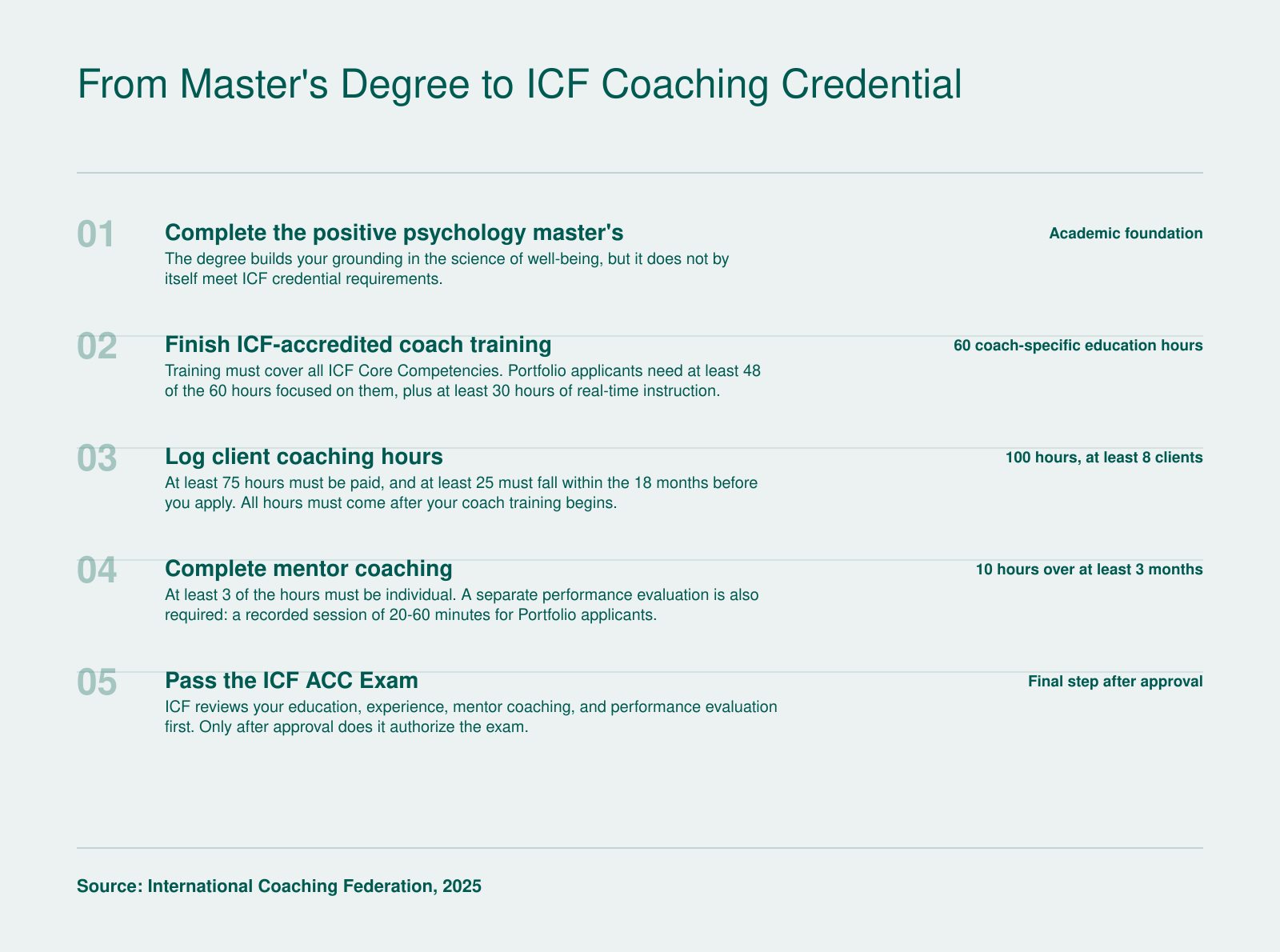
A master's in positive psychology builds real expertise in the science of wellbeing, but it is not a license to practice therapy, so weigh its cost against the roles it actually opens.
Positive Psychology programs by state
Quick Answers for Prospective Students
These answers draw on the admissions and program pages published by Penn, Claremont Graduate University, and Life University. Requirements change by cycle, so confirm details with each admissions office before you apply.
How much should I budget for a positive psychology master's from start to finish?
Do positive psychology master's programs require the GRE or an undergraduate psychology major?
Can I complete a master of applied positive psychology while working full time?
Compare Positive Psychology programs on the data that matters
Explore more Psychology specializations or browse every graduate field.
All Psychology programs