Best MBA in Supply Chain Management Programs in South Carolina
Compare 5 accredited MBA in Supply Chain Management programs in South Carolina, with graduate earnings, cost, debt, and completion data from IPEDS and the U.S. College Scorecard.

South Carolina's supply chain MBA market is shifting toward flexible formats built for people already working in operations. The state moves freight through the Port of Charleston and inland ports, and its manufacturing base keeps demand steady for managers who can run procurement, logistics, and planning. That makes the credential practical here, not theoretical.
Campus, hybrid, and online programs sit together on one page. The real tension is cost against schedule, since the cheapest option and the most flexible one are not always the same school.
Key Points
- USC Aiken's online supply chain MBA costs $13,948 total with fees.
- In-state tuition among ranked schools ranges from $13,759 to $20,250.
- Several programs here waive the GMAT or GRE entirely.
Best MBA in Supply Chain Management Programs in South Carolina, Ranked
South Carolina's supply chain MBA options range from fully online AACSB-accredited programs to flexible hybrid formats. AACSB accreditation signals a business school meets rigorous standards for faculty qualifications, curriculum, and learning outcomes, which matters to supply chain employers hiring analytically sharp managers. Here are the strongest programs currently available in the state.
University of South Carolina Aiken
#1Aiken, SC · $14,000 – $30,000/yr (est.)
Best for: Cost-conscious learners wanting online MBA
The University of South Carolina Aiken's online MBA with a Supply Chain specialization, based in Aiken and delivered fully online, is AACSB-accredited and charges the same tuition for South Carolina residents and out-of-state students. The 30-credit program uses 7-week courses and can be completed in as few as 10 months, with no GMAT required for admission. Required coursework covers production planning, inventory management, logistics, and quantitative analysis, preparing graduates for roles such as supply chain manager and logistician.
- AACSB-accredited online MBA
- No GMAT required for admission
- 30 credit hours with 7-week terms
- Can finish in as few as 10 months
- Same tuition for in-state and out-of-state students
- Covers production planning, inventory management, logistics, and quantitative analysis
- Full-time and part-time enrollment options
- Optional free foundation courses
Anderson University
#2Anderson, SC · ~$14,000/yr (est.)
Best for: Career changers seeking flexible delivery formats
Anderson University's MBA with a Supply Chain Management concentration, based in Anderson and available on campus, online, or hybrid, emphasizes data-driven decision making within a Christian framework. The 36-credit program offers full-time and part-time options, accelerated completion in 16 months, and a standard 24-month path. Students can pursue company-based partnership projects and an internship course to build applied supply chain experience.
- 36 credit hours, full-time or part-time
- Accelerated 16-month or standard 24-month path
- On campus, online, and hybrid delivery
- Christian framework with data-driven decision making
- Company-based partnership projects available
- Internship course can add hands-on experience
- Multiple start dates each fall, spring, and summer
Charleston Southern University
#3Charleston, SC · ~$20,000/yr (est.)
Best for: Working adults preferring evening hybrid classes
Charleston Southern University's MBA with a Supply Chain Management emphasis, located in Charleston and offered online and through hybrid nighttime sessions, is built for working professionals who need scheduling flexibility. The 30-credit program uses rolling enrollment and 10 courses, with a concentration covering the strategy and execution of moving and storing goods efficiently. Books are included in the Flexible MBA tuition, and the curriculum integrates a Christian worldview and ethical leadership.
- 30 credit hours across 10 courses
- Rolling admissions with no entrance exam
- Online and hybrid nighttime delivery
- Supply chain emphasis on strategy and execution
- Books included in Flexible MBA tuition
- Christian worldview and ethical leadership
- Full-time and part-time options
- IACBE-accredited business program
Cost & outcomes by school
Federal data for the highest-earning Supply Chain Management programs, independent of the ranking above. Earnings are this field's master's graduates four years after completing, where the Scorecard reports them.
| School | Earnings | Tuition / yr | Debt | Grads/yr | Format |
|---|---|---|---|---|---|
| University of South Carolina SC | $138,445 | $14,134 | $41,000 | 179 | Campus |
| Anderson University SC | $87,271 | $13,759 | $34,707 | 77 | Hybrid |
| Charleston Southern University SC | $81,984 | $20,250 | $41,239 | 83 | Hybrid |
| University of South Carolina Aiken SC | $62,849 | $14,096 | $30,750 | 208 | Online |
| Lander University SC | — | $9,810 | — | 139 | Online or campus |
Sources: U.S. Department of Education. Tuition and graduates: IPEDS. Earnings and debt: College Scorecard, this field's master's graduates; a dash means no figure is reported.
Cost, debt & payoff
Median earnings of this field's master's graduates (4 yrs after completing) vs. their median federal loan debt · U.S. College Scorecard
Across these programs the median graduate earns about $84,628 and finishes with roughly $37,854 in debt — a ratio that clears a common rule of thumb (keep debt below first-year salary). Tuition and debt vary widely school to school, so check the per-school figures in the table above before you shortlist.
Online and Hybrid Supply Chain MBA Options in South Carolina
Fully asynchronous study versus scheduled class time is the real fork in the road when comparing the best online MBA in supply chain management programs, and it matters more than campus location.
USC Aiken sits at the asynchronous end. Its online supply chain management MBA runs in seven-week terms with coursework available around the clock, 30 credits total, and a path as short as 10 months for students who push. Full-time and part-time pacing are both offered, with three start dates a year. The school also publishes the same tuition rate for in-state and out-of-state students, which removes the residency penalty that usually shapes this decision.
Anderson University delivers its 36-credit supply chain MBA primarily online with a hybrid option, mixing synchronous and asynchronous coursework and starting in fall, spring, or summer. Expect roughly 16 to 24 months depending on pace. Charleston Southern runs its supply chain emphasis through online and hybrid nighttime delivery across 10 courses, with rolling admissions and part-time scheduling.
If you work rotating shifts at a plant or distribution center, asynchronous seven-week terms are the only format that reliably bends around your schedule. If you want face time with classmates and regional recruiters, the evening hybrid options earn their inconvenience.
Which South Carolina MBA Programs Waive the GMAT or GRE
Admissions test policies for supply chain MBA programs in South Carolina vary, and some schools keep the GMAT or GRE entirely out of the application. For the ranked MBA in Supply Chain Management programs here, current published policies are as follows:
- University of South Carolina Aiken: no published GMAT or GRE requirement or waiver criteria on the MBA admissions page.
- Anderson University: no published GMAT or GRE requirement or waiver criteria on the MBA admissions page.
- Charleston Southern University: no published GMAT or GRE requirement or waiver criteria on the MBA admissions page.
Clemson University makes the GMAT optional and accepts self-reported scores.1 Winthrop University requires the GMAT or GRE but offers a waiver.2
Among the three no-policy schools above, none currently lists a work experience, undergraduate GPA, or prior graduate degree threshold that would trigger a test waiver. That absence may mean the test is not required, but it may also mean the policy is simply unpublished. A program that says nothing about the GMAT or GRE on its admissions page is not necessarily test-optional; some schools handle waivers only through individual conversations with admissions staff. Test-optional and waiver rules change from year to year, so applicants should confirm the current requirement with each program's admissions office before submitting.
Related Articles
Supply Chain MBA Tuition in South Carolina: In-State vs Out-of-State
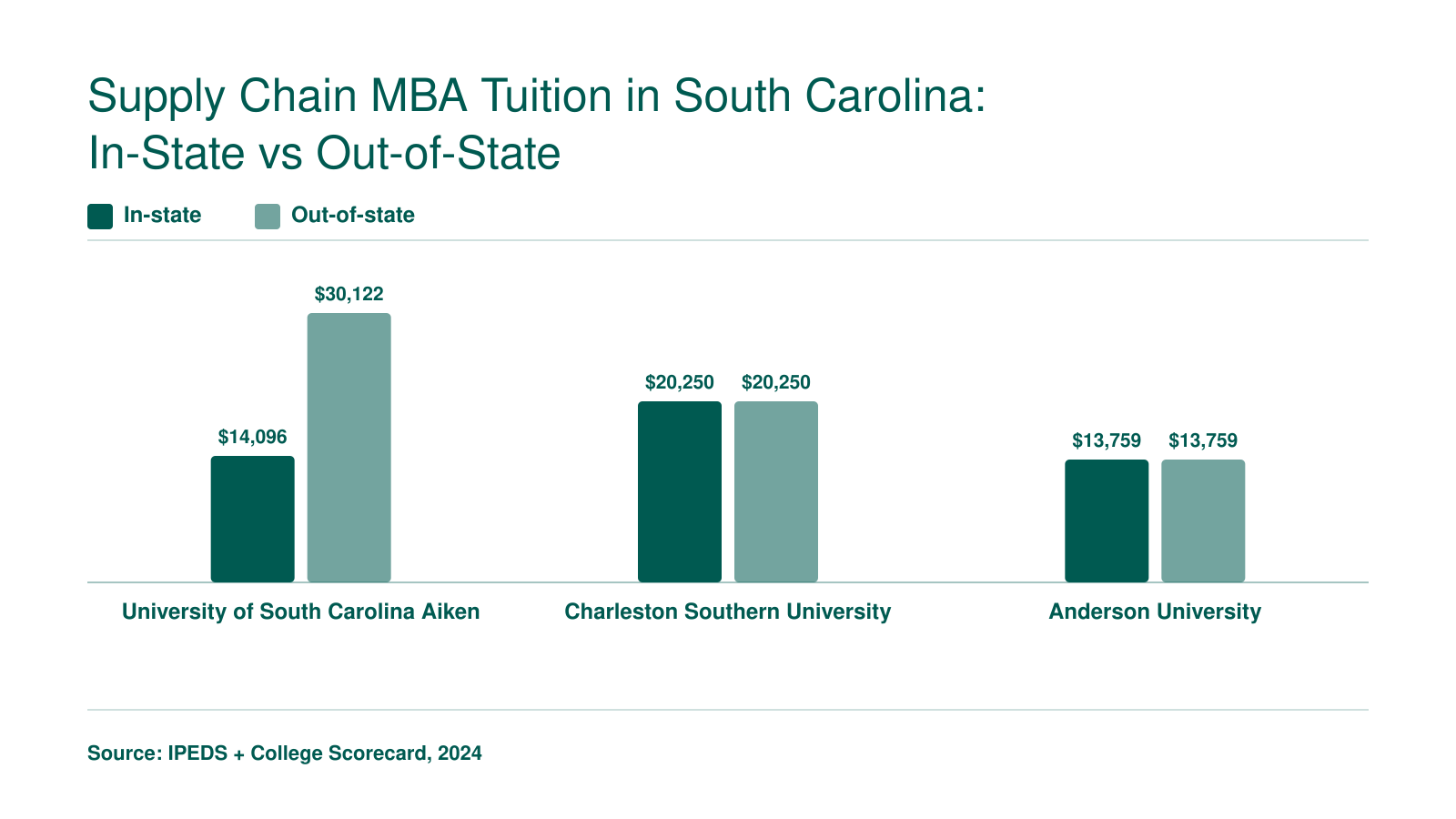
Graduate tuition and fees per year vary by residency status at some South Carolina supply chain MBA programs. In-state rates range from $13,759 to $20,250 for the schools here, before grants or scholarships. The average net price after aid is an institution-wide figure and only approximate for MBA students.
MBA Supply Chain Management Cost and South Carolina Employer Demand
For a supply chain MBA in South Carolina, total cost depends on delivery and residency. The online MBA at USC Aiken lists $467 per credit and a $13,948 total with fees, and it charges the same rate for in-state and out-of-state students. Anderson University's published program tuition is $13,759, while Charleston Southern's is $20,250. Current fee schedules can change, so check the latest cost sheet before enrolling.
What graduates earn and owe
Program-level outcome data shows meaningful differences. Anderson graduates report median earnings of $93,084 five years after finishing and median debt of $34,707. Charleston Southern reports median earnings of $80,396 five years after finishing and median debt of $41,239. USC Aiken reports median earnings of $62,849 four years after finishing and median debt of $30,750. These figures are specific to the supply chain MBA programs below, not university-wide averages.
South Carolina employer demand
The state's logistics and manufacturing base is dense. Major employers include the SC Ports Authority, BMW Spartanburg, Boeing South Carolina, Michelin, and Volvo. Available program materials do not document guaranteed internships or employer-specific recruiting with those companies, but the supply chain concentration fits the region's needs. The ROI question is whether the most affordable MBA in supply chain management programs, such as USC Aiken's $13,948, or a lower debt load, such as Anderson's $34,707, holds up against strong local hiring. For many students, the answer depends on how quickly they can convert the degree into a logistics or operations role with a Ports Authority, automaker, or tire manufacturer.
What Supply Chain Leaders Earn in South Carolina
South Carolina's logistics occupations show pay that can support an MBA investment.
How We Rank MBA Supply Chain Management Schools
Our ranking is a side-by-side comparison of South Carolina MBA programs that offer a supply chain or logistics concentration, scored on what they cost and what graduates get in return. Only programs offering an MBA with that concentration in South Carolina were eligible.
Four factors drive the order:
- Cost: Graduate tuition and net price.
- Completion: Graduation rate, which is measured across the whole institution, not the MBA alone.
- Outcomes: Program-level earnings and debt, where federal data reports them.
- Flexibility: Whether students can study online, in a hybrid format, or on campus.
The figures come from IPEDS and College Scorecard. Because graduation rates cover the entire school, read them as a general signal of student support, not a prediction for a supply chain cohort.
Choosing the Right Supply Chain MBA in South Carolina
Lowest cost and maximum flexibility rarely live in the same program, so decide what matters most before you shortlist. If in-state tuition drives your choice, weigh the public option against the private schools here, and compare most affordable MBA programs. If you need to keep working, let online delivery narrow the field. And if placement is the goal, consider whether you want ties to Upstate manufacturing or Lowcountry port and logistics employers.
Whatever you prioritize, confirm the program holds AACSB accreditation and check the No GMAT or GRE Required policy covered earlier. Then ask admissions pointed questions: How deep does the curriculum go into procurement and analytics? Does coursework align with APICS/ASCM certification?
Next, compare total cost of attendance, not sticker tuition, and request information from two or three best MBA programs before you commit.
Compare Supply Chain Management programs on the data that matters
Explore more MBA specializations or browse every graduate field.
All MBA programs