Best MBA in Engineering Management Programs
Compare 14 accredited MBA in Engineering Management programs, with graduate earnings, cost, debt, and completion data from IPEDS and the U.S. College Scorecard.

The U.S. median wage for architectural and engineering managers sits around $165,000, a figure that pulls many engineers toward management without wanting to leave technical work behind. An MBA in engineering management targets exactly that middle ground: leading teams, budgets, and R&D pipelines while keeping one foot in the technical side.
The tradeoff is cost against fit. Published graduate tuition and fees across the programs below run from roughly $3,900 a year at Columbia Southern University to about $44,500 at Stevens Institute of Technology, and several schools (University of Southern Indiana, Southern New Hampshire University, Henderson State University, Columbia Southern) deliver the degree fully online.
One caution: many "engineering management" search results are actually MEM or MS degrees, not MBAs. Every program here is an MBA track.
Key Points
- Published tuition runs from about $3,900 per year at Columbia Southern University to roughly $44,500.
- Choose the MBA for general management; choose the MEM to stay technical.
- Confirm AACSB accreditation and STEM designation before applying, especially if you need international work authorization.
The 9 Best MBA in Engineering Management Programs for 2027
The strongest MBA in engineering management programs pair business fundamentals with technical leadership and make that combination accessible through online, hybrid, or weekend schedules. We look for clear pathways into roles like engineering manager or operations director, with value anchored in program-level earnings and net price rather than name recognition. The nine programs below stand out for their mix of accredited coursework, format flexibility, and career momentum.
University of Florida
#1Gainesville, FL · ~$13,000/yr (est.)
Best for: Working engineers seeking dual degrees
This dual-degree option pairs an engineering management master's with an MBA in a 30-month lockstep cohort, meeting one weekend per month in Orlando while keeping online MBA flexibility. Working professionals can build project leadership, systems thinking, and core finance and strategy skills without pausing a career. Four years after finishing, program graduates show median earnings of $137,404.
- 30-month lockstep cohort format
- 56 total credit hours
- Classes meet one weekend per month in Orlando
- Choice of Internet MBA or Professional MBA track
- Both degrees awarded in nine semesters
- Designed for working professionals with no career interruption
- Engineering management focus on project leadership, systems thinking, and process improvement
Lehigh University
#2Bethlehem, PA · ~$29,000/yr (est.)
Best for: Experienced engineers needing hybrid study
This hybrid MBA and engineering program combines core business training with deep chemical engineering expertise for technical professionals targeting senior management. The 45-credit curriculum spans accounting, finance, operations, and strategic leadership alongside process optimization and systems design, with classes available on campus and online. Applicants need an undergraduate engineering degree and two years of professional experience. Four years after finishing, program graduates show median earnings of $86,268.
- 45 total credit hours
- 10 concentration options
- Classes on campus and online
- Integrated project required
- Free business and engineering electives
- Requires undergraduate engineering degree
- Two years professional experience required
- Chemical engineering concentration covers process optimization, materials, and systems design
Stevens Institute of Technology
#3Hoboken, NJ · ~$44,000/yr (est.)
Best for: Tech-minded professionals wanting STEM designation
This dual Master of Engineering and MBA program layers technical engineering management with MBA coursework in economics, finance, analytics, marketing, operations, and strategy. A STEM-designated MBA and industry capstone add real-world consulting exposure, with optional GMAT or GRE and both online and on-campus study. Four years after finishing, program graduates show median earnings of $138,535.
- No entrance exam required
- Test optional
- Capstone required
- STEM-designated MBA program
- Real-world consulting capstone
- On campus and online formats
- AI and machine learning curriculum
- Average starting salary $88,700
Valparaiso University
#4Valparaiso, IN · ~$13,000/yr (est.)
This MBA concentration bridges technical expertise with strategic decision-making through coursework in emerging technologies, project management, leading technical teams, and enterprise resource planning with SAP. Seven-week terms, six annual start dates, and online or on-campus options support working professionals, with a path to finish in as little as one year. Four years after finishing, program graduates show median earnings of $85,511.
- AACSB International accredited
- 9 concentration options
- 36 total credit hours
- Complete in as little as one year
- Seven-week course terms
- Six start dates per year
- Online and on-campus options
- Rolling admission
University of Maine
#5Orono, ME · ~$11,000/yr (est.)
This fully online, STEM-designated MBA in engineering management combines an MBA core in accounting, strategy, and supply chain with electives such as advanced project management, Lean Six Sigma, and neural networks. Self-paced foundation courses address prerequisites, and the 33-credit structure can be completed while working full-time. Four years after finishing, program graduates show median earnings of $106,958.
- 100% online delivery
- STEM-designated degree
- Interdisciplinary with College of Engineering
- Self-paced foundation courses
- 24 core credit hours plus 9 concentration credits
- Lean Six Sigma, advanced project management, and neural networks electives
- Prepares for engineering manager, technical director, and R&D manager roles
University of Southern Indiana
#6Evansville, IN · ~$12,000/yr (est.)
This online MBA concentration is aimed at working engineers moving into leadership, with MBA core courses plus specialized work in project, quality, and supply chain management. Eight-week courses and multiple start dates support a 12-month completion path, and the business school holds AACSB accreditation. The program lists total tuition of $13,950.
- AACSB International accredited
- No entrance exam required
- Test optional
- $13,950 total program tuition
- $465 per credit
- 30 total credit hours
- 12-month completion path
- 8-week course sessions
Columbia Southern University
#7Orange Beach, AL · ~$4,000/yr (est.)
This fully online MBA concentration emphasizes planning, scheduling, producing, and delivering engineering and technical projects while covering finance, marketing, accounting, HR, project management, and data analytics. Tuition is $359 per credit, with active-duty military paying $250 per credit, and up to 24 transfer credits can be applied. Four years after finishing, program graduates show median earnings of $79,103.
- ACBSP accredited
- $359 per credit
- 36 total credit hours
- 11 start dates per year
- Fully online option available
- Up to 24 transfer credits accepted
- Military tuition at DoD cap of $250
- Textbooks included in tuition
Southern New Hampshire University
#8Manchester, NH · ~$21,000/yr (est.)
This online MBA concentration was developed in partnership with Worcester Polytechnic Institute, pairing general MBA coursework in finance and project management with three engineering management courses taught by WPI faculty. The 30-credit, 10-course program uses 10-week terms, requires no application fee or GMAT, and supports working professionals. Four years after finishing, program graduates show median earnings of $95,086.
- No entrance exam required
- $19,770 total program tuition
- 30 total credit hours
- 10-week course terms
- Partnership with Worcester Polytechnic Institute
- Courses taught by WPI faculty
- $0 application fee
- Transfer up to 6 credits
Henderson State University
#9Arkadelphia, AR · $7,000 – $10,000/yr (est.)
This online MBA concentration focuses on logistics, supply chain management, and quality control, with an AACSB-accredited 33-credit curriculum that includes economic analysis, strategic information systems, and marketing management. Seven-week courses and multiple start dates support a 14-month completion path, and the degree automatically includes graduate certificates in project management and supply chain management. Total program tuition is $12,837.
- AACSB accredited
- No entrance exam required
- $12,837 total program tuition
- $389 per credit
- 33 total credit hours
- 14-month completion path
- 7-week course terms
- Includes graduate certificates in Project Management and Supply Chain Management
Cost & outcomes by school
Federal data for the highest-earning Engineering Management programs, independent of the ranking above. Earnings are this field's master's graduates four years after completing, where the Scorecard reports them.
| School | Earnings | Tuition / yr | Debt | Grads/yr | Format |
|---|---|---|---|---|---|
| Stevens Institute of Technology NJ | $138,535 | $44,494 | — | 148 | Hybrid |
| Lehigh University PA | $86,268 | $28,840 | — | 16 | Hybrid |
| Columbia Southern University AL | — | $3,936 | — | — | Online |
| Henderson State University AR | — | $7,497 | — | — | Online |
| University of North Alabama AL | — | $10,350 | — | — | Online |
| University of Maine ME | — | $10,662 | — | — | Campus |
| University of Florida FL | — | $12,737 | — | — | Hybrid |
| Valparaiso University IN | — | $13,250 | — | — | Hybrid |
| The University of Texas at Dallas TX | — | $15,168 | — | — | Campus |
| Southern New Hampshire University NH | — | $21,387 | — | — | Online |
| Purdue University Fort Wayne IN | — | $7,052 | — | 3 | Hybrid |
| University of Memphis TN | — | $11,628 | — | 3 | Campus |
Sources: U.S. Department of Education. Tuition and graduates: IPEDS. Earnings and debt: College Scorecard, this field's master's graduates; a dash means no figure is reported.
How We Ranked These Programs
A big-name business school and a low-cost Online MBA can look equally promising on paper. For a working engineer, the real question is what you pay versus what the degree returns.
What We Measured
This ranking is built from federal data, not brochures or reputation surveys. Each school was evaluated on graduate tuition and fees, net price after aid, and institution-wide graduation rate. Program-level earnings and debt from the College Scorecard also count when available.
Cost and outcomes carry the most weight because an MBA in engineering management is a return-on-investment decision. Most applicants already earn an engineer's salary. The degree has to justify its price through a move into management, not through prestige alone.
What the Data Can't Tell You
- Net price: This is an institution-wide average after aid. It reflects undergraduates too, so it won't match your exact bill.
- Graduation rates: These cover the whole institution, not the MBA cohort specifically.
- Earnings: Program-level earnings are not published for every ranked program, so cost and institutional outcomes carry more of the comparison.
Who Made the List
Only MBA programs that award an MBA with an engineering management concentration, track, or concurrent degree qualified. Standalone Master of Engineering Management (MEM) degrees were excluded. If you're weighing the two paths, the comparison section below covers how they differ.
MBA in Engineering Management vs. MEM: What's the Difference?
Both degrees prepare engineers to lead, but they split time between business and technical content very differently. The right choice depends on whether you want to move toward general management or stay close to technical operations. Verdict: choose the MBA for broad executive and P&L paths, and the MEM to stay closer to technical operations.
| Factor | MBA with Engineering Management | Master of Engineering Management (MEM) |
|---|---|---|
| Focus | Firm-level business decisions, with engineering as a concentration or lens (per University of Nebraska-Lincoln) | Technical and operational skills aligned with the Engineering Management Body of Knowledge (per University of Nebraska-Lincoln) |
| Curriculum balance | Business core first. Michigan Technological University describes equal weight on accounting, marketing, finance, and management | Engineering knowledge placed in an operations context, with emphasis on leadership and communication for cross-disciplinary technical teams |
| Typical students | Engineers and technical professionals aiming at general management, consulting, or executive roles | Engineers and scientists who want to lead technical teams. Drexel University expects an engineering or science bachelor's degree and a 3.0 GPA, with experience strongly recommended |
| Accrediting body | Business school accreditation, typically AACSB | Housed in an engineering college. Confirm accreditation with each university, since ABET mainly covers undergraduate engineering programs |
| Career targets | Roles needing overall business knowledge: general management, finance, strategy, P&L ownership | Technology-centric industries: project, program, and operations management close to the product |
| STEM designation | Depends on the school and the program's classification, so confirm before applying | More often classified as STEM, but this also varies by school, so verify the program's designation |
| Credit load | Often longer when paired with a second degree. Purdue University's dual degree is 60 credits | University of Massachusetts Lowell's engineering management master's is 31 credits (12 courses) |
| Dual or joint options | Purdue offers a dual degree with separate admissions decisions for each program. Lawrence Technological University awards two master's degrees through its College of Management and College of Engineering | University of Massachusetts Lowell applies 9 credits toward an MBA. Duke University waives 3 MEM core courses for Duke MBA graduates, who then complete 5 more courses plus an internship |
Online vs. On-Campus MBA in Engineering Management
Fully online and campus-based engineering management MBAs ask for very different commitments, and hybrid formats sit between the two. The right choice usually depends on whether you need to keep working in your current role, the core audience for an Online Executive MBA, or want to use business school as a pivot point.
What Online and Hybrid Actually Look Like
Several programs below are built for working engineers. Henderson State's MBA with an Engineering Management concentration is fully online, uses 7-week courses, and can be completed in as little as 14 months with no prerequisite courses, at an Accelerated MBA pace. University of Southern Indiana's online MBA uses 8-week sessions, while SNHU runs 10-week terms. In contrast, some ranked programs are hybrid by design: University of Florida's concurrent OEM/MBA meets one weekend per month in Orlando, and Lehigh, Stevens, and Valparaiso blend campus and online delivery. Valparaiso describes its online classes as asynchronous, meaning you can usually work through material on your own schedule rather than logging in at a fixed time.
Residencies and Pacing
Online does not always mean entirely remote. Some online MBAs add short in-person residencies or immersions. For example, Georgetown McDonough's online MBA combines synchronous and asynchronous classwork with two one-week residencies in Washington, D.C., plus an international residency.1 NC State's Jenkins Online MBA is mostly asynchronous but requires a three-day residency.2 At the schools here, pacing varies widely: some can finish in about a year3, while hybrid weekend formats stretch closer to 30 months.
Who Should Choose Which
Choose an online or hybrid MBA in engineering management if you are already working as an engineer, have shift or travel constraints, or need to stay in a specific city. Online coursework lets you keep your salary and apply projects directly to your job. Choose a campus or campus-heavy hybrid if you are switching industries, want on-campus recruiting, or learn better from in-person cohort discussions and networking. The diploma question is usually less important than students expect: many universities award the same master's degree regardless of delivery format. Still, ask the program directly whether the transcript notes online completion before you enroll.
Related Articles
Engineering Management MBA Tuition Cost: What You'll Actually Pay
What does an engineering management MBA actually cost after published tuition, residency rules, and financial aid?
Published Tuition and Fees
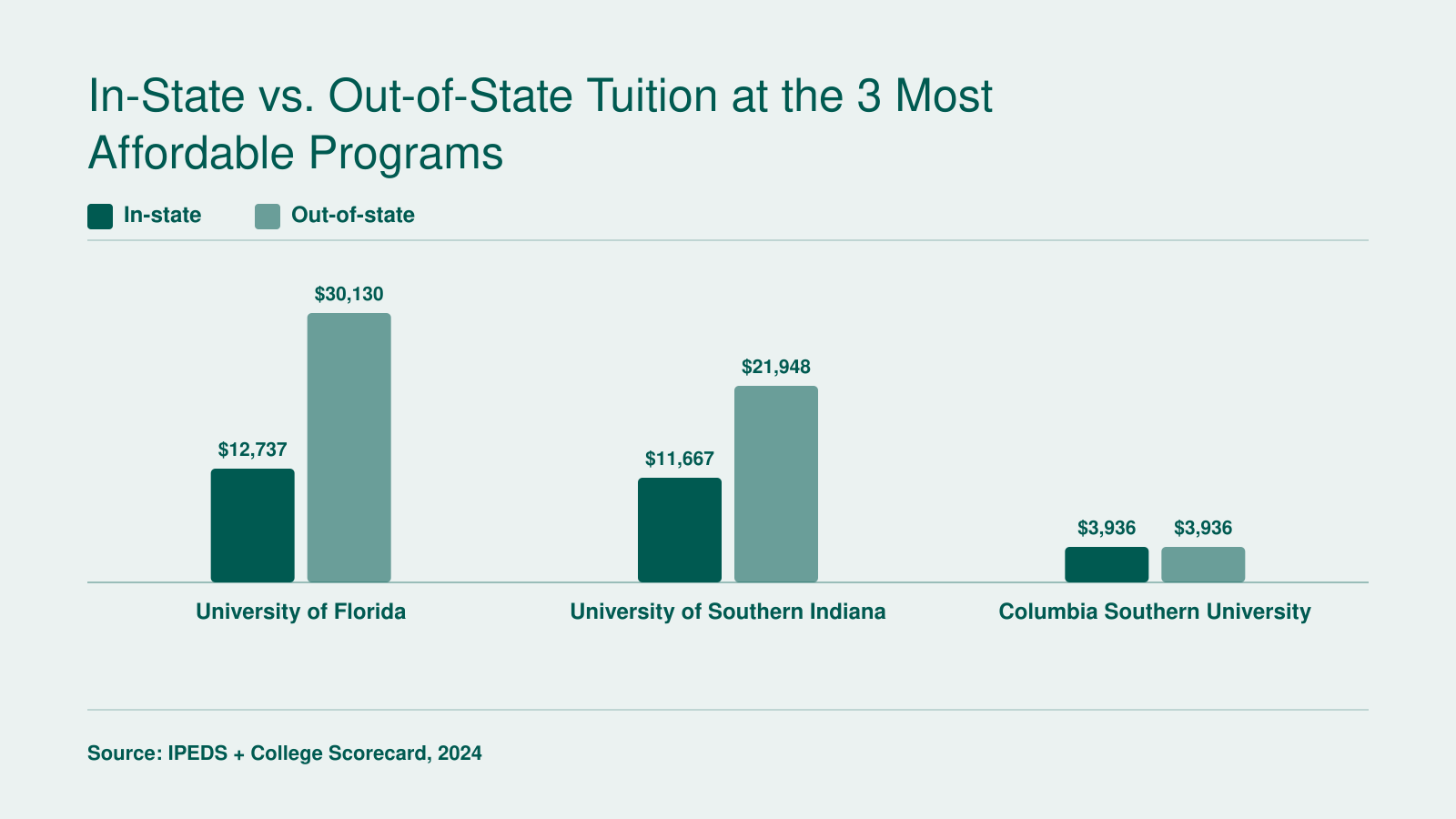
For students comparing affordable MBA programs, listed graduate tuition and required fees range from about $3,900 per year at Columbia Southern University to roughly $44,500 per year at Stevens Institute of Technology. At public universities, the range splits by residency: for example, University of Florida lists about $12,700 in-state and $30,100 out-of-state, while University of Maine lists about $10,700 in-state and $31,200 out-of-state. These are published rates before any scholarships or employer reimbursements.
The In-State vs. Out-of-State Gap
Public institutions often charge higher out-of-state rates, but that gap frequently narrows or disappears for fully online cohorts because many online programs use a single tuition rate regardless of where you live. This is not universal, so verify with the specific program before budgeting. Columbia Southern, a private online-focused school, charges the same $3,936 rate for all students.
Net Price After Aid
For context, federal data reports the institution-wide average net price after aid. Those figures here range from about $6,500 at University of Florida to about $41,300 at Stevens Institute of Technology. Treat these as school-wide averages, not quotes for MBA students, since graduate aid packages vary by program and enrollment intensity.
How Working Engineers Keep Costs Down
- Employer tuition assistance: Many engineering and technology employers reimburse a set amount per year or per course, which can cover a large share of part-time tuition.
- Part-time pacing: Slower enrollment stretches payments and often allows employer benefits to reset each calendar year.
- Federal loans: U.S. students can use federal unsubsidized loans and Grad PLUS loans up to the cost of attendance, but borrow only what you need and compare total interest.
In-State vs. Out-of-State Tuition at the 3 Most Affordable Programs
The lowest-cost options here split into two types. University of Florida and University of Southern Indiana charge out-of-state students noticeably more, while Columbia Southern University charges one flat rate. These are published graduate tuition and fees, and residency rules for online students vary by school, so confirm which rate applies to you before applying.
Accreditation, STEM Designation, and Test Policies at Each Ranked School
AACSB accreditation of the business school is a quality signal many employers use when screening MBA credentials. STEM designation matters most for international students, because a degree classified under a STEM CIP code (such as 15.1501 or 52.1301) rather than the general business code 52.0201 can open the door to an OPT extension. Cells marked "Not confirmed" mean we could not verify that detail, so check directly with the admissions office before applying.
| School | AACSB Accredited | STEM-Designated | GMAT/GRE Policy |
|---|---|---|---|
| Penn State Harrisburg (Master of Engineering Management) | Yes (School of Business Administration, undergraduate and graduate levels) | Yes; eligible graduates may receive an OPT extension of up to 36 months | Not confirmed |
| Louisiana State University (Flores MBA STEM pathway) | Yes (E. J. Ourso College of Business) | Yes | No GMAT or GRE required |
| University of Maine (MaineMBA engineering-focused collaboration) | Yes (Maine Business School) | Not confirmed | GMAT waivers available for qualified applicants |
| Stevens Institute of Technology (MBA engineering management dual program) | Not confirmed | Yes, for applicable MBA concentrations; 24-month OPT extension for international students | Optional for all master's programs; scores may be submitted for consideration |
| University of Southern Indiana (MBA in Engineering Management) | Yes (Romain College of Business) | Not confirmed | Optional; not required for admission |
| Marquette University (MBA with Systems Engineering specialization) | Yes (M.B.A. program) | Yes | Not confirmed for degree-seeking applicants; non-degree applicants do not submit scores |
Admission Requirements for an MBA in Engineering Management
Requirements vary by school, and no nationwide minimum GPA or test score exists. Use these benchmarks as a starting point, then confirm details with each program.
- Bachelor's degreeA bachelor's degree from a regionally accredited institution is the standard entry point. An engineering degree is common among applicants but not universal. Purdue University accepts non-engineering STEM majors and asks for Calculus I, Calculus II, and differential equations or linear algebra. Marquette University requires an engineering bachelor's.
- GPA and work experienceA 3.0 GPA is a common benchmark. Purdue, Marquette, the University of Wisconsin, and Texas A&M list 3.0, while Murray State lists 2.75 and the University of Southern Indiana 2.5. Engineering-focused programs often prefer 3–5 years of experience. Marquette asks for 1 year, Murray State 2–4 years, and Purdue and Texas A&M set no minimum.
- GMAT or GRETypical minimums run about 600–650 on the GMAT and 300–310 on the GRE, though policies range from required to waived. Texas A&M requires neither test, Southern Indiana makes testing optional, and Purdue makes the GRE optional but recommends it. Common waiver grounds include a strong undergraduate GPA (around 3.1 at some schools), substantial work experience, a prior graduate degree, or a PE license.
- Application materialsExpect a résumé, transcripts, essays, recommendation letters, and often an interview. Some programs will weigh a below-minimum GPA if you have engineering experience and a supervisor's recommendation.
- English proficiencyInternational applicants usually submit TOEFL or IELTS scores unless their undergraduate degree was taught entirely in English. Check each school's minimum score and waiver rules.
Engineering Management programs by state
Frequently Asked Questions About MBA in Engineering Management Programs
These answers cover the questions prospective students ask most often about cost, background requirements, pacing, and international work authorization. Program details change, so confirm specifics with each school before you apply.
Is an MBA in Engineering Management worth it?
Do I need an engineering background for an MBA in Engineering Management?
How long does an online MBA in Engineering Management take to complete part-time?
Does a STEM-designated MBA qualify international students for the 24-month STEM OPT extension?
Compare Engineering Management programs on the data that matters
Explore more MBA specializations or browse every graduate field.
All MBA programs